On this page
How to identify it
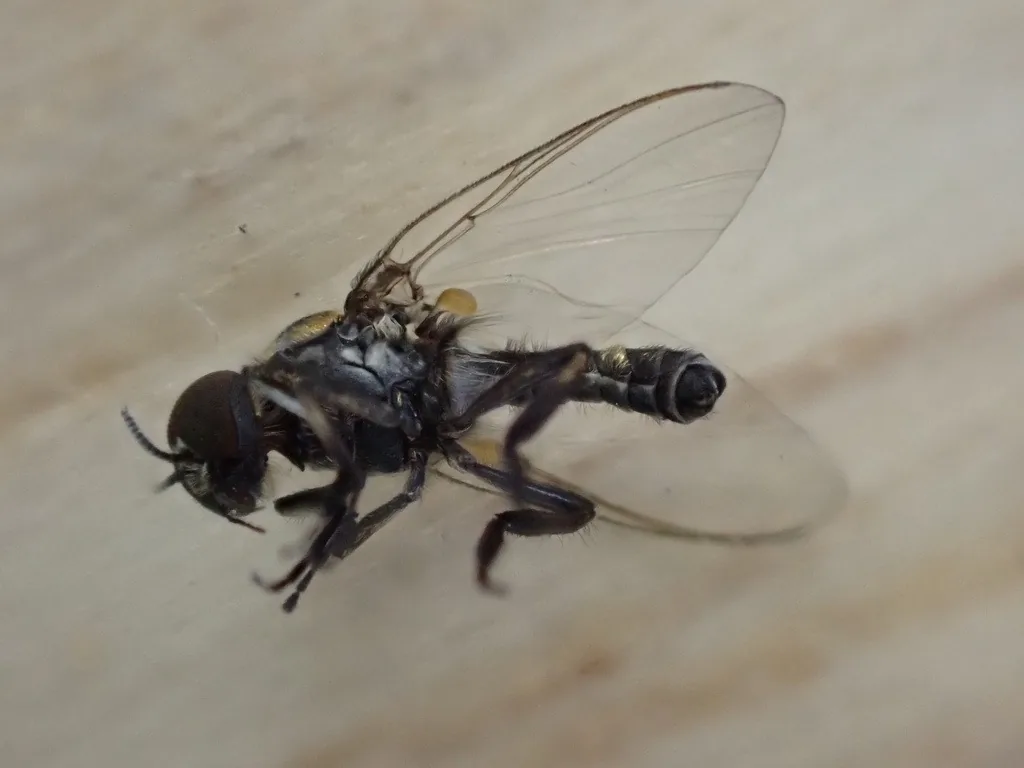
- Adults are small, stout flies with a rounded, humped back, broad wings and short legs. Minnesota Extension gives their size as about 1/16 inch, while Pennsylvania's black fly program describes them as 2 to 5 mm long.[1][3]
- Most are dark, but despite the name, some black flies are gray, tan or even greenish.[2]
- Females swarm around the head and crawl toward the eyes, ears, nose and mouth, as well as under sleeves and socks. UF/IFAS says females aren't host-specific, feed mainly in daylight and hover about the eyes, ears and nostrils of people and animals, often landing and puncturing the skin.[3][4][5]
- Larvae, found only in streams, are wormlike and legless, with an enlarged rear end and two fan-like structures near the head.[1]
Look-alikes
| Look-alike | How to tell them apart |
|---|---|
| No-see-ums (biting midges) | Also tiny dark biting flies, barely visible to the naked eye, but they breed in any muddy or moist spot, such as over-irrigated mulch or sod, and are usually active at dawn or dusk. Black flies breed only in flowing streams and rivers and bite only during the day. UF/IFAS adds that no-see-ums are under 1/16 inch (1.6 mm) long with spotted wings, breed mainly in salt marshes and in mud and debris at the edges of ponds, creeks and tree holes, and bite little when there is even a slight breeze.[6][3][4][5] |
Where it lives
Pennsylvania's black fly program counts 254 described species in North America and about 2,000 worldwide. Mississippi State Extension calls them tremendous pests every spring in the northern United States and Canada, with periodic outbreaks farther south. GBIF holds about 12,000 U.S. records of the genus Simulium since 1990, the most from Vermont and California. UF/IFAS says black flies are not considered major pests of homeowners in Florida, and that black flies and deer flies are most prevalent from early to late spring.[3][2][7][5]
Biology and life cycle
Females lay 150 to 500 eggs, dropping them onto flowing water or laying them on trailing vegetation, rocks and debris, often near dusk. Depending on the species, the eggs hatch in 2 days to 8 months. UF/IFAS says eggs go on logs, rocks or other solid surfaces in swift, oxygen-rich streams, and larvae hold on with a sucker at the rear end.[3][1][5]
Larvae anchor to underwater rocks and plants and filter food from the current. Pennsylvania's program says black flies are not found in lakes, ponds, swamps or other standing water, though New Hampshire Extension notes that biting species often breed most heavily at the outlets of ponds and lakes.[3][4][1]
Larvae develop underwater for 10 days to several weeks and pupae for about a week; new adults ride a bubble of air to the surface. Adults live about three to six weeks.[1][3]
Both sexes feed on nectar for energy, but only females bite, taking blood to develop their eggs.[1][4]
Most adults can fly about 10 miles from their breeding stream and can be carried much farther on air currents. UF/IFAS says they are known to travel 7 to 10 miles (11 to 16 km) from their breeding sites.[1][4][5]
Seasons vary by species: in Minnesota bites are most common in spring, in New Hampshire the main biter peaks in May and June, and in Mississippi pest species appear from March to June.[1][4][2]
Daily timing differs by place. New Hampshire Extension says activity peaks around 9 to 11 AM and again from 4 to 7 PM, especially on humid, cloudy days and before storms. In a survey of 418 bitten patients in eastern Poland, most attacks came from May to July, peaking in June, and in the afternoon and evening.[4][8]
Damage and signs
- Females cut the skin with their mouthparts and drink from the pool of blood, often biting along the hairline, head and neck, and on the feet, ankles and arms.[3][1][2]
- Heavy swarms can kill poultry and livestock through blood loss, toxic reactions to the bites, or stampeding; outbreaks also cut milk, beef and egg production.[3][2]
- Mississippi State Extension reports poultry and wild birds dying from a toxic shock-like reaction to black fly saliva, and chickens suffocating when the gnats clogged their airways. Some species can transmit leucocytozoonosis, a disease of turkeys, ducks, geese and sometimes chickens.[2][3]
Health risk
Most bites cause only local skin reactions. In a Polish study of 418 bitten patients, 88.52 percent had skin lesions only, most often itching, burning, swelling and redness that lasted several days and sometimes weeks, while 11.48 percent also had bodywide reactions such as headache, fever, joint pain and swollen lymph nodes. In the tropics black flies spread river blindness (onchocerciasis), found mostly in rural sub-Saharan Africa plus small areas of South America and Yemen; CDC says it takes repeated bites from infectious black flies, so it rarely affects casual travelers.[9][10]
Control
Prevention
Wear light-colored clothing, long sleeves and long pants tucked into socks; black flies are drawn to dark colors. A head net helps where they swarm.[1][4]
Black flies bite only in daylight and hesitate to go indoors, so plan outdoor work around their peak times and go inside when they're biting.[4][2]
Repellents used for mosquitoes, such as DEET, picaridin and IR3535, work on black flies but wear off faster, so treat wrists, ankles and the belt line where flies crawl under clothing. CDC also advises EPA-registered repellents and loose long sleeves and pants during the day, when black flies bite. UF/IFAS likewise notes that most repellents work less well on biting flies than on mosquitoes and must be reapplied more often; follow the label and reapply only as needed.[4][10][5]
UF/IFAS says citronella candles, coils and torches will sometimes help reduce biting fly activity on porches and patios.[5]
Traps and physical control
Fans and breezy, open areas help, because black flies have trouble flying in wind and are less of a nuisance on windy days. UF/IFAS says biting flies are most active in still air; fans on porches, patios and picnic areas help but may not give complete protection, and pruning shrubs and mowing weedy areas improves air flow where flies rest.[2][1][5]
Pesticides
Fogging for adults gives only a few hours of relief, because new flies quickly arrive from distant streams.[4]
When to call a professional
Homeowners shouldn't try to treat streams for larvae; treating part of one stream does little, and New Hampshire requires a special permit for pesticides in surface waters. Pennsylvania's suppression program treats streams with Bti, a bacterial larvicide that black fly larvae must eat for it to work. UF/IFAS adds that because black flies breed in running water, homeowners can't easily reduce breeding sites, and suggests asking the local mosquito control district about biting fly programs.[4][3][11][5]
If you are bitten
Wash the bites with soap and water, apply ice wrapped in a cloth for 10 minutes on and 10 minutes off, and use an antihistamine or anti-itch cream if needed. Over the next few days, watch for increasing redness, swelling or pain, which can signal infection.[12]
Call 911 or the local emergency number for trouble breathing, wheezing, or swelling of the face or mouth.[12]
In the Polish case series, the strongest reactions were reported in people with circulatory problems such as venous insufficiency, metabolic diseases or bacterial infections, and the authors advise limiting time outdoors during peak black fly season and hours.[8]
Where the sources disagree
Flight range: Minnesota Extension says most adults can fly about 10 miles from their breeding stream, while UF/IFAS gives 7 to 10 miles (11 to 16 km).[1][5]
Common questions
- What are the tiny gnats biting my head in spring?
- Often black flies, also called buffalo gnats. Females swarm around the head and bite along the hairline and ears during the day, mostly in spring.[1][2]
- Can I get rid of black flies in my yard?
- Not really. They breed in streams and can fly 10 miles or more, so no yard treatment keeps them away; protective clothing and repellents are the practical defense.[1][4]
- Do black flies bite at night?
- No. Black flies are daytime biters and don't bite at night.[4][2]
- Can black flies get into the house?
- They hesitate to go indoors, New Hampshire Extension says. UF/IFAS notes that biting flies usually rest on vegetation or the sides of houses before biting or following people into a dwelling.[4][5]
Sources
- University of Minnesota Extension, “Black flies (reviewed 2024).” extension.umn.edu/yard-and-garden-insects/black-flies (accessed 2026-11-11)
- Mississippi State University Extension Service, “What to Do about Black Flies (Buffalo Gnats), Publication 3755.” extension.msstate.edu/publications/what-do-about-black-flies-buffalo-gnats (accessed 2026-11-11)
- Pennsylvania Department of Environmental Protection, Black Fly Suppression Program, “Black Fly Biology and Life History.” www.pa.gov/agencies/dep/programs-and-services/bureau-of-labs/vector-management/black-fly/biology (accessed 2026-11-11)
- University of New Hampshire Extension, “Black Flies [fact sheet].” extension.unh.edu/resource/black-flies-fact-sheet (accessed 2026-11-11)
- University of Florida IFAS Extension (EDIS), “Biting Flies, ENY-220/IG081 (J. B. Pitzer, P. G. Koehler and J. W. Diclaro II).” ask.ifas.ufl.edu/publication/IG081 (accessed 2026-11-14)
- University of Arizona Cooperative Extension, “No-See-Ums (IPM short).” cales.arizona.edu/apmc/docs/No-See-Ums-IPMShort.pdf (accessed 2026-11-11)
- Global Biodiversity Information Facility (GBIF), “Simulium: U.S. occurrence records since 1990 by state (GBIF occurrence search).” api.gbif.org/v1/occurrence/search?taxonKey=5734043&country=US&hasGeospatialIssue=false&occurrenceStatus=PRESENT&year=1990%2C2026&facet=stateProvince&facetLimit=400&limit=0 (accessed 2026-11-11). Exact count at access: 11,935 U.S. records since 1990 (Vermont 5,792; California 2,418; Pennsylvania 457).
- International Journal of Environmental Research and Public Health, via PubMed, “Risk of attacks by blackflies (Diptera: Simuliidae) and occurrence of severe skin symptoms in bitten patients along the eastern border of the European Union (Sitarz et al. 2022).” pubmed.ncbi.nlm.nih.gov/35805269/ (accessed 2026-11-11)
- Journal of Clinical Medicine, via PubMed, “Skin lesions and systemic reactions in humans infested by blackflies (Diptera: Simuliidae) in recreational areas in southeastern Poland (Sitarz et al. 2021).” pubmed.ncbi.nlm.nih.gov/33669296/ (accessed 2026-11-11)
- Centers for Disease Control and Prevention (CDC), “About Onchocerciasis (river blindness).” www.cdc.gov/parasites/onchocerciasis/ (accessed 2026-11-11)
- Pennsylvania Department of Environmental Protection, Black Fly Suppression Program, “Bacillus thuringiensis israelensis (Bti).” www.pa.gov/agencies/dep/programs-and-services/bureau-of-labs/vector-management/black-fly/bti (accessed 2026-11-11)
- MedlinePlus, U.S. National Library of Medicine, “Insect bites and stings (Medical Encyclopedia).” medlineplus.gov/ency/article/000033.htm (accessed 2026-11-11)
- iNaturalist, “Simulium taxon page (order and family).” www.inaturalist.org/taxa/63165 (accessed 2026-10-06)