On this page
How to identify it
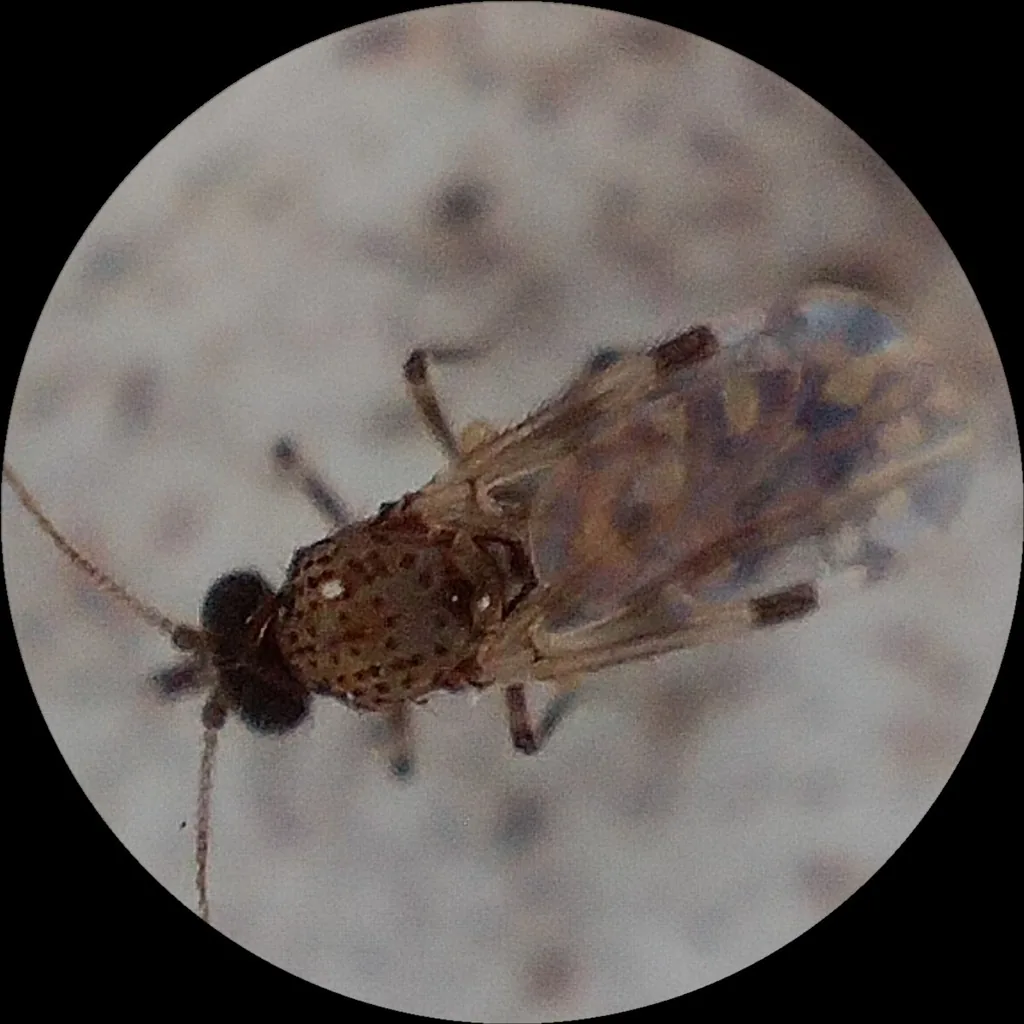
- Adults are small, dark flies, barely visible, with short, stocky bodies and a shiny thorax; up close they look like miniature mosquitoes.[1][2]
- They are small enough to pass through ordinary window screens. UF/IFAS says many species are less than one twenty-fourth of an inch, about 1 mm.[1][2][4]
- Only females bite, because they need blood to develop eggs; both sexes feed on flower nectar.[1][2][3]
- UF/IFAS says adults are usually 1.0 to 2.0 mm (0.04 to 0.08 inch) long, averaging about 1.5 mm among the 50 or so species in Florida. The wings of most species carry a pattern of dark and pale spots, and these wing patterns are the main way experts tell the species apart.[4]
- UF/IFAS says the eggs are crescent-shaped and only about 0.25 mm long, white when laid and darkening to brown. Larvae are slender and worm-like, 2 to 5 mm long when grown, with a brown or tan head and a milky or translucent body; pupae are 2 to 4 mm long and move with a swaying motion of the abdomen.[4]
Look-alikes
| Look-alike | How to tell them apart |
|---|---|
| Mosquitoes | Much larger; a no-see-um looks like a smaller, more compact mosquito.[2][1] |
| Non-biting midges | Mosquito-like flies that swarm near ponds and lights but do not bite; they belong to a different family, the Chironomidae.[5] |
Where it lives
Culicoides biting midges occur worldwide. In the U.S. they are common near springs, ponds, lakes, rivers, beaches, swamps and marshes and are also reported from plains and mountains; Culicoides furens is a widespread coastal nuisance species. Most U.S. survey work has covered the West and Florida, and a 2022 to 2024 survey found 15 species in Arkansas. UF/IFAS says Culicoides includes around 1,350 species worldwide, about 170 of them in the United States and around 50 in Florida. Coastal species that breed in marshes, swamps and mangroves can reach such densities that they drive people indoors.[6][1][3][7][4]
Biology and life cycle
Females feed mainly early and late in the day; Arizona sources say they are most active at dawn or dusk and in largest numbers in summer, and they can occur year-round where winters are warm.[3][1][2]
Eggs are laid in dark, damp places rich in organic matter: mud at the edges of ponds, streams and swamps, over-irrigated turf and mulch, tree holes, construction sites, splash pads, potted plants and even air-conditioner water.[1][2][3]
Larvae are semi-aquatic and feed on organic matter; they cannot survive drying out or more than about 2 inches of water. The life cycle takes about 2 to 6 weeks, depending on species and conditions.[1][2]
Females can disperse a little over a mile, but bites are usually heaviest close to where they emerge.[1]
UF/IFAS says females usually lay eggs within a week after a blood meal, on moist surfaces; Culicoides furens lays 50 to 110 eggs per clutch. Eggs usually hatch within a few days and cannot survive drying, but those of many species can stay dormant for months until temperature and moisture are right.[4]
UF/IFAS says larvae pass through four stages and usually finish growing within two weeks, though some species stay larvae for up to a year when food is short or temperatures are low. Each species usually uses just one or two kinds of habitat, such as marsh and mangrove, wet treeholes, the edges of streams, puddles or ponds, wet pasture, or even rotting cactus.[4]
As a group, biting midges bite amphibians, reptiles, birds and mammals, though most species studied bite mainly mammals. UF/IFAS says most bite at dusk, at night or in the morning, but in cold weather and in coastal areas many species bite in broad daylight. Adults of most species probably live at least a month.[4]
Health risk
Arizona Extension describes the bites as small, intensely itchy red welts or water-filled blisters that can bleed when scratched. MedlinePlus says insect bites can cause pain, redness, swelling and itching and, in some people, severe allergic reactions that need emergency care. CDC says Oropouche virus is spread to people mainly by the biting midge Culicoides paraensis in South America, Central America and the Caribbean. In North America, Culicoides midges spread bluetongue and epizootic hemorrhagic disease viruses among cattle, sheep and deer.[1][8][9][10][6]
Control
Prevention
Find and dry out breeding sites: hold off irrigation near areas with many bites, let wet spots drain, and get rid of stagnant water rich in organic matter. Spraying larval sites isn't practical because they are hidden and scattered.[1][2]
Use a repellent registered for biting midges, such as DEET, and follow the label. UF/IFAS says DEET-based repellents are the main repellent used against biting midges.[1][2][4]
Wear light-colored long sleeves, pants, socks and a hat with fine mesh netting where they're active; a head net helps where they are bad.[1][2]
Keep them out
Keep doors and windows shut and screened and repair rips. Standard 16 x 16 or 18 x 16 mesh screens don't stop them, so use finer mesh; Arizona Extension suggests 30 x 30 and Clemson 20 x 20 or smaller. UF/IFAS notes that regular window screens do not keep biting midges out, while no-see-um screen has openings small enough to exclude them.[1][3][4]
Traps and physical control
A fan on a porch or patio helps keep them from flying in around you.[2]
Pesticides
Area-wide control is a job for mosquito-control programs: UF/IFAS says ultra-low-volume sprays of organophosphates and pyrethroids have been used to reduce nuisance biting midges. Changing larval habitat is often limited by cost and by rules protecting wetlands, and in one California study removing a main breeding pond did not reduce the adults.[4]
Where sources disagree
Size: Arizona's IPM short gives adults as 1/8 to 1/4 inch long; Arizona's Backyard Gardener column says less than 1/16 inch, Clemson says around 1/16 inch, and UF/IFAS gives 1.0 to 2.0 mm (0.04 to 0.08 inch).[1][2][3][4]
Repellents: Arizona's IPM short says repellents that work on mosquitoes work on biting midges, and UF/IFAS says DEET-based repellents are the main ones used against them; the Backyard Gardener column says DEET seems only marginally effective against them.[1][4][2]
Screen mesh: Arizona suggests 30 x 30 mesh; Clemson says 20 x 20 or smaller can exclude them.[1][3]
Egg hatch: Arizona's IPM short says eggs hatch in 2 to 10 days; the Backyard Gardener column says in as little as 3 days; UF/IFAS gives two to five days for Culicoides sonorensis, two to four for C. furens and five to seven for C. barbosai.[1][2][4]
Biting time: Arizona says they are most active at dawn or dusk; UF/IFAS says most species bite at dusk, at night or in the morning, but many bite in broad daylight in cold weather and in coastal areas.[1][4]
Flight range: Arizona says females can disperse a little over a mile; UF/IFAS says many species fly about 2 km (about 1.2 miles), and some have been recorded flying four to six kilometers.[1][4]
Development: Arizona gives about 2 to 6 weeks for the life cycle; UF/IFAS says larval growth is usually done within two weeks and Culicoides variipennis can go from egg to adult in 16 days in the laboratory, but larvae of some species can last up to a year.[1][4]
Larval food: Arizona says larvae feed on organic matter; UF/IFAS says they feed on microscopic organisms such as other insects, nematodes, tardigrades and bacteria.[1][4]
Common questions
- How do I treat no-see-um bites?
- MedlinePlus says to wash the bite with soap and water, apply ice wrapped in a cloth for 10 minutes on and 10 minutes off, and use an antihistamine or anti-itch cream if needed, then watch for signs of infection. Call 911 for trouble breathing or swelling of the face, mouth or throat.[8]
- Can no-see-ums get through my window screens?
- Yes. Standard 16 x 16 and 18 x 16 mesh lets them through; replace it with finer no-see-um mesh and keep doors closed.[1][2][3]
- Can I spray to get rid of no-see-ums?
- Area-wide control is nearly impossible, and their breeding sites are too scattered to treat; drying out wet spots, fine screens, clothing and repellents work better.[3][2][1]
- Why are no-see-ums so bad on the coast?
- Several pest species breed in coastal marshes, swamps and mangroves and can reach enormous numbers there, and UF/IFAS says that in coastal areas many species bite in broad daylight, not just around dawn and dusk.[4]
Sources
- University of Arizona Cooperative Extension, “Something's biting me, but I can't see it! (No-See-Ums IPM Short, June 2018).” cales.arizona.edu/apmc/docs/No-See-Ums-IPMShort.pdf (accessed 2026-11-11)
- University of Arizona Cooperative Extension, ““No-See-Um” Biting Flies (Backyard Gardener #59, January 15, 2023).” extension.arizona.edu/sites/extension.arizona.edu/files/barnesm/No-See-Um.pdf (accessed 2026-11-11)
- Clemson Cooperative Extension, Home & Garden Information Center, “Gnats (HGIC).” hgic.clemson.edu/factsheet/gnats/ (accessed 2026-11-11)
- University of Florida IFAS Extension (EDIS), “Biting Midges, No-See-Ums, Culicoides spp., EENY 349/IN626 (N. Burkett-Cadena, V. Cooper, C. Addae, C. R. Connelly and E. Buckner; Featured Creatures).” ask.ifas.ufl.edu/publication/IN626 (accessed 2026-11-14)
- Clemson Cooperative Extension, Home & Garden Information Center, “Midges (HGIC).” hgic.clemson.edu/factsheet/midges/ (accessed 2026-11-11)
- Journal of Medical Entomology, via PubMed, “Steele and McDermott (2026), The Culicoides of Arkansas: a species checklist and comparison of diversity across ecoregions and habitats.” pubmed.ncbi.nlm.nih.gov/41804047/ (accessed 2026-11-11)
- Scientific Reports, via PubMed, “Montenegro et al. (2025), Laboratory and field assays indicate that a widespread no-see-um, Culicoides furens, is susceptible to permethrin.” pubmed.ncbi.nlm.nih.gov/39922977/ (accessed 2026-11-11)
- MedlinePlus, U.S. National Library of Medicine, “Insect bites and stings (Medical Encyclopedia).” medlineplus.gov/ency/article/000033.htm (accessed 2026-11-11)
- Centers for Disease Control and Prevention, “About Oropouche.” www.cdc.gov/oropouche/about/index.html (accessed 2026-11-11)
- Current Tropical Medicine Reports, via PubMed, “McGregor, Shults and McDermott (2022), A review of the vector status of North American Culicoides for bluetongue virus, epizootic hemorrhagic disease virus, and other arboviruses of concern.” pubmed.ncbi.nlm.nih.gov/36105115/ (accessed 2026-11-11)
- iNaturalist, “Culicoides taxon page (order and family).” www.inaturalist.org/taxa/122218 (accessed 2026-11-11)