On this page
How to identify it
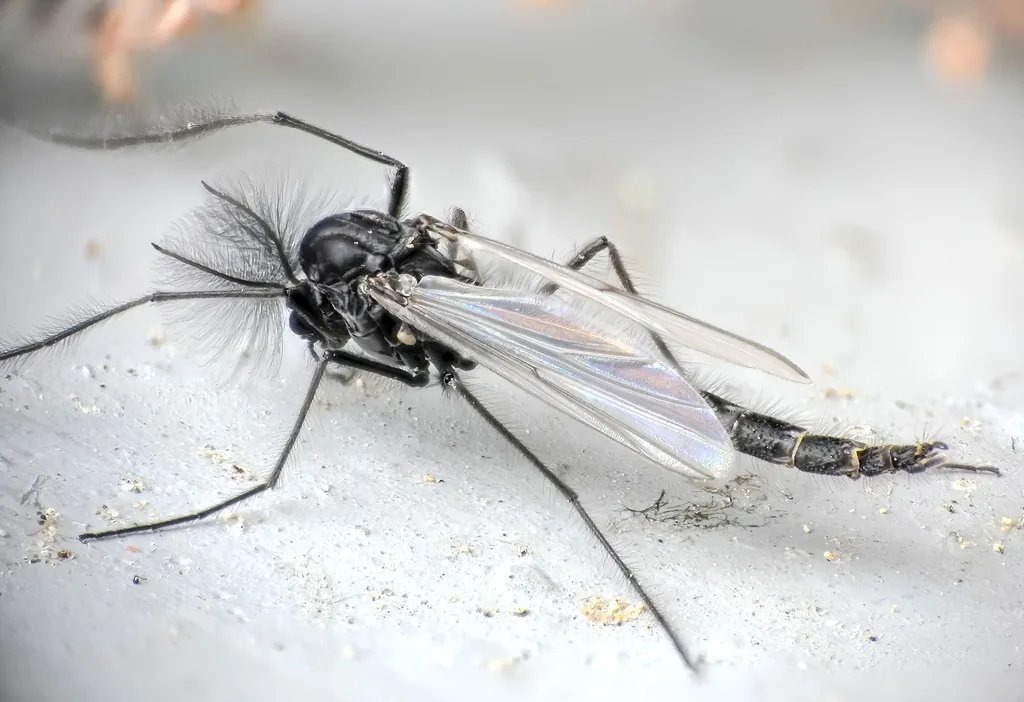
- Adults are soft-bodied, with long legs and long, narrow wings, and vary a lot in size by species. Colors run from pale green to almost black.[1][2][4]
- At rest they often hold their front legs forward and up, which can look like a second pair of antennae at a glance. The family name comes from a Greek word for a pantomimist, after that pose.[2]
- Males have bushy, feathery antennae, which gives them the nickname fuzzy bills.[3][4][2]
- Compared with mosquitoes they have a much shorter snout (proboscis), and their wings lack scales.[1][2]
Look-alikes
| Look-alike | How to tell them apart |
|---|---|
| Mosquitoes | Midges look enough like mosquitoes to be called blind mosquitoes, but they have a short snout, no scales on the wings, and don't bite.[3][1][2] |
| Biting midges (no-see-ums) | A separate family (Ceratopogonidae) of tiny flies that do bite; despite the shared word "midge", they shouldn't be confused with the non-biting midges.[1][2] |
Where it lives
Live in almost every kind of fresh water, from swift streams and slow rivers to stagnant ditches, ponds, lakes, sewage treatment ponds and stormwater retention ponds; a few species live in brackish or coastal marine water. Maryland notes they are the most widely distributed, and often the most abundant, invertebrates in fresh water worldwide.[3][4]
Biology and life cycle
Midges go through egg, larva, pupa and adult stages. Eggs are laid in jelly-like masses on the water or on objects at the water's edge; Washington State says each mass holds from under 100 to nearly 2,000 eggs.[3][1][4]
Most larvae live in the mud at the bottom, often in tubes of silk or sediment, feeding on algae and decaying matter. Many carry hemoglobin and are red, which earns them the name bloodworms. In good conditions there can be several thousand larvae per square meter.[1][2][4][3]
Pupae rise to the surface and the adults emerge. Washington State says most adults emerge within one to two weeks, from late spring to early fall.[3][1][4]
Adults feed little or not at all and live only briefly, mating and laying eggs.[1][4][2]
Males gather in swarms, often in the early evening, above a landmark such as a bush, the water or even a person. Clemson says most swarm members are males listening for a female's wingbeat.[2][1][4]
Runoff from homes, farms and recreation makes urban and suburban ponds rich in nutrients, and a few pollution-tolerant species then build up huge populations. Washington State adds newly built lakes and reservoirs and sewage ponds to the usual problem sources.[3][1][4]
Damage and signs
- The problem is numbers. Dense swarms are drawn to lights and rest on shrubs, patios and the sides of homes, often followed by spiders and their webs.[4][1][3]
- They leave stains from droppings and egg masses on cars, walls, ceilings, curtains and furnishings, and dead midges pile up.[3][4]
- Swarms can smear windshields and be thick enough to make driving dangerous, and they can contaminate products at paint, paper, pharmaceutical and food plants.[1][4][3]
Health risk
Non-biting midges can't bite, but they can cause allergies. Their hemoglobin has been identified as an allergen in people with asthma, and in Sudan mass emergences of one midge species have caused widespread allergy since about 1927, with levels of allergic antibody tied to how severe symptoms were. A 1991 review says swarms cause nuisance and economic problems and, in some situations, medical problems.[5][6][7]
Control
Prevention
Keep outdoor lights off for about 45 minutes after sundown, when Clemson says 90% of the activity occurs, or set lights away from the house and aim them back toward the area you want lit.[1]
Washington State suggests putting bright lights between the water and the house so they draw midges away, using yellow bulbs at the house, and planting a windbreak of trees and shrubs as an alternate resting site between the water and the area you use.[4]
Sanitation
Reduce fertilizer use and runoff into ponds and lakes, since nutrient-rich water supports the largest midge populations.[1][3]
Biological control
In smaller ponds, stocking bottom-feeding fish such as catfish, carp or goldfish has reduced midges, according to Clemson.[1][7]
Pesticides
Complete control is impossible. Chemical treatment of the water can harm other aquatic life, few products are available, and midges quickly become resistant; spraying adults is impractical because they live briefly and new ones keep emerging.[1][4][7]
When to call a professional
Large-scale larval control is a job for public agencies. Maryland's program on the Back River in Baltimore County treats larvae with Bti, a naturally occurring soil bacterium, applied by boat or helicopter.[3]
Where sources disagree
Size: Washington State gives 2 to 18 millimeters depending on species, while Clemson gives 1/32 to 1 3/8 inches.[4][1]
How long adults live: Washington State says usually less than a day, a few up to a week; Clemson says 3 to 10 days; Maryland about a week; and Missouri a few weeks at most.[4][1][3][2]
How long larvae take: Maryland says the larval stage takes less than two weeks depending on species and conditions, Clemson 2 to 7 weeks, and Missouri says most species spend 1 to 3 years as larvae.[3][1][2]
Fish: Clemson reports success stocking catfish, carp and goldfish in smaller ponds, while Washington State calls carp the best biological control in some situations but notes that fish and game departments seldom allow it.[1][4]
Species counts: Missouri says more than 7,300 species have been described worldwide; a 1991 review estimated 4,000 or more, fewer than 100 of them reported as pests; Clemson counts more than 800 in North America.[2][7][1]
Common questions
- Do midges bite?
- No. Non-biting midges have a short snout and don't bite, even though they look a lot like mosquitoes.[1][2][3]
- How long do midge swarms last?
- Each adult lives only briefly, but emergence goes on from late spring into early fall, so swarms come and go through the warm months.[4][1]
- Why do midges cover my house at night?
- Adults are drawn to lights near the water where they emerge. Cutting outdoor lighting in the first hour after dark, or moving lights away from the house, reduces how many settle on your walls.[1][4][3]
- Can midges cause allergies?
- Yes, in some people. Midge hemoglobin is a known allergen in people with asthma, and mass emergences have caused widespread allergy in places such as Sudan.[5][6]
Sources
- Clemson Cooperative Extension, Home & Garden Information Center, “Midges (HGIC 2433).” hgic.clemson.edu/factsheet/midges/ (accessed 2026-11-11)
- Missouri Department of Conservation, “Midges (Field Guide).” mdc.mo.gov/discover-nature/field-guide/midges (accessed 2026-11-11)
- Maryland Department of Agriculture, “Midge (Gnat) Suppression.” mda.maryland.gov/plants-pests/mosquito-control/midge-no-see-ums-suppression (accessed 2026-11-11)
- Washington State University Puyallup Research and Extension Center, “Chironomid Midges (PLS-45, updated July 2003).” wpcdn.web.wsu.edu/wp-puyallup/uploads/sites/408/2015/02/PLS-45-Chironomid-Midges.pdf (accessed 2026-11-11)
- Allergy, via PubMed, “van Kampen et al. (1994), Chironomidae hemoglobin allergy in Japanese, Swedish, and German populations.” pubmed.ncbi.nlm.nih.gov/8198244/ (accessed 2026-11-11)
- Transactions of the Royal Society of Tropical Medicine and Hygiene, via PubMed, “Cranston, Gad El Rab and Kay (1981), Chironomid midges as a cause of allergy in the Sudan.” pubmed.ncbi.nlm.nih.gov/7268834/ (accessed 2026-11-11)
- Journal of the American Mosquito Control Association, via PubMed, “Ali (1991), Perspectives on management of pestiferous Chironomidae (Diptera), an emerging global problem.” pubmed.ncbi.nlm.nih.gov/1895084/ (accessed 2026-11-11)
- iNaturalist, “Chironomidae taxon page (order and family).” www.inaturalist.org/taxa/53275 (accessed 2026-10-06)