On this page
How to identify it
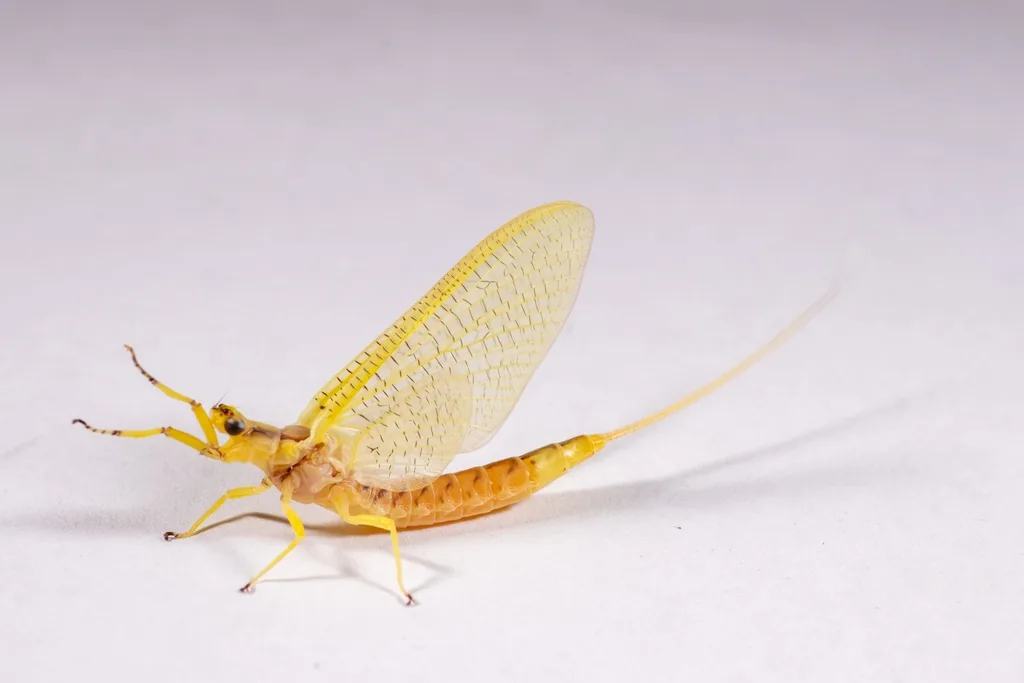
- Adults are slender and soft-bodied, with four veined wings held upright and together like a butterfly's; the front wings are much longer than the hind wings.[2]
- Two long, threadlike tails extend from the tip of the abdomen. The antennae are short, the eyes large, and the front legs are often held outward when perched.[2]
- Nymphs, called naiads, live in water and have leaflike or feathery gills along the abdomen and usually three (sometimes two) long tails.[2][1]
- Adults reach up to 1 1/4 inches long; along the upper Mississippi River, Hexagenia mayflies are among the largest.[2][3]
Where it lives
Mayflies live worldwide, with thousands of species; Missouri counts more than 600 north of Mexico. Nymphs live on the bottoms and rocks of streams, rivers, lakes and ponds, and the biggest swarms come from large lakes, reservoirs and rivers such as the upper Mississippi and the Great Lakes region.[1][2][3]
Biology and life cycle
Nymphs breathe through abdominal gills and their skin and feed on algae and other organic matter.[1][2]
Mississippi State says most mayflies have an annual life cycle, so an adult is usually about a year old, and a few species take several years; the Weather Service gives 3 months to 2 years depending on the species.[1][3][2]
Mature nymphs float to the surface and molt into a winged but sexually immature subadult, called a subimago or dun. Often within hours it molts again into the reproductive adult; Missouri says mayflies are the only insects with two "adult" molts.[2]
Adults have only remnant mouthparts and cannot eat or drink. They mate in swarms and lay eggs on the water, which sink to the bottom.[2][1][3]
Emerging together in huge numbers means fish, birds and other predators can't eat them all before they mate.[1][2]
Along the upper Mississippi River, Hexagenia mayflies generally emerge in late June to early July.[3]
Damage and signs
- Mass emergences can involve millions of insects, enough to show up on weather radar like a light to moderate thunderstorm.[1][2][3]
- Drawn to lights, adults can fly several miles inland and pile up and die on pavement, walkways and buildings, making slippery messes and safety hazards. Bridges have had to be cleared with snowplows.[3][1][2]
Health risk
Adults can't bite: they have only remnant mouthparts and don't feed. Their bodies can be an allergen, though. In a West Virginia study of 200 rural patients with asthma or allergic rhinitis, 60 reacted to at least one of five insects tested, and mayfly was the most common positive skin test, in 37 of them.[2][5]
Control
Prevention
Managing lights is the main defense, since most problems start when adults are drawn to lights at night.[1][3]
Keep them out
Physical exclusion, such as keeping mayflies out of buildings and screened areas, is more effective than insecticides during a mass emergence.[1]
Traps and physical control
Clear piles with leaf blowers, vacuums, or brooms and dust pans; these physical methods usually work better than spraying.[1]
Where sources disagree
How long adults live: Mississippi State says a day or two; Missouri says days or hours; the Weather Service says a few minutes to a few days depending on species. In a lab study of Michigan mayflies, Hexagenia limbata lived about 2.6 days on average with the last dying on day 8, and Ephemera simulans 1.6 to 2.0 days.[1][2][3][4]
How long nymphs take: Mississippi State says most species take a year and a few take several; the Weather Service gives 3 months to 2 years; the Michigan study describes a two-year life cycle for Hexagenia limbata.[1][3][4]
Common questions
- How long does a mayfly hatch last?
- Mass emergences are short-lived and usually last about a week. They happen every year, but some years produce far more mayflies than others.[1]
- Do mayflies bite?
- No. Adult mayflies have only remnant mouthparts, so they can't eat, drink or bite.[2]
- Are lots of mayflies a bad sign for the lake?
- Usually the opposite. Mayflies are a favorite food of fish, healthy mayfly populations are a sign of a healthy aquatic ecosystem, and the Weather Service notes they are sensitive to heavy organic pollution such as sewage.[1][2][3]
Sources
- Mississippi State University Extension Service, “Mayfly (Bug's Eye View, Vol. 4, No. 11).” extension.msstate.edu/newsletters/bugs-eye-view/2018/mayfly-vol-4-no-11 (accessed 2026-11-11)
- Missouri Department of Conservation, “Mayflies.” mdc.mo.gov/discover-nature/field-guide/mayflies (accessed 2026-11-11)
- National Weather Service, La Crosse, WI office, “Tracking Mayflies.” www.weather.gov/arx/mayfly_tracking (accessed 2026-11-11)
- Experimental Gerontology, via PubMed, “Longevity minimalists: life table studies of two species of northern Michigan adult mayflies (Carey 2002).” pubmed.ncbi.nlm.nih.gov/11830359/ (accessed 2026-11-11)
- Allergy and Asthma Proceedings, via PubMed, “Modern prevalence of insect sensitization in rural asthma and allergic rhinitis patients (Smith et al. 2005).” pubmed.ncbi.nlm.nih.gov/16450569/ (accessed 2026-11-11)
- iNaturalist, “Hexagenia limbata taxon page (order and family).” www.inaturalist.org/taxa/51116 (accessed 2026-11-11)