On this page
How to identify it
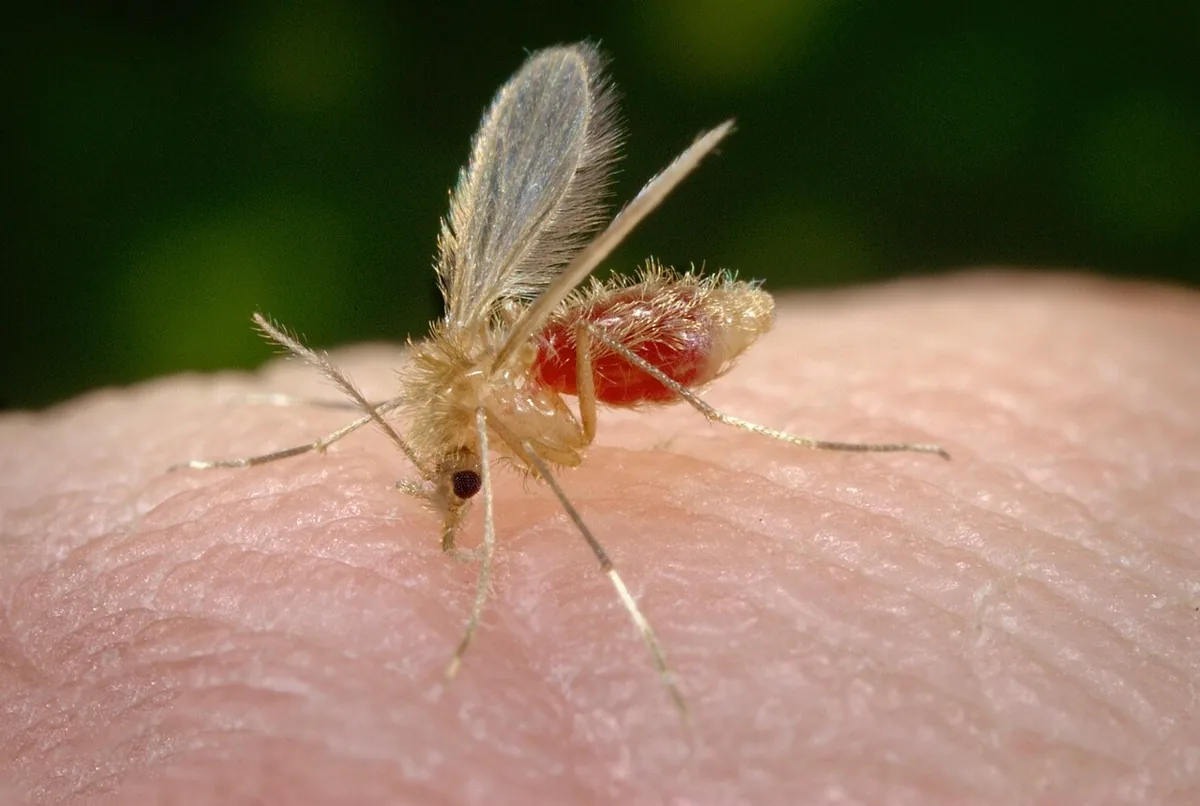
- Tiny, fragile, long-legged flies 1.5 to 3.5 mm long (about 1/16 to 1/8 inch), with a hairy look and large black eyes. CDC says the ones that spread leishmaniasis are about a quarter the size of a mosquito. UF/IFAS describes adult Lutzomyia shannoni as small, silvery-brownish, long-legged flies with narrow bodies and wings less than 3 mm (1/8 inch) long.[9][5][15]
- The wings are hairy and held up at about a 40-degree angle over the body when the fly is resting or feeding; other flies in the same family are squatter and sturdier. UF/IFAS says phlebotomine sand flies hold their densely hairy wings erect over the body in a vertical V, while the family's other subfamilies hold theirs flat and close to the body.[9][15]
- They are silent, and many people don't notice the bite. They fly weakly, in short hops, usually no more than a few hundred meters from where they bred, and even a light wind keeps them from biting. UF/IFAS says Lu. shannoni typically disperses no more than half a kilometer.[5][9][15]
- By day adults rest in cool, dark, humid places such as rock crevices, caves, rodent burrows and animal shelters. UF/IFAS names tree holes, animal burrows and the spaces under rocks as daytime shelters for Lu. shannoni, which is tied to live oak forests and, to a lesser extent, mixed hardwood forests with plenty of tree holes.[9][15]
Look-alikes
| Look-alike | How to tell them apart |
|---|---|
| No-see-ums (biting midges) | Another tiny biter, but CDC says biting midges are active in the daytime and evening and can get through ordinary window screens. Phlebotomine sand flies are the ones with hairy wings raised at an angle over the body. UF/IFAS notes that the name sand fly is also used for biting midges in the genera Ceratopogon and Culicoides, a common source of confusion.[7][9][15] |
| Drain flies (moth flies) | Members of the same fly family, Psychodidae, but squatter and sturdier; of the family's five subfamilies, only sand flies have mouthparts that can take blood.[9] |
Where it lives
A 2022 review lists Lutzomyia shannoni from 17 states, including Alabama, Arkansas, Delaware, Florida, Georgia, Kentucky, Kansas, Louisiana, Maryland, Missouri, Mississippi, North Carolina, New Jersey, Ohio, South Carolina, Tennessee and Texas; Lu. vexator more widely, west to California and Washington; Lu. anthophora from Arkansas, Oklahoma and Texas; Lu. diabolica from Texas; and Lu. cruciata from Florida and Georgia. Lu. anthophora is the only species definitively shown to carry Leishmania mexicana in Texas, and it has been collected at the homes of patients in north Texas and southeastern Oklahoma. GBIF holds only about 170 US records of the genus since 1990, from 3 states, mostly California, far fewer than the published surveys. UF/IFAS describes Lu. shannoni as ranging from Argentina to the United States, where it occurs from Florida to Louisiana plus Arkansas, Tennessee and the Carolinas, and north to Maryland and Delaware; it says Florida also has Lu. cubensis, Lu. vexator and Lu. cruciata.[1][2][4][13][15]
Biology and life cycle
Females lay eggs, usually 30 to 70 per batch, in cracks in the ground or buildings, animal burrows and among tree roots, in humid spots but not in water. The larvae feed on organic matter such as fungi, decaying leaves and animal droppings, and breeding sites are hard to find. UF/IFAS says Lu. shannoni lays its eggs singly in ground-level spots rich in organic matter that feeds the larvae, and that very little is known about where larvae occur.[9][15]
ECDC, describing sand flies in general, gives 4 to 20 days for eggs to hatch, 20 to 30 days for larval development and 6 to 13 days as a pupa, and larvae can pause development for months in extreme heat, cold or drought. For Lutzomyia shannoni, UF/IFAS gives a full life cycle of 36 to 74 days depending on temperature and larval food: 6 to 13 days as eggs, 21 to 51 as larvae, 7 to 32 as pupae and 4 to 15 as adults.[9][15]
Both sexes feed on plant juices and sugary secretions. Only females take blood, which they need to produce eggs, and they feed on a wide range of animals, including people, dogs, rodents and birds. UF/IFAS adds that both sexes take sugar from plant tissues and from honeydew of aphids and scale insects, that Florida females can lay up to 40 viable eggs without a blood meal, and that recorded blood hosts of Lu. shannoni include white-tailed deer, horses, donkeys, mules, cattle, pigs, raccoons, rodents, birds and people.[9][5][15]
In Texas, Lutzomyia anthophora is active from February to November and has 3 to 5 generations a year. Woodrats are the main reservoir of the Leishmania parasite there, and sand fly numbers rise with warmer air and warmer woodrat nests.[2]
Damage and signs
Health risk
Sand flies spread Leishmania parasites. Most US cases are in people infected while traveling or living abroad, but locally acquired cutaneous leishmaniasis occurs, especially in Texas: 58 locally acquired cases in Texas residents have been reported in the medical literature since 2000, from 23 counties led by Collin, Dallas, Grayson and Denton, and Texas is the only state where leishmaniasis is a reportable condition (since 2007). Skin sores usually appear within weeks or months of the bite, are often painless, can be mistaken for skin cancer and can leave scars; in Texas cases where it was reported, the median time from the sore appearing to a correct diagnosis was 4 months. There are no vaccines or drugs to prevent it. Infected dogs and cats have also been found in Texas.[5][2][3][8]
Control
Prevention
Avoid being outdoors from dusk to dawn where sand flies are active, and use an EPA-registered repellent on exposed skin and under the ends of sleeves and pant legs; CDC says repellents with DEET are generally the most effective.[6][8][7]
Wear long sleeves, long pants and socks, and treat clothing, bed nets and screens with a pyrethroid insecticide such as permethrin; CDC says to retreat clothing after five washes.[6][7]
For dogs, insecticide collars and spot-on products that repel sand flies are available. UF/IFAS lists insecticide-impregnated dog collars among sand fly control measures.[1][9][15]
Keep them out
Sand flies are small enough to get through ordinary mosquito screens, so stay in well-screened or air-conditioned rooms, or sleep under a fine-mesh insecticide-treated bed net tucked under the mattress.[6]
Sanitation
Removing breeding and resting sites, such as organic waste, wood piles and unwanted vegetation, helps, though breeding sites are hard to find; in Texas, brush clearing and reducing outdoor lighting may help suppress local sand flies. UF/IFAS adds that spraying larval habitat is usually not possible because so little is known about where the larvae occur.[9][3][2][15]
Pesticides
Spraying living and sleeping areas with insecticide is a standard prevention step, and indoor residual sprays and treated nets are the main tools where sand flies bite inside homes. UF/IFAS says residual spraying of home surfaces has been the primary sand fly control method but does not help against species that bite away from houses.[6][8][3][9][15]
Where sources disagree
Which sand fly carries it in Texas: Lutzomyia diabolica was long considered the probable vector because it bites people readily, and Lu. anthophora was discounted because it prefers other hosts. A 2020 investigation found anthophora made up 190 of 194 sand flies near a patient's home, with Leishmania and human blood in some, and a 2025 review calls it the only species definitively shown to carry Leishmania mexicana in Texas.[1][10][2]
Where people have caught it: CDC names Texas and, rarely, Oklahoma and Arizona; a 2023 dermatology review names Texas and Oklahoma; and a 2022 review counts locally acquired human cases in four states.[5][3][1]
Treatment: the Texas health department says most skin cases heal without treatment, and US guidelines cited in a 2025 review say people with healthy immune systems do not require it, but the same review notes that untreated sores may scar more and can become infected.[8][2]
When they bite: CDC says sand flies are most active from dusk to dawn and its travel guidance says dawn and dusk, while ECDC adds that they can bite in the daytime indoors in darkened rooms or in shaded vegetation.[5][7][9]
Names: recent papers place anthophora in the genus or subgenus Dampfomyia and shannoni in Psathyromyia, so the same flies appear under different names.[10][12]
Stage lengths: ECDC's general figures for sand flies give 4 to 20 days as eggs and 20 to 30 days as larvae, while UF/IFAS's figures for Lu. shannoni are 6 to 13 days and 21 to 51 days.[9][15]
Wing posture: ECDC describes the wings as held up at about a 40-degree angle, while UF/IFAS describes them as erect over the body in a vertical V.[9][15]
Common questions
- Are sand flies the same as no-see-ums?
- No. Both are tiny biters, but phlebotomine sand flies have hairy wings raised over the body and carry Leishmania parasites, while no-see-ums are biting midges, active in the daytime and evening.[9][7]
- Can you catch leishmaniasis in the United States?
- Yes, occasionally. Locally acquired cutaneous leishmaniasis has been reported mostly in Texas and also in Oklahoma, and in 2026 researchers sequenced the parasite's genome from a 3-year-old Texas boy with no travel history.[5][4][3][11]
- When do sand flies bite?
- Mostly from dusk through the night to dawn. In Texas, Lutzomyia anthophora is active from February to November.[5][2]
- Can my dog get leishmaniasis?
- It can, though in US dogs it spreads mainly from mother to pup; a 2026 nationwide survey found antibodies in 0.35 percent of pet dogs, excluding foxhounds. Collars and spot-on products that repel sand flies are available.[12][1]
- Where do sand flies hide during the day?
- UF/IFAS says adult Lu. shannoni shelter by day in dark, humid places such as tree holes, animal burrows or under rocks, and the species is tied to live oak and mixed hardwood forests with plenty of tree holes; they come out at night.[15]
Sources
- Current Tropical Medicine Reports (full text via PubMed Central, PMC9490703), “Possibility of Leishmania Transmission via Lutzomyia spp. Sand Flies Within the USA and Implications for Human and Canine Autochthonous Infection (Beasley, Mahachi and Petersen), Curr Trop Med Rep, 2022.” pmc.ncbi.nlm.nih.gov/articles/PMC9490703/ (accessed 2026-11-11)
- Biology (Basel) (full text via PubMed Central, PMC12383855), “Leishmania in Texas: A Contemporary One Health Scoping Review of Vectors, Reservoirs, and Human Health (Jibowu et al.), Biology (Basel), 2025.” pmc.ncbi.nlm.nih.gov/articles/PMC12383855/ (accessed 2026-11-11)
- Cutis (peer-reviewed dermatology journal), “What's Eating You? Phlebotomine Sandflies and Leishmania Parasites (Zhu, Gillooly and Gilson), Cutis 112:E16-E19, 2023.” cdn.mdedge.com/files/s3fs-public/CT112004016_e.pdf (accessed 2026-11-11)
- American Journal of Tropical Medicine and Hygiene (abstract via PubMed Central, PMC3541728), “Case report: Emergence of autochthonous cutaneous leishmaniasis in northeastern Texas and southeastern Oklahoma (Clarke et al.), Am J Trop Med Hyg 88(1):157-161, 2013.” pmc.ncbi.nlm.nih.gov/articles/PMC3541728/ (accessed 2026-11-11)
- U.S. Centers for Disease Control and Prevention, “About Leishmaniasis.” www.cdc.gov/leishmaniasis/about/index.html (accessed 2026-11-11)
- U.S. Centers for Disease Control and Prevention, “Preventing Leishmaniasis.” www.cdc.gov/leishmaniasis/prevention/index.html (accessed 2026-11-11)
- U.S. Centers for Disease Control and Prevention, “Mosquitoes, Ticks, and Other Arthropods (CDC Yellow Book).” www.cdc.gov/yellow-book/hcp/environmental-hazards-risks/mosquitoes-ticks-and-other-arthropods.html (accessed 2026-11-11)
- Texas Department of State Health Services, Zoonosis Control, “Leishmaniasis.” www.dshs.texas.gov/leishmaniasis (accessed 2026-11-11)
- European Centre for Disease Prevention and Control (ECDC), “Phlebotomine sand flies: factsheet for experts.” www.ecdc.europa.eu/en/disease-vectors/facts/phlebotomine-sand-flies (accessed 2026-11-11)
- American Journal of Tropical Medicine and Hygiene, via PubMed, “An Atypical Case of Autochthonous Cutaneous Leishmaniasis Associated with Naturally Infected Phlebotomine Sand Flies in Texas, United States (Kipp et al. 2020).” pubmed.ncbi.nlm.nih.gov/32618254/ (accessed 2026-11-11)
- American Journal of Tropical Medicine and Hygiene, via PubMed, “Genomic Characterization of a Locally Transmitted Leishmania mexicana Isolate from Texas (Ramirez et al. 2026).” pubmed.ncbi.nlm.nih.gov/41990732/ (accessed 2026-11-11)
- Parasites & Vectors, via PubMed, “Serological and molecular surveillance of leishmaniosis in dogs across the United States (Barrantes Murillo et al. 2026).” pubmed.ncbi.nlm.nih.gov/42958595/ (accessed 2026-11-11)
- Global Biodiversity Information Facility (GBIF), “Lutzomyia (genus): US occurrence records since 1990 by state (GBIF occurrence search API).” api.gbif.org/v1/occurrence/search?taxonKey=5980929&country=US&hasGeospatialIssue=false&occurrenceStatus=PRESENT&year=1990%2C2026&facet=stateProvince&facetLimit=400&limit=0 (accessed 2026-11-11)
- iNaturalist, “Lutzomyia taxon page (order and family).” www.inaturalist.org/taxa/247745 (accessed 2026-11-11)
- University of Florida IFAS Extension, EDIS (Featured Creatures), “A Sand Fly, Lutzomyia shannoni Dyar, EENY-421/IN797 (Featured Creatures).” ask.ifas.ufl.edu/publication/IN797 (accessed 2026-11-14)