The short answer
- Sand flies spread it, but not only sand flies. Merck says dogs catch it mainly from the bites of infected female sand flies and from an infected mother to her pups, and that in the US it is passed from mother to pup.[2]
- In the US it is uncommon. Merck says canine leishmaniosis occurs occasionally in North America, especially in foxhounds and in dogs that have traveled to affected regions; it is common in Central and South America, the Middle East, Asia and the Mediterranean.[1]
- Call your vet if your dog has hair loss with heavy scaling, sores on the head, ears or legs, weight loss, low energy, nosebleeds, swollen lymph nodes or eye problems, especially if it came from or traveled to a country where the disease is common. Merck lists these signs and says vets ask about travel history.[1][2]
- People catch leishmaniasis mainly from sand fly bites, CDC says. CDC adds that where the parasite species Leishmania infantum is found, dogs are the main reservoir, which is why protecting dogs from sand flies matters.[4][6]
The fly behind it
What canine leishmaniasis is
Merck says leishmaniosis is caused by Leishmania parasites, that most clinical cases in animals are in dogs, and that the most important species for pets is Leishmania infantum. Cats, horses and other mammals can also be infected.[2]
The parasite lives in two hosts: a sand fly, and a mammal such as a dog. In the dog it spreads through the body, mostly to the blood and lymph organs, Merck says. Signs can appear long after infection, and the disease typically progresses slowly.[2][1]
Many infected dogs look healthy. Merck says that where the disease is common, far more dogs carry the infection than show disease, and that dogs with or without signs can pass the parasite to sand flies.[2]
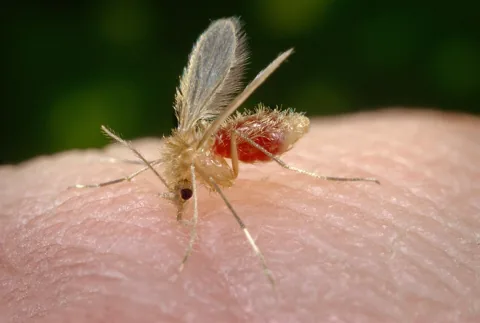
For what sand flies look like, where they hide and when they bite, see our sand fly profile; this page sticks to the dog.[3]
How dogs get it
Sand fly bites. Merck says dogs are thought to be infected most often when an infected sand fly bites and deposits the parasite in the skin. Only a minority of sand fly species can carry Leishmania.[2]
From mother to pup. Merck names vertical transmission from dam to pup as the second confirmed route and says it happens in US dogs. A 2011 study of a naturally infected US dog with no travel history found the parasite spread through 8-day-old pups, the first report of this route in North American dogs.[2][8]
Other routes. Merck says blood transfusions from infected dogs have caused infection, and that direct dog-to-dog spread is the likely route in some cases where fighting or close contact with a sick dog was the only link. Merck's key points add that dogs outside endemic areas can be infected by mating with dogs imported from endemic areas.[2]
Where it shows up in the US
Foxhounds. A CDC-led study reported that in 2000 the infection caused high rates of illness and death among foxhounds in a New York kennel. A serosurvey of more than 12,000 foxhounds and other canids then found infected foxhounds in 18 states and 2 Canadian provinces, with spread that appeared limited to dog-to-dog routes.[7]
Researchers later reported that vertical transmission is the main route in US dogs and that the role of local sand flies is still unclear. A 2026 nationwide survey found antibodies in 0.35% of non-foxhound pet dogs from 48 states, and seropositive dogs in Texas and Oklahoma.[9]
Imported and traveling dogs. Merck says the disease is a concern in countries where it is not native because of imported cases, and that dogs can be infected when they travel to endemic areas without protection from sand fly bites. If you adopted a dog from the Mediterranean, the Middle East or Latin America, tell your vet.[2][1]
Texas. CDC says people have occasionally caught the skin form of leishmaniasis locally in the US, especially in Texas and rarely other states such as Oklahoma and Arizona.[4]
Signs to watch for
Skin. Merck's owner page says skin signs often include hair loss and severe scaliness, usually starting on the head and spreading over the body, or chronic sores on the head and legs, sometimes with bleeding from ear sores. Merck's vet text adds overgrown, abnormal nails and sores on the nose, mouth or genitals.[1][2]
Whole body. Merck lists weight loss, poor appetite, less ability to exercise, lack of energy, enlarged lymph nodes, nosebleeds, lameness, anemia, eye disease and, in some dogs, chronic diarrhea or liver disease.[1][2]
Kidneys. Merck says some kidney damage is present in most affected dogs even when it is not obvious, that more drinking and urinating can be a sign, and that kidney failure is believed to be the main cause of death.[2]
These signs overlap with many other diseases, so only your vet can sort them out. Call your vet if your dog shows them, and mention any time it spent outside the US, its breed, and whether its mother was tested.[2]
What the vet does
Merck says diagnosis is difficult and combines a full history (including travel), an exam, blood and urine tests and specific tests for the parasite, most often blood tests for antibodies, plus looking for the parasite in samples or testing for its DNA.[2]
In the southern US, Merck notes that the Chagas parasite can cross-react on some of these tests, which is one more reason the vet may order more than one. See our page on Chagas disease in dogs.[2]
Treatment exists but rarely clears the parasite completely, Merck says: treated dogs can stay carriers and relapse, so long-term follow-up with your vet is normal. Your vet chooses the medicines; don't give anything on your own.[1][2]
Can people catch it?
CDC says leishmaniasis is spread by the bite of infected sand flies. Some species can also spread through shared needles or blood transfusions, and there are reports of a mother passing it to her baby during pregnancy or birth.[4]
CDC says that in many areas animal reservoir hosts such as rodents or dogs, along with sand flies, keep the parasite going in nature, and that in Leishmania infantum areas dogs are the main reservoir hosts.[6]
In people the most common form causes skin sores that can change over time and are often painless; a form that affects internal organs can cause fever, general illness and anemia, CDC says. See a healthcare provider if you think you have it.[4]
Prevention: keep sand flies off your dog
Merck says topical insecticides that repel sand flies cut bites and spread of the parasite, and recommends them for dogs in endemic areas, dogs traveling to endemic areas, and infected dogs. The classes Merck lists are pyrethroids (deltamethrin, flumethrin, permethrin) and other insecticides used with them, in collars and spot-ons. In the US these must be used as their EPA label directs; ask your vet which fits your dog.[2]
Some dog spot-ons in this group contain permethrin. If you have cats, read our permethrin and cats page before using any dog product, and see our page on flea and tick product reactions.[2]
Merck says no leishmaniosis vaccine is licensed for use in the US; vaccines are sold in Europe and Brazil.[2][1]
Cut sand fly contact. CDC says sand flies are most active from dusk to dawn, and advises staying in well-screened or air-conditioned areas, using fine-mesh bed nets and treating screens, curtains and clothing with insecticide. Merck says sand flies are weak fliers that even slight air currents deter, and that they rest by day in crevices, stone walls, vegetation, burrows and dark buildings. Keeping your dog indoors in the evening applies the same idea.[4][5][3]
Breeding. Because pups can catch it from their mother, Merck and the 2011 study point to the dam: ask your vet about testing before breeding a dog from an affected line or from abroad.[2][8]
Common questions
- Is leishmaniasis common in dogs in the US?
- No. Merck says it occurs occasionally in North America, mainly in foxhounds and dogs that have traveled, and a 2026 nationwide survey found antibodies in 0.35% of non-foxhound pet dogs.[1][9]
- Can my dog give leishmaniasis to me?
- CDC says people catch it mainly from sand fly bites, with rare spread by needles, transfusions or mother to baby, and that dogs are the main reservoir where Leishmania infantum occurs. Talk with your doctor and your vet if your dog is diagnosed.[4][6]
- My rescue dog came from Spain or Greece. Should I worry?
- Mention it to your vet. Merck says the disease is common in the Mediterranean region, that imported cases are a concern, and that vets take a travel history when it is suspected.[1][2]
- Can leishmaniasis in dogs be cured?
- Merck says treatment often improves signs but usually does not clear the infection, so dogs can stay carriers and relapse is common.[1][2]
Photo credits
- Phlebotomine sand flies: James Gathany, CDC Public Health Image Library 10275 (public domain), via Wikimedia Commons
Sources
- Merck Veterinary Manual, “Leishmaniosis (Visceral Leishmaniasis) in Dogs (Dog Owner Version).” www.merckvetmanual.com/dog-owners/disorders-affecting-multiple-body-systems-of-dogs/leishmaniosis-visceral-leishmaniasis-in-dogs (accessed 2026-11-15)
- Merck Veterinary Manual, “Leishmaniosis in Dogs.” www.merckvetmanual.com/infectious-diseases/leishmaniosis/leishmaniosis-in-dogs (accessed 2026-11-15)
- Merck Veterinary Manual, “Sand Flies of Animals.” www.merckvetmanual.com/integumentary-system/flies/sand-flies-of-animals (accessed 2026-11-15)
- U.S. Centers for Disease Control and Prevention (CDC), “About Leishmaniasis.” www.cdc.gov/leishmaniasis/about/index.html (accessed 2026-11-15)
- U.S. Centers for Disease Control and Prevention (CDC), “Preventing Leishmaniasis.” www.cdc.gov/leishmaniasis/prevention/index.html (accessed 2026-11-15)
- U.S. Centers for Disease Control and Prevention (CDC), “Clinical Overview of Leishmaniasis.” www.cdc.gov/leishmaniasis/hcp/clinical-overview/index.html (accessed 2026-11-15)
- Emerging Infectious Diseases (PubMed abstract), “Duprey ZH et al. Canine visceral leishmaniasis, United States and Canada, 2000-2003. Emerg Infect Dis. 2006;12(3):440-6 (PMID 16704782).” pubmed.ncbi.nlm.nih.gov/16704782/ (accessed 2026-11-15)
- PLoS Neglected Tropical Diseases (PubMed abstract), “Boggiatto PM et al. Transplacental transmission of Leishmania infantum as a means for continued disease incidence in North America. PLoS Negl Trop Dis. 2011;5(4):e1019 (PMID 21532741).” pubmed.ncbi.nlm.nih.gov/21532741/ (accessed 2026-11-15)
- Parasites & Vectors (PubMed abstract), “Serological and molecular surveillance of leishmaniosis in dogs across the United States. Parasit Vectors. 2026;19(1):465 (PMID 42958595).” pubmed.ncbi.nlm.nih.gov/42958595/ (accessed 2026-11-15)