The short answer
- How pets get it: a mosquito picks up baby heartworms (microfilariae) when it bites an infected dog, the larvae develop inside the mosquito, and the mosquito passes them on with its next bite. A pet cannot catch heartworm from another pet.[1][2]
- Watch for: in dogs, coughing, tiring easily with exercise, labored breathing, fainting or a swollen belly. In cats, coughing, trouble breathing, vomiting or weight loss. Many infected pets show no signs at first. Call your vet about any of these.[1][3][4]
- Call your vet now if a pet collapses, has sudden trouble breathing or is coughing up blood. The Merck Veterinary Manual says the death of heartworms in a cat can cause sudden respiratory distress and shock that may be fatal.[3][4]
- Prevention: every heartworm preventive sold in the US needs a veterinarian's prescription, and the FDA says year-round prevention is best for dogs, cats and ferrets. Indoor pets can be infected too.[1][2][4]
- Testing: vets check dogs with blood tests, and the FDA recommends annual testing of dogs on prevention. Cats and ferrets are harder to test, so vets combine blood tests with x-rays and heart ultrasound.[1][3]
Mosquitoes that can carry heartworm
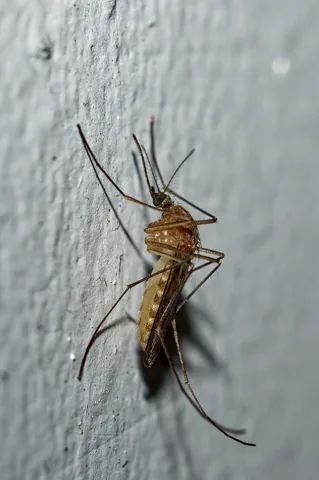 Mosquito
Culicidae (shown: Culex pipiens complex)
Mosquitoes are small, delicate flies whose females feed on blood and can pass on viruses such as West Nile; the control that works best goes after the larvae in standing water.
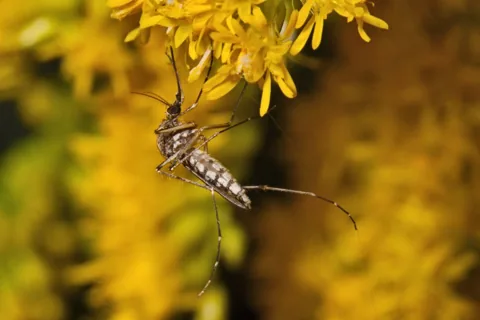 Inland Floodwater Mosquito
Aedes vexans
The inland floodwater mosquito is one of the most widespread pest mosquitoes in the world. Its eggs wait on damp ground and won't hatch until floodwater or heavy rain covers them, which can be months or even years after they were laid.
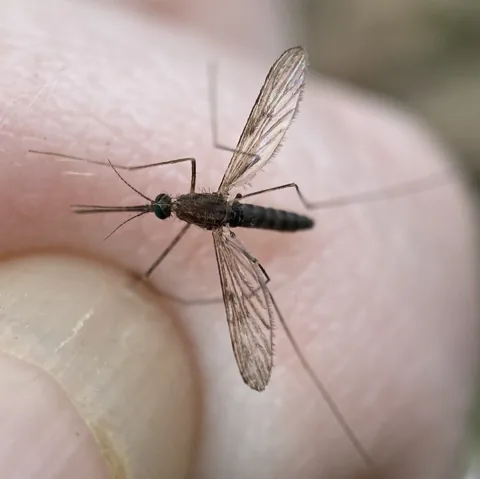 Common Malaria Mosquito
Anopheles quadrimaculatus (a complex of five sibling species)
The common malaria mosquito is a large, dark Anopheles mosquito of the eastern United States. It was the most important malaria carrier in the Southeast, still serves as the primary vector in eastern outbreaks, and bites livestock, deer and, to a lesser extent, people.
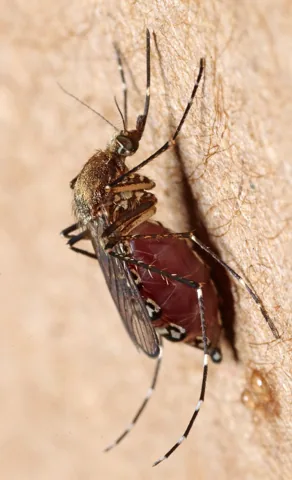 Black Salt Marsh Mosquito
Aedes taeniorhynchus
The black salt marsh mosquito is a severe biter of people and livestock along the southern U.S. coasts. Its eggs hatch when tides or heavy rain flood salt marshes and mangroves, broods can number in the millions, and females fly miles inland looking for blood. In Florida, hurricane flooding has set off huge outbreaks.
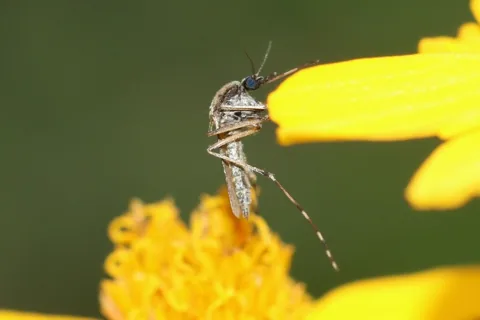 Eastern saltmarsh mosquito
Aedes sollicitans
The eastern saltmarsh mosquito is a major pest along the coast from Atlantic Canada to Texas. Huge broods hatch from salt marsh pools after unusually high tides or heavy rain, and the females fly inland and bite persistently, by day or night.
How mosquitoes spread heartworm
Adult female heartworms living in an infected dog release microfilariae into its bloodstream. A mosquito that bites the dog swallows them, and inside the mosquito they develop into infective larvae. The FDA says that takes 10 to 14 days under the right conditions; the Merck Veterinary Manual says about 1 to 4 weeks depending on temperature, and 10 to 14 days when the average temperature is above 27°C (81°F) and humidity is 80%.[1][2]
When the mosquito feeds again, the larvae leave its mouthparts and enter the new animal through the bite wound. CDC's parasite diagnostic site describes the same steps for Dirofilaria immitis.[2][5]
Microfilariae must pass through a mosquito to become infective, so heartworm is not contagious between pets. The FDA says a dog cannot catch it from being near an infected dog.[1]
Many kinds of mosquitoes can carry it. Merck lists at least 70 species as possible hosts, with Aedes, Anopheles and Culex the most common genera. Dogs and coyotes are the main reservoirs the mosquitoes pick it up from.[2][3]
What the worms do inside a pet
In a newly infected dog, the FDA says the larvae take about 6 to 7 months to grow into adult heartworms. The adults live in the heart, the lungs and the blood vessels that connect them, which is how the disease got its name.[1][3]
Adults look like strands of cooked spaghetti. The FDA gives about 4 to 6 inches for males and 10 to 12 inches for females.[1]
Sources give different lifespans for adult worms in dogs: 5 to 7 years (FDA), typically 3 to 5 years (Merck pet owner edition) and 5 to 10 years (CDC). In cats the FDA gives 2 to 4 years and Merck about 2 years.[1][3][5][4]
Damage builds with time. Merck says the worms inflame the vessels and lungs, the dog's own immune response adds more damage, and infections longer than a year scar the blood vessels. Pets can be reinfected again and again, so worms of different ages can be present at once.[3]
The FDA says untreated heartworm disease keeps progressing and damages a dog's heart, lungs, liver and kidneys, eventually causing death.[1]
Signs of heartworm in dogs
Early on there may be nothing to see. The FDA says signs may not be obvious in dogs that have few worms, were recently infected or are not very active, while very active dogs and dogs with many worms or long infections often show clear signs.[1][3]
Signs listed by the Merck Veterinary Manual include coughing, exercise intolerance, labored breathing, blue or purplish gums, coughing up blood, fainting, nosebleeds and fluid building up in the belly.[3]
The FDA describes the disease in four classes. Class 1 has no signs or an occasional cough; class 2 adds tiredness after moderate activity; class 3 brings a sickly look, a persistent cough, tiring after mild activity and often trouble breathing and heart failure.[1]
Class 4, caval syndrome, is an emergency: so many worms that blood flowing back to the heart is blocked. The FDA says quick surgical removal is the only option and most dogs with caval syndrome die even with surgery.[1][2]
How vets test for heartworm
A blood antigen test is the main test for dogs. It detects proteins released by adult female worms; Merck calls it the most accurate test available for dogs, but it cannot find early infections.[1][3]
Timing matters. The FDA says the earliest a dog's antigen test can turn positive is about 5 months after the infective bite, and microfilariae can show up in the blood at about 6 months. A dog bitten this summer can test negative today.[1]
The FDA recommends testing dogs 7 months and older before they start a preventive, and testing every dog on prevention once a year. It warns that giving a preventive to a dog that already has adult heartworms may be harmful or deadly.[1][3]
Your vet may also test after a missed preventive, a switch between products, or travel to an area where heartworm is more common, according to the FDA. Other tools include chest x-rays and heart ultrasound.[1][3]
Cats are different
Cats can get heartworm from an infected mosquito, but they are less susceptible than dogs and are not a natural host. Indoor and outdoor cats are both at risk, according to the FDA and the Merck Veterinary Manual.[1][4][2]
Cats usually carry only one to a few worms, but their small hearts and blood vessels mean even that is a heavy infection. Merck says cats are more likely than dogs to die of heartworm infection.[1][4]
The FDA says signs often come at two points. About 3 to 4 months after the infective bite, young worms reach the lung arteries and many die, causing heartworm associated respiratory disease (HARD), which can look like feline asthma. When adult worms later die, the lung damage can cause sudden death, and the death of even one worm can be fatal.[1][4]
Other signs are vague: vomiting, less activity and appetite, and weight loss. Some cats show no signs at all, and some die suddenly without ever seeming sick.[1][4]
Testing is harder in cats. The FDA says vets combine two kinds of blood test with x-rays and heart ultrasound, and that a negative result does not rule infection out.[1][4]
There is no FDA-approved drug to treat heartworm disease in cats, so prevention matters even more. FDA-approved cat preventives are topical or oral and all require a prescription; Merck says a preventive is recommended for all cats, indoor or outdoor, where the disease is common.[1][4]
Ferrets
Ferrets get heartworm from infected mosquitoes too. The FDA says they are about as susceptible as dogs, but their signs look more like a cat's: less activity, coughing, trouble breathing and weakness, with heart failure in severe cases.[1][2]
Blood tests are generally unreliable in ferrets, so vets rely on signs, chest x-rays and heart ultrasound. Merck notes that sudden death in infected ferrets is thought to be caused by pulmonary embolism, a blockage in a lung artery.[1][2]
No drug is FDA-approved to treat heartworm in ferrets. Prescription topical preventives are approved, and the FDA recommends year-round prevention for all ferrets.[1]
Why prevention matters, and why year-round
Treating heartworm in a dog is hard on the dog. The FDA says treatment can be toxic and can cause serious complications such as life-threatening blood clots in the lungs, and needs multiple vet visits, blood tests, x-rays and hospitalization. For cats and ferrets there is no FDA-approved treatment at all.[1][3]
Many products are FDA-approved to prevent heartworm in dogs, cats and ferrets, and every one requires a veterinarian's prescription. Some also control intestinal worms, fleas, ticks or ear mites. Your vet picks the product and schedule for your pet.[1][3]
Year-round, not just summer. Merck says transmission runs all year in tropical and subtropical areas, and in cooler areas the season is hard to predict, so giving preventives throughout the year in all climates is safest. The FDA says year-round prevention is best.[2][1][3]
Don't skip doses. Merck says missing a preventive can have serious consequences and that you should contact your vet if you miss one; reminders on a calendar or the fridge help.[3]
Where in the US: the FDA says heartworm is most common along the Atlantic and Gulf coasts from the Gulf of Mexico to New Jersey and along the Mississippi River and its major tributaries, but it has been reported in dogs in all 50 states.[1]
Can people get heartworm?
Not from pets. The FDA says heartworm spreads only through mosquito bites. In rare cases a person bitten by an infected mosquito is infected, but people are not a natural host and the larvae usually die before becoming adults.[1][2]
When that happens, the dead larvae can leave a small round spot in the lung, called a coin lesion, that shows on a chest x-ray and can look like lung cancer. CDC classes this as pulmonary dirofilariasis.[2][5]
Cutting down mosquitoes at home
Preventives protect the pet; fewer mosquitoes lowers the number of bites. Merck says infection risk is greatest for dogs and cats housed outdoors, though any dog, cat or ferret, indoor or outdoor, can be infected.[2][3]
CDC's home steps: once a week, empty and scrub, turn over, cover or throw out anything that holds water, such as tires, buckets, planters, toys, pools, birdbaths, flowerpot saucers and trash containers, because mosquitoes lay eggs near water. Indoors, install or repair window and door screens.[6]
For water you can't dump, CDC says larvicides can treat larger bodies of water that won't be used for drinking; follow the label. Rain barrels, ponds and Bti dunks are covered in the guide to stopping mosquito breeding, and pet-safe product choices are in the pet-safe pest control guide.[6]
Common questions
- Can my dog get heartworm from another dog?
- No. The FDA says heartworm is not contagious and spreads only through the bite of an infected mosquito.[1]
- Do indoor cats need heartworm prevention?
- The FDA and the Merck Veterinary Manual say indoor and outdoor cats are both at risk, and Merck says a preventive is recommended for all cats where the disease is common. Ask your vet.[1][4]
- Do pets need heartworm prevention in winter?
- The FDA says year-round prevention is best. Merck says the season in cooler climates is hard to predict, so year-round use in all climates is safest.[1][2]
- Can I buy heartworm medicine without a vet?
- No. The FDA says all FDA-approved heartworm preventives for dogs, cats and ferrets require a veterinarian's prescription, and dogs 7 months and older should be tested before starting.[1]
- Why does my dog need a heartworm test every year if it takes preventives?
- The FDA recommends annual testing of all dogs on prevention, and Merck notes the antigen test cannot find early infections, which is part of why yearly testing is advised.[1][3]
- Which mosquitoes carry heartworm?
- At least 70 mosquito species can, according to the Merck Veterinary Manual, mostly in the genera Aedes, Anopheles and Culex.[2][3]
- Can people get heartworm?
- Not from pets. Rarely, an infected mosquito passes larvae to a person, but they usually die in the lungs and can leave a spot on a chest x-ray, according to the FDA, Merck and CDC.[1][2][5]
Photo credits
- Mosquito: (c) Donald Davesne, some rights reserved (CC BY) — via iNaturalist, CC BY 4.0
- Inland Floodwater Mosquito: Dennis White, public domain (CC0), via iNaturalist
- Common Malaria Mosquito: (c) fuzzyspider, some rights reserved (CC BY) — via iNaturalist, CC BY 4.0
- Black Salt Marsh Mosquito: (c) Chris Baer, some rights reserved (CC BY) — via iNaturalist, CC BY 4.0
- Eastern saltmarsh mosquito: (c) Rich Sommer, some rights reserved (CC BY) — via iNaturalist, CC BY 4.0
Sources
- U.S. Food and Drug Administration, Center for Veterinary Medicine, “Keep the Worms Out of Your Pet's Heart! The Facts about Heartworm Disease.” www.fda.gov/animal-veterinary/animal-health-literacy/keep-worms-out-your-pets-heart-facts-about-heartworm-disease (accessed 2026-11-15)
- Merck Veterinary Manual, “Heartworm Disease in Dogs, Cats, and Ferrets.” www.merckvetmanual.com/circulatory-system/heartworm-disease/overview-of-heartworm-disease (accessed 2026-11-15)
- Merck Veterinary Manual, “Heartworm Disease in Dogs (Dog Owners).” www.merckvetmanual.com/dog-owners/heart-and-blood-vessel-disorders-of-dogs/heartworm-disease-in-dogs (accessed 2026-11-15)
- Merck Veterinary Manual, “Heartworm Disease in Cats (Cat Owners).” www.merckvetmanual.com/cat-owners/heart-and-blood-vessel-disorders-of-cats/heartworm-disease-in-cats (accessed 2026-11-15)
- Centers for Disease Control and Prevention, “DPDx: Dirofilariasis.” www.cdc.gov/dpdx/dirofilariasis/index.html (accessed 2026-11-15)
- Centers for Disease Control and Prevention, “Mosquito Control at Home.” www.cdc.gov/mosquitoes/mosquito-control/mosquito-control-at-home.html (accessed 2026-11-15)