On this page
How to identify it
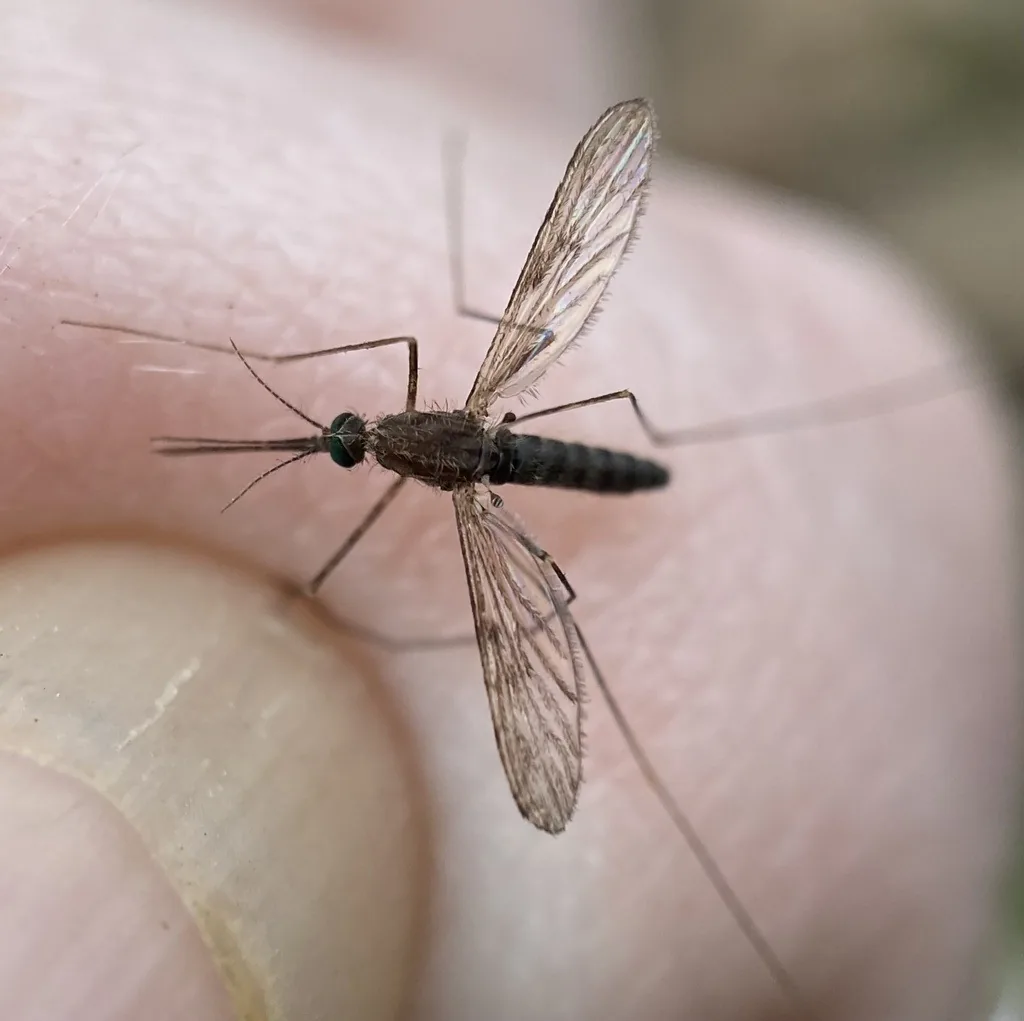
- Adults are large, dark brown mosquitoes with four dense patches of dark scales on each wing. UF/IFAS adds that they are very dark, covered in dark brown to black hairs, with palps about as long as the proboscis.[1][15]
- It is a complex of five sibling species that look identical as adults; they are told apart only by lab methods such as enzyme, chromosome and DNA tests, and by their eggs.[1]
- As in other Anopheles, the larvae have no breathing siphon at the rear of the body, unlike Culex and Aedes larvae. They feed at the water surface on microorganisms and detritus. UF/IFAS says the larvae lie horizontally at the surface, filter feeding on organic material, and take in oxygen through palmate hairs along the abdomen.[3][1][15]
- Eggs are laid one at a time directly on the water and float on the surface. UF/IFAS says each egg has a float on either side.[4][15]
- Pupae don't feed. Like all mosquito pupae they are active, and when disturbed they 'tumble' from the surface to the bottom of the water.[15]
Look-alikes
| Look-alike | How to tell them apart |
|---|---|
| Other mosquitoes | Culex and Aedes larvae have a breathing siphon, which Anopheles larvae lack. Among adults, Rutgers notes that resting quads stand more parallel to the surface than other Anopheles do.[3][1] |
| Anopheles crucians complex | Another Anopheles of the Southeast. In Miami-Dade County surveillance from 2020 to 2022 it was the more abundant of the two (36,589 collected against 9943 An. quadrimaculatus), and it is considered a competent vector but has not been directly implicated in human transmission.[2] |
Where it lives
Rutgers gives the range of species A, An. quadrimaculatus in the strict sense, as much of the eastern United States, from southern Canada to the Florida Everglades and west from Minnesota to Mexico. Species B and D occur in states south of Kentucky and east of Texas, and the two species C populations mainly along Florida's Gulf coast and Georgia's Atlantic coast. It was one of the two most abundant Anopheles in 20 years of Iowa mosquito surveillance. UF/IFAS describes it as mainly eastern North America, from the southern edge of Canada through the eastern United States to parts of Mexico south to Vera Cruz, with the greatest abundance in the Southeast.[1][5][15]
Biology and life cycle
Species A breeds in large bodies of water with surface or emergent plants, such as rice fields, reservoirs, lakes and canals; species B uses permanent swamps with filtered sunlight. CDC says Anopheles lay their eggs in marshy areas or near the banks of shallow creeks and streams. UF/IFAS names fresh water streams, ponds and lakes with aquatic vegetation as preferred egg-laying sites, and says females lay soon after fresh water is added to rice fields, which is why the biggest populations are in rice-growing regions.[1][4][15]
Females lay 50 to 200 eggs at a time. Rutgers says eggs of species A and B hatch within 36 to 48 hours, and CDC says an Anopheles egg takes 10 to 14 days to develop into an adult.[4][1]
Females bite usually late in the evening or at night, then rest for a few days while the eggs develop; Rutgers says quads lay eggs 3 to 4 days after feeding. Where species A and B are common, favorite hosts include cattle, horses, pigs and deer, and people to a lesser extent.[4][1]
Rutgers says females typically fly less than 1 mile for a blood meal; CDC says Anopheles generally don't fly more than 1.2 miles (2 km) from their larval habitats. By day they rest in dark, sheltered places.[1][4]
In northern areas species A is active in the warm months and overwinters as an adult female. In more temperate regions species A, B and D have a 6 month breeding season, and in Florida and along the Gulf coast all 5 species breed year round.[1]
Males and females both feed on plant sugars and nectar; only females take blood. UF/IFAS says they mostly feed on ruminants, horses and their relatives, rabbits and dogs, and that the share of meals taken from people depends on how close homes are to larval and resting sites: up to 93% in mosquitoes collected resting indoors, but at most 18% in those collected away from dwellings.[15]
UF/IFAS says adult females can live over a month in captivity but in nature probably don't survive more than two weeks.[15]
In colder climates fertilized females overwinter in barns, tree holes and other dark, protected shelters. UF/IFAS counts seven to eight broods a year in North Carolina and nine to 10 farther south, and says blood feeding starts in spring and stops by November.[15]
Numbers follow the water. UF/IFAS says population size tracks seasonal lake levels, with peak numbers coming 14 to 30 days after peak water levels.[15]
Damage and signs
- Large populations from rice fields, reservoirs, lakes and rivers make it a significant pest of people and livestock.[1]
- It is a major host of the nematode that causes dog heartworm. In northeast Arkansas it made up 23.7% of mosquitoes collected in a 2009 survey, and 6.9% of its sample pools tested positive for heartworm.[1][6]
Health risk
Anopheles mosquitoes are the type that spread malaria from person to person, and this species has been the primary vector in eastern US outbreaks. Malaria is not endemic in the United States, and CDC calls the risk of locally acquired malaria very low, but on rare occasions local spread follows an imported case.[7][2][8]
Control
Prevention
Use an EPA-registered repellent containing DEET, picaridin, IR3535, oil of lemon eucalyptus, PMD or 2-undecanone, and wear loose long sleeves and pants; CDC also recommends permethrin-treated clothing. Anopheles bite mostly late in the evening and at night.[9][4][3]
Keep them out
Keep fine-mesh window and door screens in good repair.[3]
Biological control
Bti (Bacillus thuringiensis subspecies israelensis) kills mosquito larvae that eat it and does not affect people, animals or plants; mosquito-eating fish can be stocked in isolated ponds. UF/IFAS calls Bti an effective larvicide for this species in rice-growing regions, working better on early than on late instars, and says Gambusia affinis fish controlled mosquitoes in white rice but not in wild rice.[3][15]
When to call a professional
Its breeding sites are large waters such as lakes, reservoirs, rice fields and swamps, so control is a job for mosquito control agencies. During the 2003 Palm Beach County outbreak, county mosquito control added spraying within a 3-mile radius of each patient's home. UF/IFAS notes that the Tennessee Valley Authority and the U.S. Army Corps of Engineers run programs that monitor and manage Anopheles populations, that resting boxes give the most unbiased sample of adults, and that malathion resistance has been reported where adults are controlled in rice regions.[1][10][15]
Local malaria in the United States
In a typical year the United States reports about 2,000 malaria cases, mostly in people infected while traveling. CDC notes that most temperate areas that eliminated malaria still have Anopheles mosquitoes that can spread it, so reintroduction remains a risk.[7][11]
In July and August 2003, seven locally acquired P. vivax cases were investigated in Palm Beach County, Florida, and An. quadrimaculatus and An. crucians were trapped near the patients' homes. A 2004 CDC report counted eight cases in that outbreak.[10][12]
In 2023 the US reported 10 locally acquired mosquito-transmitted cases in 4 states, the first such outbreaks in 20 years; seven were in Sarasota County, Florida, with single cases in Texas and Maryland.[13][2][8]
Early malaria symptoms include fever and flu-like illness, chills, headache, muscle aches and tiredness, and sometimes nausea, vomiting and diarrhea. See a health care provider promptly if you have these symptoms and have traveled in the last year to or from an area where malaria occurs.[7]
Where sources disagree
When malaria was eliminated: a 2024 study dates elimination from the United States to 1951, while the 2003 CDC report cites certification of eradication in 1970.[5][10]
Palm Beach County, 2003: the first CDC report described seven cases, and a 2004 CDC report counted eight.[10][12]
Drying: CDC says Anopheles eggs do not tolerate drying out, while Rutgers says eggs of the coastal species C can resist drought for weeks and hatch when the swamp refloods.[4][1]
Time in the water: UF/IFAS, citing CDC, gives five to 14 days for the egg, larval and pupal stages together, while CDC's current page says an Anopheles egg takes 10 to 14 days to become an adult.[15][4]
Egg hatch: UF/IFAS says eggs hatch within two to three days of being laid; Rutgers says eggs of species A and B hatch within 36 to 48 hours.[15][1]
Drying, continued: UF/IFAS agrees that An. quadrimaculatus eggs can't survive drying, but says sibling species C1, Anopheles diluvialis, is adapted to floodwater and its eggs can survive 28 days out of water.[15]
Resting posture: UF/IFAS says Anopheles adults rest with the abdomen at an angle to the surface, which makes them easy to pick out on skin, while Rutgers notes quads stand more parallel to the surface than other Anopheles do.[15][1]
Common questions
- Can mosquitoes still spread malaria in the US?
- Rarely. Malaria is not endemic in the US, but local spread still happens on rare occasions; in 2023, 10 locally acquired cases were reported in 4 states, the first such outbreaks in 20 years.[7][13]
- How can I tell an Anopheles mosquito?
- Look for a large, dark mosquito with four dark spots of scales on each wing; its larvae have no breathing siphon. Resting posture isn't a reliable sign for this one: Rutgers notes quads stand more parallel to surfaces than other Anopheles.[1][3]
- Where do common malaria mosquitoes breed?
- In fresh water with plants. UF/IFAS lists streams, ponds and lakes with aquatic vegetation, and rice fields soon after fresh water is added; Rutgers adds reservoirs, canals and swamps.[15][1]
Sources
- Rutgers Center for Vector Biology, “The 'Quads,' Anopheles quadrimaculatus (Kaiser 1994, Wing Beats).” vectorbio.rutgers.edu/outreach/species/sp3.htm (accessed 2026-11-11)
- Malaria Journal, via PubMed, “Wilke and others (2024), Presence and abundance of malaria vector species in Miami-Dade County, Florida.” pubmed.ncbi.nlm.nih.gov/38238772/ (accessed 2026-11-11)
- University of California Statewide IPM Program, “Pest Notes: Mosquitoes, Publication 7451 (revised April 2020).” ipm.ucanr.edu/legacy_assets/PDF/PESTNOTES/pnmosquitoes.pdf (accessed 2026-11-11)
- U.S. Centers for Disease Control and Prevention, “Life Cycle of Anopheles Mosquitoes.” www.cdc.gov/mosquitoes/about/life-cycle-of-anopheles-mosquitoes.html (accessed 2026-11-11)
- Journal of Medical Entomology, via PubMed, “Lee, Leonard and Smith (2024), Abundance, distribution, and dynamics of Anopheles species in Iowa, United States.” pubmed.ncbi.nlm.nih.gov/39158078/ (accessed 2026-11-11)
- Journal of Medical Entomology, via PubMed, “McKay and others (2013), Prevalence of Dirofilaria immitis in mosquitoes from northeast Arkansas.” pubmed.ncbi.nlm.nih.gov/23926787/ (accessed 2026-11-11)
- U.S. Centers for Disease Control and Prevention, “About Malaria.” www.cdc.gov/malaria/about/index.html (accessed 2026-11-11)
- Morbidity and Mortality Weekly Report, via PubMed, “Blackburn and others (2023), Outbreak of locally acquired mosquito-transmitted (autochthonous) malaria, Florida and Texas, May-July 2023.” pubmed.ncbi.nlm.nih.gov/37676839/ (accessed 2026-11-11)
- U.S. Centers for Disease Control and Prevention, “Preventing Mosquito Bites.” www.cdc.gov/mosquitoes/prevention/index.html (accessed 2026-11-11)
- U.S. Centers for Disease Control and Prevention, “Local Transmission of Plasmodium vivax Malaria, Palm Beach County, Florida, 2003 (MMWR 52(38)).” www.cdc.gov/mmwr/preview/mmwrhtml/mm5238a3.htm (accessed 2026-11-11)
- U.S. Centers for Disease Control and Prevention, “Where Malaria Occurs.” www.cdc.gov/malaria/data-research/index.html (accessed 2026-11-11)
- Morbidity and Mortality Weekly Report, via PubMed, “CDC (2004), Multifocal autochthonous transmission of malaria, Florida, 2003.” pubmed.ncbi.nlm.nih.gov/15152184/ (accessed 2026-11-11)
- JAMA Network Open, via PubMed, “DeVita and others (2025), Public health response to the first locally acquired malaria outbreaks in the US in 20 years.” pubmed.ncbi.nlm.nih.gov/41051775/ (accessed 2026-11-11)
- iNaturalist, “Anopheles quadrimaculatus taxon page (order and family).” www.inaturalist.org/taxa/1098642 (accessed 2026-10-06)
- University of Florida IFAS Extension, EDIS, “Common Malaria Mosquito, Anopheles quadrimaculatus Say, EENY 491/IN791 (Featured Creatures).” ask.ifas.ufl.edu/publication/IN791 (accessed 2026-11-14)