On this page
How to identify it
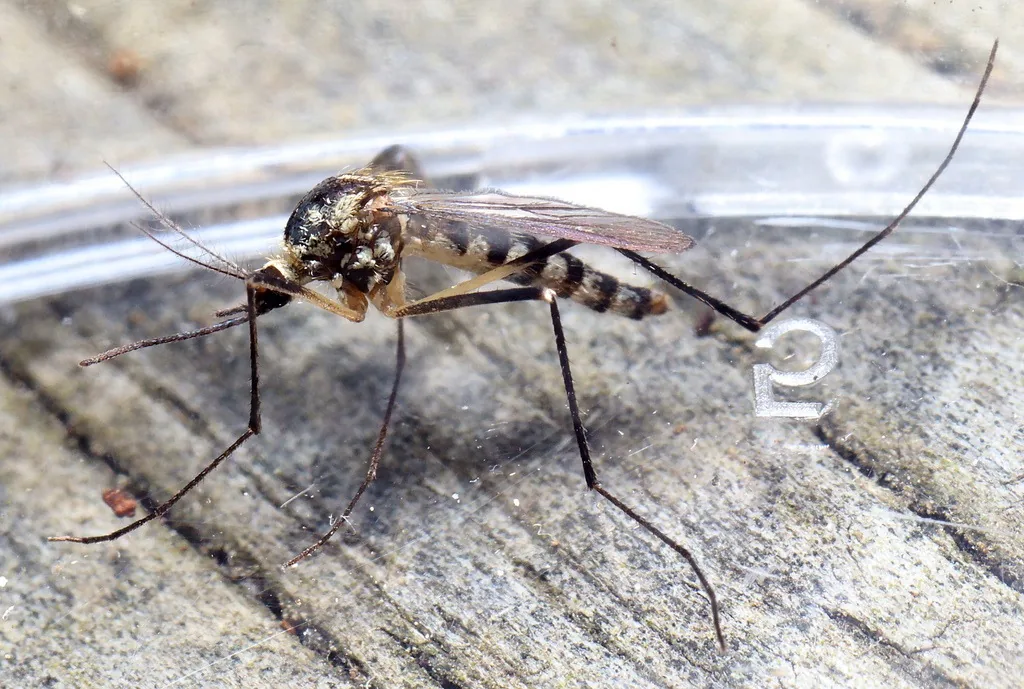
- It is a dark mosquito; Rutgers says the silvery scales on the sides of the thorax are its most diagnostic feature. Seen from above, a stripe of dark brown scales runs down the middle of the thorax with silvery-white scales on either side. UF/IFAS says the broad black stripe is notably wider than the pale side stripes and tends to be wider in Florida populations.[2][3][4]
- The proboscis and legs are dark and unbanded. The abdomen is dark, with silvery-white triangular patches at the front edges of the segments but no pale bands. UF/IFAS notes patches of pale scales on the sides of the abdomen at the base of each segment.[2][3][4]
- The wing scales are entirely dark and narrow.[3]
- Connecticut's identification guide lists it under the older name Ochlerotatus triseriatus.[3]
- Eggs are dark, cylindrical and taper at both ends, averaging 0.69 mm long; larvae are usually gray and worm-like, UF/IFAS says.[4]
Look-alikes
| Look-alike | How to tell them apart |
|---|---|
| Asian tiger mosquito | Also a container breeder, but it has one conspicuous silvery-white stripe down the middle of the thorax and broad white bands on the hind legs. The treehole mosquito's silver scales are on the sides of the thorax and its legs are unbanded.[3][2] |
| Aedes hendersoni | A close relative whose adults are remarkably similar. UF/IFAS says the treehole mosquito has a broader dark stripe on the front half of the thorax, only 1 to 4 weakly developed bristles in a shallow pit on the thorax (A. hendersoni has many), and black rather than pale scales at the base of the front wing vein; because these are hard to see, larvae or molecular tests are usually used.[4] |
| Yellow fever mosquito (Aedes aegypti) | It has pale scale bands on its legs, which the eastern treehole mosquito lacks.[4] |
Where it lives
Rutgers gives its range as Florida north to Ontario and Quebec and west to the Dakotas and Texas, and Connecticut records it from eight of its counties. CDC says La Crosse virus circulates between treehole mosquitoes and small mammals in the eastern and north central United States. UF/IFAS adds southern Ontario, Quebec, New Brunswick and Manitoba in Canada, Cuba, northeastern Mexico (Chihuahua, Coahuila, Nuevo Leon and Tamaulipas) and Morelos and Tlaxcala in central Mexico. It has been detected in Greenland and France, with no evidence that it became established there.[2][3][1][4]
Biology and life cycle
Larvae grow in natural tree holes and in artificial containers such as discarded tires, rain barrels and cans. Rutgers says it breeds mainly in shaded tires, from a single tire behind a garage to tire dumps, and scrap-tire yards can produce as many as 60,000 females per acre in midsummer.[3][2][1]
Eggs are laid singly on the sides of containers. In the north it overwinters as eggs: from mid-August, shortening days switch the eggs into a resting state (diapause) so they won't hatch even if flooded, and they hatch in spring as temperatures rise and rain raises the water. In the south both eggs and larvae overwinter.[2][3]
It has several generations a year; in Connecticut, larvae are found from May to September and adults from June to October.[3]
Adults don't fly far, often staying within a few hundred yards of the tree hole or tire pile they came from.[2]
Females bite many mammals, including people, and sometimes birds; Rutgers says they especially like chipmunks and squirrels, and Connecticut also lists reptiles and amphibians. CDC calls it an aggressive daytime biter in or near woods, while Connecticut says females feed mainly at dawn and dusk but also bite during the day in wooded areas.[2][3][1]
Larvae of a predatory mosquito, Toxorhynchites, eat treehole mosquito larvae and can be a major factor regulating their numbers.[2]
Females lay their eggs on the inner walls of tree holes just above the waterline, and UF/IFAS says egg laying is markedly higher in forests than in urban or residential areas. The eggs resist drying and wait for rain.[4]
When rain floods a tree hole, only part of each batch hatches at a time, which UF/IFAS describes as a hedge against brief good spells. Larvae filter-feed on decaying leaf litter, microbes and other debris.[4]
In the lab, development from egg to adult takes 16 to 24 days depending on day length and temperature; in the field, larvae reach the pupal stage in 7 to 10 days, longer when food is short.[4]
In the Midwest, UF/IFAS says it commonly feeds on white-tailed deer, eastern chipmunks and gray squirrels, with deer the main source where they are abundant and chipmunks in more urban areas. It bites people opportunistically; studies have found roughly 2 to 12 percent of its blood meals came from humans.[4]
Urbanization and habitat fragmentation are typically linked to lower numbers, and invasive Aedes species can outcompete it where they share larval habitats, UF/IFAS says.[4]
Damage and signs
- Around homes, UF/IFAS cites a study in which poorly kept yards with many artificial containers had more egg laying, more adults and a higher share of blood meals from people than the nearby forest, while well-kept yards with fewer containers showed the opposite.[4]
Health risk
It is the primary vector of La Crosse virus, which mosquitoes pick up from chipmunks and squirrels. Most infected people have no symptoms, but severe disease, including encephalitis, occurs most often in children under 16. Medical reviews call La Crosse encephalitis one of the most common neuroinvasive arthropod-borne viral infections of childhood in North America and a leading cause of arboviral encephalitis in U.S. children.[1][5][6][7]
Control
Prevention
Tightly cover rain barrels and other water storage containers so mosquitoes can't get in to lay eggs.[8]
There is no vaccine or medicine to prevent La Crosse, so prevent bites: use insect repellent, wear long sleeves and long pants, and treat clothing and gear, especially in or near woods, where this mosquito bites during the day.[9][5][1]
Sanitation
Once a week, empty and scrub, turn over, cover or throw out anything that holds water, such as tires, buckets, planters, toys and birdbaths. CDC also advises filling tree holes so they can't hold water.[8]
UF/IFAS says control of this mosquito relies mainly on source reduction: getting rid of the artificial containers it breeds in.[4]
La Crosse virus: what to know
Females pass La Crosse virus to their eggs, and the virus survives the winter in dormant eggs and develops into infected adults in spring. Rutgers adds that males infected this way can pass the virus to females during mating.[1][2]
People are dead-end hosts: they don't pass the virus to mosquitoes that bite them, and it doesn't spread by coughing, sneezing, touching or other contact.[1]
Symptoms start 5 to 15 days after the bite and include fever, headache, nausea, vomiting, fatigue and lethargy. Severe illness can bring neck stiffness, disorientation, seizures, muscle weakness, paralysis or coma. About 1 percent of neuroinvasive cases are fatal, and 6 to 15 percent leave lasting neurologic problems such as epilepsy or thinking and behavior problems.[10][11]
No medicine treats La Crosse; rest, fluids and over-the-counter pain relievers may ease symptoms, and severe cases often need hospital care. See a health care provider if you get sick after mosquito exposure in an area where the virus spreads.[5][10]
The U.S. reports 30 to 90 neuroinvasive cases a year, mostly from late spring through early fall. Most cases were historically in the upper Midwest (Ohio, Wisconsin, Minnesota, Indiana, Illinois and Iowa), with more recently reported from northeastern, mid-Atlantic and southeastern states, and the risk is highest for people who live, work or spend time in woodlands. A 2024 review notes increasing infections in Appalachia and lists the invasive Asian tiger mosquito among likely factors in the virus's spread.[12][7]
Where the sources disagree
Biting times: CDC calls it an aggressive daytime biter, Connecticut says it feeds mainly at dawn and dusk but also bites by day in woods, and UF/IFAS says adults are generally active by day with peaks in early morning and late afternoon, though a Tennessee study found host-seeking mostly after 5:00 pm.[1][3][4]
Common questions
- Who is most at risk from La Crosse virus?
- Children under 16, who are the most likely to develop severe disease, and anyone who lives, works or spends time in woodlands where the virus circulates.[5][10][12]
- Does this mosquito bite during the day?
- Yes. CDC calls it an aggressive daytime biter in or near woods; Connecticut's guide says it feeds mainly at dawn and dusk but also bites by day in wooded areas.[1][3]
- Can you catch La Crosse virus from a sick person?
- No. It spreads through mosquito bites, not by coughing, sneezing or touching.[1]
- Where does the eastern treehole mosquito lay its eggs?
- On the inner walls of water-filled tree holes just above the waterline, and also in discarded tires, plastic containers and other things that hold water. The eggs resist drying and hatch after rain floods them.[4][3]
Sources
- U.S. Centers for Disease Control and Prevention, “La Crosse: Causes and How It Spreads.” www.cdc.gov/la-crosse-encephalitis/cause-and-spread/index.html (accessed 2026-11-11)
- Rutgers Center for Vector Biology (New Jersey Agricultural Experiment Station), “The Eastern Treehole Mosquito, Aedes triseriatus (Walker, Wing Beats 1992).” vectorbio.rutgers.edu/outreach/species/sp9.htm (accessed 2026-11-11)
- Connecticut Agricultural Experiment Station, “Identification Guide to the Mosquitoes of Connecticut, Bulletin No. 966 (Andreadis, Thomas and Shepard, 2005).” portal.ct.gov/-/media/caes/documents/publications/bulletins/b966b996pdf.pdf (accessed 2026-11-11)
- University of Florida IFAS Extension (EDIS), “Eastern Treehole Mosquito, Aedes triseriatus (Say, 1823), EENY-830/IN1473 (S. Mendez-Cardona, B. Alto and N. Burkett-Cadena; Featured Creatures).” ask.ifas.ufl.edu/publication/IN1473 (accessed 2026-11-14)
- U.S. Centers for Disease Control and Prevention, “About La Crosse Virus.” www.cdc.gov/la-crosse-encephalitis/about/index.html (accessed 2026-11-11)
- Current Opinion in Infectious Diseases, via PubMed, “Ouellette CP (2024), La Crosse virus encephalitis in children, Current Opinion in Infectious Diseases.” pubmed.ncbi.nlm.nih.gov/39079177/ (accessed 2026-11-11). Cited from the PubMed abstract.
- American Journal of Tropical Medicine and Hygiene, via PubMed, “Goldman T, Hamer DH (2024), Current status of La Crosse virus in North America and potential for future spread, American Journal of Tropical Medicine and Hygiene.” pubmed.ncbi.nlm.nih.gov/38531108/ (accessed 2026-11-11). Cited from the PubMed abstract.
- U.S. Centers for Disease Control and Prevention, “Mosquito Control at Home.” www.cdc.gov/mosquitoes/mosquito-control/mosquito-control-at-home.html (accessed 2026-11-11)
- U.S. Centers for Disease Control and Prevention, “Preventing La Crosse.” www.cdc.gov/la-crosse-encephalitis/prevention/index.html (accessed 2026-11-11)
- U.S. Centers for Disease Control and Prevention, “Symptoms of La Crosse.” www.cdc.gov/la-crosse-encephalitis/signs-symptoms/index.html (accessed 2026-11-11)
- U.S. Centers for Disease Control and Prevention, “Clinical Signs and Symptoms of La Crosse Virus Disease (for health care providers).” www.cdc.gov/la-crosse-encephalitis/hcp/clinical-signs/index.html (accessed 2026-11-11)
- U.S. Centers for Disease Control and Prevention, “Data and Maps for La Crosse.” www.cdc.gov/la-crosse-encephalitis/data-maps/index.html (accessed 2026-11-11)
- iNaturalist, “Aedes triseriatus taxon page (order and family).” www.inaturalist.org/taxa/1112143 (accessed 2026-11-11)