On this page
How to identify it
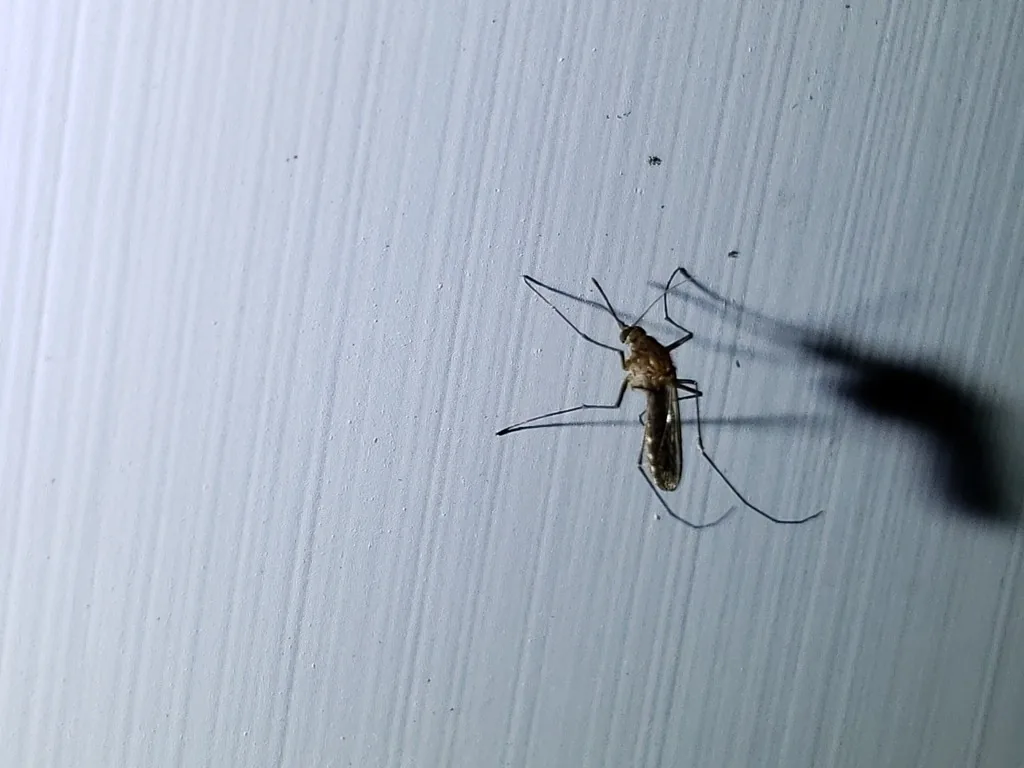
- A medium-sized, nondescript mosquito, dark brown to bronze, with no noticeable bands or patches; the abdomen lacks obvious crosswise bands. UF/IFAS adds that the top of the thorax is brown with fine dark bronze to brown scales, the legs are dark with bronze to metallic blue-green scales, and narrow white bands occasionally show on some abdominal segments.[4][5]
- With no standout markings, it is hard to tell from other brown Culex mosquitoes by eye; mosquito control programs sort it to species when they test trapped mosquitoes for viruses. UF/IFAS calls identifying it to species in the field extremely difficult.[4][6][5]
Where it lives
Jacksonville's mosquito control program calls it common throughout Florida. North Florida is a transition zone: the species is widespread farther south and normally not abundant in the north, though mild winters and springs let it build up there. GBIF's 1990-2026 U.S. records (67,549) come almost entirely from Florida (66,262), with smaller numbers from Alabama (777), Texas (319) and Georgia (142). UF/IFAS says in the U.S. it lives in warm, humid coastal habitats from North Carolina to Texas and up the Mississippi River basin as far north as Kentucky, and it also occurs in the Caribbean, Mexico, Central America and northern South America. It is found in all 67 Florida counties but is most abundant from Brevard County south to Dade County, west to Collier County and north along the Gulf of Mexico to Pensacola.[4][7][8][5]
Biology and life cycle
Larvae grow in many kinds of standing water, most often ditches; Jacksonville inspectors also find them in ponds, salt marshes and catch basins. UF/IFAS calls it a floodwater Culex: females prefer freshly flooded roadside ditches and farm furrows that stay wet for 10 to 14 days. Gravid females take flight at dusk and search through the night for egg-laying sites, laying rafts of 90 to 210 eggs that hatch 24 to 36 hours later.[4][5]
Rain controls egg laying. High humidity is important for females to start and finish laying eggs, and in Indian River County heavy rains of more than 50 mm (about 2 inches) set off waves of egg laying and blood feeding.[9][3]
It is a wet-season mosquito. In Indian River County it was uncommon in the dry months of January through June, then increased in July and stayed abundant into early winter; in Duval County it was most abundant in summer and autumn.[9][7]
It can produce large populations in a short time. In north Florida an unusually mild spring in 1991 let the summer population emerge more than 8 weeks earlier than in the next two years.[10][7]
Sources differ on its feeding: Jacksonville says it prefers birds but bites mammals, including people, when numbers are high, while a peer-reviewed review calls it an opportunist that blood feeds on virtually any available vertebrate. UF/IFAS describes the females as extremely opportunistic, feeding on anything from tree frogs to people: in the dry winter and spring they feed mostly on resting birds in humid forest, and in the wet summer and autumn they move into open fields and bite horses, cows, dogs, rabbits, armadillos and people.[4][10][5]
Larvae grow in the rich organic mix of shallow flooded ditches, fastest in midsummer, when ditch water can exceed 100°F. Each of the four larval stages lasts about 24 hours in summer and 48 hours in winter, and adults emerge from the pupae 36 to 48 hours later.[5]
Adults mate near the breeding site, and females start seeking hosts at about 48 hours old, biting mainly around dawn and dusk. After a blood meal a female takes about four days to digest it and form eggs, faster in hot weather.[5]
Extended below-freezing weather kills adults and larvae, so it is most abundant in southern coastal areas with mild winters and spreads north during warm periods.[5]
Health risk
It is the major vector of St. Louis encephalitis virus in Florida. The 1990-1991 epidemic caused 226 clinical cases and 11 deaths in 28 counties, and smaller outbreaks followed in 1993 and 1997. It is also a competent vector of West Nile and eastern equine encephalitis viruses. CDC says most people infected with St. Louis encephalitis virus have no symptoms; some get fever, headache, nausea, vomiting and tiredness, a few develop encephalitis or meningitis, and there is no vaccine or specific treatment.[2][11][1][12]
Control
Prevention
Avoiding mosquito bites is the only protection, because CDC says no vaccine or medicine prevents St. Louis encephalitis. MedlinePlus advises using insect repellent and wearing protective clothing.[12][13]
When to call a professional
This mosquito is hard for homeowners to control by removing breeding sites, since it breeds in ditches and wetlands. Jacksonville Mosquito Control monitors wetlands known to produce it and treats them when they are wet and larvae are found. UF/IFAS says its many breeding sites make adult numbers hard to regulate, so it is seldom targeted and larval control is seldom attempted. It adds that there is little evidence that ultra-low-volume adulticide spraying, from the ground or the air, controls Culex nigripalpus females in Florida.[4][5]
Florida programs watch for virus with sentinel chickens and by testing trapped Culex nigripalpus. Researchers warn that chicken blood tests may underestimate West Nile virus in mosquitoes while mosquito infection rates may overestimate the risk to people.[6][11]
UF/IFAS researchers found that resting collections made with ground aspirators measure adult populations better than light traps, because they catch males as well as females in every feeding and egg-carrying condition.[5]
Why rain and drought matter
In Indian River County, virus transmission followed spring droughts and then a rising water table. During drought, mosquitoes and young and adult wild birds crowd into the same refuges, where the virus multiplies; when rain returns, infected mosquitoes and birds disperse and carry it to people.[2]
In 1990, conditions produced unusual numbers of mosquitoes and bird hosts early in the year, and transmission to sentinel chickens and people was greatest right after heavy rains synchronized egg laying and blood feeding.[11][3]
West Nile virus has caused only small, local outbreaks in Florida since it arrived in 2001. Researchers credit weather effects on this mosquito's egg laying, feeding and ability to transmit the virus, and warn a change in those conditions could still bring a large epidemic.[1]
UF/IFAS describes "egg dumping": during summer droughts, egg-carrying females build up, sometimes to 90% of the adult females. After a rain big enough to flood ditches, usually 2 or more inches in 24 hours, they lay eggs, seek hosts and blood feed in a cycle synchronized by the rain.[5]
Common questions
- Which mosquito spreads St. Louis encephalitis in Florida?
- Mainly Culex nigripalpus, the Florida SLE mosquito. Researchers call it the major vector of the virus in the state.[2][1]
- Can I recognize it by sight?
- Not easily. It is a nondescript dark brown to bronze mosquito with no obvious bands or patches.[4]
- Does it carry West Nile virus?
- It can. It is a competent vector of West Nile virus in Florida, and infected pools were found in 2005, but Florida has seen only small, local West Nile outbreaks.[1][6]
- When is it most common?
- UF/IFAS says huge numbers are often seen during the wet summer months in south Florida, because females lay their eggs in freshly flooded ditches.[5]
Sources
- Journal of Medical Entomology, via PubMed, “Day JF, Tabachnick WJ, Smartt CT (2015), Factors that influence the transmission of West Nile virus in Florida, Journal of Medical Entomology 52(5):743-754.” pubmed.ncbi.nlm.nih.gov/26336216/ (accessed 2026-11-14). Cited from the PubMed abstract.
- Emerging Infectious Diseases (CDC), via PubMed, “Shaman J, Day JF, Stieglitz M (2002), Drought-induced amplification of Saint Louis encephalitis virus, Florida, Emerging Infectious Diseases 8(6):575-580.” pubmed.ncbi.nlm.nih.gov/12023912/ (accessed 2026-11-14). Cited from the PubMed abstract (PMC2738489).
- Journal of Medical Entomology, via PubMed, “Day JF, Curtis GA (1999), Blood feeding and oviposition by Culex nigripalpus before, during, and after a widespread St. Louis encephalitis virus epidemic in Florida, Journal of Medical Entomology 36(2):176-181.” pubmed.ncbi.nlm.nih.gov/10083754/ (accessed 2026-11-14). Cited from the PubMed abstract.
- City of Jacksonville Mosquito Control (Florida), “Culex nigripalpus.” www.jacksonville.gov/Departments/Neighborhoods/Mosquito-Control/Culex-nigripalpus (accessed 2026-11-14)
- University of Florida/IFAS Extension (Featured Creatures), “The Florida SLE Mosquito, Culex (Culex) nigripalpus Theobald, EENY-010/IN136.” ask.ifas.ufl.edu/publication/IN136 (accessed 2026-11-14). Used for identification, biology, range and control only; not for disease lines.
- Journal of Medical Entomology, via PubMed, “Vitek CJ, Richards SL, Mores CN, Day JF, Lord CC (2008), Arbovirus transmission by Culex nigripalpus in Florida, 2005, Journal of Medical Entomology 45(3):483-493.” pubmed.ncbi.nlm.nih.gov/18533444/ (accessed 2026-11-14). Cited from the PubMed abstract.
- Journal of Vector Ecology, via PubMed, “Zyzak M, Loyless T, Cope S, Wooster M, Day JF (2002), Seasonal abundance of Culex nigripalpus Theobald and Culex salinarius Coquillett in north Florida, USA, Journal of Vector Ecology 27(1):155-162.” pubmed.ncbi.nlm.nih.gov/12125867/ (accessed 2026-11-14). Cited from the PubMed abstract.
- Global Biodiversity Information Facility (GBIF), “Culex nigripalpus (Florida SLE mosquito): occurrence records in the U.S., 1990-2026 (GBIF occurrence search).” api.gbif.org/v1/occurrence/search?taxonKey=1653046&country=US&hasGeospatialIssue=false&occurrenceStatus=PRESENT&year=1990%2C2026&facet=stateProvince&facetLimit=400&limit=0 (accessed 2026-11-14). State counts are records reported (iNaturalist research-grade, museum specimens, surveys), not abundance.
- Journal of Medical Entomology, via PubMed, “Day JF, Curtis GA, Edman JD (1990), Rainfall-directed oviposition behavior of Culex nigripalpus and its influence on St. Louis encephalitis virus transmission in Indian River County, Florida, Journal of Medical Entomology 27(1):43-50.” pubmed.ncbi.nlm.nih.gov/2299655/ (accessed 2026-11-14). Cited from the PubMed abstract.
- Journal of the American Mosquito Control Association, via PubMed, “Day JF (2005), Host-seeking strategies of mosquito disease vectors, Journal of the American Mosquito Control Association 21(4 Suppl):17-22.” pubmed.ncbi.nlm.nih.gov/16921679/ (accessed 2026-11-14). Cited from the PubMed abstract.
- Journal of Medical Entomology, via PubMed, “Day JF, Stark LM (2000), Frequency of Saint Louis encephalitis virus in humans from Florida, USA: 1990-1999, Journal of Medical Entomology 37(4):626-633.” pubmed.ncbi.nlm.nih.gov/10916306/ (accessed 2026-11-14). Cited from the PubMed abstract.
- Centers for Disease Control and Prevention, “About St. Louis Encephalitis Virus (June 23, 2026).” www.cdc.gov/sle/about/index.html (accessed 2026-11-14)
- MedlinePlus, U.S. National Library of Medicine, “Insect Bites and Stings (health topic).” medlineplus.gov/insectbitesandstings.html (accessed 2026-11-14)
- iNaturalist, “Culex nigripalpus taxon page (order and family).” www.inaturalist.org/taxa/294261 (accessed 2026-11-14)