On this page
How to identify it
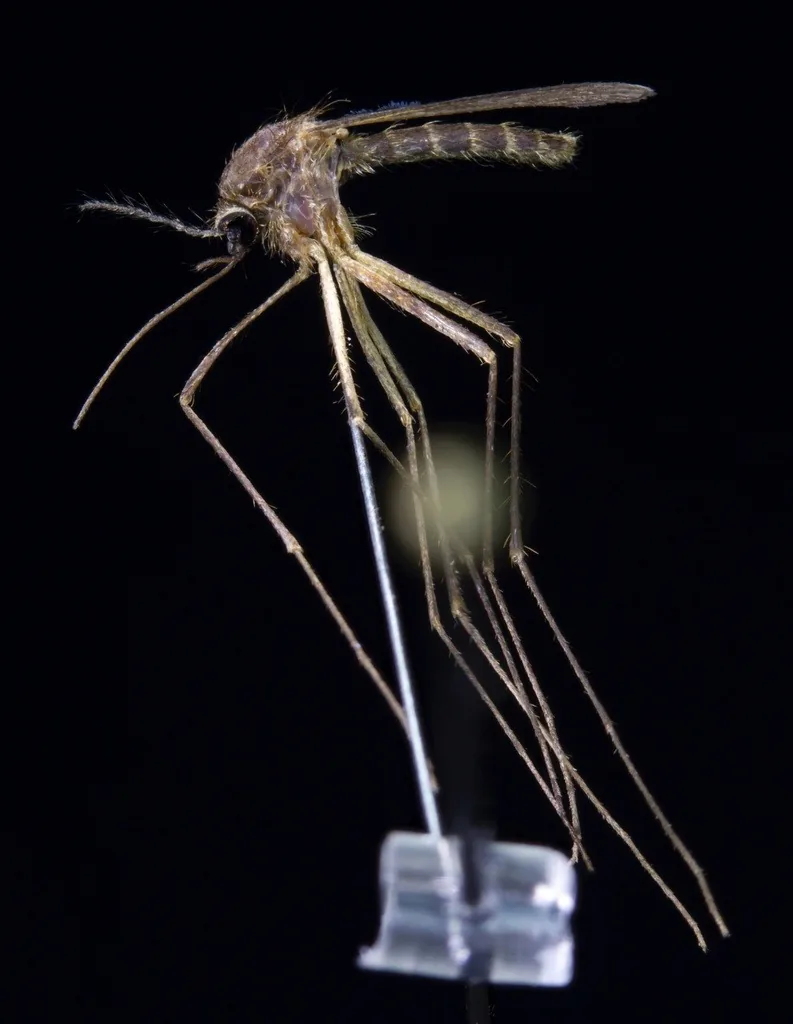
- The adult female has a long, weakly curved, dark-scaled proboscis, dark brown to golden-brown scales on the thorax, dark-scaled wings and hind feet, and an abdomen that is all dark or golden-brown with narrow pale bands on some segments. UF/IFAS explains that melanura means 'dark-colored tail', for the dark abdomen. In overall shape and color it resembles a Culex mosquito; the top of the head carries narrow yellow scales and upright dark scales, the sides of the thorax are speckled with dull-white patches, and a cluster of dark setae at the base of a vein on the underside of the wing marks the genus Culiseta.[8][16]
- Larvae have a long breathing siphon, six to seven times as long as it is wide, with a row of 8 to 14 branched hair tufts along its underside; Connecticut's identification key uses that row to separate it from other mosquito larvae.[8]
- Eggs are laid on the water in floating, bowl-shaped rafts of about 100 eggs, 2.0 to 2.5 mm (0.08 to 0.1 in) across. They look like Culex egg rafts, but the eggs are usually larger.[16]
- Larvae are usually dark, with completely dark antennae (many mosquito larvae have a white section) and a long, narrow siphon that barely tapers. A pair of hairs at the very base of the siphon is found only in Culiseta larvae.[16]
Look-alikes
| Look-alike | How to tell them apart |
|---|---|
| Other mosquitoes | Check the proboscis and hind feet: in this species both are dark-scaled, and the proboscis is long and weakly curved.[8] |
| Culex mosquitoes, such as the southern house mosquito | Similar in overall shape and dark coloring. UF/IFAS separates the dark-tailed mosquito by its unusually long, curved, dark-scaled proboscis with short dark palps; its egg rafts also resemble Culex rafts, but the eggs are usually larger.[16] |
Where it lives
EEE transmission tied to this mosquito centers on freshwater hardwood swamps in the Atlantic and Gulf Coast states and the Great Lakes region. Its swamps shift by region: red maple and Atlantic white cedar in the Northeast, bald cypress and water tupelo bottomlands in the Southeast, and sphagnum bogs around the Great Lakes. Larvae have also been collected in Nuevo Leon, Mexico. GBIF's 1990-2026 U.S. records come mostly from Florida and Virginia, then Maryland, Massachusetts, Alabama, Wisconsin and Michigan. UF/IFAS places it mainly in lowland freshwater swamps of eastern North America outside upland Appalachia, from Maine, southern Quebec and the Great Lakes south to Florida and west to eastern Texas. In Florida it is most abundant in the northern half of the state and less common in the southern peninsula; the Nuevo Leon larvae were first collected in 2001.[6][14][15][16]
Biology and life cycle
Larvae live in water-filled crypts and cavities under tree roots and sphagnum mats in acidic swamps.[8][6][12]
In Connecticut it spends the winter as 2nd, 3rd and 4th instar larvae in root crypts, where the water stayed above freezing (1.8 degrees C on average) under surface ice. They don't develop over winter and resume in mid-April as the water warms to about 9 degrees C.[12]
It has several generations a year. In Connecticut larvae are present year-round and adults from May to December. In northern Florida it was one of the most common mosquitoes collected from November to April and the likely winter carrier of EEE virus to sentinel chickens.[8][13]
In the Northeast it bites birds almost exclusively. In central New York, 94.2% of blood-fed females had fed only on birds, 0.8% only on mammals and 5.0% on both, with wood thrush the top host; in southwestern Michigan, 42% of blood meals came from American robins and northern cardinals.[8][9][10]
Farther south it is less of a bird specialist. In central Florida birds made up 30 to 85% of blood meals depending on season, reptiles (mostly brown anoles) took over in spring, and humans were the most-bitten mammal at 12.7% of meals overall, mainly in summer.[11]
UF/IFAS says it is one of only a few mosquitoes in the eastern U.S. that overwinter as larvae; most overwinter as adults or eggs. Females favor acidic water (pH 5.0 or lower) in dark crypts such as the hollows under upturned root masses in cypress, white cedar or red maple swamps, and larvae usually hatch within two days.[16]
Larvae filter-feed on algae, plankton, fungi, bacteria and other microorganisms, and development is slow, often two to three months. In very cold weather they burrow into the bottom muck and can survive several months there. In northern states they typically pupate in April and adults emerge by early May, with two major adult peaks about one month apart.[16]
Females seek hosts mainly in the first two hours after sunset but bite through the night. Besides songbirds such as the northern cardinal, American robin and wood thrush, they bite lizards in the South, mainly in warm months when lizards sleep on exposed leaves, and occasionally mammals such as white-tailed deer, raccoons, dogs, cats and people.[16]
Damage and signs
- Its importance is as a virus carrier rather than a nuisance biter. People and horses are dead-end hosts: they can get sick and die, but they don't pass the virus on to mosquitoes.[4][6]
- In late summer, when birds disperse after nesting, swamp mosquitoes may look for blood outside the swamp, raising the chance that the virus spills over to other animals and to bridge mosquitoes.[6]
Health risk
CDC says Culiseta melanura is not considered an important vector to people because it feeds almost exclusively on birds; bridge mosquitoes in the Aedes, Coquillettidia and Culex groups usually carry EEE virus to people and horses. CDC's control guidelines add that it can act as an epidemic vector too, and blood-meal studies in New York and Florida found it does sometimes feed on mammals, including people. EEE symptoms can include fever, headache, vomiting, diarrhea, seizures, behavior changes and drowsiness, many survivors have lasting neurologic problems, and there is no human vaccine or medicine to prevent it.[4][6][9][11][3][5]
Control
Prevention
Prevent bites with an EPA-registered repellent containing DEET, picaridin, IR3535, oil of lemon eucalyptus, para-menthane-diol or 2-undecanone, and wear loose long-sleeved shirts and pants, ideally permethrin-treated.[7][5][1]
Keep them out
Keep screens on windows and doors and repair any holes; use air conditioning if you have it.[7][1]
When to call a professional
Mosquito control programs use larvicides and adulticides, but its root-crypt larval sites are hard to find and labor-intensive to treat. One aerial methoprene application reached the crypts and inhibited 81% of emergence over 5 weeks, while temephos didn't reach them; and by the time aerial adulticides go out, people may already have been infected. UF/IFAS adds that the swamps where larvae develop are typically protected by environmental laws, so changing the habitat is generally not possible, and aerial adulticide sprays have given varying control, possibly because protected habitat can't be sprayed.[6][16]
Where the sources disagree
Larvicide reach: CDC's control guidelines cite an aerial methoprene application that reached the root crypts and inhibited 81% of emergence over 5 weeks; UF/IFAS cites a study in which aerial granular methoprene cut emergence from open water but did not penetrate the crypts well enough, so significantly more mosquitoes emerged from crypts than from open water.[6][16]
Mammal bites: CDC describes it as feeding almost exclusively on birds; UF/IFAS cites studies in which 5% to 25% of its blood meals came from mammals.[4][16]
Generations: UF/IFAS says there are multiple generations a year in the South, where adults are active year-round, but only two a year in the Northeast.[16]
Common questions
- Which mosquito spreads eastern equine encephalitis?
- Culiseta melanura keeps the virus going among birds in swamps; other bridge mosquitoes (Aedes, Coquillettidia and Culex species) usually carry it to people and horses.[4][6]
- Where does the dark-tailed mosquito breed?
- In water-filled hollows under tree roots and sphagnum mats in acidic freshwater swamps and bogs.[8][6]
- Does the dark-tailed mosquito bite people?
- Seldom in the Northeast, where it feeds almost only on birds. In central Florida, though, humans accounted for 12.7% of its blood meals.[8][9][11]
- When does the dark-tailed mosquito bite?
- UF/IFAS says females seek hosts mostly in the first two hours after sunset, though they also bite through the night.[16]
Sources
- University of California Statewide IPM Program, “Pest Notes: Mosquitoes, Publication 7451 (revised April 2020).” ipm.ucanr.edu/legacy_assets/PDF/PESTNOTES/pnmosquitoes.pdf (accessed 2026-11-11)
- iNaturalist, “Culiseta melanura taxon page (order and family).” www.inaturalist.org/taxa/217909 (accessed 2026-11-11)
- Centers for Disease Control and Prevention, “About Eastern Equine Encephalitis Virus.” www.cdc.gov/eastern-equine-encephalitis/about/index.html (accessed 2026-11-11)
- Centers for Disease Control and Prevention, “Eastern Equine Encephalitis: Causes and How It Spreads.” www.cdc.gov/eastern-equine-encephalitis/cause-and-spread/index.html (accessed 2026-11-11)
- Centers for Disease Control and Prevention, “Preventing Eastern Equine Encephalitis.” www.cdc.gov/eastern-equine-encephalitis/prevention/index.html (accessed 2026-11-11)
- Centers for Disease Control and Prevention, “Guidelines for Eastern Equine Encephalitis Virus Surveillance and Control.” www.cdc.gov/eastern-equine-encephalitis/php/surveillance-and-control-guidelines/index.html (accessed 2026-11-11)
- Centers for Disease Control and Prevention, “Preventing Mosquito Bites.” www.cdc.gov/mosquitoes/prevention/index.html (accessed 2026-11-11)
- Connecticut Agricultural Experiment Station, “Identification Guide to the Mosquitoes of Connecticut, Bulletin No. 966 (Andreadis, Thomas and Shepard, 2005).” portal.ct.gov/-/media/caes/documents/publications/bulletins/b966b996pdf.pdf (accessed 2026-11-11)
- American Journal of Tropical Medicine and Hygiene, via PubMed, “Molaei G, Oliver J, Andreadis TG, Armstrong PM, Howard JJ (2006), Molecular identification of blood-meal sources in Culiseta melanura and Culiseta morsitans from an endemic focus of eastern equine encephalitis virus in New York, American Journal of Tropical Medicine and Hygiene 75(6):1140-1147.” pubmed.ncbi.nlm.nih.gov/17172382/ (accessed 2026-11-11). Cited from the PubMed abstract.
- American Journal of Tropical Medicine and Hygiene, via PubMed, “Keven JB, Walker ED (2025), Blood-meal hosts of the enzootic vector of eastern equine encephalomyelitis virus, Culiseta melanura, in Michigan, United States, American Journal of Tropical Medicine and Hygiene 112(6):1325-1328.” pubmed.ncbi.nlm.nih.gov/40199279/ (accessed 2026-11-11). Cited from the PubMed abstract.
- Journal of Medical Entomology, via PubMed, “West RG, Mathias DK, Day JF, Acevedo C, Unnasch TR, Burkett-Cadena ND (2020), Seasonal changes of host use by Culiseta melanura in central Florida, Journal of Medical Entomology 57(5):1627-1634.” pubmed.ncbi.nlm.nih.gov/32280994/ (accessed 2026-11-11). Cited from the PubMed abstract.
- Journal of the American Mosquito Control Association, via PubMed, “Andreadis TG, Shepard JJ, Thomas MC (2012), Field observations on the overwintering ecology of Culiseta melanura in the northeastern USA, Journal of the American Mosquito Control Association 28(4):286-291.” pubmed.ncbi.nlm.nih.gov/23393750/ (accessed 2026-11-11). Cited from the PubMed abstract.
- Journal of Medical Entomology, via PubMed, “Burkett-Cadena ND, Bingham AM, Hunt B, Morse G, Unnasch TR (2015), Ecology of Culiseta melanura and other mosquitoes from Walton County, FL, during winter period 2013-2014, Journal of Medical Entomology 52(5):1074-1082.” pubmed.ncbi.nlm.nih.gov/26336227/ (accessed 2026-11-11). Cited from the PubMed abstract.
- Journal of the American Mosquito Control Association, via PubMed, “Ortega-Morales AI et al. (2009), First record of Culiseta melanura in Mexico, with additional Mexican records for Aedes sollicitans, Journal of the American Mosquito Control Association 25(1):100-102.” pubmed.ncbi.nlm.nih.gov/19432074/ (accessed 2026-11-11). Cited from the PubMed abstract.
- Global Biodiversity Information Facility (GBIF), “Culiseta melanura (dark-tailed mosquito): occurrence records in the U.S., 1990-2026 (GBIF occurrence search).” api.gbif.org/v1/occurrence/search?taxonKey=1649514&country=US&hasGeospatialIssue=false&occurrenceStatus=PRESENT&year=1990%2C2026&facet=stateProvince&facetLimit=400&limit=0 (accessed 2026-11-11). State counts are records reported (largely mosquito surveillance datasets, plus museum and iNaturalist records), not abundance.
- University of Florida IFAS Extension, EDIS (Featured Creatures), “Dark-Tailed Mosquito, Culiseta melanura (Coquillett), EENY-536/IN950 (Featured Creatures).” ask.ifas.ufl.edu/publication/IN950 (accessed 2026-11-14)