On this page
How to identify it
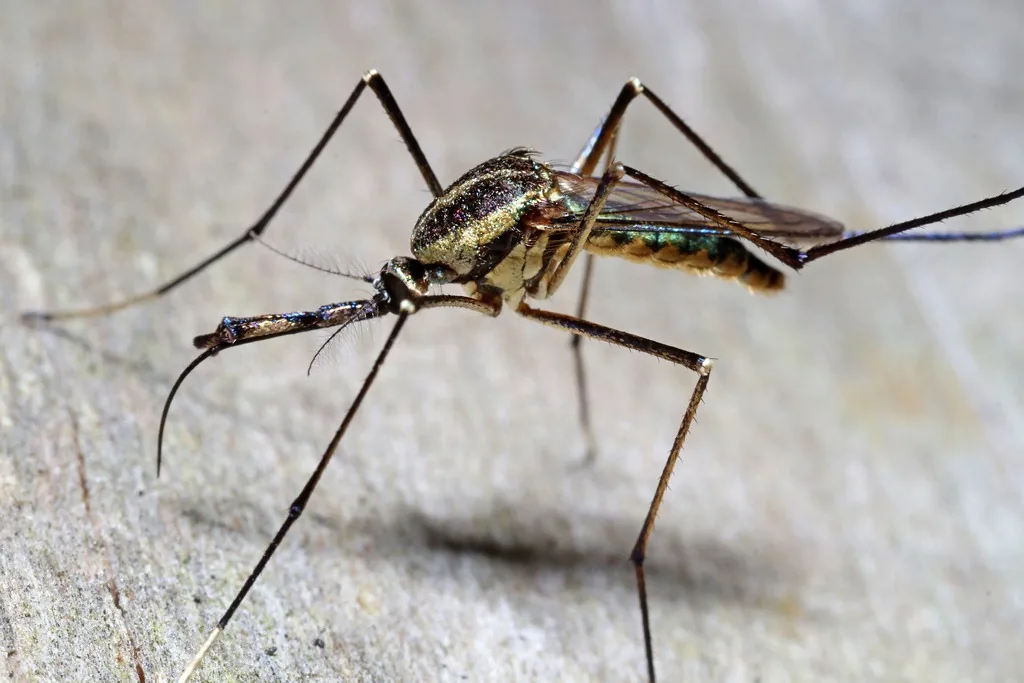
- Adults are unusually large for mosquitoes: the wingspan may exceed 12 mm and the body 7 mm.[2]
- They are often covered with iridescent scales, and the proboscis has a pronounced 90-degree downward curve. UF/IFAS lists the iridescent scales as blue, white, green and purple, and says the proboscis curves down at 90 degrees or more.[2][3]
- Larvae are dark brown or reddish with very noticeable hairs on the abdomen and a thick head with powerful jaws. Full-grown larvae can be more than 2 cm long. UF/IFAS describes them as dark red above and pale grayish white below, with a square head and a short, stout breathing siphon.[2][3]
- Males of the two subspecies differ: UF/IFAS says Toxorhynchites rutilus rutilus has a pale band on the front-leg tarsus, while T. rutilus septentrionalis has entirely dark front tarsi.[3]
- Eggs are creamy white and oval, shaped like a rugby ball, and float high on the water. The comma-shaped pupae are larger than most mosquito pupae and turn from light brown to dark brown or black before the adult emerges.[3]
Look-alikes
| Look-alike | How to tell them apart |
|---|---|
| Biting mosquitoes | Most mosquitoes are small flies about ¼ to ½ inch long with a straight, strawlike proboscis, and their females drink blood. The elephant mosquito is larger, often shiny with iridescent scales, and its proboscis bends sharply down.[4][2] |
Where it lives
Two subspecies live in the mainland U.S. The northern one reaches 40 degrees north latitude in Connecticut and southern New York, while the southern one has been reported only from Florida, Georgia and Louisiana. A 2020 habitat model puts the center of its suitable range in central Tennessee and expects that center to shift north-northeast by 2070. UF/IFAS describes a wide range in the eastern half of the United States and says septentrionalis has the wider range.[2][5][3]
Biology and life cycle
Larvae live in flooded tree holes, bromeliads and man-made containers, the same places container-breeding mosquitoes use, such as flower pots, clogged gutters, pet bowls and old tires.[2][1]
Young larvae find prey by movement. One larva may eat as many as 400 mosquito larvae while it develops, but it can also finish on water fleas or brine shrimp, and older larvae will eat motionless food, including detritus.[2][1]
Larvae are cannibals, especially in small containers, though a container with plenty of food, such as a tire, may hold half a dozen or more of similar size.[2][1]
All the protein a female needs for eggs comes from larval feeding; adults drink floral nectar. They fly clumsily and are most often seen resting near tree holes or flying in looping patterns at the mouths of containers while laying eggs.[2][1]
They have several generations a year and in the United States usually spend the winter as late-stage larvae, with day length, not temperature, setting off that rest period. UF/IFAS says short day lengths experienced by young larvae lead to the fourth-stage rest, and some south Florida populations diapause too.[2][3]
A female lays eggs one at a time onto the water while hovering, after flying a series of counterclockwise ellipses above a container, which lets her reach containers with small or blocked openings. UF/IFAS cites 1.0 to 3.2 eggs a day and 58.5 eggs over a female's life, spread across several containers.[3]
Eggs hatch in 40 to 60 hours, depending on temperature, and must stay in contact with water. The pupal stage usually lasts 3 to 7 days, though times as long as 23 days have been observed. Adults are active by day.[3]
Fourth-stage larvae show 'prepupal compulsive killing', killing prey without eating it, which UF/IFAS says likely evolved because the pupa is vulnerable to predators, including other Toxorhynchites larvae.[3]
In south Florida tree holes and tires, mosquitoes made up only 6% of prey items found in larval guts from tree holes and 5% from tires, but estimated prey choice was high for Asian tiger mosquito (Aedes albopictus) larvae. Survival from egg to adult there ranged from 1.8 to 5.6%.[3]
Health risk
Adults are incapable of taking a blood meal and feed on floral nectar, so the elephant mosquito does not bite people or animals.[1][2]
Control
Prevention
Rutgers' Center for Vector Biology suggests using these large, docile mosquitoes in public campaigns to clean up containers that breed pest mosquitoes.[2]
Biological control
Predatory Toxorhynchites mosquitoes are the arthropods most often used against container-breeding mosquitoes. Harris County, Texas, rears the northern subspecies in the lab and releases it to cut down yellow fever and Asian tiger mosquito larvae. UF/IFAS notes it was used against container mosquitoes in New Orleans until mosquito control there switched to a tropical species, Toxorhynchites amboinensis, which covered natural and artificial containers better.[2][1][3]
Pesticides
Elephant mosquitoes are highly susceptible to insecticides, so mosquito sprays and releases have to be timed with care.[2][6]
How mosquito control products affect it
A 2026 study found that a permethrin ultra-low-volume space spray killed all adult elephant mosquitoes within 1 hour, but adults survived a bifenthrin barrier treatment on foliage that killed yellow fever mosquitoes for up to 28 days.[6]
In the same study, Bti killed 50 to 92% of young elephant mosquito larvae and 4 to 66% of older ones, spinosad killed 84 to 100% of larvae in most tests, and methoprene had little effect on them.[6]
Boric acid toxic sugar baits were much less toxic to elephant mosquitoes than to yellow fever mosquitoes, and they survived longer when the bait was applied to flowering plants.[7]
Where sources disagree
How much it helps: Rutgers' Center for Vector Biology says Toxorhynchites alone is unlikely to push pest mosquitoes below operational thresholds, though it can be a valuable tool where containers and tree holes produce many of them. Marshall and Butler call it a promising biocontrol agent for North American mosquito control programs. UF/IFAS likewise says using Toxorhynchites alone to eradicate vector mosquitoes has had limited success, but combining it with other tools such as insecticides may improve results.[2][5][3]
Appetite: Rutgers' Center for Vector Biology says one larva may eat as many as 400 mosquito larvae while it develops, while UF/IFAS says a single larva may consume thousands of prey items of all kinds.[2][3]
Common questions
Sources
- Journal of Insect Science, via PubMed, “Updated Methods for the Production of Toxorhynchites rutilus septentrionalis for Use as Biocontrol Agent Against Container Breeding Pest Mosquitoes in Harris County, Texas (Schiller et al. 2019; full text via PMC).” pubmed.ncbi.nlm.nih.gov/30843583/ (accessed 2026-11-11)
- Rutgers Center for Vector Biology (New Jersey Agricultural Experiment Station), “Toxorhynchites rutilus septentrionalis (Jones and Schreiber, Wing Beats 1994).” vectorbio.rutgers.edu/outreach/species/sp2.htm (accessed 2026-11-11)
- University of Florida IFAS Extension (EDIS), “Elephant mosquito, Toxorhynchites rutilus Coquillett, EENY-787/IN1380 (A. A. Alomar and B. W. Alto; Featured Creatures).” ask.ifas.ufl.edu/publication/IN1380 (accessed 2026-11-14)
- Missouri Department of Conservation, “Mosquitoes (Field Guide).” mdc.mo.gov/discover-nature/field-guide/mosquitoes (accessed 2026-11-11)
- Journal of the American Mosquito Control Association, via PubMed, “Potential Distribution of the Biocontrol Agent Toxorhynchites rutilus By 2070 (Marshall and Butler 2020).” pubmed.ncbi.nlm.nih.gov/33600581/ (accessed 2026-11-11)
- Journal of Medical Entomology, via PubMed, “Do mosquito insecticides harm beneficial mosquitoes? Evidence from Toxorhynchites rutilus septentrionalis (Liu et al. 2026).” pubmed.ncbi.nlm.nih.gov/42750151/ (accessed 2026-11-11)
- Journal of Medical Entomology, via PubMed, “The effects of toxic sugar bait on a natural predator, Toxorhynchites rutilus rutilus (Liu et al. 2025).” pubmed.ncbi.nlm.nih.gov/40578804/ (accessed 2026-11-11)
- iNaturalist, “Toxorhynchites rutilus taxon page (order and family).” www.inaturalist.org/taxa/232765 (accessed 2026-10-06)