On this page
How to identify it
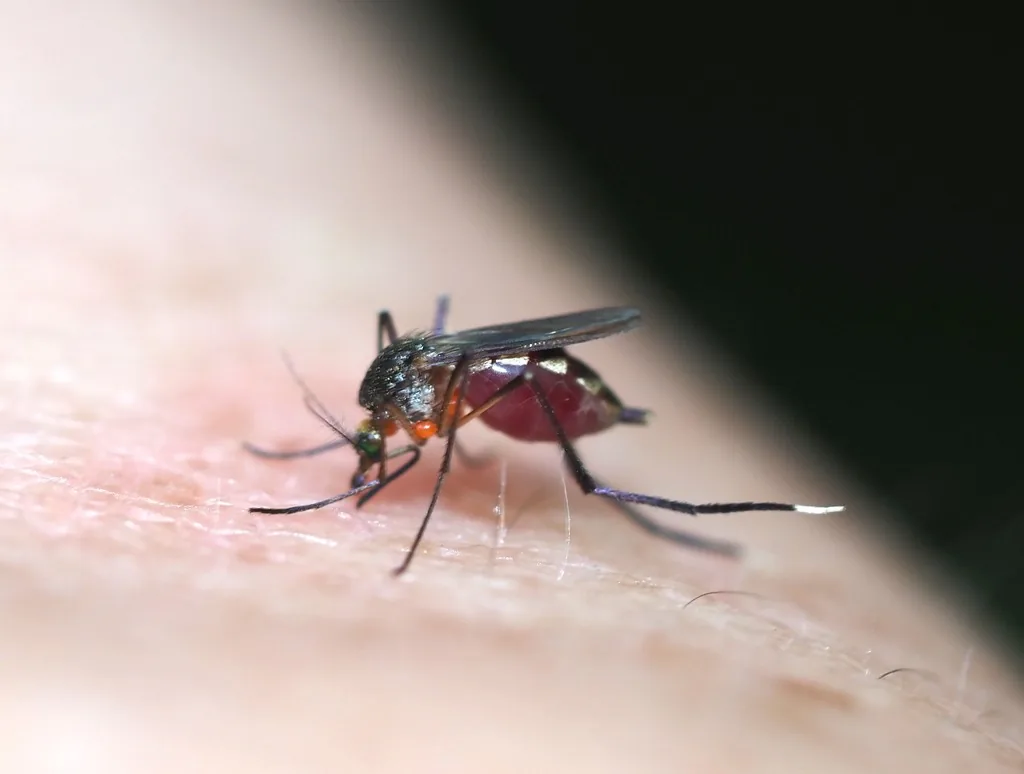
- The last two segments of each hind foot are entirely white, and the hind tibia ends in long, shaggy, iridescent purple scales. UF/IFAS says hind-foot segments 5, 4 and often 3 are white and the hind feet look shaggy, and that the common name comes from its woodland habitat and those white hind feet.[2][4]
- The back of the thorax is covered with golden-yellow and dark brown scales mixed with no set pattern, the abdomen is dark with a metallic purple sheen, and the wing scales are dark and narrow.[2]
- Like other Psorophora and Aedes, the female's abdomen tapers to a point at the tip. UF/IFAS says North American Psorophora adults are identified by a pointed abdomen and bristles both in front of and behind the spiracle.[1][4]
- Larvae from Jamaica reached almost 8 mm, and P. ferox larvae have antennae as long as or longer than the head; like all mosquitoes they pass through four larval stages. Pupae are comma-shaped and do not feed.[4]
Look-alikes
| Look-alike | How to tell them apart |
|---|---|
| Other mosquitoes | Check the hind legs: Psorophora ferox has white last foot segments and shaggy purple scales at the end of the tibia. Its close relative P. ciliata has a narrow stripe of golden scales down the thorax and hind feet that are not fully white at the tip.[2] |
Where it lives
CDC's training guide describes it as frequent in woodland areas throughout the South and East, in most states from Texas to Nebraska and eastward; Connecticut records it in all eight counties. GBIF records also come from Canada, Mexico, Central America, the Caribbean and South America as far as Argentina, and it was one of the two most abundant mosquitoes collected in a 2024 study in the Peruvian Amazon. UF/IFAS lists collections from southeastern Canada (Ontario) through the eastern U.S., Mexico, Central America and the Caribbean to South America, including Argentina, Brazil and Venezuela.[1][2][5][6][4]
Biology and life cycle
Like all Psorophora, females lay eggs on ground that floods, and the eggs wait there until rain or floodwater covers them; hatching on flooding allows several generations a year. It overwinters as eggs. UF/IFAS adds that eggs may also skip the resting stage and hatch soon after they are laid.[1][2][4]
Larvae live in temporary rain-filled pools and depressions in shaded woods and floodplains and develop rapidly. In Brunswick County, North Carolina, they turn up from March to November, with adults peaking from June through October; in Connecticut adults fly from June to October. UF/IFAS gives larval development as 5 to 7 days and the pupal stage as 1 to 2 days; in Florida, larvae live in well-shaded pools and depressions in palm and oak woodlands.[2][3][1][4]
In a laboratory study of field-caught females, ferox averaged 73 eggs per female and was smaller than its relatives P. howardii and P. ciliata. UF/IFAS cites one female laying about 80 eggs in one blood-feeding cycle.[7][4]
Females feed on mammals and bite people any time of day or night when disturbed near their woodland breeding sites, even in daylight on cloudy days. They tend to stay close to the pools where they hatched and don't readily come to light traps. UF/IFAS says females feed mostly on mammals but may feed on birds, bite at sunrise, sunset and during the day and possibly at night, and that adults are thought to live 4 to 9 days in the wild.[2][3][1][4]
In the tropics the human bot fly lays its eggs on mosquitoes such as this one, which carry them to a host; a ferox caught in Peru carried 8 bot fly eggs. UF/IFAS also reports that the bot fly frequently lays eggs on the abdomen of female P. ferox.[6][4]
After emerging, adults rest near the ground or on the water for several hours, then disperse into the forest. They swarm to mate by day in shaded, open spots in the forest when it is cloudy, in swarms 1 to 2 meters across or less, and swarming stops soon after sunset.[4]
Damage and signs
- It is a nuisance more than a property pest: Brunswick County Mosquito Control rates it highly because people living near woodland pools are bitten heavily, and it was the dominant mosquito the county collected after Hurricane Fran in 1996. UF/IFAS notes that mosquito control programs don't usually target it, since it is a woodland floodwater species most people don't often encounter.[3][4]
Health risk
Its main impact is painful bites. Field surveys have found eastern equine encephalitis virus in it in New York and Cache Valley virus in Connecticut, and dog heartworm DNA in it in Arkansas; in the Connecticut study a different mosquito, Anopheles punctipennis, was identified as the most likely Cache Valley vector.[1][8][9][10]
Control
Prevention
Use an EPA-registered insect repellent (DEET, picaridin, IR3535, oil of lemon eucalyptus, PMD or 2-undecanone) and wear loose, long-sleeved shirts and long pants. Because this mosquito bites in daytime, repellent matters in the woods during the day too, not just at dusk. UF/IFAS also suggests avoiding outdoor activity at dawn and dusk, when most biting insects are active.[11][1][2][4]
CDC also recommends clothing and gear treated with permethrin for time outdoors.[11]
Expect the worst biting near low, shaded woods that hold rainwater, especially in the weeks after heavy summer rains.[3][2]
More from Brunswick County Mosquito Control
Brunswick County Mosquito Control in North Carolina reports that its larvae turn up from March to November in rain-filled woodland pools and floodplains, with peak adult numbers from June through October. Females stay close to the pools where they hatch, tend to bite faces and elbows, and attack by day on cloudy days.[3]
What the research says about disease
New York's surveillance from 1993 to 2012 found eastern equine encephalitis virus in this species for the first time in the state; the virus was found in nine other mosquito types as well.[8]
In a laboratory study of mosquitoes from Florida, P. ferox was among the species that could transmit Rift Valley fever virus, a disease not found in North America; the authors say such species would need control if the virus were ever introduced.[12]
Where the sources disagree
White hind feet: Connecticut's bulletin says the last two segments of each hind foot are entirely white; UF/IFAS says segments 5, 4 and often 3 are white.[2][4]
Eggs per female: a laboratory study of field-caught females averaged 73 eggs, while UF/IFAS cites about 80 eggs in one blood-feeding cycle.[7][4]
Common questions
- What mosquito bites so painfully in the woods during the day?
- It may be Psorophora ferox, a persistent, painful biter that attacks readily in daytime near woodland pools.[1][2][3]
- Do white-footed woods mosquitoes spread disease?
- Viruses including eastern equine encephalitis and Cache Valley virus have been found in field-caught ferox, but finding a virus in a mosquito is not the same as being a main vector; in Connecticut a different mosquito was the likely Cache Valley vector.[8][9]
- How long do white-footed woods mosquitoes live?
- UF/IFAS says adults are thought to live 4 to 9 days in the wild; larvae develop in 5 to 7 days and pupae in 1 to 2, so new generations come quickly after rain fills woodland pools.[4]
Sources
- U.S. Public Health Service, Communicable Disease Center (now CDC), via CDC Stacks, “Mosquitoes of Public Health Importance and Their Control (Pratt, Barnes and Littig; Insect Control Series Part VI, Public Health Service Publication No. 772).” stacks.cdc.gov/view/cdc/7613/cdc_7613_DS1.pdf (accessed 2026-11-14). Historical training guide; used only for species description and biting habits.
- Connecticut Agricultural Experiment Station, “Identification Guide to the Mosquitoes of Connecticut, Bulletin No. 966 (Andreadis, Thomas and Shepard, 2005).” portal.ct.gov/-/media/caes/documents/publications/bulletins/b966b996pdf.pdf (accessed 2026-11-14)
- Brunswick County Mosquito Control (North Carolina), “Psorophora ferox Biology (Hickman and Brown).” www.brunswickcountync.gov/DocumentCenter/View/1404/Psorophora-Ferox-Biology-PDF (accessed 2026-11-14)
- University of Florida/IFAS Extension (Featured Creatures), “Psorophora ferox (Humboldt), IN1100.” ask.ifas.ufl.edu/publication/IN1100 (accessed 2026-11-14). Used for identification, range and biology; its virus, vector and bot-fly risk lines are not used (medical-source rule).
- Global Biodiversity Information Facility (GBIF), “Psorophora ferox: occurrence records, 1990-2026 (GBIF occurrence search).” api.gbif.org/v1/occurrence/search?taxonKey=1654734&hasGeospatialIssue=false&occurrenceStatus=PRESENT&year=1990%2C2026&facet=country&facetLimit=400&limit=0 (accessed 2026-11-14). Counts by country are records reported (iNaturalist research-grade, museum specimens, surveys), not abundance.
- BMC Research Notes, via PubMed, “Requena-Zuniga E et al. (2024), First record of Psorophora ferox (Diptera: Culicidae) infested with eggs of Dermatobia hominis (Diptera: Cuterebridae), in Ucayali: Peru, BMC Research Notes 17(1):98.” pubmed.ncbi.nlm.nih.gov/38561830/ (accessed 2026-11-14). Cited from the PubMed abstract.
- Journal of Medical Entomology, via PubMed, “Zhu L, Fulcher A, Hossain T, Davidson C, Beier JC, Xue RD (2014), Body size, blood feeding activity, and fecundity of Psorophora howardii, Psorophora ciliata, and Psorophora ferox (Diptera: Culicidae), Journal of Medical Entomology 51(2):382-386.” pubmed.ncbi.nlm.nih.gov/24724287/ (accessed 2026-11-14). Cited from the PubMed abstract.
- Parasites & Vectors, via PubMed, “Oliver J et al. (2018), Twenty years of surveillance for Eastern equine encephalitis virus in mosquitoes in New York State from 1993 to 2012, Parasites & Vectors 11(1):362.” pubmed.ncbi.nlm.nih.gov/29941031/ (accessed 2026-11-14). Cited from the PubMed abstract.
- Vector-Borne and Zoonotic Diseases, via PubMed, “Andreadis TG, Armstrong PM, Anderson JF, Main AJ (2014), Spatial-temporal analysis of Cache Valley virus infection in anopheline and culicine mosquitoes in the northeastern United States, 1997-2012, Vector-Borne and Zoonotic Diseases 14(10):763-773.” pubmed.ncbi.nlm.nih.gov/25325321/ (accessed 2026-11-14). Cited from the PubMed abstract.
- Journal of Medical Entomology, via PubMed, “McKay T, Bianco T, Rhodes L, Barnett S (2013), Prevalence of Dirofilaria immitis (Nematoda: Filarioidea) in mosquitoes from northeast Arkansas, the United States, Journal of Medical Entomology 50(4):871-878.” pubmed.ncbi.nlm.nih.gov/23926787/ (accessed 2026-11-14). Cited from the PubMed abstract.
- U.S. Centers for Disease Control and Prevention, “Preventing Mosquito Bites.” www.cdc.gov/mosquitoes/prevention/index.html (accessed 2026-11-14)
- Journal of Medical Entomology, via PubMed, “Turell MJ et al. (2013), Potential for mosquitoes (Diptera: Culicidae) from Florida to transmit Rift Valley fever virus, Journal of Medical Entomology 50(5):1111-1117.” pubmed.ncbi.nlm.nih.gov/24180117/ (accessed 2026-11-14). Cited from the PubMed abstract.
- iNaturalist, “Psorophora ferox taxon page (order and family).” www.inaturalist.org/taxa/132756 (accessed 2026-11-14)