On this page
How to identify it
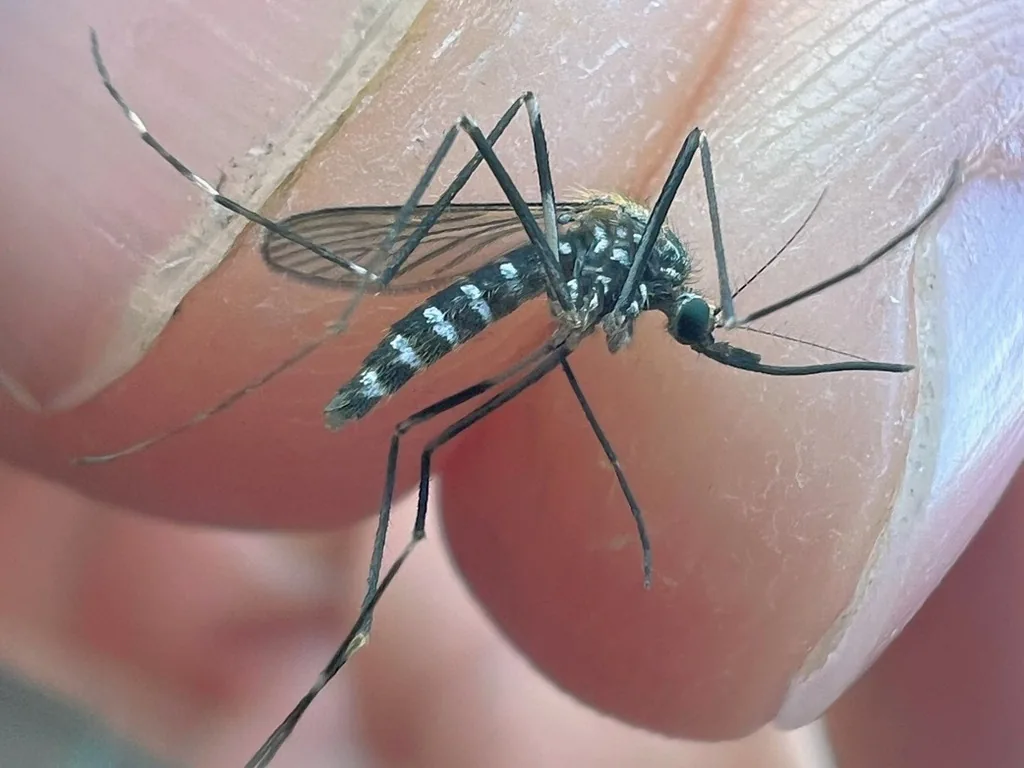
- The adult has a distinctive bronze-colored, lyre-shaped pattern of scales on top of the thorax, which sets it apart from similar mosquitoes in North America. UF/IFAS describes a medium-sized mosquito with golden stripes forming a lyre-like pattern on top of the thorax, black and white scales on the sides of the thorax, and black-and-white banded legs.[1][3]
- Under magnification the larvae can be identified too: they have a row of branched hairs across the front of the head and a strongly spiny saddle plate near the tail end. UF/IFAS adds that the comb of teeth on the larva's breathing tube runs almost its whole length, with larger, more widely spaced teeth toward the tip.[1][3]
- Males have feathery antennae; females are typically larger and lack them, UF/IFAS says.[3]
Look-alikes
| Look-alike | How to tell them apart |
|---|---|
| Asian tiger mosquito | Another invasive container mosquito from Asia, brought to the US in used tires and spread through the South in the late 1980s. Kaufman and Fonseca note that in Europe the Asian bush mosquito can be confused with it and other invasive Aedes; check the thorax for the bronze lyre pattern. UF/IFAS says the Asian tiger mosquito has a single silver line down the middle of the thorax instead of a golden lyre.[4][1][3] |
| Yellow fever mosquito | It has a silver, not golden, lyre-shaped pattern on top of the thorax, UF/IFAS says.[3] |
Where it lives
Native from northeastern Russia to southern China and Taiwan, including Japan and Korea. A 2014 review found it in every US state east of the Mississippi River except Florida and Louisiana, plus Iowa, Missouri, Minnesota, Arkansas, Washington, Oregon and Hawaii, and in Quebec and Ontario; it has also spread into Central Europe. Ohio records go back to 1999. UF/IFAS lists it in all states east of the Mississippi River plus Iowa, Missouri, Minnesota, Arkansas, Oklahoma, Oregon, Washington and Hawaii, and Purdue Extension says it is established in parts of Indiana.[1][2][3][5]
Biology and life cycle
Larvae live in rock pools, tree holes, bamboo stumps and all kinds of containers, especially stone or concrete ones. Researchers have also found them in tires, cans, wooden barrels, porcelain bathtubs and large plastic buckets, and in New Jersey they favored black or gray containers. Purdue Extension notes larvae in discarded tires too. UF/IFAS adds rainwater collection basins, flowerpots and debris.[1][2][5][3]
It spends the winter mostly as eggs and sometimes as larvae in milder climates. Larvae turn up earlier in the year than other container species, and in some early-spring habitats it was the only mosquito found. UF/IFAS says females lay small (about 0.5 mm), matte black, cigar-shaped eggs above the waterline, and the eggs withstand drying and sub-zero temperatures. In the northeastern U.S. larvae develop from March to November and adults are active from May to November; larvae can survive winter where there are no sustained freezes.[1][3]
Heat limits it: in the south, temperatures regularly above 30-35°C (86-95°F) keep it to higher elevations and shady sites. UF/IFAS adds that in the lab, temperatures above 30°C held back egg development and emergence.[1][3]
Females feed mainly on mammals, often deer, and also on birds; up to 63% of blood meals in some studies came from people.[1]
The used-tire trade is the likely route into new countries, and lawn ornaments, plant pots and stone basins could carry eggs and larvae too. UF/IFAS notes that larvae were found in tire shipments from Japan arriving in New Zealand, confirming that pathway there.[1][2][3]
Adults are not easily caught in standard light traps, so surveys may undercount them; in Wooster, Ohio, it was the most abundant mosquito caught in gravid traps in 2021.[1][2]
Pupae don't feed but swim actively to avoid predators and take about two days to develop, longer when it is cool. Adults of both sexes feed on sugars and plant nectar; only females take blood, to develop their eggs.[3]
Damage and signs
- It bites people around homes and can dominate the mosquitoes breeding in tires and rock pools, in some places replacing the native rock pool mosquito. UF/IFAS says it is not particularly aggressive, but its willingness to bite people and its success breeding around homes make it a potential nuisance.[1][6][3]
Health risk
It is not considered a major disease carrier in North America, but field-caught Asian bush mosquitoes in the US have tested positive for West Nile and La Crosse viruses, and in lab studies it transmitted several other encephalitis viruses. A New York study found West Nile virus in field-collected Asian bush mosquitoes and called the species a possible public health concern.[1][6][2]
Control
Prevention
Wear loose long sleeves and pants and use an EPA-registered repellent with DEET, picaridin, IR3535, oil of lemon eucalyptus, PMD or 2-undecanone; don't use OLE or PMD on children under 3. UF/IFAS also suggests limiting time outdoors when mosquitoes are most active.[8][3]
To check whether it breeds nearby, UF/IFAS says sampling larvae is likely to work better than adult traps, which tend to undercount this species; dark-colored five-gallon buckets holding a leaf infusion have been used.[3]
Keep them out
Cover rain barrels and other water storage containers tightly, or use wire mesh with holes smaller than a mosquito, and keep window and door screens repaired.[7][8]
Sanitation
Once a week, empty and scrub, turn over, cover or throw out anything that holds water, such as tires, buckets, planters, birdbaths and trash containers; fill tree holes.[7]
Pesticides
Larvicides can treat water that won't be used for drinking and can't be covered or dumped out. Follow the label. UF/IFAS cites a study in which adding targeted larvicide treatments to container removal reduced Asian bush mosquito numbers.[7][3]
Where sources disagree
How much it bites people: Kaufman and Fonseca say it can be a nuisance biter but is not noted as an aggressive human biter, yet blood-meal studies found up to 63% human blood; a New York study calls it a potential human biter.[1][6]
Florida: the 2014 review lists it in every state east of the Mississippi except Florida and Louisiana, while a 2023 Ohio study lists Florida among the states where it has been reported. GBIF holds no Florida records.[1][2][9]
Florida (continued): UF/IFAS says it was first documented in Florida in Okaloosa County in 2012 and has since been recorded in Bay, Leon, Santa Rosa and Walton counties in the Panhandle.[3]
First U.S. find: the 2023 Ohio study says it was first detected in New York in 1998; UF/IFAS says it was first documented in Connecticut that year and shortly afterward in New York and New Jersey.[2][3]
Biting: Purdue Extension calls females aggressive biters of humans, while UF/IFAS says it is not particularly aggressive.[5][3]
Common questions
- How do I tell an Asian bush mosquito from an Asian tiger mosquito?
- Look at the top of the thorax for the Asian bush mosquito's bronze, lyre-shaped pattern of scales.[1]
- Why do I see these mosquitoes so early in spring?
- It is cold tolerant: eggs survive winter, larvae hatch earlier than other container species, and adults stay active later into fall.[1]
- Does it carry West Nile virus?
- Field-caught Asian bush mosquitoes have tested positive for West Nile virus in the US, though its role as a disease carrier is still unclear.[1][6]
- Is the Asian bush mosquito found in Florida?
- Yes, in the Panhandle. UF/IFAS says it was first documented in Okaloosa County in 2012 and has since been recorded in Bay, Leon, Santa Rosa and Walton counties.[3]
Sources
- Annual Review of Entomology, via PubMed, “Invasion biology of Aedes japonicus japonicus (Kaufman & Fonseca 2014; full text via PMC4106299).” pubmed.ncbi.nlm.nih.gov/24397520/ (accessed 2026-11-14)
- Insects, via PubMed, “Invasive Aedes japonicus mosquitoes dominate the Aedes fauna collected with gravid traps in Wooster, northeastern Ohio, USA (Nanfack-Minkeu et al. 2023; full text via PMC9861081).” pubmed.ncbi.nlm.nih.gov/36661984/ (accessed 2026-11-14)
- University of Florida/IFAS Extension (Featured Creatures), “Asian Bush Mosquito, Asian Rock Pool Mosquito, Aedes japonicus japonicus (Theobald, 1901), EENY-761/IN1307.” ask.ifas.ufl.edu/publication/IN1307 (accessed 2026-11-14). Used for identification, biology, range and management only; not for disease lines.
- Clemson Cooperative Extension Home & Garden Information Center, “Asian Tiger Mosquito (HGIC 2471).” hgic.clemson.edu/factsheet/asian-tiger-mosquito/ (accessed 2026-11-14)
- Purdue University Extension Entomology (Public Health and Medical Entomology), “Mosquitoes.” extension.entm.purdue.edu/publichealth/insects/mosquito.html (accessed 2026-11-14). Not used for disease lines.
- Journal of the American Mosquito Control Association, via PubMed, “Aedes japonicus and West Nile virus in New York (DeCarlo et al. 2020).” pubmed.ncbi.nlm.nih.gov/33647113/ (accessed 2026-11-14)
- U.S. Centers for Disease Control and Prevention, “Mosquito Control at Home (reviewed April 16, 2024).” www.cdc.gov/mosquitoes/mosquito-control/mosquito-control-at-home.html (accessed 2026-11-14)
- U.S. Centers for Disease Control and Prevention, “Preventing Mosquito Bites.” www.cdc.gov/mosquitoes/prevention/index.html (accessed 2026-11-14)
- Global Biodiversity Information Facility (GBIF), “Aedes japonicus: US occurrence records since 1990 by state (GBIF occurrence search API).” api.gbif.org/v1/occurrence/search?taxonKey=1652212&country=US&hasGeospatialIssue=false&occurrenceStatus=PRESENT&year=1990%2C2026&facet=stateProvince&facetLimit=400&limit=0 (accessed 2026-11-14)
- iNaturalist, “Aedes japonicus taxon page (order and family).” www.inaturalist.org/taxa/1112094 (accessed 2026-11-14)