On this page
How to identify it
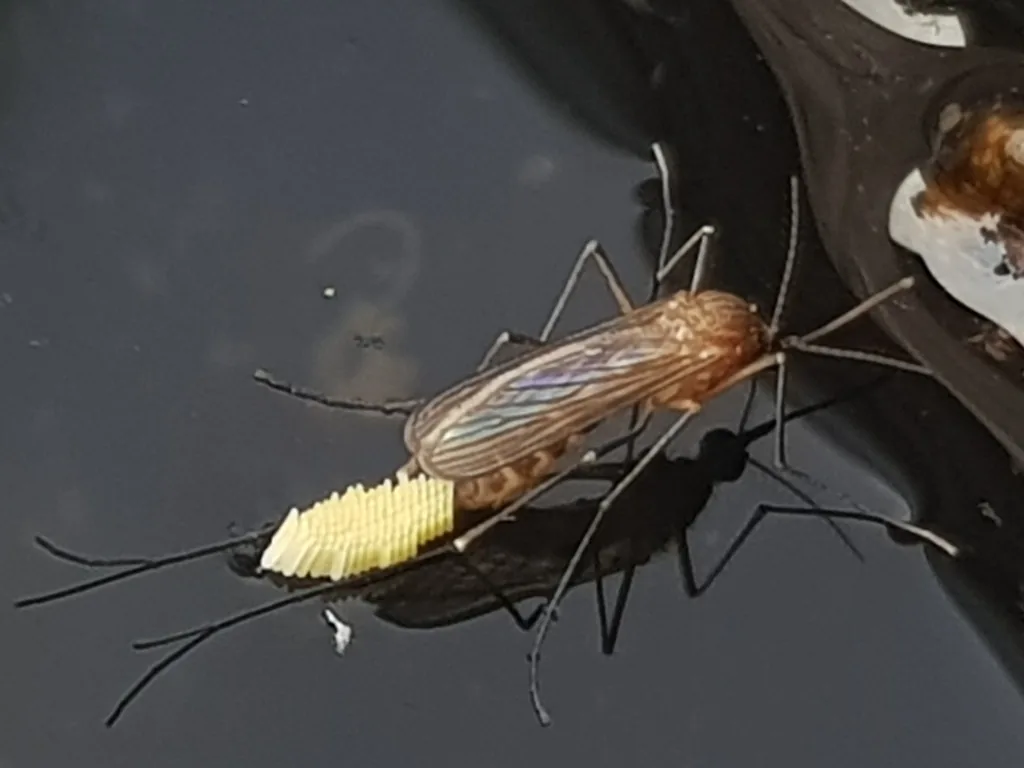
- A medium-sized, nondescript mosquito: Jacksonville describes it as dark brown to bronze with pale bands across the abdomen, and Texas A&M as delicate and dull brown with light, M-shaped bands at the base of the abdominal segments.[3][1]
- The legs and proboscis have no pale bands. Hawaii's fact sheet adds that the tip of the abdomen is blunt and gives the adult length as less than 3/16 inch.[1][4]
- Eggs float in rafts on the water. CDC says a Culex raft holds 100 to 300 eggs, Mississippi State gives 50 to 400 for Culex, and Hawaii says up to 400. UF says each raft holds 100 or more eggs.[2][5][4][6]
- Larvae have long breathing tubes and move with a whip-like motion when disturbed. UF says the breathing tube (siphon) is four times longer than wide, with several tufts of hairs.[4][6]
- The University of Florida gives the adult length as 3.96 to 4.25 mm. It is brown, with the proboscis, thorax, wings and legs darker, and the pale bands at the base of each abdominal segment take a half-moon shape.[6]
Look-alikes
| Look-alike | How to tell them apart |
|---|---|
| Northern house mosquito | Its close relative in the Culex pipiens complex, and the two interbreed. A 2025 survey of 26 U.S. sites found hybrids beyond the previously mapped hybrid zone, southern house mosquito genes moving north, and a pattern that varied by region. Telling the species apart in the field is hard; Mississippi State says separating adult Culex species with field guides is difficult, and specimens may need to go to the proper authorities for identification.[7][5] |
Where it lives
In North America it occupies the southern regions while the northern house mosquito lives at higher latitudes; a 2025 study describes the zone where the two meet and hybridize at roughly 33 to 36 degrees north and found hybrids north of the southern house mosquito's expected range. It lacks diapause (a dormant winter stage) and is limited to subtropical and tropical climates. Jacksonville's mosquito control calls it common throughout Florida, and it is found on all the major Hawaiian Islands. The University of Florida says it is usually found between 36 degrees north and 36 degrees south. In the US it ranges from Virginia across the southern plains to southern California and from southern Iowa south to Texas and Florida, it has been collected in Hawaii, and it is found in all 67 Florida counties.[7][3][4][6]
Biology and life cycle
It breeds in a wide range of places but favors dirty, polluted water: Jacksonville's inspectors find larvae in cow ponds, ditches, septic tanks and catch basins, and Texas A&M says it also breeds in containers.[3][1]
Mississippi State says Culex eggs hatch in 24 to 48 hours, larvae pass through four stages in 5 to 7 days, and the pupal stage lasts 1 to 2 days, so egg to adult can take 8 to 10 days in warm weather. Hawaii gives 1 to 2 days to hatch and 8 to 10 days for the larval and pupal stages together.[5][4]
Adults may live 3 to 6 weeks or more (Mississippi State) or two weeks to two months (Hawaii).[5][4]
Texas A&M says it rarely flies more than a mile from where it bred; CDC says Culex mosquitoes in general have been known to fly up to 2 miles.[1][2]
Indoors, Jacksonville says these mosquitoes rest in moist spots such as bathrooms. Outdoors, CDC says Culex adults rest in grass, shrubs and other thick, cool vegetation.[3][2]
Egg-laying females fly at night to nutrient-rich standing water, from waste water to bird baths, old tires and almost any container. UF says the larvae need five to eight days to develop at 30 °C, and adults emerge after about 36 hours as pupae at 27 °C.[6]
Both sexes feed on plant sugar; males live on sugar alone, while females take multiple blood meals, and UF says a single female can lay up to five rafts.[6]
Damage and signs
- Females bite from dusk to dawn. Jacksonville says it prefers birds but bites mammals, including people, when numbers are high, and Texas A&M says it often comes indoors to bite people as they sleep. UF describes it as an opportunistic night-time feeder that takes blood from mammals and birds.[2][3][1][6]
Health risk
CDC lists the southern house mosquito among the Culex species that spread West Nile, St. Louis encephalitis and eastern equine encephalitis viruses in U.S. states, and a 2025 study calls the species and its hybrids important vectors of West Nile virus that feed readily on both birds and mammals. CDC says most St. Louis encephalitis cases occur in Eastern and Central states, with sporadic cases and outbreaks in the Southwest.[2][7][8]
Control
Prevention
Limit time outdoors in the late afternoon, at night and just after sunrise when these mosquitoes feed, and wear long sleeves, long pants and an approved repellent such as DEET. UF recommends long sleeves and insect repellent for outdoor activity at night, and says spending less time outside also lowers the risk of bites.[5][2][6]
Keep them out
If you have a septic tank, keep the lid closed and uncracked and cover open vent pipes with fine mesh. Keep window screens free of holes.[3][9][5]
Sanitation
Drain or change water in birdbaths, wading pools, pet dishes and other containers every 4 to 5 days (Mississippi State) or at least once a week (CDC), and get rid of used tires. UF adds: don't overwater plants, cover or turn over containers that can't be removed, keep ornamental ponds stocked with mosquito fish, and keep drainage ditches clear of debris.[5][9][6]
Biological control
For ponds, unmaintained pools and other water you can't drain, use mosquito dunks or another Bti larvicide, following the label.[2][4]
When to call a professional
Local mosquito control programs track Culex numbers and virus activity and may treat larvae or adults when risk is high; contact your district or program before using adulticides on your property. UF notes that larvicides placed where larvae concentrate kill the most immature mosquitoes with the least insecticide, that resistance can reduce how well insecticides work, and that some products require a licensed applicator, so check with your local Extension office or mosquito control district first.[2][3][6]
More from Jacksonville Mosquito Control
Jacksonville's program says the southern house mosquito is hard for homeowners to control by removing water alone, so it monitors and treats wetlands known to breed it. Septic tank lids and window screens are the two things it asks homeowners to check.[3]
Where the sources disagree
Hybrid zone: the University of Florida describes a broad hybrid zone with the northern house mosquito between 36 and 39 degrees north; a 2025 study puts the zone at roughly 33 to 36 degrees north and found hybrids beyond it.[6][7]
Egg hatch: UF says rafts normally hatch 24 to 30 hours after they are laid; Mississippi State says Culex eggs hatch in 24 to 48 hours.[6][5]
Common questions
- When does the southern house mosquito bite?
- From evening through early morning. Texas A&M says it is active in the evening, at night and in the early morning, and CDC says Culex adults are most active from dusk to dawn.[1][2]
- Where does it breed around a home?
- In dirty or standing water: septic tanks, ditches and catch basins, plus birdbaths, pet dishes, wading pools, old tires and other containers.[3][1][5]
- Does the southern house mosquito spread West Nile virus?
- Yes. CDC lists it among the Culex mosquitoes that spread West Nile virus in U.S. states, and Texas A&M calls it one of the most important carriers.[2][1]
- Is the southern house mosquito found all over Florida?
- Yes. The University of Florida says it is found in all 67 Florida counties, and Jacksonville's mosquito control calls it common throughout the state.[6][3]
Sources
- Texas A&M AgriLife Extension, “Culex quinquefasciatus (Mosquito Safari).” mosquitosafari.tamu.edu/types/culex-quinquefasciatus/ (accessed 2026-11-14)
- Centers for Disease Control and Prevention, “About Culex Mosquitoes.” www.cdc.gov/mosquitoes/about/life-cycle-of-culex-mosquitoes.html (accessed 2026-11-14)
- City of Jacksonville Mosquito Control (Florida), “Southern House Mosquito (Culex pipiens quinquefasciatus).” www.jacksonville.gov/Departments/Neighborhoods/Mosquito-Control/Culex-pipiens-quinquefasciatus (accessed 2026-11-14)
- University of Hawaii CTAHR, with the Hawaii Department of Health, “Southern House Mosquito (LM-10.2).” www.ctahr.hawaii.edu/oc/freepubs/pdf/LM-10-2.pdf (accessed 2026-11-14)
- Mississippi State University Extension Service, “The Southern House Mosquito and Related Species: Biology and Control.” extension.msstate.edu/publications/the-southern-house-mosquito-and-related-species-biology-and-control (accessed 2026-11-14)
- University of Florida/IFAS Extension (Featured Creatures), “Southern House Mosquito, Culex quinquefasciatus Say, EENY-457/IN837 (S. Hill and C. R. Connelly).” ask.ifas.ufl.edu/publication/IN837 (accessed 2026-11-14)
- One Health, via PubMed, “Saarman et al. (2025), Range expansion of Culex quinquefasciatus and Culex pipiens hybrids across mid-latitudes of North America, One Health 21:101205.” pubmed.ncbi.nlm.nih.gov/41036083/ (accessed 2026-11-14). Range line cited from the PMC full text (PMC12482292).
- Centers for Disease Control and Prevention, “About St. Louis Encephalitis Virus.” www.cdc.gov/sle/about/index.html (accessed 2026-11-14)
- Centers for Disease Control and Prevention, “Mosquito Control at Home.” www.cdc.gov/mosquitoes/mosquito-control/mosquito-control-at-home.html (accessed 2026-11-14)
- iNaturalist, “Culex quinquefasciatus taxon page (order and family).” www.inaturalist.org/taxa/155309 (accessed 2026-11-14)