On this page
How to identify it
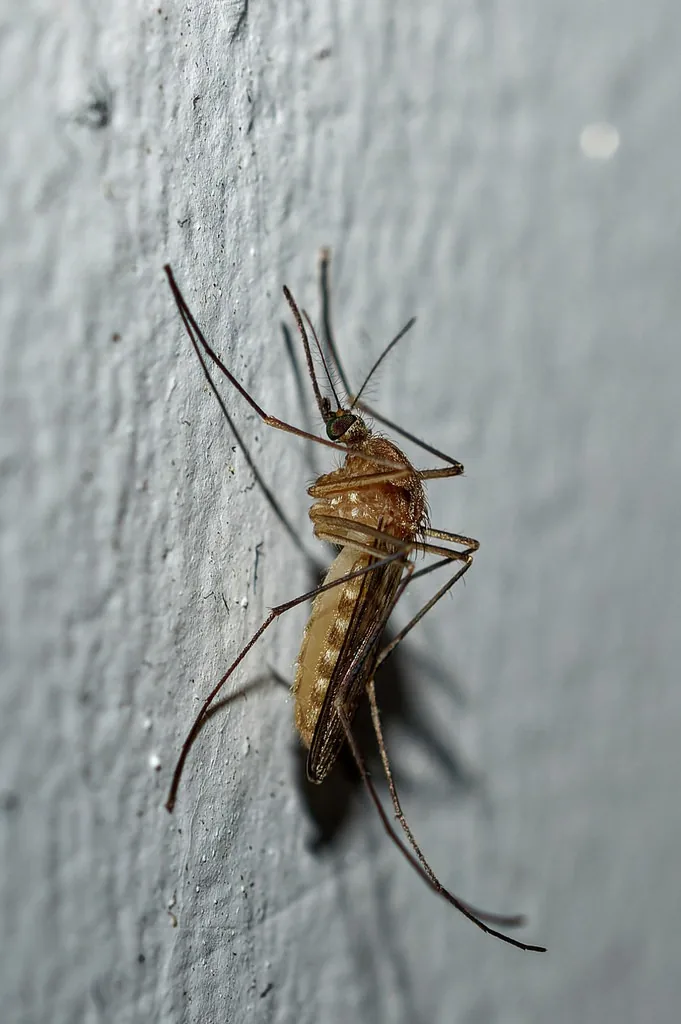
- A medium-sized brown mosquito covered in golden-brown scales, with no bold markings; the legs are entirely dark. UF/IFAS describes a small to medium, light brown mosquito with scattered patches of pale scales and a dark proboscis about as long as the antennae; the top of the thorax is brown with narrow golden-brown scales, and the wings are 3.5 to 4.0 mm long with narrow dark scales.[3][5][6]
- Each abdominal segment has a dingy white band across its base that narrows at the sides into pale side patches. UF/IFAS says the pale bands are constricted at two points and that the tip of the abdomen is obviously rounded when seen from above.[5][3][6]
- Eggs are laid together as a floating raft on the surface of standing water. UF/IFAS says the oval rafts typically hold 150 to 300 eggs and float until the larvae emerge.[2][3][6]
- Adults are most active from dusk to dawn and rest in cool, dark, humid vegetation by day; they readily enter houses, where their whining is annoying.[2][5][3]
- UF/IFAS says the larvae are small and pale to brown, with a head wider than long and a long, thin breathing siphon usually four to five times longer than its width at the midpoint. Pupae are comma-shaped, don't feed, breathe at the surface through a pair of trumpets and swim with two broad paddles.[6]
Look-alikes
| Look-alike | How to tell them apart |
|---|---|
| Southern house mosquito (Culex quinquefasciatus) | A close relative that is hard to tell apart. It occurs in all the southern states and reaches north to Nebraska, Iowa, Illinois and Ohio, so one or both species probably occur in every state. In the South it is thought to be the main West Nile carrier. UF/IFAS places the northern house mosquito above 39 degrees north latitude and the southern house mosquito below 36 degrees north, with a broad zone between 32 and 40 degrees north where both species and their hybrids occur; the hybrids are viable.[3][4][6] |
| White-dotted mosquito (Culex restuans) | Usually has a pair of pale spots on the top of the thorax, and its abdominal bands run straight across rather than narrowing at the sides.[5] |
| Asian tiger mosquito | An Aedes mosquito that glues its eggs to container walls just above the waterline, while house mosquitoes lay floating egg rafts on the water.[7][2] |
| Other mosquitoes | Several Culex species in the U.S., including the southern house mosquito and Culex tarsalis, spread West Nile, St. Louis encephalitis and eastern equine encephalitis viruses.[2] |
Where it lives
Found throughout the northern United States and as far south as Georgia and Oklahoma, where the closely related southern house mosquito takes over; one or both species probably occur in every state. GBIF holds about 184,000 US records since 1990 from 12 states, most from mosquito surveillance in Illinois, Iowa, Indiana, Idaho and Utah. UF/IFAS says Culex pipiens is native to Africa but has been introduced to many regions, including South America, the Middle East, Asia and Europe, and in North America is widely distributed in urban, suburban and rural areas.[3][8][6]
Biology and life cycle
Larvae thrive in water rich in organic matter, including sewage, cesspools, open septic tanks, polluted ground pools and poorly drained street gutters. UF/IFAS adds ponds, buckets, rain barrels, cans, roadside ditches and sewage seepage.[3][5][1][6]
Around homes and cities, it breeds in tires, cans, rain barrels, clogged gutters, untended birdbaths, wading pools, storm drains and catch basins.[1][3][5]
Eggs hatch within a day or two in warm weather, and the larval and pupal stages take 8 to 10 days, longer in cool spring and fall weather; CDC gives 7 to 10 days from egg to adult. UF/IFAS says eggs hatch within 2 to 3 days, larvae pass through four stages and the pupal stage lasts 2 to 3 days.[3][2][6]
Mated females spend winter in a slowed-down state in basements, cellars, culverts and other sheltered places that stay above freezing, then bite and lay eggs in spring. UF/IFAS adds caves to the list of sheltered overwintering spots.[1][5][6]
Females feed mainly on birds but also bite mammals, including people, especially in the evening; some urban strains readily feed on humans. Culex mosquitoes don't usually fly far but have been known to fly up to 2 miles. UF/IFAS says host-feeding studies show birds are its primary blood-meal hosts.[1][5][2][6]
In Connecticut larvae are found from May to October, and adults year-round.[5]
Larvae filter organic matter, microscopic organisms and plant and animal particles from the water and move up and down the water column for food and air, UF/IFAS says.[6]
Both sexes feed on sugar from flower nectar, damaged fruit or honeydew; only females take blood, which they need as protein for developing eggs, UF/IFAS says.[6]
Damage and signs
Health risk
West Nile virus is the leading cause of mosquito-borne disease in the contiguous United States, and Culex mosquitoes are its main carriers; mosquitoes pick it up from infected birds. Most infected people have no symptoms; some get fever, headache, body aches, vomiting, diarrhea or rash, and fewer than 1 percent develop serious brain or nerve infections, a risk that is higher in people over 60 and those with weakened immune systems. Culex pipiens is also a vector of St. Louis encephalitis virus, and in Connecticut eastern equine encephalitis virus has been isolated from it.[9][10][11][12][1][5]
Control
Prevention
Use an EPA-registered repellent with DEET, picaridin, IR3535, oil of lemon eucalyptus, PMD or 2-undecanone, especially from dusk to dawn.[14][2]
Wear loose, long-sleeved shirts and pants, and consider permethrin-treated clothing and gear.[14]
Keep them out
Repair cracks in septic tanks, screen open vent and plumbing pipes, and tightly cover water storage containers.[13]
Install and repair window and door screens, and keep doors, including garage doors, closed.[13]
Sanitation
Each week, dump and scrub, tip over, cover or discard water-holding items like old tires, buckets, planters, toys and birdbaths.[13]
Pesticides
Larvicides can treat larger standing water that won't be used for drinking, such as ponds or unmaintained pools, and adulticides can treat shady resting spots; a local mosquito control program or licensed professional can apply them, and anyone applying them should follow the label. UF/IFAS says successful control takes integrated mosquito management, which targets the mosquito at several life stages with a variety of tools.[13][2][6]
Where sources disagree
Who it bites: Rutgers and the Connecticut station call it primarily a bird feeder that will also bite people, and Rutgers notes that some urban strains readily feed on humans. A 2012 review found its role in human West Nile cases varies by region: in the Northeast it mainly spreads the virus among birds and its role in human infection appears more limited, while in the north-central and Mid-Atlantic states it bites people more often and is a key carrier to humans.[1][5][4]
Egg raft size: CDC says rafts hold 100 to 300 eggs, while CDC's 1963 training guide gives clusters of 50 to 400 eggs. UF/IFAS says rafts typically contain 150 to 300 eggs.[2][3][6]
Range: CDC's 1963 training guide places it throughout the northern United States and as far south as Georgia and Oklahoma, with the southern house mosquito covering the South; GBIF's public records come from only 12 states, nearly all from surveillance in a handful of them. UF/IFAS instead places it in the northern United States and southern Canada above 39 degrees north latitude, with a hybrid zone shared with the southern house mosquito between 32 and 40 degrees north.[3][8][6]
Hatching time: CDC's 1963 training guide says eggs hatch within a day or two in warm weather, while UF/IFAS says within 2 to 3 days.[3][6]
Common questions
- Which mosquito spreads West Nile virus?
- Mainly Culex mosquitoes. The northern house mosquito is a major vector in North America, though how much it bites people varies by region; in the South the southern house mosquito plays the bigger role and in the rural West Culex tarsalis does.[10][2][4]
- Can I catch West Nile virus from another person?
- Not through coughing, sneezing or touching. In rare cases it has spread through blood transfusions, organ transplants and from mother to baby, and infected people don't carry enough virus to infect mosquitoes.[10][12]
- Where do house mosquitoes go in winter?
- Mated females shelter in basements, cellars, culverts and other protected spots that stay above freezing, then emerge in spring to feed and lay eggs.[1][5]
- Do male northern house mosquitoes bite?
- No. UF/IFAS says both males and females feed on sugar from nectar, damaged fruit or honeydew, but only females take blood meals, which they need to develop eggs.[6]
Sources
- Rutgers University, Center for Vector Biology (Mosquito Research and Control), “Culex pipiens: The Northern House Mosquito.” vectorbio.rutgers.edu/outreach/species/cxpip.htm (accessed 2026-11-11)
- U.S. Centers for Disease Control and Prevention, “Life Cycle of Culex Mosquitoes.” www.cdc.gov/mosquitoes/about/life-cycle-of-culex-mosquitoes.html (accessed 2026-11-11)
- U.S. Public Health Service, Communicable Disease Center (now CDC), via CDC Stacks, “Mosquitoes of Public Health Importance and Their Control (Training Guide, Insect Control Series; Pratt, Barnes and Littig, 1963).” stacks.cdc.gov/view/cdc/7613/cdc_7613_DS1.pdf (accessed 2026-11-11)
- Journal of the American Mosquito Control Association, via PubMed, “The contribution of Culex pipiens complex mosquitoes to transmission and persistence of West Nile virus in North America (Andreadis 2012).” pubmed.ncbi.nlm.nih.gov/23401954/ (accessed 2026-11-11)
- Connecticut Agricultural Experiment Station, “Identification Guide to the Mosquitoes of Connecticut, Bulletin No. 966 (Andreadis, Thomas and Shepard, 2005).” portal.ct.gov/-/media/caes/documents/publications/bulletins/b966b996pdf.pdf (accessed 2026-11-11)
- University of Florida IFAS Extension (EDIS), “Northern House Mosquito, Culex pipiens Linnaeus, EENY-765/IN1324 (Featured Creatures; A. A. Alomar, N. D. Burkett-Cadena and D. K. Mathias).” ask.ifas.ufl.edu/publication/IN1324 (accessed 2026-11-14)
- U.S. Centers for Disease Control and Prevention, “Life Cycle of Aedes Mosquitoes (reviewed April 16, 2024).” www.cdc.gov/mosquitoes/about/life-cycle-of-aedes-mosquitoes.html (accessed 2026-11-11)
- Global Biodiversity Information Facility (GBIF), “Culex pipiens: US occurrence records since 1990 by state (GBIF occurrence search API).” api.gbif.org/v1/occurrence/search?taxonKey=1652991&country=US&hasGeospatialIssue=false&occurrenceStatus=PRESENT&year=1990%2C2026&facet=stateProvince&facetLimit=400&limit=0 (accessed 2026-11-11)
- U.S. Centers for Disease Control and Prevention, “About West Nile.” www.cdc.gov/west-nile-virus/about/index.html (accessed 2026-11-11)
- U.S. Centers for Disease Control and Prevention, “West Nile: Causes and How It Spreads (reviewed July 15, 2026).” www.cdc.gov/west-nile-virus/causes/index.html (accessed 2026-11-11)
- U.S. Centers for Disease Control and Prevention, “Clinical Signs and Symptoms of West Nile Virus Disease.” www.cdc.gov/west-nile-virus/hcp/clinical-signs/index.html (accessed 2026-11-11)
- MedlinePlus, U.S. National Library of Medicine, “West Nile Virus (Health Topic).” medlineplus.gov/westnilevirus.html (accessed 2026-11-11)
- U.S. Centers for Disease Control and Prevention, “Mosquito Control at Home (reviewed April 16, 2024).” www.cdc.gov/mosquitoes/mosquito-control/mosquito-control-at-home.html (accessed 2026-11-11)
- U.S. Centers for Disease Control and Prevention, “Preventing Mosquito Bites (reviewed August 28, 2024).” www.cdc.gov/mosquitoes/prevention/index.html (accessed 2026-11-11)
- iNaturalist, “Culex pipiens taxon page (order and family).” www.inaturalist.org/taxa/1096295 (accessed 2026-11-11)