On this page
How to identify it
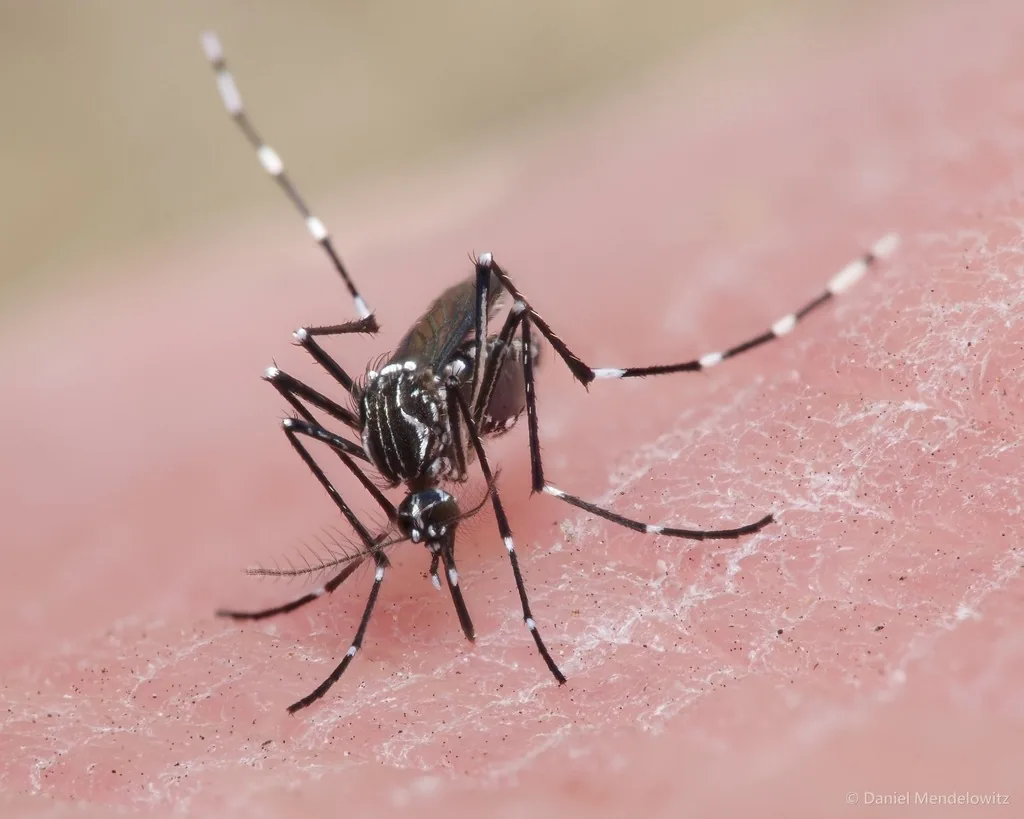
- A medium-sized, blackish mosquito. The best field mark is a silvery-white, lyre-shaped pattern of scales on top of the thorax. UF/IFAS gives it as small to medium-sized, about 1/4 inch long, with a dark brown to black abdomen that may also carry white scales; as in all Aedes, the abdomen ends in a point.[3][17]
- The hind legs look striped: the first four segments of each hind foot have broad white rings at the base, and the last segment is all white.[3]
- Males and females are colored alike. Only the females bite. UF/IFAS says females are larger than males and have small palps tipped with silver or white scales, while males have feathery (plumose) antennae; adults of both sexes feed on plant nectar.[3][1][17]
- Adults often rest indoors in dim places. Rutgers' profile names closets, cabinets and cupboards, and the CDC lists under sinks, in showers, in closets, under furniture and in laundry rooms.[3][4]
- When it bites: the CDC says these Aedes mosquitoes bite during the day and at night. Rutgers' profile describes the yellow fever mosquito as an early-morning and late-afternoon feeder that will also bite at night under artificial light, with the ankles a favorite target. UF/IFAS says that while many mosquitoes bite at night, dawn or dusk, this one readily bites during the day and indoors as well as outdoors.[5][3][17]
Look-alikes
| Look-alike | How to tell them apart |
|---|---|
| Asian tiger mosquito | Also black with silvery-white bands, but its best mark is a single stripe of silver scales running down the top of the head and thorax instead of a lyre shape. The CDC says it lives outdoors, tolerates cooler temperatures and feeds on animals as well as people. UF/IFAS says that to the unaided eye the two differ only slightly in size and in the thorax pattern, and Oklahoma State says the pattern on the thorax needs careful attention because the two are easily confused.[6][1][2][17][18] |
| Other container mosquitoes | Its larvae often share containers with other species, including the Asian tiger mosquito, the eastern treehole mosquito and the southern house mosquito, so check the adults for the lyre-shaped mark.[3] |
Where it lives
The CDC describes it as a mosquito of tropical, subtropical and some temperate climates. In the United States it declined after the Asian tiger mosquito arrived in the 1980s but persists in some urban areas, particularly in south Florida. A CDC-led county survey found reports from 183 counties between 1995 and early 2016, and a follow-up at the end of 2016 added 38 more counties. Breeding populations were first reported in California in 2013 and have since spread across Southern California, the Central Valley and into the San Francisco Bay Area. CDC's map shows where it could potentially live; actual populations vary by state and county. UF/IFAS says it originated in Africa and probably reached the New World on ships; a 2005 count placed it in 23 states, from the Southeast up the East Coast to New York and west to Indiana and Kentucky, and it remains common in urban southern Florida and in Gulf Coast cities of Texas and Louisiana. A mid-1900s eradication program cleared much of its range in the Americas, but it re-established after the program ended.[2][7][8][9][10][11][17]
Biology and life cycle
Females lay eggs on the inner walls of containers just above the waterline, and the eggs stick there like glue. A small amount of water is enough: UC IPM notes even a bottle cap of water can support larvae. UF/IFAS says a female lays 100 to 200 eggs per batch after a full blood meal, fewer after a smaller one, and up to five batches in her life, laying them singly at varying heights above the waterline and usually spreading a clutch over two or more sites. The eggs are about 1 mm long, white when laid and shiny black within minutes.[1][11][17]
The eggs survive drying out, which is how a dry bucket can produce mosquitoes after the next rain. The CDC says for up to 8 months; Rutgers' profile says up to a year. UC IPM adds that not all eggs hatch the first time they are flooded, so repeated wetting keeps producing larvae.[1][3][11]
Growth is fast. The CDC says an egg becomes an adult in 7 to 10 days, and the larval stage alone takes about 4 to 10 days depending on water temperature and food. UF/IFAS says larvae spend up to three days in the last of four instars, reaching about eight millimeters, and can stay larvae for months in cool water; pupae take about two days.[1][3][17]
Typical breeding sites include bowls, cups, fountains, tires, barrels and vases. Old tires serve as both nursery and adult resting site. UF/IFAS adds unused flowerpots, spare tires, untreated swimming pools and drainage ditches, and notes that it is extremely common where there is no piped water and people store water. Oklahoma State says it is commonly found in tires, laying eggs in collected rainwater.[1][3][17][18]
It doesn't travel far. The CDC says these mosquitoes fly only a few blocks in their lifetime, and Rutgers' profile says a few hundred yards, so the source is usually close by.[1][3]
It is active all year in the far south and only in summer farther north. Adults are killed by freezing and do poorly below about 5 degrees Celsius; Rutgers' profile says it does not overwinter as eggs in colder climates, while the CDC notes the eggs can survive a winter in the southern United States.[3][1]
Females live up to about a month on average, and males die sooner. UF/IFAS gives the adult life span as two weeks to a month depending on conditions.[3][17]
Damage and signs
- It does no harm to homes or plants. The concern is its bites: it lives near people and prefers to feed on them, which is why the CDC considers it more likely than other mosquitoes to spread viruses.[2][1]
- It is hard to control. It uses small, hidden water sources, its eggs act as a seed bank that lets it return to cleared areas, and UC IPM says many populations resist insecticides commonly used against mosquitoes. Resistance is not new: UF/IFAS notes that after the Pan American eradication program ended, the mosquito rapidly became resistant to malathion used against it.[11][17]
Health risk
The CDC calls Aedes aegypti the main type of mosquito that spreads Zika, dengue and chikungunya viruses, and Rutgers' profile notes it is historically the main carrier of yellow fever. U.S. outbreaks of dengue and chikungunya have been small and local, reported in parts of Hawaii, Florida and Texas. A 2016 Zika outbreak in Florida driven by this mosquito caused more than 200 locally acquired cases. Yellow fever virus is found in tropical and subtropical Africa and South America and is a very rare cause of illness in U.S. travelers.[2][3][9][12]
Control
Prevention
Protect yourself in daytime as well as evening: wear loose long sleeves and pants or permethrin-treated clothing, and use an EPA-registered repellent containing DEET, picaridin, IR3535, oil of lemon eucalyptus, PMD or 2-undecanone. Don't use oil of lemon eucalyptus or PMD on children under 3.[13]
Keep them out
Tightly cover water storage containers such as buckets, cisterns and rain barrels, and cover open containers with wire mesh that has holes smaller than an adult mosquito.[4]
Install or repair window and door screens, keep doors closed, including garage doors, and use air conditioning when possible.[4]
Sanitation
Once a week, empty and scrub, turn over, cover or throw out anything outdoors that holds water: tires, buckets, planters, toys, pools, birdbaths, flowerpot saucers and trash containers.[4]
Do the same indoors with vases and flowerpot saucers. Mosquitoes that get inside can start laying eggs there.[4]
Pesticides
Outdoor adulticides can treat dark, humid resting spots such as under patio furniture or in a carport or garage; follow the label. Expect mixed results: California health department screening found pyrethroid-resistance mutations nearly fixed in the state's central population and rising each year from 2015 through 2017 in the south.[4][14]
When to call a professional
If mosquitoes persist indoors after screens are fixed and containers are emptied, use an indoor insecticide or hire a pest control professional. The CDC notes that an indoor spray alone won't keep a home free of mosquitoes.[4]
Yellow fever mosquito or Asian tiger mosquito?
The two often share the same yards and containers. The yellow fever mosquito lives indoors and outdoors and feeds mostly on people; the Asian tiger mosquito lives outdoors, bites animals as well as people, and survives in cooler places.[1][2][3]
Because it bites animals too, the CDC rates the Asian tiger mosquito as less likely to spread Zika, dengue and chikungunya.[2]
Researchers have tracked the yellow fever mosquito's decline in the U.S. since the Asian tiger mosquito arrived. A Palm Beach County study found its local range had shifted again by 2013, possibly because the yellow fever mosquito is adapting to its competitor.[7]
How a local outbreak starts
A mosquito has to bite someone during the first week of infection, when the virus is in the blood, then live long enough for the virus to multiply before biting another person.[2]
That is why people sick with chikungunya are told to avoid mosquito bites for the first week of illness, so they don't pass the virus to local mosquitoes.[15]
Where the sources disagree
Egg survival when dry: the CDC says up to 8 months, Rutgers' profile up to a year, and UF/IFAS simply says months.[1][3][17]
Biting times: UF/IFAS says it readily bites during the day, the CDC says these Aedes bite during the day and at night, and Rutgers' profile calls it an early-morning and late-afternoon feeder that also bites at night under artificial light.[17][5][3]
Common questions
- Can yellow fever mosquitoes live inside my house?
- Yes. Unlike the Asian tiger mosquito, Aedes aegypti lives indoors as well as outdoors, resting in dark spots such as closets and under sinks.[1][4][3]
- Why do dry containers still produce mosquitoes?
- Eggs glued to a container's walls survive drying out for months (up to 8 months per the CDC, up to a year per Rutgers) and hatch when rain or a refill covers them.[1][3]
- Does it bite during the day?
- Yes. The CDC says these mosquitoes bite during the day and at night, so repellent matters in daytime too.[5][13]
- Is yellow fever spread in the United States?
- The CDC places yellow fever virus in tropical and subtropical Africa and South America and calls it a very rare cause of illness in U.S. travelers. A vaccine is available for travelers at risk.[12]
- How many eggs does one yellow fever mosquito lay?
- UF/IFAS says a female lays 100 to 200 eggs per batch after a full blood meal and up to five batches in her life, scattering each clutch over two or more wet spots, which is why every container around a house counts.[17]
Sources
- U.S. Centers for Disease Control and Prevention, “Life Cycle of Aedes Mosquitoes (reviewed April 16, 2024).” www.cdc.gov/mosquitoes/about/life-cycle-of-aedes-mosquitoes.html (accessed 2026-11-11)
- U.S. Centers for Disease Control and Prevention, “Potential Range of Aedes Mosquitoes (reviewed July 1, 2024).” www.cdc.gov/mosquitoes/php/toolkit/potential-range-of-aedes.html (accessed 2026-11-11)
- Rutgers Center for Vector Biology, “The yellow fever mosquito, Aedes aegypti (Womack 1993, Wing Beats).” vectorbio.rutgers.edu/outreach/species/sp5.htm (accessed 2026-11-11)
- U.S. Centers for Disease Control and Prevention, “Mosquito Control at Home (reviewed April 16, 2024).” www.cdc.gov/mosquitoes/mosquito-control/mosquito-control-at-home.html (accessed 2026-11-11)
- U.S. Centers for Disease Control and Prevention, “How Dengue Spreads.” www.cdc.gov/dengue/transmission/index.html (accessed 2026-11-11)
- Rutgers Center for Vector Biology, “The Asian tiger mosquito, Aedes albopictus (Novak 1992, Wing Beats).” vectorbio.rutgers.edu/outreach/species/sp8.htm (accessed 2026-11-11)
- Journal of Medical Entomology, via PubMed, “Recent changes in the local distribution of Aedes aegypti in South Florida, USA (Hopperstad and Reiskind 2016).” pubmed.ncbi.nlm.nih.gov/27113103/ (accessed 2026-11-11)
- Journal of Medical Entomology, via PubMed, “Reported distribution of Aedes aegypti and Aedes albopictus in the United States, 1995-2016 (Hahn et al. 2016).” pubmed.ncbi.nlm.nih.gov/27282817/ (accessed 2026-11-11)
- Journal of Medical Entomology, via PubMed, “Updated reported distribution of Aedes aegypti and Aedes albopictus in the United States, 1995-2016 (Hahn et al. 2017).” pubmed.ncbi.nlm.nih.gov/28874014/ (accessed 2026-11-11)
- PLoS Neglected Tropical Diseases, via PubMed, “Multiple introductions of the dengue vector, Aedes aegypti, into California (Pless et al. 2017).” pubmed.ncbi.nlm.nih.gov/28796789/ (accessed 2026-11-11)
- University of California Statewide IPM Program, “Pest Notes: Mosquitoes (Publication 7451).” ipm.ucanr.edu/home-and-landscape/mosquitoes/ (accessed 2026-11-11)
- U.S. Centers for Disease Control and Prevention, “About Yellow Fever Virus.” www.cdc.gov/yellow-fever/about/index.html (accessed 2026-11-11)
- U.S. Centers for Disease Control and Prevention, “Preventing Mosquito Bites (reviewed August 28, 2024).” www.cdc.gov/mosquitoes/prevention/index.html (accessed 2026-11-11)
- Journal of Medical Entomology, via PubMed, “Identification of molecular determinants of resistance to pyrethroid insecticides in Aedes aegypti populations in California (Liebman et al. 2019).” pubmed.ncbi.nlm.nih.gov/31121042/ (accessed 2026-11-11)
- U.S. Centers for Disease Control and Prevention, “About Chikungunya Virus.” www.cdc.gov/chikungunya/about/index.html (accessed 2026-11-11)
- iNaturalist, “Aedes aegypti taxon page (order and family).” www.inaturalist.org/taxa/155453 (accessed 2026-10-06)
- University of Florida IFAS Extension, EDIS (Featured Creatures), “Yellow Fever Mosquito, Aedes aegypti (Linnaeus), EENY-434/IN792 (Featured Creatures).” ask.ifas.ufl.edu/publication/IN792 (accessed 2026-11-14)
- Oklahoma Cooperative Extension Service (Oklahoma State University), “Guide to the Twelve Most-Important Oklahoma Mosquitoes of Concern for Pest Control Specialists, EPP-7335.” pods.okstate.edu/fact-sheets/EPP-7335pod.pdf (accessed 2026-11-14)