On this page
How to identify it
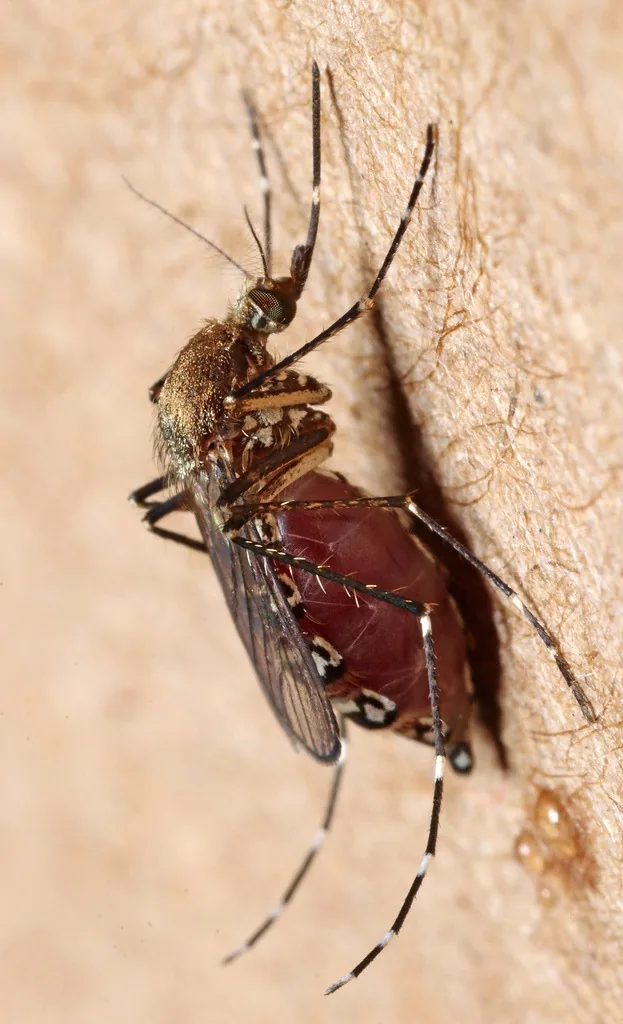
- A generally very dark, black mosquito with bands of white scales across the upper sides of the abdominal segments. UF/IFAS places the white bands at the base of the abdominal segments and adds white tips on the palps.[1][15]
- A band of white scales circles the middle of the proboscis (the long mouthparts), and each leg carries bands of white scales.[1]
- Males have feathery antennae; females have only a few hairs on theirs, and their palps are shorter than the proboscis.[15]
Look-alikes
| Look-alike | How to tell them apart |
|---|---|
| Other mosquitoes | The white ring around the middle of the proboscis, together with the banded legs and very dark body, helps set this species apart.[1] |
| Eastern saltmarsh mosquito (Aedes sollicitans) | Commonly found with it in grass salt marshes, so both may turn up in the same broods.[1] |
Where it lives
Rutgers places it on the coastal plains from Massachusetts to Texas, along the Pacific coast in California and in the Caribbean, more abundant in the south. GBIF's 1990-2026 U.S. records (about 26,500) come from 6 states on the map, and about 96% of them are from Florida, followed by Virginia, Maryland, Rhode Island and Texas. UF/IFAS says it lives in brackish, marshy areas of North, Central and South America and the Caribbean islands; although larvae are mostly in coastal salt marshes, its long flight range means it can turn up throughout Florida.[1][14][15]
Biology and life cycle
Females lay one or more clutches of 100 to 200 eggs each in a band along a contour line in depressions in the upper salt marsh and mangrove swamps, above the high-water line. Part of each clutch hatches whenever the site is flooded by wind or lunar tides or heavy rain.[1]
Larvae develop in salt marsh grasses such as spike grass and salt meadow hay, and in the south around mangroves, saltwort and glassworts; they also breed on dredge disposal islands. Under good conditions adults can emerge as little as six days after the eggs hatch.[1]
Females usually fly 2 to 5 miles from the marsh, and wind-assisted flights of over 30 miles are known. Mark-recapture studies in the Florida Keys showed them flying from uninhabited refuge islands to inhabited ones such as Big Pine Key.[1][7]
They seek hosts mostly in the evening and less in the morning, and not much in full darkness, but will bite anyone who comes near their daytime resting spots. They feed on birds as well as mammals, and Florida populations can produce some eggs without a blood meal.[1]
In the north the eggs survive winter in a resting state; in the far south breeding can go on year-round.[1]
Hurricane flooding can bring both booms and busts. After Hurricane Irma in 2017, Collier County, Florida recorded landing rates up to 150 females in 2 minutes, followed the next year by a population crash. St. Johns County's mosquito control district received more than 3,500 service requests after Hurricane Matthew flooding in 2016.[8][9]
UF/IFAS says eggs are laid in moist soil, not water, in sheltered spots high enough above the waterline that only enough flooding by rain or tides hatches them; occasionally they are laid in containers. The four larval stages take 5 to 15 days depending on temperature, larvae can develop in anything from fresh water to ocean water, and the pupal stage lasts only a couple of days.[15]
Adults mate within a few days of emerging. Mammals and birds are the preferred hosts, but females readily bite people, feeding mainly at night and by day when their resting sites are disturbed. Unlike most mosquitoes, a female can lay her first batch of eggs without a blood meal.[15]
Damage and signs
- It is a severe biter of people and livestock, and unchecked populations can have a major economic impact. In Florida it accounts for a large majority of the state's adult mosquito control missions.[1][8]
- UF/IFAS says it is responsible for a large part of mosquito insecticide applications in Florida, and that it is sheltered from large-scale mosquito control in Everglades National Park to protect that ecosystem.[15]
Health risk
It is a natural carrier of dog heartworm. Infective heartworm larvae develop in it in laboratory studies, and in coastal Yucatan, Mexico, it was identified as the main heartworm vector. FDA explains that heartworm is spread only by mosquito bites and can kill dogs, cats and ferrets, so pets in its range need a veterinarian's heartworm testing and prevention. For human viruses its role is smaller: it was relatively resistant to West Nile virus in laboratory tests, and CDC's eastern equine encephalitis guidelines do not list it among the main bridge vectors to people, although lab studies show it can carry viruses of the EEE complex.[11][12][5][10][4][13]
Control
Prevention
Use EPA-registered insect repellents (such as DEET, picaridin, IR3535 or oil of lemon eucalyptus) as the label directs, wear loose long sleeves and pants, and use permethrin-treated clothing and gear. EPA's search tool lists registered products by active ingredient and protection time. UF/IFAS adds that insecticide-treated clothing works best combined with a repellent.[3][6][15]
Since host seeking peaks in the evening, be most careful outdoors at dusk, and avoid brushing through vegetation near marshes where resting females will bite by day.[1]
Screened windows and doors keep biting mosquitoes out of the house. Emptying standing water from containers helps against other mosquitoes, but UF/IFAS says it has minimal effect on this marsh-breeding species.[15]
When to call a professional
Because broods come from large tidal marshes, control is done mostly by local mosquito control districts using ground and aerial treatments; residents can report heavy biting to them, as thousands did in St. Johns County after hurricane flooding.[9][8]
UF/IFAS says salt marsh mosquito management combines source reduction, surveillance, larviciding and adulticiding. Source reduction uses water management such as impounding, ditching and open marsh water management, which shrink larval habitat or let native larva-eating fish reach the larvae.[15]
Where the sources disagree
Biting time: Rutgers says host seeking is mostly in the evening and not much in full darkness; UF/IFAS says feeding occurs primarily at night.[1][15]
Common questions
- Why are mosquitoes so bad after a coastal storm?
- Eggs laid in the upper salt marsh hatch when tides or heavy rain flood them, so storm flooding can trigger huge broods, as happened in Florida after Hurricanes Matthew and Irma.[1][8][9]
- Do they bite during the day?
- They seek hosts mostly in the evening, and less in the morning, but will bite during the day if you come near where they are resting. UF/IFAS says feeding occurs primarily at night, but they will bite during the day if their resting sites are disturbed.[1][15]
- How far inland do salt marsh mosquitoes fly?
- Usually 2 to 5 miles from the marsh, but wind-assisted flights of over 30 miles are known.[1]
- Can they give my dog heartworm?
- Yes. It is a natural carrier of dog heartworm, which is spread only by mosquito bites; ask a veterinarian about heartworm testing and prevention.[1][11][5]
- Will dumping standing water around my house stop them?
- Not much. UF/IFAS says destroying container breeding sites has minimal effect on this species, which breeds in coastal marshes, though it does cut down other mosquitoes around the home.[15]
Sources
- Rutgers Center for Vector Biology (New Jersey Agricultural Experiment Station), “The Black Salt Marsh Mosquito, Aedes taeniorhynchus (Apperson, Wing Beats 1991).” vectorbio.rutgers.edu/outreach/species/sp10.htm (accessed 2026-11-11)
- iNaturalist, “Aedes taeniorhynchus taxon page (order and family).” www.inaturalist.org/taxa/1112134 (accessed 2026-11-11)
- Centers for Disease Control and Prevention, “Preventing Mosquito Bites.” www.cdc.gov/mosquitoes/prevention/index.html (accessed 2026-11-11)
- Centers for Disease Control and Prevention, “Guidelines for Eastern Equine Encephalitis Virus Surveillance and Control.” www.cdc.gov/eastern-equine-encephalitis/php/surveillance-and-control-guidelines/index.html (accessed 2026-11-11)
- U.S. Food and Drug Administration, Center for Veterinary Medicine, “Keep the Worms Out of Your Pet's Heart! The Facts about Heartworm Disease.” www.fda.gov/animal-veterinary/animal-health-literacy/keep-worms-out-your-pets-heart-facts-about-heartworm-disease (accessed 2026-11-11)
- U.S. Environmental Protection Agency, “Find the Repellent that is Right for You.” www.epa.gov/insect-repellents/find-repellent-right-you (accessed 2026-11-11)
- J Am Mosq Control Assoc, via PubMed, “Vlach JJ, Hall KJ, Day JF, Curtis GA, Hribar LJ, Fussell EM (2006), Interisland dispersal of the black salt marsh mosquito, Ochlerotatus taeniorhynchus, in the Florida Keys, Journal of the American Mosquito Control Association 22(4):615-621.” pubmed.ncbi.nlm.nih.gov/17304926/ (accessed 2026-11-11). Cited from the PubMed abstract.
- J Am Mosq Control Assoc, via PubMed, “Lucas KJ, Watkins A, Phillips N, Appazato DJ, Linn P (2019), The impact of Hurricane Irma on population density of the black salt-marsh mosquito, Aedes taeniorhynchus, in Collier County, Florida, Journal of the American Mosquito Control Association 35(1).” pubmed.ncbi.nlm.nih.gov/31442180/ (accessed 2026-11-11). Cited from the PubMed abstract.
- J Am Mosq Control Assoc, via PubMed, “Weaver JR, Xue RD, Gaines MK (2020), Population outbreaks of mosquitoes after Hurricanes Matthew and Irma and the control efforts in St. Johns County, northeastern Florida, Journal of the American Mosquito Control Association 36(4).” pubmed.ncbi.nlm.nih.gov/33647146/ (accessed 2026-11-11). Cited from the PubMed abstract.
- Journal of Medical Entomology, via PubMed, “Turell MJ, O'Guinn ML, Dohm DJ, Jones JW (2001), Vector competence of North American mosquitoes for West Nile virus, Journal of Medical Entomology 38(2):130-134.” pubmed.ncbi.nlm.nih.gov/11296813/ (accessed 2026-11-11). Cited from the PubMed abstract.
- Journal of Medical Entomology, via PubMed, “Parker BM (2000), Density and distribution of Dirofilaria immitis third-stage larvae in Aedes sollicitans and Aedes taeniorhynchus, Journal of Medical Entomology 37(5):695-700.” pubmed.ncbi.nlm.nih.gov/11004780/ (accessed 2026-11-11). Cited from the PubMed abstract.
- Medical and Veterinary Entomology, via PubMed, “Manrique-Saide P, Escobedo-Ortegon J, Bolio-Gonzalez M, et al. (2010), Incrimination of the mosquito, Aedes taeniorhynchus, as the primary vector of heartworm, Dirofilaria immitis, in coastal Yucatan, Mexico, Medical and Veterinary Entomology 24(4).” pubmed.ncbi.nlm.nih.gov/20572932/ (accessed 2026-11-11). Cited from the PubMed abstract.
- PLoS Neglected Tropical Diseases, via PubMed, “Carvalho-Leandro D, Ferreira FC, Fernandez Santos N, et al. (2026), Transmission potential of Culex and Aedes species for Madariaga virus, a member of the eastern equine encephalitis virus complex, PLoS Neglected Tropical Diseases.” pubmed.ncbi.nlm.nih.gov/42118771/ (accessed 2026-11-11). Cited from the PubMed abstract.
- Global Biodiversity Information Facility (GBIF), “Aedes taeniorhynchus: occurrence records in the U.S., 1990-2026 (GBIF occurrence search).” api.gbif.org/v1/occurrence/search?taxonKey=1652052&country=US&hasGeospatialIssue=false&occurrenceStatus=PRESENT&year=1990%2C2026&facet=stateProvince&facetLimit=400&limit=0 (accessed 2026-11-11). State counts are records reported (iNaturalist research-grade, museum specimens, surveys), not abundance.
- University of Florida IFAS Extension, EDIS (Featured Creatures), “Black Salt Marsh Mosquito, Aedes taeniorhynchus (Wiedemann), EENY-591/IN1035 (Featured Creatures).” ask.ifas.ufl.edu/publication/IN1035 (accessed 2026-11-14)