On this page
How to identify it
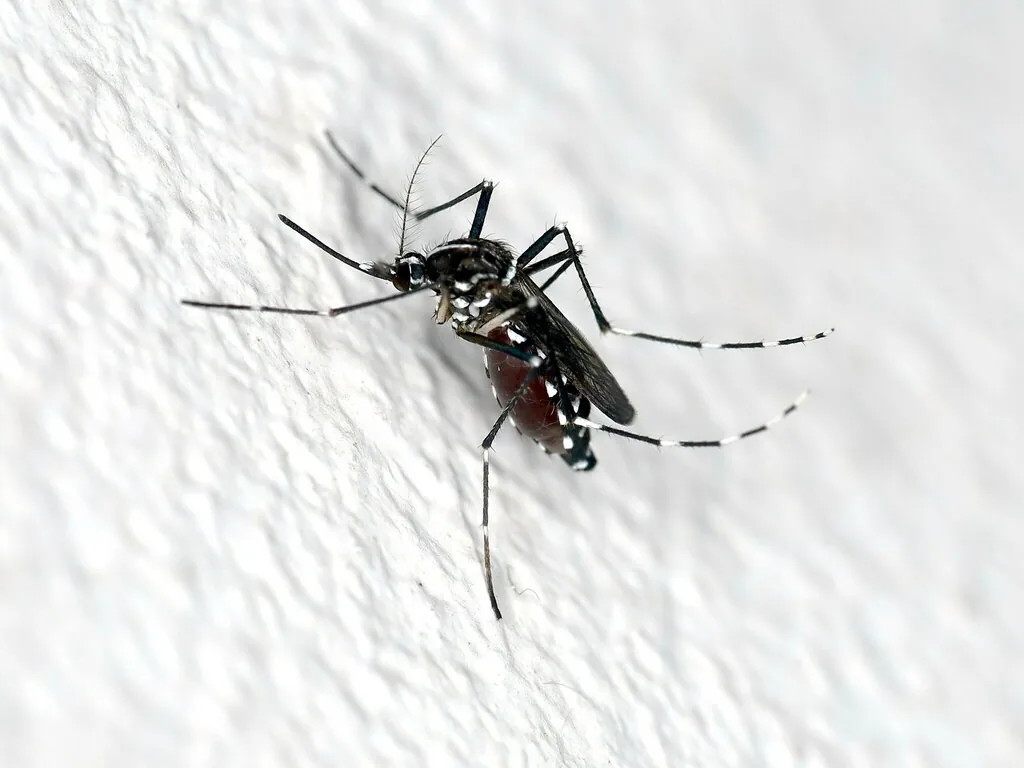
- Adults are covered in shiny black scales with distinct silver-white bands. The most striking mark is a single stripe of silvery-white scales running down the middle of the head and back (thorax). UF/IFAS says it is medium-sized, about 2.0 to 10.0 mm (0.08 to 0.4 in), with males on average 20 percent smaller than females, and the abdomen narrows to a point, as in other Aedes.[1][5][6]
- The palps and the leg segments (tarsi) are banded silver-white; on the hind legs the white bands are broad, and the last segment is usually all white. The proboscis is not banded.[1][5]
- Behavior helps too: it is a very aggressive daytime biter, with peaks generally in the early morning and late afternoon.[1][5][4]
- UF/IFAS says males have feathery antennae and mouthparts adapted for nectar feeding. The eggs are black, oval and about 0.5 mm long.[6]
Look-alikes
| Look-alike | How to tell them apart |
|---|---|
| Yellow fever mosquito (Aedes aegypti) | A close relative that also breeds in containers. CDC says it lives indoors as well as outdoors while the Asian tiger mosquito lives outdoors, though Novak's species account notes the tiger mosquito bites people indoors and outdoors. CDC also rates Ae. aegypti more likely to spread dengue, chikungunya and Zika.[7][1][8] |
| Other house mosquitoes | Many native mosquitoes breed in swamps and other natural wetlands; the Asian tiger mosquito breeds mainly in containers and is most active in daylight.[4][1] |
Where it lives
Native to Asia, from the tropics of Southeast Asia north through China and Japan, it arrived in the U.S. in imported used tires. By 1990, five years after its discovery in Texas, it had been found in 17 states, and by 1987 it had reached Baltimore and Delaware. In temperate climates it survives winter as eggs, and a 2015 global study found Aedes distributions the widest ever recorded. GBIF's public U.S. records since 1990 (about 41,000) come from 26 states on the map, counting the District of Columbia, most from Florida, Texas and Virginia. UF/IFAS says it was found in Florida a year after Texas, at a tire dump near Jacksonville, and has since reached all 67 Florida counties; citing CDC figures from 2001, it put the species in 866 counties in 26 states. Its arrival has been linked to a decline of the yellow fever mosquito, which a 2002 review cited by UF/IFAS placed only in urban areas of southern Texas, Florida and New Orleans.[1][3][2][9][10][6]
Biology and life cycle
Females lay eggs on the inner walls of containers just above the waterline, preferring dark, rounded surfaces. The eggs stick like glue and can survive drying out for up to 8 months, which is why an empty bucket or tire can produce mosquitoes after the next rain. UF/IFAS says the eggs are laid singly, may need several soakings before they hatch, and that low oxygen in the water is a stronger hatching cue than flooding or temperature.[7][1][6]
An egg becomes an adult in about 7 to 10 days; larvae can finish developing in 5 to 10 days depending on temperature and food, and pupae take about 2 days. UF/IFAS says the larvae, or wigglers, feed on fine organic particles in the water, come to the surface to breathe through a siphon and pass through four stages; pupae don't feed but can move about.[7][1][6]
Breeding spots include tires, buckets, birdbaths, flowerpots, cans, barrels, clogged gutters, tarps, boats, garden pools and ornamental ponds, as well as tree holes and other natural containers.[4][1]
Adults don't fly far, usually only a few blocks in a lifetime, so the mosquitoes biting you are often breeding nearby. Its main means of long-distance spread is the transport of used tires.[7][1]
It feeds on people, domestic and wild animals, and birds.[1][7]
In temperate climates it survives the winter as eggs, but in tropical and subtropical areas it is active all year, UF/IFAS says.[6]
Damage and signs
Health risk
CDC says dengue, Zika and chikungunya viruses spread through the bites of infected Aedes aegypti or Aedes albopictus, though Ae. aegypti is the more likely carrier. Laboratory studies show Ae. albopictus can be infected by at least 32 viruses, 13 of them present in the U.S., but a 2016 review found its role in natural transmission has been limited so far.[11][12][8][13]
Control
Prevention
Use an EPA-registered repellent with DEET, picaridin, IR3535, oil of lemon eucalyptus, PMD or 2-undecanone, and wear loose long sleeves and pants. Don't use OLE or PMD products on children under 3.[15]
Keep them out
Keep window and door screens in good repair and don't prop doors open.[14]
Sanitation
Once a week, empty and scrub, turn over, cover or throw out anything that holds water, such as tires, buckets, planters, toys, pools, birdbaths and flowerpot saucers. UF/IFAS adds changing pet water dishes, plant overflow saucers and birdbath water frequently, and not letting water collect in rain barrels or gutters.[14][6]
Clear clogged gutters, tightly cover rain barrels and other water storage, and drill drain holes in containers you must keep outside.[14][4]
Biological control
For water you can't dump, small floating products that release Bti, a bacterium that kills mosquito larvae, can treat small containers, tree holes and ponds.[4]
Pesticides
An outdoor adulticide can be applied to shady resting areas such as under patio furniture, but nighttime fogging often misses this species because it is active during the day. UF/IFAS adds that adult control is harder for this species because of tolerance to malathion, temephos and bendiocarb reported in 1987, and that removing breeding containers is an effective way for communities to manage it.[14][4][6]
Where the sources disagree
Egg survival: CDC says the eggs can survive drying out for up to 8 months, while UF/IFAS says they can withstand drying for up to one year.[7][6]
Common questions
- Why am I getting bitten by mosquitoes in the middle of the day?
- Daytime biting points to the Asian tiger mosquito, which feeds in daylight, with peaks in early morning and late afternoon, and breeds in containers close to homes.[4][1]
- How far do Asian tiger mosquitoes travel?
- Only a few blocks over their lifetime, so the ones biting you are usually breeding close by, in your yard or a neighbor's.[7]
- How did the Asian tiger mosquito spread so fast?
- UF/IFAS says it was most likely carried along highways in shipments of used tires imported for retreading, and its eggs survive drying, so tires moved it long distances.[6]
Sources
- Rutgers Center for Vector Biology, “The Asian tiger mosquito, Aedes albopictus (Novak 1992, Wing Beats).” vectorbio.rutgers.edu/outreach/species/sp8.htm (accessed 2026-11-11)
- Rutgers Center for Vector Biology, “Aedes albopictus (Skuse) (species account by W.J. Crans).” vectorbio.rutgers.edu/outreach/species/albo.htm (accessed 2026-11-11)
- J Am Mosq Control Assoc, via PubMed, “Past, present and future of Aedes albopictus in the United States (Moore et al. 1990).” pubmed.ncbi.nlm.nih.gov/2182773/ (accessed 2026-11-11). Cited from the PubMed abstract.
- Clemson Cooperative Extension, Home & Garden Information Center, “Asian Tiger Mosquito (HGIC 2471).” hgic.clemson.edu/factsheet/asian-tiger-mosquito/ (accessed 2026-11-11)
- Connecticut Agricultural Experiment Station, “Identification Guide to the Mosquitoes of Connecticut, Bulletin No. 966 (Andreadis, Thomas and Shepard, 2005).” portal.ct.gov/-/media/caes/documents/publications/bulletins/b966b996pdf.pdf (accessed 2026-11-11)
- University of Florida IFAS Extension (EDIS), “Asian Tiger Mosquito, Aedes albopictus (Skuse), EENY319/IN594 (Featured Creatures; L. Rios and J. E. Maruniak).” ask.ifas.ufl.edu/publication/IN594 (accessed 2026-11-14)
- U.S. Centers for Disease Control and Prevention, “Life Cycle of Aedes Mosquitoes (reviewed April 16, 2024).” www.cdc.gov/mosquitoes/about/life-cycle-of-aedes-mosquitoes.html (accessed 2026-11-11)
- U.S. Centers for Disease Control and Prevention, “Potential Range of Aedes Mosquitoes (reviewed July 1, 2024).” www.cdc.gov/mosquitoes/php/toolkit/potential-range-of-aedes.html (accessed 2026-11-11)
- eLife, via PubMed, “The global distribution of the arbovirus vectors Aedes aegypti and Ae. albopictus (Kraemer et al. 2015).” pubmed.ncbi.nlm.nih.gov/26126267/ (accessed 2026-11-11). Cited from the PubMed abstract.
- Global Biodiversity Information Facility (GBIF), “Aedes albopictus: occurrence records in the U.S., 1990-2026 (GBIF occurrence search).” api.gbif.org/v1/occurrence/search?taxonKey=1651430&country=US&hasGeospatialIssue=false&occurrenceStatus=PRESENT&year=1990%2C2026&facet=stateProvince&facetLimit=400&limit=0 (accessed 2026-11-11). State counts are records reported (iNaturalist research-grade, museum specimens, surveys), not abundance.
- U.S. Centers for Disease Control and Prevention, “How Dengue Spreads (reviewed May 22, 2025).” www.cdc.gov/dengue/transmission/index.html (accessed 2026-11-11)
- Centers for Disease Control and Prevention, “How Zika Spreads.” www.cdc.gov/zika/causes/index.html (accessed 2026-11-11)
- J Med Entomol, via PubMed, “Aedes albopictus and mosquito-borne viruses in the United States (Vanlandingham, Higgs & Huang 2016).” pubmed.ncbi.nlm.nih.gov/27113107/ (accessed 2026-11-11). Cited from the PubMed abstract.
- U.S. Centers for Disease Control and Prevention, “Mosquito Control at Home (reviewed April 16, 2024).” www.cdc.gov/mosquitoes/mosquito-control/mosquito-control-at-home.html (accessed 2026-11-11)
- U.S. Centers for Disease Control and Prevention, “Preventing Mosquito Bites.” www.cdc.gov/mosquitoes/prevention/index.html (accessed 2026-11-11)
- iNaturalist, “Aedes albopictus taxon page (order and family).” www.inaturalist.org/taxa/62984 (accessed 2026-11-11)