On this page
How to identify it
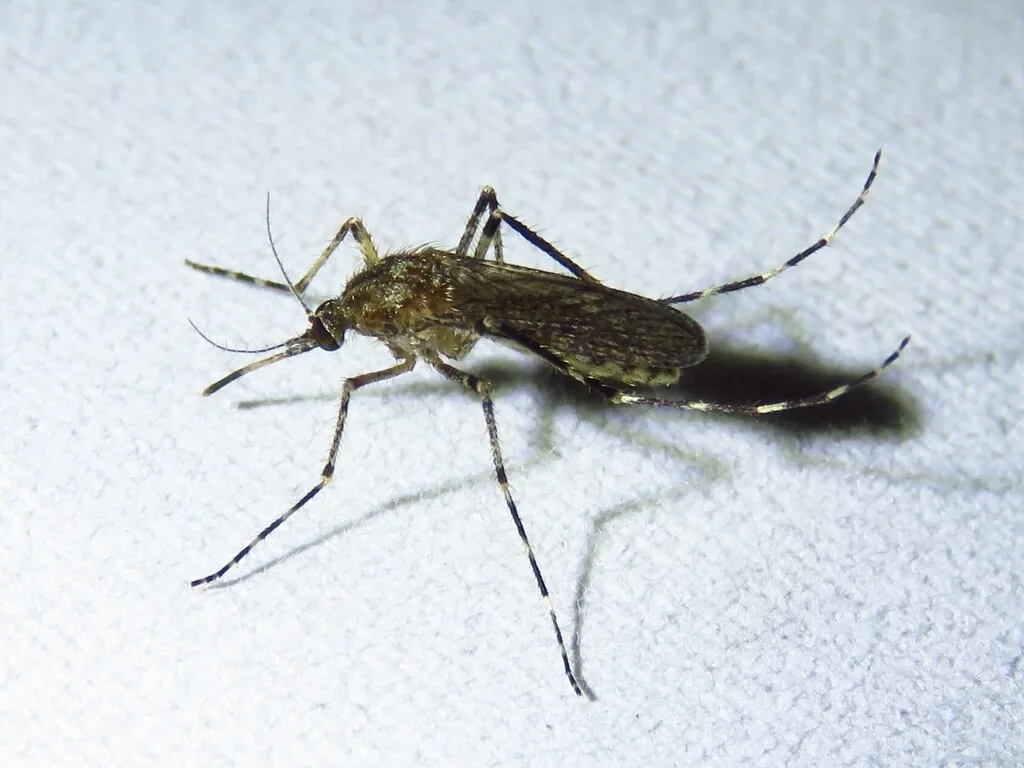
- The adult female has a dark proboscis with a broad pale band in the middle, golden-brown scales on the thorax, a dark abdomen with narrow yellowish bands, legs with pale bands on the foot segments, and wings speckled with broad pale and dark scales.[3]
- Larvae and pupae don't hang at the water surface. Their short, pointed breathing tubes have saw-toothed tips that pierce plant roots and stems, and they take air from inside the plant.[3][1][12]
- Disturbed larvae let go and burrow into the mud, which makes them hard to find.[3][1]
Look-alikes
| Look-alike | How to tell them apart |
|---|---|
| Other mosquitoes | Look at the proboscis and legs: this species has a broad pale band in the middle of the proboscis and pale bands on the foot segments of every leg.[3] |
Where it lives
GBIF's 1990-2026 U.S. records run from Florida, Maryland and Virginia (the most records) west to Montana, Idaho and Washington and north to Alaska; these come largely from mosquito-surveillance programs, so they track where trapping happens. It has been recorded in all eight Connecticut counties, and a study in eastern Ontario, Canada also collected it.[14][3][11]
Biology and life cycle
Larvae live in permanent bodies of water with muddy bottoms and plenty of emergent plants such as cattails. In an Ocean County, New Jersey survey, breeding sites were bogs and ponds edged with swamp loosestrife, cattail, arrow arum and other emergent plants, with counts up to 30 to 35 larvae per clump of roots.[3][1]
It has one generation a year. Larvae are present year-round and spend the winter in that stage; in Connecticut adults fly from May to September.[3]
Females lay eggs in rafts. In a laboratory study, blood-fed females laid rafts in containers holding water hyacinth plants.[12]
Females bite people readily in the early morning, at dusk, in the evening, and during the day in densely shaded areas.[3]
It feeds on both birds and mammals. At EEE sites in Connecticut its identified blood meals were split between birds and mammals, and in eastern Ontario it fed on a mix of birds and mammals, including people at a relatively high frequency.[3][10][11]
Damage and signs
- In late summer 1983, after four horses died of EEE in Jackson Township, Ocean County, New Jersey, EEE virus was isolated from this mosquito, and it made up as much as 36% of light-trap catches around the time of the cases.[1]
Health risk
CDC names Coquillettidia perturbans a primary bridge vector of EEE virus in the Northeast, Mid-Atlantic, Southeast and Midwest, and says high numbers of it have been associated with elevated EEE activity. Connecticut has isolated EEE, West Nile, Jamestown Canyon, Cache Valley and other viruses from it. In New York from 1971 to 2012, years with human EEE cases were associated with finding the virus in this species. There are no human vaccines or medicines to prevent EEE or West Nile.[5][3][9][6][7]
Control
Prevention
Prevent bites with an EPA-registered repellent containing DEET, picaridin, IR3535, oil of lemon eucalyptus, para-menthane-diol or 2-undecanone, and wear loose long-sleeved shirts and pants, especially at dawn, dusk and in shaded areas near marshes.[8][3]
When to call a professional
Larval control is hard because larvae sit in root mats near the bottom, where organic matter breaks down larvicides. A 1983 New Jersey aerial larvicide trial cut larvae by up to an estimated 60%, and a 2021 Minnesota study found a spinosad granule reduced emergence from cattail marshes by only 25%.[1][13]
Common questions
- Why are mosquitoes bad near my cattail pond?
- Cattail mosquito larvae develop attached to the roots of cattails and other emergent plants in permanent ponds and marshes, and the adults readily bite people.[3][1]
- Do larvicides work on cattail mosquitoes?
- Not well. Larvae stay in the root mats and don't come to the surface for air, so treatments struggle to reach them; field trials found partial reductions of about 25% to 60%.[1][13]
- Can the cattail mosquito spread eastern equine encephalitis?
- Yes. CDC lists it as a primary bridge vector that carries EEE virus from birds to people and horses.[5][4]
Sources
- Rutgers Center for Vector Biology (New Jersey Agricultural Experiment Station), “Identification and surveillance of Coquillettidia perturbans breeding habitat, Ocean County, N.J. (Romanowski and Candeletti, 1984).” vectorbio.rutgers.edu/outreach/species/sp16.htm (accessed 2026-11-11)
- iNaturalist, “Coquillettidia perturbans taxon page (order and family).” www.inaturalist.org/taxa/259061 (accessed 2026-11-11)
- Connecticut Agricultural Experiment Station, “Identification Guide to the Mosquitoes of Connecticut, Bulletin No. 966 (Andreadis, Thomas and Shepard, 2005).” portal.ct.gov/-/media/caes/documents/publications/bulletins/b966b996pdf.pdf (accessed 2026-11-11)
- Centers for Disease Control and Prevention, “Eastern Equine Encephalitis: Causes and How It Spreads.” www.cdc.gov/eastern-equine-encephalitis/cause-and-spread/index.html (accessed 2026-11-11)
- Centers for Disease Control and Prevention, “Guidelines for Eastern Equine Encephalitis Virus Surveillance and Control.” www.cdc.gov/eastern-equine-encephalitis/php/surveillance-and-control-guidelines/index.html (accessed 2026-11-11)
- Centers for Disease Control and Prevention, “About Eastern Equine Encephalitis Virus.” www.cdc.gov/eastern-equine-encephalitis/about/index.html (accessed 2026-11-11)
- Centers for Disease Control and Prevention, “West Nile: Causes and How It Spreads.” www.cdc.gov/west-nile-virus/causes/index.html (accessed 2026-11-11)
- Centers for Disease Control and Prevention, “Preventing Mosquito Bites.” www.cdc.gov/mosquitoes/prevention/index.html (accessed 2026-11-11)
- Epidemiology and Infection, via PubMed, “Sherwood JA, Stehman SV, Howard JJ, Oliver J (2020), Cases of eastern equine encephalitis in humans associated with Aedes canadensis, Coquillettidia perturbans and Culiseta melanura mosquitoes with the virus in New York State from 1971 to 2012, Epidemiology and Infection 148:e72 (New York State Department of Health).” pubmed.ncbi.nlm.nih.gov/32234110/ (accessed 2026-11-11). Cited from the PubMed abstract.
- Parasites and Vectors, via PubMed, “Shepard JJ, Andreadis TG, Thomas MC, Molaei G (2016), Host associations of mosquitoes at eastern equine encephalitis virus foci in Connecticut, USA, Parasites and Vectors 9:474 (Connecticut Agricultural Experiment Station).” pubmed.ncbi.nlm.nih.gov/27577939/ (accessed 2026-11-11). Cited from the PubMed abstract.
- Medical and Veterinary Entomology, via PubMed, “Stephens CRA, Forbes MR, Wilson S, Ludwig A, Lapen DR, Mitchell GW (2026), Mosquito feeding patterns in the context of West Nile and eastern equine encephalitis viruses in eastern Ontario, Canada, Medical and Veterinary Entomology 40(3):634-646.” pubmed.ncbi.nlm.nih.gov/42135883/ (accessed 2026-11-11). Cited from the PubMed abstract.
- Journal of Insect Science, via PubMed, “Benton N, Hunter FF (2026), Observations of the developmental stages of Coquillettidia perturbans with special reference to the pupal trumpets, Journal of Insect Science 26(2):ieag016 (Brock University).” pubmed.ncbi.nlm.nih.gov/41804670/ (accessed 2026-11-11). Cited from the PubMed abstract.
- Journal of the American Mosquito Control Association, via PubMed, “Crane DM, Lamere CA, Moon RD, Manweiler SA (2021), Efficacy and nontarget effects of a spinosad-based larvicide in Minnesota vernal pools and cattail marshes, Journal of the American Mosquito Control Association 37(3):125-131.” pubmed.ncbi.nlm.nih.gov/34407168/ (accessed 2026-11-11). Cited from the PubMed abstract.
- Global Biodiversity Information Facility (GBIF), “Coquillettidia perturbans (cattail mosquito): occurrence records in the U.S., 1990-2026 (GBIF occurrence search).” api.gbif.org/v1/occurrence/search?taxonKey=1648878&country=US&hasGeospatialIssue=false&occurrenceStatus=PRESENT&year=1990%2C2026&facet=stateProvince&facetLimit=400&limit=0 (accessed 2026-11-11). State counts are records reported (largely mosquito surveillance datasets, plus museum and iNaturalist records), so they track where trapping programs report data, not abundance.