The short answer
- What spreads it: the virus lives in a cycle between a swamp mosquito, Culiseta melanura, and birds in freshwater hardwood swamps. That mosquito feeds almost only on birds, so people and horses get infected when other 'bridge' mosquitoes (mostly Aedes, Coquillettidia and Culex species) bite an infected bird and then bite them (CDC, Virginia Department of Health).[3][9]
- Where: transmission is most common in and around freshwater hardwood swamps in the Atlantic and Gulf Coast states and the Great Lakes region (CDC). Virginia says risk is highest for people in lowland areas of eastern or Gulf Coast states and people who work or play outdoors.[4][9]
- Most infected people never get sick. But get emergency care for fever with a severe headache, confusion or behavior changes, drowsiness, seizures, weakness or loss of consciousness after mosquito bites. CDC lists these among the signs of severe EEE, and MedlinePlus says to go to the emergency room or call 911 for sudden fever with other signs of encephalitis.[2][10]
- There is no human vaccine and no medicine that prevents or treats EEE, so preventing mosquito bites is the main protection (CDC, Virginia Department of Health). Horses can be vaccinated (Merck Veterinary Manual).[5][1][9][11]
A mosquito linked to EEE
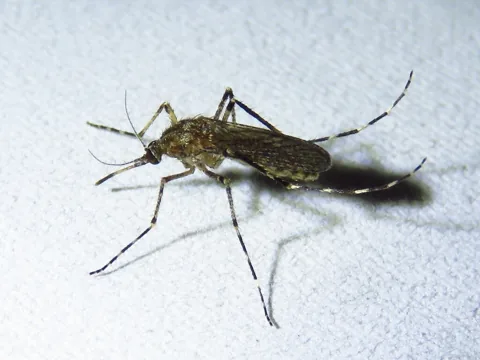
The swamp mosquito, birds and the bridge mosquitoes
CDC says EEE virus is maintained in a cycle between Culiseta melanura mosquitoes and birds in freshwater hardwood swamps. Virginia calls this the blacktailed mosquito and says it passes the virus to birds or picks it up by feeding on infected birds in swampland.[3][9]
Because Cs. melanura feeds almost exclusively on birds, CDC does not consider it an important vector to people. Another mosquito species has to form a 'bridge' between infected birds and mammals such as people or horses; most bridge species are in the Aedes, Coquillettidia and Culex groups (CDC).[3]
- Cattail mosquito (Coquillettidia perturbans): Virginia names it one of the most likely EEE vectors to people. It breeds in cattail marshes; see its profile below.[9]
- Floodwater mosquitoes: Virginia says transmission can also come from several floodwater mosquito species that are most common in coastal or swampy areas.[9]
- Dead-end hosts: people and horses can get sick and die, but they don't pass the virus on to mosquitoes that bite them, and it does not spread from person to person except in rare cases of organ transplantation (CDC). Merck says people catch these viruses from mosquitoes, not directly from horses.[3][11]
- Outbreak build-up: in a 2019 Connecticut outbreak, numbers of Cs. melanura and of mammal-biting bridge mosquitoes carrying the virus both rose distinctly shortly before human cases appeared (Emerging Infectious Diseases).[8]
Where and when people get EEE
CDC says cases are rare largely because the main transmission cycle happens in and around swampy areas where people are less likely to go. Transmission is most common near freshwater hardwood swamps in the Atlantic and Gulf Coast states and the Great Lakes region, and anyone living in or visiting an area with known virus activity is at risk.[4]
Case numbers: CDC's data page says an average of 11 human cases are reported in the US each year. A CDC MMWR report gives an average of eight cases a year during 2003–2018 (range 4–21), so the long-run average depends on the years counted.[4][7]
2019 was unusual: as of October 15, 2019, CDC had reports of 34 cases from seven states, including Massachusetts (12 cases) and Michigan (10). All 34 patients were hospitalized and 12 (35%) died; illness began between June 18 and September 20, and 21 (62%) began in August (CDC MMWR).[7]
Season: CDC tells clinicians to consider EEE especially during the summer months in areas with reported virus activity. In the 2019 Connecticut outbreak, horse infections surfaced in early August and infected mosquitoes stayed elevated through mid-October (Emerging Infectious Diseases).[6][8]
CDC's EEE prevention page notes that mosquitoes bite during the day and night.[5]
Symptoms and when to get care
Most people infected with EEE virus have no symptoms. When symptoms happen, they start 4 to 10 days after the infected bite (CDC, Virginia Department of Health); CDC's clinician page says the wait can be several weeks in people with weakened immune systems.[2][9][6]
Mild illness: fever, chills, body aches and joint pain lasting 1 to 2 weeks; most people recover completely when the brain and spinal cord are not involved (CDC).[2]
Severe illness: meningitis or encephalitis, with fever, headache, vomiting, diarrhea, seizures, behavior changes, drowsiness and coma (CDC). CDC says severe illness often comes soon after onset in infants, while older children and adults may have several days of general illness first. CDC's clinician page says the illness progresses to meningitis or encephalitis in fewer than 5% of people with symptoms; its data page says about 4–5% of infections result in EEE.[2][6][4]
Why it matters: CDC's main page says about 30% of people who develop severe EEE die; its symptoms page and Virginia say about a third. Many survivors have lasting problems, from intellectual disability and personality changes to seizures and paralysis (CDC, Virginia Department of Health).[1][2][9]
Higher risk: CDC says people over 50 and under 15 seem to be at greatest risk of severe disease, and people who work or play outdoors in affected areas are at increased risk of infection.[4]
When to get care: talk to a healthcare provider if you think you or a family member might have EEE, and tell them about mosquito exposure and where you live or traveled (CDC). MedlinePlus says to go to the emergency room or call 911 for sudden fever with other encephalitis symptoms; it lists loss of consciousness, poor responsiveness, muscle weakness or paralysis and seizures as emergency symptoms. This page can't diagnose you.[2][10]
How it is diagnosed and treated
Providers diagnose EEE from symptoms, a history of living in or traveling to an area where the virus circulates, possible exposure to mosquitoes that spread it, and laboratory tests (CDC). Virginia says diagnosis is mainly based on blood or spinal fluid tests that look for antibodies.[2][9]
No medicine treats EEE, and antibiotics don't work against viruses. Rest, fluids and over-the-counter pain medicine may ease mild symptoms; severe cases often need hospital care such as IV fluids, pain medicine and nursing care (CDC, Virginia Department of Health).[1][2][9]
CDC says infection is thought to give life-long immunity to EEE, but not to other mosquito-borne viruses such as West Nile, western equine encephalitis or La Crosse virus.[4]
Prevention: stop the bites
There are no human vaccines or medicines to prevent EEE; CDC's prevention steps are to use insect repellent, wear long sleeves and pants, treat clothing and gear, and control mosquitoes indoors and outdoors.[5]
- Repellent: use an EPA-registered repellent with DEET, picaridin, IR3535, oil of lemon eucalyptus, para-menthane-diol or 2-undecanone (CDC); EPA's repellent finder lets you match one to your needs. Follow the label. MedlinePlus says not to use DEET on infants younger than 2 months.[13][14][10]
- Clothing: permethrin-treated clothing and gear keep protecting after multiple washings; don't put permethrin products on skin (CDC). Virginia gives the same advice.[13][9]
- Home: keep window and door screens secure and intact (Virginia Department of Health), and remove standing water such as old tires, cans, gutters and wading pools (MedlinePlus). The indoor and yard mosquito guides cover the details.[9][10]
- Timing: CDC notes mosquitoes bite day and night, and MedlinePlus advises long sleeves and pants outdoors, especially at dusk.[5][10]
Horses and EEE
EEE is one of four main viral encephalomyelitis diseases of horses and occurs mainly in eastern North America and the Caribbean. Merck says EEE is often severe and horses can die quickly; signs can include fever (Merck Veterinary Manual).[11]
A vet diagnoses it from the horse's signs, location, time of year and blood tests. There is no specific cure; care is supportive (Merck Veterinary Manual).[11]
Vaccine: Merck says horse vaccines are available for all four types, and the mosquito-borne nervous-system viruses are on its list of core horse vaccines; your veterinarian sets the schedule for your area and risk. CDC's MMWR also notes veterinary EEE vaccines for horses, while none is licensed for people.[11][12][7]
Around the barn: Merck lists removing standing water, cleaning troughs and buckets weekly and reducing insect breeding areas.[11]
Western equine encephalitis is a different virus found in western North America (Merck). The western encephalitis mosquito has its own profile page.[11]
Common questions
- Can I catch EEE from a horse or another person?
- No. People and horses are dead-end hosts and the virus does not spread person to person, except in rare cases of organ transplantation (CDC). Merck says people catch it from mosquitoes, not directly from horses.[3][11]
- Is there an EEE vaccine for people?
- No. CDC and Virginia say there is no human vaccine or preventive drug. Vaccines exist for horses (Merck Veterinary Manual, CDC MMWR).[5][9][11][7]
- How long after a mosquito bite do EEE symptoms start?
- CDC and Virginia say 4 to 10 days; CDC says it can be longer, even several weeks, in people with weakened immune systems.[2][9][6]
- Is EEE the same as West Nile virus?
- No. Both are spread by mosquitoes and can cause encephalitis, but they are different viruses, and CDC says EEE immunity does not protect against West Nile. The West Nile page covers that virus.[4][10]
- Which states get EEE?
- CDC says transmission is most common near freshwater hardwood swamps in the Atlantic and Gulf Coast states and the Great Lakes region. In 2019, cases came from Massachusetts, Michigan, Connecticut, New Jersey, Rhode Island, North Carolina and Tennessee (CDC MMWR).[4][7]
Photo credits
- Cattail Mosquito: (c) Annika Lindqvist, some rights reserved (CC BY) — via iNaturalist, CC BY 4.0
Sources
- Centers for Disease Control and Prevention, “About Eastern Equine Encephalitis Virus.” www.cdc.gov/eastern-equine-encephalitis/about/index.html (accessed 2026-11-14)
- Centers for Disease Control and Prevention, “Symptoms of Eastern Equine Encephalitis.” www.cdc.gov/eastern-equine-encephalitis/signs-symptoms/index.html (accessed 2026-11-14)
- Centers for Disease Control and Prevention, “Eastern Equine Encephalitis: Causes and How It Spreads.” www.cdc.gov/eastern-equine-encephalitis/cause-and-spread/index.html (accessed 2026-11-14)
- Centers for Disease Control and Prevention, “Data and Maps for Eastern Equine Encephalitis.” www.cdc.gov/eastern-equine-encephalitis/data-maps/index.html (accessed 2026-11-14)
- Centers for Disease Control and Prevention, “Preventing Eastern Equine Encephalitis.” www.cdc.gov/eastern-equine-encephalitis/prevention/index.html (accessed 2026-11-14)
- Centers for Disease Control and Prevention, “Clinical Signs and Symptoms of Eastern Equine Encephalitis.” www.cdc.gov/eastern-equine-encephalitis/hcp/clinical-signs/index.html (accessed 2026-11-14)
- Centers for Disease Control and Prevention, “Notes from the Field: Multistate Outbreak of Eastern Equine Encephalitis Virus, United States, 2019 (MMWR 2020;69:50-51).” www.cdc.gov/mmwr/volumes/69/wr/mm6902a4.htm (accessed 2026-11-14)
- Emerging Infectious Diseases (CDC journal), “Four Human Cases of Eastern Equine Encephalitis in Connecticut, USA, during a Larger Regional Outbreak, 2019 (Emerging Infectious Diseases 27(8), 2021).” wwwnc.cdc.gov/eid/article/27/8/20-3730_article (accessed 2026-11-14)
- Virginia Department of Health, “Eastern Equine Encephalitis (EEE) fact sheet.” www.vdh.virginia.gov/epidemiology/epidemiology-fact-sheets/eastern-equine-encephalitis-eee/ (accessed 2026-11-14)
- MedlinePlus, National Library of Medicine, “Encephalitis (Medical Encyclopedia).” medlineplus.gov/ency/article/001415.htm (accessed 2026-11-14)
- Merck Veterinary Manual, “Viral Encephalomyelitis (Encephalitis) in Horses.” www.merckvetmanual.com/horse-owners/brain-spinal-cord-and-nerve-disorders-of-horses/equine-viral-encephalomyelitis-encephalitis (accessed 2026-11-14)
- Merck Veterinary Manual, “Vaccinations for a Horse.” www.merckvetmanual.com/horse-owners/routine-care-of-horses/vaccinations-for-a-horse (accessed 2026-11-14)
- Centers for Disease Control and Prevention, “Preventing Mosquito Bites.” www.cdc.gov/mosquitoes/prevention/index.html (accessed 2026-11-14)
- US Environmental Protection Agency, “Find the Repellent that is Right for You.” www.epa.gov/insect-repellents/find-repellent-right-you (accessed 2026-11-14)