The short answer
- Call your veterinarian right away if a horse shows fever with stumbling, weakness in the hind end, muscle tremors or twitching of the muzzle, head pressing, circling, wandering, trouble swallowing, or behavior changes. USDA APHIS and the Merck Veterinary Manual list these among the signs.[7][1][2]
- These are mosquito-borne viruses. Merck says EEE is often severe and horses can die quickly, while West Nile and WEE are often less serious and some infected horses show no signs at all.[2][1]
- Vaccines exist for all of them, and Merck calls vaccination one of the best ways to prevent West Nile in horses. Ask your vet which vaccines your horse needs and when; this page gives no schedules.[2][1][7]
- Your horse can't give the virus to you. CDC calls people and horses 'dead-end' hosts, and Merck says people catch these viruses from mosquitoes, not from caring for a sick horse.[9][8][2]
- A sick horse does mean infected mosquitoes are biting in your area, so protect yourself from bites too (CDC).[11][10]
Mosquitoes tied to these viruses
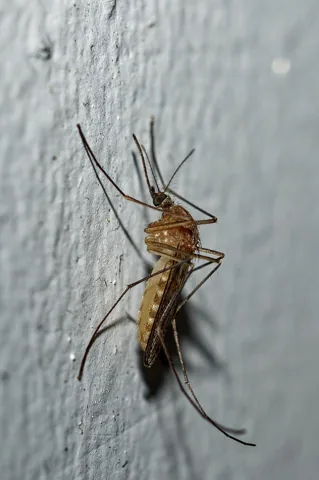 Northern House Mosquito
Culex pipiens
The northern house mosquito, Culex pipiens, is often the most common pest mosquito in cities and suburbs. It bites from dusk to dawn, breeds in stagnant and polluted water, and is a major carrier of West Nile virus in North America.
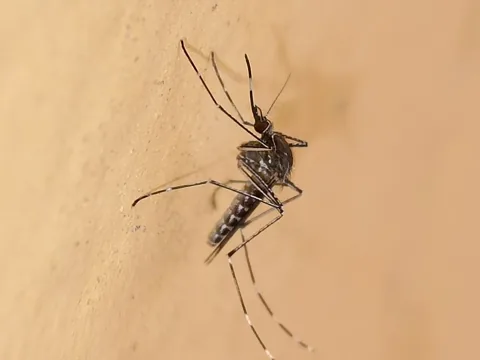 Western Encephalitis Mosquito
Culex tarsalis
The western encephalitis mosquito, Culex tarsalis, is a major carrier of West Nile virus in the western and central United States. A 15-year Iowa study called it the most important carrier of human infections there. It feeds on birds, where the virus multiplies, and also on people and horses.
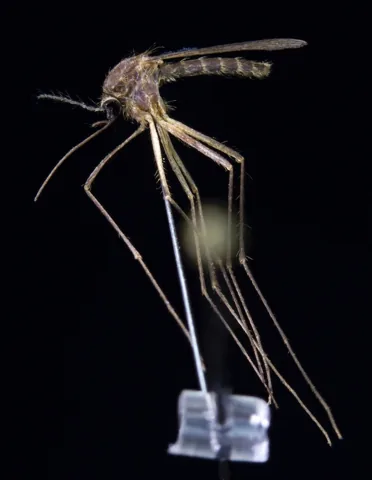 Dark-Tailed Mosquito
Culiseta melanura
The dark-tailed mosquito, Culiseta melanura, is the main mosquito that keeps eastern equine encephalitis (EEE) virus cycling among birds in freshwater hardwood swamps. EEE is rare in people but serious: about 30% of people who develop severe disease die.
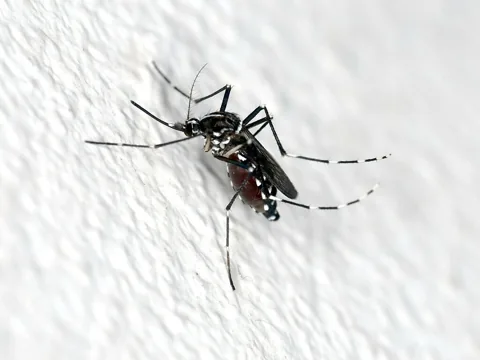 Asian Tiger Mosquito
Aedes albopictus
The Asian tiger mosquito is an invasive, aggressive mosquito that bites during the day and breeds in small water-holding containers around homes. First found at a tire dump near Houston in 1985, it spread rapidly through the southern United States and up the East Coast.
Which viruses, and where
Merck lists four main types of viral encephalomyelitis in horses: West Nile, eastern equine encephalitis (EEE), western equine encephalitis (WEE) and Venezuelan equine encephalitis (VEE). Each is caused by a different virus, often spread by mosquito bites.[2]
Merck says EEE occurs mainly in eastern North America and the Caribbean, WEE in western North America and parts of Central and South America, and VEE in Mexico and Central and South America, while West Nile is present throughout North America.[2]
USDA APHIS adds that EEE is commonly found in the eastern United States and Canada but has turned up further west in recent years, that WEE has not been detected in the United States since the late 1990s, and that the last US outbreak of VEE was in 1971.[7]
The viruses live in birds and mosquitoes. Merck's professional chapter says most of these viruses use a mosquito-to-bird or mosquito-to-rodent cycle, and USDA APHIS calls birds and rodents their reservoirs. Our West Nile and EEE pages cover the mosquito and bird cycle in detail.[3][7]
Horses are dead-end hosts
CDC calls people and horses 'dead-end' hosts for EEE: they can get sick and die, but they do not spread the virus to mosquitoes that bite them. CDC says the same of people, horses and other mammals for West Nile.[9][8]
Merck says people can catch these viruses from infected mosquitoes but not directly from horses, and its West Nile page says people are not infected by caring for a sick horse.[2][1]
Merck's vaccination chapter puts it the same way for West Nile: there is very little risk of catching the disease from an infected horse.[5]
Signs that mean call the vet now
Early signs are vague. Merck says a horse with West Nile may first seem anxious, run a mild fever, go lame or just seem unwell, and its professional chapter says horses are at first quiet and sleepy before nervous-system signs appear.[1][3]
Signs can look like other illnesses, Merck notes, so a vet exam is the only way to sort it out. Call promptly for any of the signs below.[1]
- EEE and WEE (USDA APHIS): fever, severe depression ('sleeping sickness'), behavior changes, impaired vision, circling or head pressing, muscle twitches, inability to swallow, paralysis, convulsions, death.[7]
- West Nile (USDA APHIS): fever, incoordination, hind-end weakness, depression, not eating, muscle tremors, teeth grinding, inability to swallow, head pressing, heavy sweating, behavior changes, down and unable to rise.[7]
- West Nile (Merck): muzzle twitching, vision problems, wandering, walking in circles, an unusual gait, weakness, muscle spasms, seizures; some horses become very sensitive to sound, light or touch.[1][2]
- Merck's professional chapter adds that weakness of the face and tongue can make a horse drop feed or choke, and that West Nile cases sometimes begin as colic or lameness.[3]
What your vet does
Merck says vets diagnose these diseases from the horse's signs, the location and time of year, and blood tests that look for antibodies to the suspected virus. Telling your vet the horse's vaccine history helps, since Merck's professional chapter lists vaccination status as part of the assessment.[2][3]
There is no specific cure. Merck says treatment is supportive, with fluids, medicines your vet chooses and careful nursing care.[2][1][7]
Outcomes vary. Merck says some horses recover completely while others have lasting nerve damage or die; many West Nile survivors improve over the following months, but some keep long-term movement problems.[2][1]
Vaccines: ask your vet
Merck says vaccines are available for all four types of encephalitis, and lists encephalomyelitis and West Nile among the core vaccines recommended for horses.[2][4]
Merck's professional chapter says core vaccination against these viruses is considered the standard of care for all US horses, as endorsed by the American Association of Equine Practitioners. USDA APHIS says vaccination effectively prevents disease.[3][7]
Merck says vaccinated horses that do get West Nile usually have milder signs and recover better, and that reported West Nile cases in US horses fell after the early 2000s, likely because of vaccination and mosquito control.[1]
Your vet sets the schedule. Merck says a veterinarian can recommend one based on where you live and current risk, and USDA APHIS says to ask about boosters if your horse lives in or travels to an area with year-round mosquitoes or past EEE or WEE cases. VEE vaccine, APHIS says, may be needed near the Mexican border.[2][7][5]
Reporting a case
If you suspect one of these diseases, USDA APHIS tells owners to contact their veterinarian to examine the animal.[7]
The vet handles official reporting. APHIS says veterinarians and diagnostic laboratories report diagnosed or suspected cases of nationally listed reportable animal diseases to APHIS Area Veterinarians in Charge and to the State animal health official under State rules. Merck's professional chapter calls reporting these infections a basic duty of all veterinarians.[7][3]
APHIS also asks the public to report dead wild birds, especially crows, jays, magpies and ravens, to the local health department.[7]
Cutting mosquitoes around the barn
USDA APHIS and Merck pair vaccination with less mosquito exposure. Steps they list:[7][3][1]
- Remove standing water from the property (APHIS, Merck). Our guide to stopping mosquito breeding covers containers, gutters and ponds.[7][3][2]
- Clean water troughs, tanks and buckets at least weekly (Merck).[3][2][1]
- Keep barn areas, paddocks and pastures cleared of weeds and of organic material such as manure that can shelter adult mosquitoes (Merck). Our barn fly control guide covers manure handling.[3]
- Place fans where horses rest, used safely (APHIS, Merck).[7][1]
- Limit outdoor time at dawn and dusk (APHIS).[7]
- Use a mosquito repellent approved for horses, following the label (APHIS, Merck). Your vet can help choose one.[7][1]
What a horse case means for people
A horse case shows the virus is in local mosquitoes. CDC's West Nile surveillance guidelines say horse cases may serve a sentinel function where there is no other environmental surveillance, and list dead horses among the signs of virus activity programs track.[11]
Sources differ on how early that warning comes. CDC's guidelines say widespread horse vaccination makes horses less useful as sentinels, and a CDC Emerging Infectious Diseases study of New York's 1999-2000 outbreak found horse cases did not serve as an early warning to public health officials in an area of intense activity.[11][14]
CDC says everyone living in or visiting an area with EEE activity is at risk. There is no vaccine for people against West Nile, EEE or WEE, so preventing mosquito bites is the protection; our West Nile and EEE pages cover symptoms and when to see a doctor.[10][8][9][12]
WEE is rare in people now. CDC says no human cases have been reported in the US since 1999, but outbreaks have occurred periodically in unvaccinated horses.[13][12]
Common questions
- Can I catch West Nile or EEE from my horse?
- No. CDC calls horses dead-end hosts, and Merck says people catch these viruses from mosquitoes, not from horses.[9][8][2]
- Can donkeys and mules get these viruses?
- Yes. USDA APHIS says the viruses can cause severe brain inflammation in equids, such as horses and donkeys.[7]
- Is there a cure?
- No specific cure. Merck says treatment is supportive care, so call your vet as soon as you see signs.[2][7]
- Which mosquitoes carry them?
- Merck names Culex tarsalis as an important carrier of WEE and lists the Asian tiger mosquito among species that transmit equine encephalitis. CDC's West Nile guidelines say only a few Culex species drive its spread.[6][11]
- Can dogs and cats get them?
- Rarely. Merck's professional chapter says few infections have been documented in dogs and cats, though exposure is detected in both during mosquito season.[3]
Photo credits
- Northern House Mosquito: (c) Donald Davesne, some rights reserved (CC BY) — via iNaturalist, CC BY 4.0
- Western Encephalitis Mosquito: (c) Diego López, some rights reserved (CC BY) — via iNaturalist, CC BY 4.0
- Dark-Tailed Mosquito: (c) Kyle Rossner, some rights reserved (CC BY) — via iNaturalist, CC BY 4.0
- Asian Tiger Mosquito: (c) Rafael Carbonell Font, some rights reserved (CC BY) — via iNaturalist, CC BY 4.0
Sources
- Merck Veterinary Manual, “West Nile Encephalomyelitis in Horses (Horse Owner Version).” www.merckvetmanual.com/horse-owners/brain-spinal-cord-and-nerve-disorders-of-horses/west-nile-encephalomyelitis-in-horses (accessed 2026-11-15)
- Merck Veterinary Manual, “Viral Encephalomyelitis (Encephalitis) in Horses (Horse Owner Version).” www.merckvetmanual.com/horse-owners/brain-spinal-cord-and-nerve-disorders-of-horses/equine-viral-encephalomyelitis-encephalitis (accessed 2026-11-15)
- Merck Veterinary Manual, “Equine Arboviral Encephalomyelitis.” www.merckvetmanual.com/nervous-system/equine-arboviral-encephalomyelitis/equine-arboviral-encephalomyelitis (accessed 2026-11-15)
- Merck Veterinary Manual, “Vaccinations for a Horse (Horse Owner Version).” www.merckvetmanual.com/horse-owners/routine-care-of-horses/vaccinations-for-a-horse (accessed 2026-11-15)
- Merck Veterinary Manual, “Vaccination Program for Horses.” www.merckvetmanual.com/management-and-nutrition/preventative-health-care-and-husbandry-of-horses/vaccination-program-for-horses (accessed 2026-11-15)
- Merck Veterinary Manual, “Mosquitoes of Animals.” www.merckvetmanual.com/integumentary-system/flies/mosquitoes-of-animals (accessed 2026-11-15)
- USDA Animal and Plant Health Inspection Service, “Disease Alert: Equine Encephalitis (EEE/WEE/VEE).” www.aphis.usda.gov/livestock-poultry-disease/equine/encephalitides (accessed 2026-11-15)
- Centers for Disease Control and Prevention, “West Nile: Causes and How It Spreads.” www.cdc.gov/west-nile-virus/causes/index.html (accessed 2026-11-15)
- Centers for Disease Control and Prevention, “Eastern Equine Encephalitis: Causes and How It Spreads.” www.cdc.gov/eastern-equine-encephalitis/cause-and-spread/index.html (accessed 2026-11-15)
- Centers for Disease Control and Prevention, “Data and Maps for Eastern Equine Encephalitis.” www.cdc.gov/eastern-equine-encephalitis/data-maps/index.html (accessed 2026-11-15)
- Centers for Disease Control and Prevention, “Guidelines for West Nile Virus Surveillance and Control.” www.cdc.gov/west-nile-virus/php/surveillance-and-control-guidelines/index.html (accessed 2026-11-15)
- Centers for Disease Control and Prevention, “About Western Equine Encephalitis Virus.” www.cdc.gov/wee/about/index.html (accessed 2026-11-15)
- Centers for Disease Control and Prevention, “Data and Maps for Western Equine Encephalitis.” www.cdc.gov/wee/data-maps/index.html (accessed 2026-11-15)
- Centers for Disease Control and Prevention, “West Nile Virus Outbreak Among Horses in New York State, 1999 and 2000 (Emerging Infectious Diseases).” wwwnc.cdc.gov/eid/article/7/4/01-7427_article (accessed 2026-11-15)