The short answer
- West Nile virus cycles between mosquitoes, especially Culex species, and birds; mosquitoes pick it up from infected birds and then bite people. CDC says all states in the contiguous US have reported cases, and people get infected during mosquito season, typically June through October.[1][3][4]
- Most infections are mild or silent. CDC says about 20% of infected people get flu-like symptoms such as fever, headache and body aches, and less than 1% develop severe illness that affects the central nervous system. Washington's health department says 8 out of 10 infected people will not get sick.[4][10]
- Get medical care right away for high fever, neck stiffness, muscle weakness, confusion or tremors, CDC says. MedlinePlus adds that if you are very sick you should go to an emergency room. People over 60 and those with conditions such as cancer, diabetes, high blood pressure or kidney disease, or a weakened immune system, are at higher risk of severe illness.[4][8][7]
The mosquitoes behind West Nile
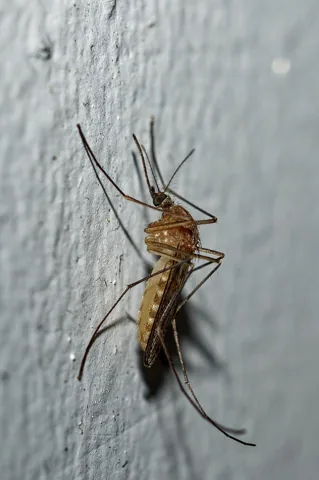 Northern House Mosquito
Culex pipiens
The northern house mosquito, Culex pipiens, is often the most common pest mosquito in cities and suburbs. It bites from dusk to dawn, breeds in stagnant and polluted water, and is a major carrier of West Nile virus in North America.
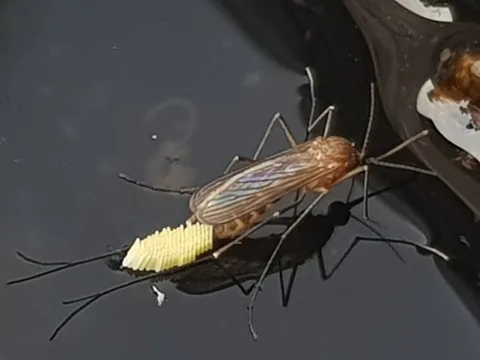 Southern House Mosquito
Culex quinquefasciatus
The southern house mosquito bites in the evening, at night and in the early morning, and Texas A&M calls it the most important carrier of West Nile virus and St. Louis encephalitis, especially in the eastern U.S. It prefers birds but will come through unscreened windows and open doors to bite sleeping people.
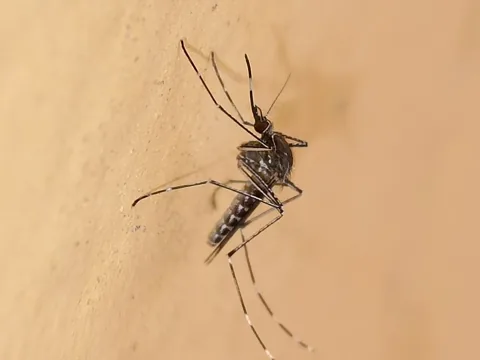 Western Encephalitis Mosquito
Culex tarsalis
The western encephalitis mosquito, Culex tarsalis, is a major carrier of West Nile virus in the western and central United States. A 15-year Iowa study called it the most important carrier of human infections there. It feeds on birds, where the virus multiplies, and also on people and horses.
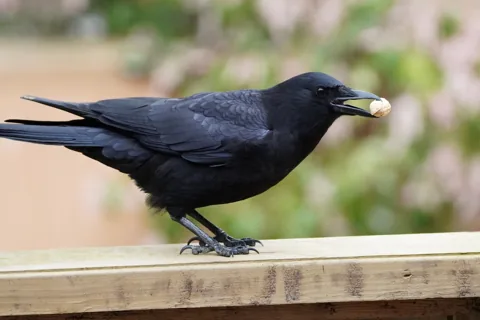 American crow
Corvus brachyrhynchos
The American crow is a large, all-black, highly intelligent bird that thrives around people. Most complaints involve big fall and winter roosts in towns, with noise and droppings, plus raided garbage and some crop damage.
Which mosquitoes spread it, and the bird connection
- CDC says West Nile virus cycles in nature between mosquitoes (especially Culex species) and birds. Some infected birds develop high levels of virus in their blood; mosquitoes that bite them become infected and, after about a week, can spread the virus when they bite. California's health department calls Culex mosquitoes the main type that spread West Nile.[1][2]
- People and horses are dead-end hosts. CDC says people don't develop enough virus in their blood to infect mosquitoes that bite them, and the Merck Veterinary Manual lists horses, humans and many other mammals as dead-end hosts.[1][14]
- Birds are the reservoir, and some species die from it. Merck says crows and jays are considered the most susceptible to severe illness and death from West Nile, though raptors, some songbirds and waterfowl can also die. That is why health departments track dead birds; the dead-bird page on this site covers safe handling and reporting.[14][1]
- People do not spread the virus to each other, except rarely through blood transfusion, organ transplantation, and from mother to baby during pregnancy, delivery or breastfeeding, CDC says. Washington's health department says it is not spread by direct contact with infected people or animals.[1][10]
Where and when people catch it
- Where: CDC says anyone who lives in or travels to an area where West Nile virus circulates is at risk, and all states in the contiguous United States have reported cases. Washington's health department says the virus is most often found in south central Washington, a reminder that risk varies within a state.[4][10]
- When: CDC says mosquito season starts in summer and continues through fall (typically June through October), and the number of people diagnosed typically peaks in late August to early September. MedlinePlus says mosquitoes carry the most virus in late summer and early fall, and cases drop as colder weather kills mosquitoes off.[3][8]
- Time of day: CDC advises avoiding being outside between dusk and dawn, when the mosquitoes that spread West Nile are most active. California's health department says these mosquitoes bite in the early morning and evening.[5][2]
- How common: CDC's About West Nile page (updated June 16, 2026) says about 2,000 people in the United States are diagnosed each year, and calls that an underestimate because most people have no symptoms or blame mild symptoms on something else. CDC says yearly counts can swing widely because of periodic epidemics. For this season's numbers, see the 2026 season check linked below.[3][6]
Symptoms: mostly mild, sometimes severe
- Timing: CDC says symptoms usually start 2 to 6 days after the bite of an infected mosquito, and can take longer in people with a weakened immune system. MedlinePlus gives a range of 1 to 14 days.[3][8]
- No symptoms: CDC says most infected people never develop any. Washington's health department puts it at 8 out of 10.[3][10]
- Mild illness (West Nile fever): CDC says about 20% of infected people develop fever with headache, body aches, joint pains, vomiting, diarrhea or rash. Most recover completely, but fatigue and weakness can last for weeks or months. MedlinePlus says these symptoms usually go away on their own within a few days to several weeks.[4][7]
- Severe (neuroinvasive) illness: CDC says less than 1% of infected people develop severe illness affecting the central nervous system, such as encephalitis (brain inflammation) or meningitis. Minnesota's health department and Washington's health department both give about 1 in 150. Symptoms can include high fever, headache, neck stiffness, stupor, disorientation, coma, tremors, convulsions, muscle weakness, vision loss, numbness and paralysis.[4][9][10]
- Recovery from severe illness can take several weeks or months, and CDC says some effects might be permanent. MedlinePlus lists permanent muscle weakness among the possible complications, and Washington's health department says severe disease can cause lasting neurologic effects or death.[4][8][10]
Who is at higher risk of severe illness
- Age: CDC says the risk of severe illness increases with age; people 65 and older are three times as likely to develop neurologic illness as people younger than 65. MedlinePlus and Washington's health department name people over age 60.[4][7][10]
- Health conditions: CDC, MedlinePlus and Washington's health department list chronic conditions such as cancer, diabetes, high blood pressure (hypertension) and kidney disease.[4][7][10]
- Weakened immune system: CDC includes people who take certain medicines for cancers, autoimmune and inflammatory conditions or to prevent rejection of a transplanted organ. MedlinePlus lists organ transplants, HIV/AIDS and recent chemotherapy.[4][7][8]
When to get medical care
- CDC says to seek immediate medical attention for high fever, neck stiffness, muscle weakness, confusion or tremors. MedlinePlus says muscle weakness, a stiff neck, weakness of one arm or leg, and confusion or trouble thinking clearly need prompt attention.[4][8]
- For milder symptoms, MedlinePlus says to contact your health care provider, particularly if you may have had contact with mosquitoes, and to go to an emergency room if you are very sick. Washington's health department also says to contact your provider if you have symptoms.[8][10]
- Tell the provider about mosquito bites and where you have been outdoors or traveled. CDC says providers diagnose West Nile based on signs and symptoms, history of possible exposure to mosquitoes that can spread it, and laboratory testing; MedlinePlus lists a blood test or spinal tap that checks for antibodies to the virus.[4][8]
Is there a treatment or vaccine?
- No medicine treats West Nile itself, CDC says. MedlinePlus explains that because it is a virus, antibiotics do not work, and supportive care in the hospital may help lower the risk of complications in severe illness. CDC says people with mild illness can often manage symptoms by resting and staying hydrated; ask a provider what is right for you.[4][3][8]
- There is no vaccine for people. CDC says no licensed vaccines or medicines are available to prevent West Nile in people, and MedlinePlus says there is no treatment to avoid infection after a mosquito bite. Minnesota's health department notes a vaccine does exist for horses.[5][8][9]
- CDC says people recently diagnosed with West Nile virus infection should not donate blood or bone marrow for 120 days after infection.[1]
Preventing West Nile
- Repellent: CDC says to use an insect repellent registered with EPA. Washington's health department lists the most effective active ingredients as DEET, picaridin, IR3535, oil of lemon eucalyptus, para-menthane-diol (PMD) and 2-undecanone. EPA's search tool lists only EPA-registered skin-applied repellents, and EPA says to always read the label before use.[5][10][11]
- Timing and clothing: CDC advises long, loose-fitting shirts and pants and avoiding being outside between dusk and dawn. Washington's health department adds treating clothing and gear with permethrin.[5][10]
- Keep them out: CDC says to use screens on windows and doors, or air conditioning if available. The indoor mosquito page linked below covers screens and indoor water.[5]
- Standing water: Washington's health department says to empty anything that holds standing water, such as tires, buckets, planters, toys, birdbaths, animal troughs and flowerpots; if it can't be emptied, cover it or change the water at least twice per week, and keep roof gutters draining. For permanent water, CDC says homeowners can consider mosquito dunks or other larvicides and can contact a local mosquito control program with questions.[10][5]
Horses, dogs and cats
- Horses: The Merck Veterinary Manual says many infected horses never show signs, but those that do can become very ill and some die. Early signs may be anxiety, a mild fever, lameness or just seeming unwell; later signs include muzzle twitching, wandering, head pressing, circling, trouble swallowing, tremors, poor coordination, weakness, paralysis and seizures. Call your veterinarian about any of these.[12]
- Merck says unvaccinated horses are at greater risk, older or unvaccinated horses are more likely to become severely ill, and vaccination is one of the best ways to prevent West Nile in horses. Minnesota's health department also says to contact your veterinarian for horse vaccine recommendations.[12][9]
- Merck lists cleaning water containers weekly, removing standing water, using fans safely in barns and using insect control products on horses as the label directs. It says horses usually do not spread the virus to people, who get infected mainly from mosquito bites, not from caring for a sick horse.[12]
- Dogs and cats: Merck says dogs and cats are rarely infected with West Nile through mosquito bites and remain clinically normal. Keep pets away from dead birds; the dead-bird page covers that.[13]
Common questions
- Can I get West Nile from a dead bird?
- CDC says the virus spreads to people mainly through mosquito bites, and advises using gloves or double plastic bags if you dispose of a dead bird. The dead-bird page on this site covers handling and who to report it to.[1]
- Can West Nile spread from person to person?
- Not through ordinary contact. CDC says it spreads between people only rarely, through blood transfusion, organ transplantation, or from mother to baby.[1][10]
- Does every mosquito bite carry West Nile?
- No. Only mosquitoes that picked up the virus from infected birds can spread it, CDC says, and Washington's health department says 8 out of 10 infected people do not get sick.[1][10]
- Is there a West Nile vaccine?
- Not for people. CDC says no licensed vaccines or medicines are available to prevent West Nile in people. Horses can be vaccinated, according to Merck and Minnesota's health department.[5][12][9]
- What time of day is riskiest?
- CDC says the mosquitoes that spread West Nile are most active between dusk and dawn.[5][2]
- Can my dog get West Nile?
- Rarely. The Merck Veterinary Manual says dogs and cats are rarely infected through mosquito bites and remain clinically normal.[13]
Sources
- U.S. Centers for Disease Control and Prevention, “West Nile: Causes and How It Spreads (reviewed July 15, 2026).” www.cdc.gov/west-nile-virus/causes/index.html (accessed 2026-11-14)
- California Department of Public Health (westnile.ca.gov), “West Nile Virus Frequently Asked Questions.” westnile.ca.gov/faq.php (accessed 2026-11-14)
- Centers for Disease Control and Prevention, “About West Nile.” www.cdc.gov/west-nile-virus/about/index.html (accessed 2026-11-14)
- Centers for Disease Control and Prevention, “Symptoms of West Nile.” www.cdc.gov/west-nile-virus/signs-symptoms/index.html (accessed 2026-11-14)
- Centers for Disease Control and Prevention, “Preventing West Nile.” www.cdc.gov/west-nile-virus/prevention/index.html (accessed 2026-11-14)
- Centers for Disease Control and Prevention, “Data and Maps for West Nile.” www.cdc.gov/west-nile-virus/data-maps/index.html (accessed 2026-11-14)
- MedlinePlus, U.S. National Library of Medicine, “West Nile Virus.” medlineplus.gov/westnilevirus.html (accessed 2026-11-14)
- MedlinePlus, U.S. National Library of Medicine, “West Nile virus infection (Medical Encyclopedia).” medlineplus.gov/ency/article/007186.htm (accessed 2026-11-14)
- Minnesota Department of Health, “About West Nile Virus.” www.health.state.mn.us/diseases/westnile/basics.html (accessed 2026-11-14)
- Washington State Department of Health, “West Nile Virus.” doh.wa.gov/you-and-your-family/illness-and-disease-z/west-nile-virus (accessed 2026-11-14)
- U.S. Environmental Protection Agency, “Find the Repellent that is Right for You.” www.epa.gov/insect-repellents/find-repellent-right-you (accessed 2026-11-14)
- Merck Veterinary Manual, “West Nile Encephalomyelitis in Horses (Horse Owners).” www.merckvetmanual.com/horse-owners/brain-spinal-cord-and-nerve-disorders-of-horses/west-nile-encephalomyelitis-in-horses (accessed 2026-11-14)
- Merck Veterinary Manual, “Mosquitoes of Animals.” www.merckvetmanual.com/integumentary-system/flies/mosquitoes-of-animals (accessed 2026-11-14)
- Merck Veterinary Manual, “West Nile Virus in Birds.” www.merckvetmanual.com/poultry/viral-encephalitides-in-birds/west-nile-virus-in-birds (accessed 2026-11-14)
Updated 2026-11-14. Built from sourced records. Spot an error? Tell us.