The short answer
- Don't touch it with bare hands, and keep kids and pets away from it. California's health department says it's extremely unlikely that you, a child or a pet would catch West Nile virus from a dead bird, and Illinois' health department says catching bird flu from handling one is unlikely, but both say to be careful anyway.[6][2]
- Before you throw it away, check whether your state or county wants it reported. CDC says to check with local and state agencies first; health departments and state wildlife agencies can tell you how reporting works where you live. In California, for example, the person who takes your report tells you whether to save the bird for pickup and testing or throw it away.[1][6]
- If you're told to throw it away, use disposable gloves or a plastic bag turned inside out to pick it up, seal it in a bag, put it in the trash, and wash your hands with soap and water.[1][6][2]
Related profiles on this site
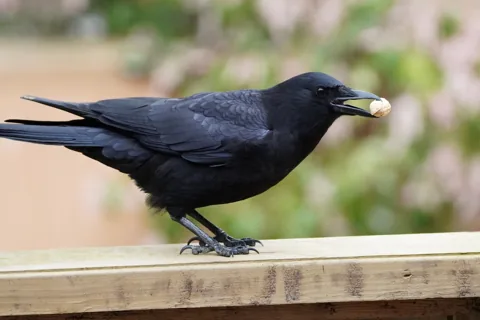 American crow
Corvus brachyrhynchos
The American crow is a large, all-black, highly intelligent bird that thrives around people. Most complaints involve big fall and winter roosts in towns, with noise and droppings, plus raided garbage and some crop damage.
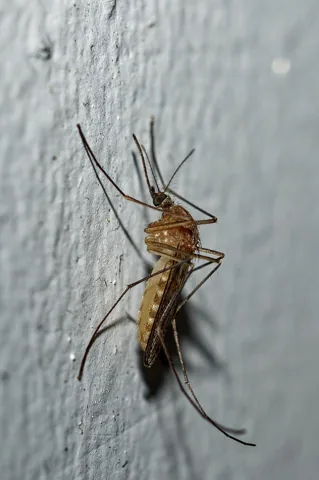 Northern House Mosquito
Culex pipiens
The northern house mosquito, Culex pipiens, is often the most common pest mosquito in cities and suburbs. It bites from dusk to dawn, breeds in stagnant and polluted water, and is a major carrier of West Nile virus in North America.
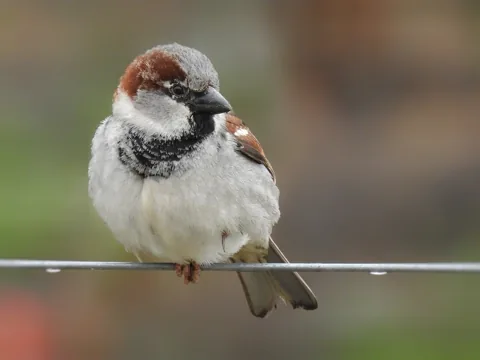 House sparrow (English sparrow)
Passer domesticus
The house sparrow is a small, chunky, non-native bird that thrives wherever people build farms, towns and cities. It packs messy nests into any sheltered gap on buildings, leaves droppings where it roosts, and drives native birds from nest boxes.
What probably killed it
You usually can't tell from looking. Agencies that test birds only take ones that are fresh and not obviously injured, and California decides whether a bird is testable based on the condition of the carcass and whether it's a species likely to have died from West Nile virus.[7][8]
- A window strike. The U.S. Fish and Wildlife Service says most fatal collisions happen at homes and buildings shorter than four stories, that birds are drawn toward reflections of plants and sky in the glass, and that many birds that hit a window seem fine at first but later die from their injuries. A bird found under a window or glass door fits this.[14]
- A cat. Cats have the highest estimate in the Fish and Wildlife Service's table of yearly U.S. bird deaths from human-related causes, above building glass, and the agency asks owners to keep cats indoors, on a leash or in a catio.[15]
- West Nile virus. Crows, jays, ravens and magpies are the birds most likely to get sick and die from it, according to San Mateo County's vector control district. Sick birds may move without coordination, seem weak and have trouble breathing.[7][6]
- Bird flu (H5N1). Illinois' health department flags waterfowl, other water birds and birds of prey as the main concern for avian influenza in wild birds, and the Merck Veterinary Manual says wild waterfowl and shorebirds often carry the virus without showing illness.[2][12]
- Salmonella from a bird feeder. CDC says birds can carry Salmonella while looking healthy and that it can spread between birds, to pets and to people. Utah State University Extension lists ruffled feathers, rapid breathing, weakness and diarrhea among the signs in sick songbirds. The bird feeder page linked below covers feeder outbreaks in detail.[4][5]
Is one dead bird a sign of more?
- One bird under a window is usually just that. Several dead birds, or sick birds showing up over a few days, is different. Utah State University Extension, citing Utah's wildlife agency, says to contact the state wildlife office if you see five or more dead birds in your yard or birds with signs of infection.[5]
- CDC asks people to report sick birds or unusual bird deaths to their state veterinarian or to USDA's toll-free line, 1-866-536-7593. If you keep backyard chickens, New Jersey's health department says owners should report sick birds or unexplained deaths right away; for small flocks that can mean one bird dying each day for two days in a row.[1][9]
- If the dead bird was near a feeder or bird bath, CDC says to take both down for two weeks and clean them outdoors.[4]
How to pick it up safely
Bird flu reaches people mainly through close, unprotected contact with infected birds, their saliva, mucus or droppings, or contaminated surfaces, CDC says. West Nile virus is different: CDC says it spreads by mosquito bite and not by touching live animals, though you should still avoid bare-handed contact with any dead animal. California adds that dead birds can leak fluids and have sharp beaks and claws.[1][3][6]
- Gear: disposable waterproof gloves and plastic bags. Illinois also suggests a raincoat or a trash bag over your clothes, and goggles plus an N95 mask if the bird is wet or splashing is possible.[2]
- Pick-up: use gloves or a plastic bag turned inside out, or scoop the bird with a shovel, into a plastic bag. Tie or seal it. Illinois says to double-bag it and put it in a trash can that children and animals can't get into.[6][2][1]
- After: take the gloves off first and bag them, don't touch your face, and wash your hands with soap and water. Illinois says to wash the clothes on a hot cycle and to disinfect shoes, either by soaking them for 10 minutes in 1 part bleach to 10 parts water or with a benzalkonium chloride spray.[2][6]
- Watch your health: Illinois says to call your local health department if you get flu-like symptoms within ten days of disposing of dead birds. CDC's guidance for people exposed to H5N1-infected animals is to watch for new respiratory symptoms or eye redness for 10 days after the last exposure.[2][11]
Who to report it to
Start with your state or local health department or your state wildlife agency; CDC points people to both. Programs differ a lot from state to state, so the examples below are just that.[1]
- California: report online at westnile.ca.gov or by calling 1-877-WNV-BIRD. California's health department asks especially for crows, jays, magpies, ravens, sparrows, finches and hawks, and staff may send someone to collect the bird for testing.[6][7]
- South Carolina: the state health department has asked residents to bring in recently dead crows, blue jays, house finches, house sparrows and other songbirds that aren't injured or decayed. It says to keep the bagged bird cool and to freeze it if you can't deliver it within 36 hours.[8]
- New Jersey: the state stopped routine West Nile testing of birds in 2016 because the virus is now expected in birds and mosquitoes statewide each year, but it still asks people to tell their county mosquito control agency about dead birds. For sick or dead wild birds it points to the state Division of Fish and Wildlife or USDA Wildlife Services.[9]
- Nationally, dead bird reports feed into ArboNET, the system state and local health departments use to send West Nile data to CDC.[10]
Keeping pets away from dead birds
- The Merck Veterinary Manual says H5N1 infections have been reported in cats and dogs, and that experimental infections have followed eating infected chickens or wild birds. FDA says cats are especially sensitive to H5N1, that dogs usually get milder illness, and that pets should be kept from hunting and eating wild birds.[12][13]
- FDA, citing the American Veterinary Medical Association, says to see a veterinarian if your cat or dog shows fever, lethargy, low appetite, red or inflamed eyes, eye or nose discharge, trouble breathing, or neurologic signs such as tremors, seizures, poor coordination or blindness.[13]
- West Nile is a smaller worry for pets: California's health department says dogs and cats can get it from mosquito bites but rarely get sick. CDC also notes that pets that have contact with wild birds can carry Salmonella to people, so wash your hands after handling a pet that got to a dead bird.[6][4]
What to do next
- If a window was the cause: the Fish and Wildlife Service recommends patterns on the outside of the glass, with marks at least 1/4 inch across and no more than 2 inches apart.[14]
- If you feed birds: clean feeders and bird baths at least monthly, outdoors when you can, and never in the kitchen, CDC says. Utah State University Extension recommends washing with soap and water, then soaking in a 10% bleach solution for 30 minutes, rinsing and drying.[4][5]
- If West Nile is active near you: the mosquitoes that bite birds also bite people. California's health department says to dump standing water in buckets, tires, birdbaths and pet bowls; the mosquito guides linked below go further.[6][3]
- If the bird was in your pool: California says there's no evidence pools can be contaminated with West Nile from a dead bird, but an untended pool can breed mosquitoes.[6]
Common questions
- Can I get West Nile virus from a dead bird?
- It's very unlikely. CDC says West Nile spreads to people through mosquito bites, and California's health department says people can't get it by touching or being around birds that have it. Use gloves anyway, since a dead bird can carry other germs.[3][6]
- Can I get bird flu from a dead bird in my yard?
- The risk is low but not zero. Illinois' health department calls it unlikely, while CDC advises avoiding direct contact with sick or dead wild birds and using protective gear if you must handle one.[2][1]
- Should I just throw it in the trash?
- Only after checking whether your area wants it reported. If local officials say to throw it away, CDC says a sealed bag in the regular trash is fine where allowed.[1][4]
- My dog or cat picked up a dead bird. What now?
- Take it away, wash your hands, and watch for signs FDA lists for H5N1 such as fever, lethargy, eye or nose discharge, trouble breathing or tremors. Call your veterinarian if any appear. Merck notes that infections in cats and dogs have followed eating infected birds.[13][12]
Photo credits
- American crow: Steven Smethurst, public domain (CC0), via iNaturalist
- Northern House Mosquito: (c) Donald Davesne, some rights reserved (CC BY) — via iNaturalist, CC BY 4.0
- House sparrow (English sparrow): (c) Esteban Poveda, some rights reserved (CC BY) — via iNaturalist, CC BY 4.0
Sources
- Centers for Disease Control and Prevention, “Preventing Bird Flu Infections.” www.cdc.gov/bird-flu/prevention/index.html (accessed 2026-11-14)
- Illinois Department of Public Health, “Safe Dead Bird Disposal (Less than 5 Birds).” dph.illinois.gov/topics-services/diseases-and-conditions/respiratory-disease/diseases/influenza/h5n1/dead-bird-disposal-less-than-5.html (accessed 2026-11-14)
- U.S. Centers for Disease Control and Prevention, “West Nile: Causes and How It Spreads (reviewed July 15, 2026).” www.cdc.gov/west-nile-virus/causes/index.html (accessed 2026-11-14)
- Centers for Disease Control and Prevention, “Salmonella Outbreak Linked to Wild Songbirds (posted Aug. 23, 2021).” archive.cdc.gov/www_cdc_gov/salmonella/typhimurium-04-21/index.html (accessed 2026-11-14)
- Utah State University Extension, “USU Extension: Steps to Limit Salmonella Outbreak from Bird Feeders.” www.usu.edu/today/story/usu-extension-steps-to-limit-salmonella-outbreak-from-bird-feeders (accessed 2026-11-14)
- California Department of Public Health (westnile.ca.gov), “West Nile Virus Frequently Asked Questions.” westnile.ca.gov/faq.php (accessed 2026-11-14)
- San Mateo County Mosquito and Vector Control District (California), “Report Dead Birds.” smcmvcd.org/report-dead-birds (accessed 2026-11-14)
- South Carolina Department of Public Health, “Residents Encouraged to Continue Submitting Dead Birds for Testing to Help DPH Track West Nile Virus (July 24, 2024).” dph.sc.gov/news/residents-encouraged-continue-submitting-dead-birds-testing-help-dph-track-west-nile-virus (accessed 2026-11-14)
- New Jersey Department of Health, “Recommendation to Discontinue Routine West Nile Virus (WNV) Bird Testing (Aug. 2, 2016).” nj.gov/health/cd/westnile/documents/discontinue_bird_testing_2016.pdf (accessed 2026-11-14)
- Centers for Disease Control and Prevention, “Data and Maps for West Nile.” www.cdc.gov/west-nile-virus/data-maps/index.html (accessed 2026-11-14)
- Centers for Disease Control and Prevention, “Highly Pathogenic Avian Influenza A(H5N1) Virus: Interim Recommendations for Prevention, Monitoring, and Public Health Investigations.” www.cdc.gov/bird-flu/prevention/hpai-interim-recommendations.html (accessed 2026-11-14)
- Merck Veterinary Manual, “Avian Influenza in Poultry and Wild Birds.” www.merckvetmanual.com/poultry/avian-influenza/avian-influenza (accessed 2026-11-14)
- U.S. Food and Drug Administration, Center for Veterinary Medicine, “FDA Outlines Ways to Reduce Risk of HPAI in Cats (Dec. 13, 2024).” www.fda.gov/animal-veterinary/cvm-updates/fda-outlines-ways-reduce-risk-hpai-cats (accessed 2026-11-14)
- U.S. Fish and Wildlife Service, “Threats to Birds: Collisions (Buildings & Glass).” www.fws.gov/story/threats-birds-collisions-buildings-glass (accessed 2026-11-14)
- U.S. Fish and Wildlife Service, “Threats to Birds.” www.fws.gov/library/collections/threats-birds (accessed 2026-11-14)