The short answer
- It's most likely a mouse or rat, especially if anyone has put out rodent bait. UC IPM says dead house mouse odors may result when poisoning is done inside buildings, and ICWDM says animals often die in walls and attics because of toxicants.[3][1][4]
- Try to find it: follow the flies and the strongest spot of the smell. If you can reach it, wear gloves, spray it with disinfectant, double-bag it and wash your hands, following CDC's dead-rodent steps.[5][1][11]
- If you can't reach it, the smell does fade. ICWDM says it lingers for days to weeks and goes away once the carcass dries out; an Ask Extension expert says it usually goes away within a week or two, depending on the size of the animal. Airing the room out helps.[1][2]
- Keep pets away from any dead rodent you find. Merck Veterinary Manual says pets can be poisoned by eating poisoned prey or carrion (relay toxicosis).[9][10]
Related pest profiles
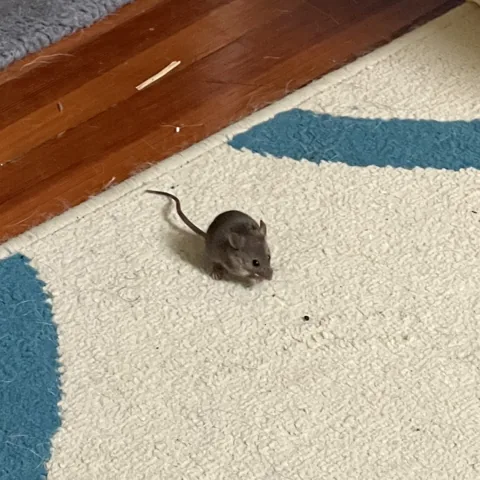 House Mouse
Mus musculus
The house mouse is a small, adaptable rodent that lives close to people in homes, schools and food businesses, eating and contaminating food, gnawing wiring and carrying disease.
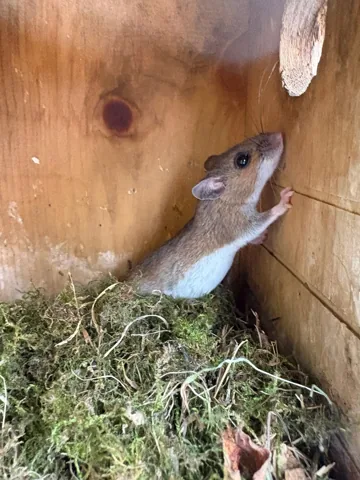 Deer Mouse
Peromyscus species (shown: P. maniculatus)
The deer mouse is a wild mouse with a white belly and a furred, two-toned tail that sometimes moves into cabins, sheds and homes. In the United States it spreads the most common hantavirus that causes hantavirus pulmonary syndrome (HPS), a severe and potentially deadly lung disease, so the droppings and nests it leaves need careful cleanup.
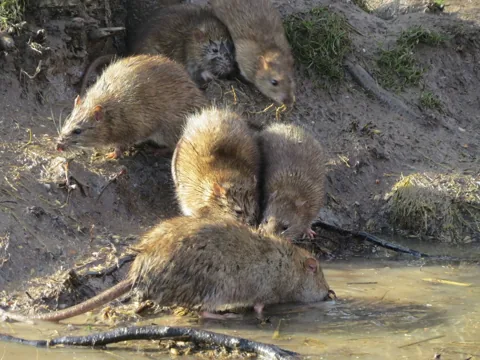 Norway Rat
Rattus norvegicus
The Norway rat, also called the brown or sewer rat, is a large, burrowing rat found throughout the contiguous United States wherever people live.
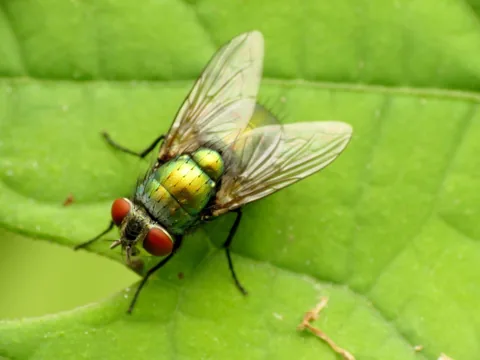 Common Green Bottle Fly
Calliphoridae (shown: Lucilia sericata)
A sudden crowd of shiny green or blue flies indoors often means an animal has died in a chimney, wall or ceiling. Outdoors, most blow flies come from garbage with food waste and from pet waste.
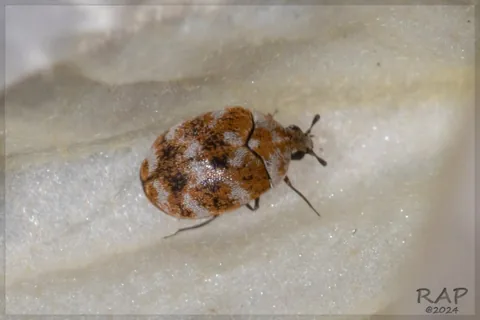 Varied Carpet Beetle
Anthrenus verbasci
Carpet beetles are small beetles whose larvae damage wool, silk, fur, feathers, leather and other animal products; the adults feed on pollen outdoors and often fly in through windows.
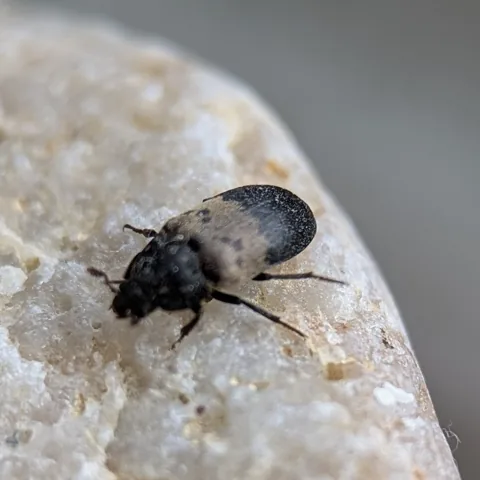 Larder Beetle
Dermestes lardarius
The larder beetle is a dermestid beetle named for its old attraction to larders and cured meats. Home curing is rare now, and it is more often found in dry pet food or feeding on dead insects trapped in attics and wall voids.
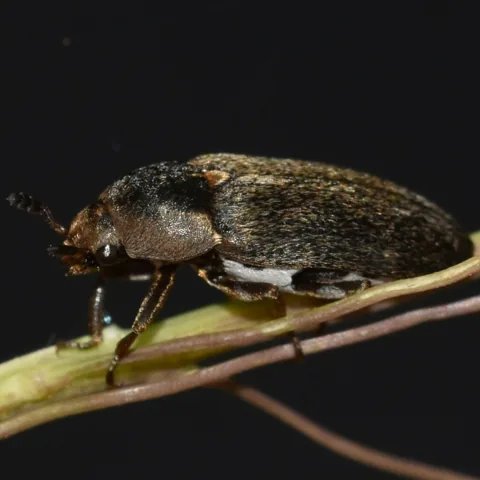 Hide Beetle
Dermestes maculatus
The hide beetle is a dark dermestid beetle that eats dead animal matter. In homes and storage it gets into dried fish and meat, dry pet food and treats, hides, fur and feathers, and museums and taxidermists keep colonies on purpose to clean skeletons. It doesn't bite or sting; the harm is to food, specimens and materials. To get rid of it, find and throw out the infested item, vacuum the area, and freeze or heat anything you want to keep. Sprays alone don't solve it.
What is it likely to be?
Rodents top the list. ICWDM says animals often die in walls and attics after poison baits are used, and it advises against poisons for mice because the odor problem can happen again. ICWDM's mouse guide says trapping avoids odor from carcasses that may remain when toxicants are used. UC IPM gives avoiding dead mouse odor as one advantage of trapping over poisoning inside buildings.[1][4][3]
Birds, squirrels and other animals that get into chimneys, attics and wall voids can die there too. Clemson says blow flies around a home suggest a dead mouse, squirrel, bird or stray animal, and Texas A&M lists dead birds or other animals in an attic or chimney as fly breeding sites.[13][12]
Bats are another cause. ICWDM notes similar odor problems when animals die in inaccessible spots, and Wisconsin's bat program and Delaware's wildlife division both warn that sealing bats out in summer can trap flightless young inside to die.[19][21][20]
- Signs it's a dead animal, per ICWDM: flies; a smell that starts faint, gets stronger and lingers for days to weeks; a putrid odor.[1]
- Other things that smell bad: ICWDM lists droppings and urine from bats, raccoons or flying squirrels, the musky smell of living animals, cracked wastewater pipes and stinkhorn fungi. UC IPM says a musky odor is common with large or long-term mouse infestations.[1][3]
How to find it
Follow the flies. University of Minnesota Extension says that when an animal dies hidden in a chimney, wall void or ceiling, a sudden crowd of adult blow flies may show up several days later. Clemson says blow and bottle flies should have you looking for a dead animal.[11][13]
Follow your nose to the strongest spot, and check the places animals use: attics, chimneys and wall voids (Texas A&M, Minnesota). Look carefully, because ICWDM warns that other living animals may still be around.[12][11][1]
Think before you cut. ICWDM does not recommend tearing a hole in the wall, because it's easy to be one stud off and end up making two holes. It suggests a fiber optic scope to see inside the wall without large holes.[1]
Texas A&M is frank that carcasses are sometimes difficult to find or out of reach.[12]
How long will the smell last?
Usually days to a few weeks. ICWDM says the odor lingers for days to weeks and disappears once the carcass dries out, and that larger carcasses take longer. An Ask Extension expert in Collin County, Texas, says it usually goes away within a week or two, depending on the size of the animal.[1][2]
While you wait: ICWDM says air flow dissipates the smell and that plain spray deodorant can help (test it first, since some can discolor surfaces). It is skeptical of ozone and ionizing machines, saying it has no firm scientific handle on their claims. The Ask Extension expert suggests opening windows and closing off the worst room.[1][2]
Safe removal and cleanup
CDC's steps for a dead rodent or nest: wear rubber or plastic gloves; spray the dead rodent, nest and surrounding area with disinfectant and let it soak for 5 minutes or as the label says; put it in a plastic bag with any used traps; tie the bag, put it in a second bag and tie that; throw it in a covered garbage can that is emptied regularly; wash gloved hands with soap and water or disinfectant, then take off the gloves and wash your hands with soap and warm water.[5]
For disinfectant, CDC says a household disinfectant or a fresh bleach solution of 1 part bleach to 9 parts water works. Fleas are common on rodents, so CDC suggests insect repellent on clothing, shoes and hands while you pick up dead rodents and nests.[5]
ICWDM recommends rubber gloves inside leather gloves, old clothes and a properly fitted HEPA filter mask when you search, since there may be infectious agents in the carcass.[1]
If there are droppings and nesting material too, follow the full hantavirus cleanup on our hantavirus safety page.[5]
- Dead bat: don't touch it with bare hands. CDC says to avoid touching bats and to contact your health department to have a bat tested for rabies if someone may have had contact with it.[16]
- Dead bird: CDC says to check with local and state agencies first, and if told to throw it away, not to touch it with bare hands but to use gloves or an inside-out plastic bag to put it in a garbage bag for the regular trash. Illinois' health department adds double-bagging, washing hands with soap and water, and not touching your face.[17][18]
Pets and poisoned rodents
Merck Veterinary Manual says pets and wildlife can be poisoned by eating poisoned prey or carrion, called relay toxicosis. With anticoagulant baits, signs of bleeding typically show up 3 to 7 days after a toxic dose, so a dog that ate a dead mouse can look fine at first. A vitamin K1 antidote exists, so call your veterinarian right away.[9][10]
EPA tells bait users to promptly remove and dispose of dead rodents so pets and wildlife can't eat them.[8]
Flies, maggots and beetles that follow
Blow flies (blue and green bottle flies) lay eggs on dead animals. Minnesota Extension says the maggots can reach full size by the second or third day after hatching in warm weather, then crawl away from the carcass to pupate, which is why you may find maggots on the floor below.[11][13]
Kill the adults with a flyswatter (Minnesota says a swatter works for small numbers), but the flies keep coming until the source is gone or dried out. Texas A&M says to remove the carcass if you can.[11][12]
Weeks later, beetles can move in. Kentucky Extension says carpet beetles proliferate on animal carcasses, bird nests and dead insects, and Clemson says their larvae often feed on dead animal material and in rodent and bird nests. If you see small fuzzy larvae or shed skins near the spot, see our carpet beetle guide.[14][15]
Stopping it happening again
Use snap traps indoors. CDC recommends snap traps and says to use poison or bait stations only for infestations that persist. UC IPM says trapping lets you get rid of the dead mice and avoid the odors poisoning can cause, and ICWDM says the same.[7][3][4]
If you do bait, search for dead rodents during and after baiting (EPA) and see our bait-station guide.[8]
Seal entry points. CDC says mice can fit through a hole the width of a pencil (1/4 inch), and suggests steel wool with caulk or spray foam for small holes.[6]
Don't seal animals in. Wisconsin's bat program and Delaware warn that summer bat exclusions can trap young bats inside to die; use the timing on our bat exclusion guide.[21][20]
When to call a pro
You can't find it, it's out of reach, or it's in a chimney or ceiling. Texas A&M notes carcasses are sometimes difficult to find or out of reach, and ICWDM suggests a fiber optic scope rather than guessing with holes.[12][1]
Animals may still be living there. ICWDM warns other living animals may be around while you search.[1]
It's a bat, or someone touched one. CDC says to contact animal control or your health department.[16]
Common questions
- How long does a dead mouse smell last in a wall?
- Days to weeks. ICWDM says it goes away once the carcass dries out, larger animals take longer, and an Ask Extension expert says usually within a week or two.[1][2]
- Should I cut a hole in the wall?
- Only once you're sure where it is. ICWDM says it's easy to be one stud off and need two holes, and suggests a fiber optic scope first.[1]
- Why are there big shiny flies in one room?
- Blow flies. Minnesota Extension says a sudden crowd of them may appear several days after an animal dies hidden in a wall, chimney or ceiling.[11][13]
- Is the smell dangerous?
- The bigger concern is handling the carcass and droppings. Follow CDC's glove, disinfect and double-bag steps, and use insect repellent for the fleas rodents carry.[5]
- Can my dog get sick from a poisoned mouse?
- Yes. Merck Veterinary Manual describes relay toxicosis from eating poisoned prey or carrion; call your veterinarian.[9][10]
Photo credits
- House Mouse: (c) Carrie Seltzer, some rights reserved (CC BY) — via iNaturalist, CC BY 4.0
- Deer Mouse: (c) Derek Duplessis, some rights reserved (CC BY) — via iNaturalist, CC BY 4.0
- Norway Rat: petehawkins, public domain (CC0), via iNaturalist
- Common Green Bottle Fly: (c) Katja Schulz, some rights reserved (CC BY) — via iNaturalist, CC BY 4.0
- Varied Carpet Beetle: (c) RAP, some rights reserved (CC BY) — via iNaturalist, CC BY 4.0
- Larder Beetle: (c) Nelson Chu Pavlosky, some rights reserved (CC BY) — via iNaturalist, CC BY 4.0
- Hide Beetle: kbkash, public domain (CC0), via iNaturalist
Sources
- Internet Center for Wildlife Damage Management, “Identifying and Responding to Wildlife Odors.” icwdm.org/?p=88 (accessed 2026-11-14)
- Ask Extension (Extension Foundation), “Dead animal odor (Ask Extension #371381, expert response, Collin County, Texas).” ask.extension.org/kb/faq.php?id=371381 (accessed 2026-11-14)
- University of California Statewide IPM Program, “Pest Notes: House Mouse.” ipm.ucanr.edu/home-and-landscape/house-mouse/ (accessed 2026-11-14)
- Internet Center for Wildlife Damage Management, “House Mouse Damage Prevention and Control Methods.” icwdm.org/species/rodents/house-mice/house-mouse-damage-prevention-and-control-methods/ (accessed 2026-11-14)
- Centers for Disease Control and Prevention, “How to Clean Up After Rodents.” www.cdc.gov/healthy-pets/rodent-control/clean-up.html (accessed 2026-11-14)
- Centers for Disease Control and Prevention, “How to Seal Up to Prevent Rodents.” www.cdc.gov/healthy-pets/rodent-control/seal-up.html (accessed 2026-11-14)
- Centers for Disease Control and Prevention, “How to Trap Up to Control Rodents.” www.cdc.gov/healthy-pets/rodent-control/trap-up.html (accessed 2026-11-14)
- U.S. Environmental Protection Agency, “Safely Use Rodent Bait Products.” www.epa.gov/rodenticides/safely-use-rodent-bait-products (accessed 2026-11-14)
- Merck Veterinary Manual, “Anticoagulant Rodenticide Poisoning in Animals.” www.merckvetmanual.com/toxicology/rodenticide-poisoning/anticoagulant-rodenticide-poisoning-in-animals (accessed 2026-11-14)
- Merck Veterinary Manual, “Overview of Rodenticide Poisoning.” www.merckvetmanual.com/toxicology/rodenticide-poisoning/overview-of-rodenticide-poisoning (accessed 2026-11-14)
- University of Minnesota Extension, “Flies.” extension.umn.edu/garden-and-home/home-maintenance/household-insects/flies (accessed 2026-11-14)
- Texas A&M AgriLife Extension Service, “Indoor Flies and Their Control.” agrilifeextension.tamu.edu/library/insects/indoor-flies-and-their-control/ (accessed 2026-11-14)
- Clemson Cooperative Extension Home & Garden Information Center, “Nuisance Flies (HGIC).” hgic.clemson.edu/factsheet/nuisance-flies/ (accessed 2026-11-14)
- University of Kentucky Entomology, “ENTFACT-601: Carpet Beetles.” entomology.mgcafe.uky.edu/ef601 (accessed 2026-11-14)
- Clemson Cooperative Extension Home & Garden Information Center, “Fabric Pest Control (HGIC 2490).” hgic.clemson.edu/factsheet/controlling-fabric-pests/ (accessed 2026-11-14)
- Centers for Disease Control and Prevention, “Preventing Rabies from Bats.” www.cdc.gov/rabies/exposure/animals/bats.html (accessed 2026-11-14)
- Centers for Disease Control and Prevention, “Preventing Bird Flu Infections.” www.cdc.gov/bird-flu/prevention/index.html (accessed 2026-11-14)
- Illinois Department of Public Health, “Safe Dead Bird Disposal (Less than 5 Birds).” dph.illinois.gov/topics-services/diseases-and-conditions/respiratory-disease/diseases/influenza/h5n1/dead-bird-disposal-less-than-5.html (accessed 2026-11-14)
- Internet Center for Wildlife Damage Management, “Bat Damage Identification.” icwdm.org/species/other-mammals/bats/bat-damage-identification/ (accessed 2026-11-14)
- Delaware Department of Natural Resources and Environmental Control, Division of Fish and Wildlife, “Best Management Practices for Bat Exclusions.” documents.dnrec.delaware.gov/fw/conservation/bats/Best%20Management%20Practices%20for%20Bat%20Exclusions%20-%20Dec%202010.pdf (accessed 2026-11-14)
- Wisconsin Bat Program, Wisconsin Department of Natural Resources, “Bat Exclusion: A Proven Solution (method used by the Wisconsin Bat Program).” www.wiatri.net/inventory/bats/aboutBats/pdf/BatExclusion.pdf (accessed 2026-11-14)