The short answer
- Don't pick it up bare-handed or sweep it up. Put on rubber or plastic gloves, spray the mouse and the area around it with disinfectant or a bleach solution (1.5 cups of household bleach in 1 gallon of water) and let it soak before you touch it (CDC). Washington's Department of Health gives the same bleach mix.[1][6]
- Double-bag it: put it in a plastic bag, knot the bag, put that in a second bag and knot it, then put it in a covered garbage can. Wash your gloved hands, take the gloves off, then wash your hands with soap and warm water (CDC).[1]
- Keep pets away from it. A mouse that ate rodent bait can poison a dog or cat that eats it; NPIC calls this secondary poisoning, and EPA says to remove dead rodents promptly to protect pets and wildlife.[11][14]
- Then look for droppings, gnaw marks and nests. CDC says those are the main signs mice are present, and UC IPM says house mice breed so fast that a few can become many within months.[3][8]
Profiles on this site
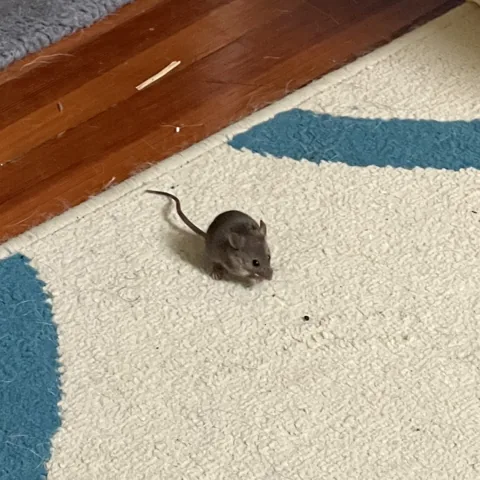 House Mouse
Mus musculus
The house mouse is a small, adaptable rodent that lives close to people in homes, schools and food businesses, eating and contaminating food, gnawing wiring and carrying disease.
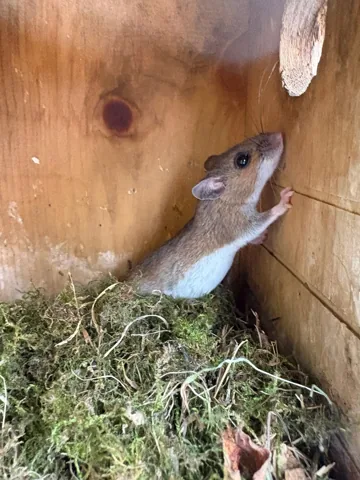 Deer Mouse
Peromyscus species (shown: P. maniculatus)
The deer mouse is a wild mouse with a white belly and a furred, two-toned tail that sometimes moves into cabins, sheds and homes. In the United States it spreads the most common hantavirus that causes hantavirus pulmonary syndrome (HPS), a severe and potentially deadly lung disease, so the droppings and nests it leaves need careful cleanup.
Does one dead mouse mean there are more?
Often, yes, or at least it means mice have been getting in. Mice are mostly active at night and hard to see, so NPIC says signs of chewing, nesting and droppings are how a mouse problem is usually found. Utah State University Extension says most mice roam a house undetected at night.[10][9]
House mice multiply quickly. UC IPM says a female may have 5 to 10 litters of about 5 or 6 pups in a year, and young are sexually mature 5 to 6 weeks after birth. USU Extension says a pair can produce several litters within months.[8][9]
UC IPM lists the main causes of house mouse death as disease, predation, human management, climate-related challenges and starvation. A mouse found dead in the open may have been caught by a cat, killed by a trap, or poisoned by bait set by you, a previous owner or a neighbor; you usually can't tell which by looking, so handle every dead mouse as possibly poisoned around pets.[8][11]
- One dead mouse and nothing else: clean up, then check the places below over the next week or two. CDC says one way to be sure rodents are still active is to clean an area and see if new droppings appear.[3]
- Droppings, gnaw marks or a musky smell as well: you have an active infestation. UC IPM says the musky odor is common in large or long-term infestations; see I saw a mouse in my house and I found mouse droppings for what to do.[8]
- A mouse seen running in daytime: USU Extension says daytime sightings could mean several mice are in the house.[9]
How to clean up a dead mouse (CDC steps)
These are CDC's steps for a dead rodent. Don't vacuum or sweep droppings or nesting material near it; CDC says that can put virus particles into the air you breathe.[1]
- 1. Put on rubber or plastic gloves. CDC also suggests insect repellent on clothing, shoes and hands, because fleas are common on rodents.[1]
- 2. Spray the dead mouse, any nest and the surrounding area with disinfectant until wet and let it soak for 5 minutes, or as long as the disinfectant label says (CDC). Washington's Department of Health says to soak for 10 minutes; use the longer time if unsure.[1][6]
- 3. Put the mouse (and the trap, if you won't reuse it) in a plastic bag, tie it shut, place it in a second bag and tie that shut (CDC). Washington DOH says to double-bag it with all cleaning materials.[1][6]
- 4. Throw the bag in a covered garbage can that is emptied regularly, or ask your state health department about other ways to dispose of it (CDC). Washington DOH and UC IPM also allow burying it.[1][6][8]
- 5. Wipe up any droppings or urine with paper towels after soaking, then disinfect the spot (CDC).[1]
- 6. Wash gloved hands with soap and water or disinfectant before taking the gloves off, then wash bare hands with soap and warm water (CDC, Washington DOH).[1][6]
- Reusing a snap trap: CDC says to submerge the trap with the mouse in disinfectant in a bucket for 5 minutes while wearing gloves, then hold it over a plastic bag and lift the bar so the mouse drops in.[1]
Is a dead mouse dangerous to people?
The main concern is breathing in contaminated dust from droppings, urine or nesting material. CDC says rodent diseases are mainly spread to people this way, which is why it says to wet everything first and never sweep or vacuum it.[1][3]
Deer mice can carry hantavirus. MedlinePlus says anyone who has been around rodents and develops fever, deep muscle aches and severe shortness of breath should see a health care provider immediately. If the dead mouse was in a cabin, shed or other closed-up space, or there is a lot of nesting material, follow the hantavirus safety guide, which covers airing out the space for 30 minutes first and heavy infestations.[7][1]
Could the dead mouse poison my dog or cat?
Yes, if it ate rodent bait. NPIC says eating poisoned prey is called secondary poisoning or relay toxicosis, and the Merck Veterinary Manual lists relay toxicosis from prey or scavenged carrion as a route of anticoagulant poisoning, and its rodenticide overview says the newer, more potent baits raised the risk to pets and wildlife that eat poisoned prey or carrion.[11][13][12]
NPIC says the rodenticides with the greatest secondary poisoning risk to dogs, cats and wild mammals are chlorophacinone, diphacinone, bromadiolone and brodifacoum, and that bromethalin and cholecalciferol may pose secondary risks that have not been measured. Single-dose anticoagulants can build up in the mouse, and residues may stay in liver tissue for weeks.[11]
Signs can be delayed. NPIC says anticoagulant signs may be delayed up to five days; the Merck Veterinary Manual says bleeding is typically noted 3-7 days after a toxic dose. Signs include weakness, lethargy, trouble breathing, pale gums and bleeding (NPIC, Merck). If your pet ate a dead mouse, call your veterinarian or NPIC rather than waiting for signs.[11][13]
To lower the risk, NPIC and EPA both say to search for, collect and dispose of poisoned rodents promptly, use gloves, and keep trash can lids secured so pets and wildlife can't reach them.[11][14]
Where to look next
CDC says the first signs of rodents usually appear before you see one, and regular inspection inside and outside the home makes them easier to control before they become established.[3]
- Cabinets, drawers and other out-of-sight spots: CDC says droppings are common there. Mouse droppings are pointed at one end and often contain hair (CDC).[3]
- Within about 30 feet of where you found it: UC IPM says house mice seldom travel more than 30 feet from their nest and food.[8]
- Gnaw marks, and nests of finely shredded paper or other fibrous material in sheltered spots (UC IPM, CDC).[8][3]
- Gaps around pipes, vents and doors: UC IPM says house mice can squeeze under gaps 1/4 inch tall, and USU Extension says to seal openings larger than 1/4 inch with mortar, sheet metal or heavy hardware cloth.[8][9]
- A bad smell days later: poisoned mice can die where you can't reach them. UC IPM says trapping avoids the dead-mouse odors that can follow poisoning inside buildings; see I smell a dead animal in my wall.[8]
What to do next
CDC's approach is seal up, trap up, clean up: seal holes inside and outside the home, trap the mice that are already inside, then clean up safely. CDC says to check traps daily and dispose of dead rodents right away.[5][4][3]
UC IPM says trapping is the preferred method in homes where only a few mice are present, and it lets you see and remove what you catch. If you use bait, NPIC and EPA say to keep it in bait stations out of reach of children and pets.[8][11][14]
Call a pro if you keep finding droppings after cleanup, or if rodents have got into heating and cooling ducts; CDC says to contact a professional rodent service when there is evidence of rodents in ventilation systems.[3][1]
Common questions
- Can I just pick up a dead mouse with a paper towel?
- CDC says to wear rubber or plastic gloves, spray the mouse and surrounding area with disinfectant and let it soak first, then double-bag it. A paper towel alone doesn't protect you, and picking it up dry can stir up contaminated material.[1]
- How long should the disinfectant soak?
- CDC says 5 minutes, or as long as the disinfectant label says. Washington's Department of Health says 10 minutes for bleach solution. Using the longer time does no harm.[1][6]
- My dog ate a dead mouse. What should I do?
- Call your veterinarian, or NPIC to speak with a pesticide specialist, even if your dog seems fine. NPIC says anticoagulant signs can take up to five days to show, and Merck says bleeding is typically seen 3-7 days after a toxic dose.[11][13]
- Is a dead mouse in the yard a problem?
- It can be for pets and wildlife if it was poisoned. EPA says to promptly remove and dispose of dead rodents so pets and wildlife don't eat them, and NPIC says many baits can harm wildlife that eat a recently poisoned rodent.[14][11]
Photo credits
- House Mouse: (c) Carrie Seltzer, some rights reserved (CC BY) — via iNaturalist, CC BY 4.0
- Deer Mouse: (c) Derek Duplessis, some rights reserved (CC BY) — via iNaturalist, CC BY 4.0
Sources
- Centers for Disease Control and Prevention, “How to Clean Up After Rodents.” www.cdc.gov/healthy-pets/rodent-control/clean-up.html (accessed 2026-11-14)
- Centers for Disease Control and Prevention, “Hantavirus Prevention.” www.cdc.gov/hantavirus/prevention/index.html (accessed 2026-11-14)
- Centers for Disease Control and Prevention, “Controlling Wild Rodent Infestations.” www.cdc.gov/healthy-pets/rodent-control/index.html (accessed 2026-11-14)
- Centers for Disease Control and Prevention, “How to Trap Up to Remove Rodents.” www.cdc.gov/healthy-pets/rodent-control/trap-up.html (accessed 2026-11-14)
- Centers for Disease Control and Prevention, “How to Seal Up to Prevent Rodents.” www.cdc.gov/healthy-pets/rodent-control/seal-up.html (accessed 2026-11-14)
- Washington State Department of Health, “Hantavirus.” doh.wa.gov/you-and-your-family/illness-and-disease-z/hantavirus (accessed 2026-11-14)
- MedlinePlus, National Library of Medicine, “Hantavirus Infections.” medlineplus.gov/hantavirusinfections.html (accessed 2026-11-14)
- University of California Statewide IPM Program, “House Mouse (Pest Notes).” ipm.ucanr.edu/home-and-landscape/house-mouse/ (accessed 2026-11-14)
- Utah State University Extension, “Should You Worry About Mice?.” extension.usu.edu/archive/should-you-worry-about-mice (accessed 2026-11-14)
- National Pesticide Information Center, “Mice.” npic.orst.edu/pest/mice.html (accessed 2026-11-14)
- National Pesticide Information Center, “Rodenticides Fact Sheet.” npic.orst.edu/factsheets/rodenticides.html (accessed 2026-11-14)
- Merck Veterinary Manual, “Overview of Rodenticide Poisoning in Animals.” www.merckvetmanual.com/toxicology/rodenticide-poisoning/overview-of-rodenticide-poisoning (accessed 2026-11-14)
- Merck Veterinary Manual, “Anticoagulant Rodenticide Poisoning in Animals.” www.merckvetmanual.com/toxicology/rodenticide-poisoning/anticoagulant-rodenticide-poisoning-in-animals (accessed 2026-11-14)
- US Environmental Protection Agency, “Safely Use Rodent Bait Products.” www.epa.gov/rodenticides/safely-use-rodent-bait-products (accessed 2026-11-14)