The short answer
- Check the tail. A deer mouse's tail is sharply bicolored, dark on top and white underneath, and furred. A house mouse's tail is one color and nearly hairless, with obvious scale rings. UC IPM calls the bicolored tail the easiest way to tell a deer mouse from a house mouse.[1][4][3][5]
- Check the belly and feet. Deer mice have white undersides, legs and feet, with a distinct line where the brown back meets the white belly. House mice are gray-brown with a gray or buff belly.[1][2][4][3]
- Check the eyes and ears. Deer mice and white-footed mice have larger eyes and ears than house mice. House mice have small, black eyes.[4][1][2]
- Think about the place. House mice live close to people in homes, schools and food businesses. Deer mice aren't common in towns unless large parks or fields are nearby, and they often move into vacated homes, cabins and other buildings.[2][1]
Profiles on this site
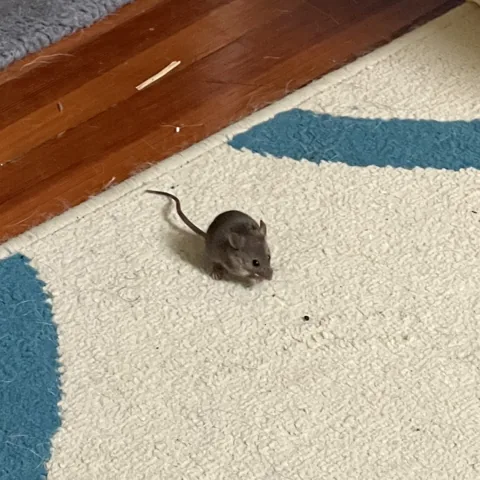 House Mouse
Mus musculus
The house mouse is a small, adaptable rodent that lives close to people in homes, schools and food businesses, eating and contaminating food, gnawing wiring and carrying disease.
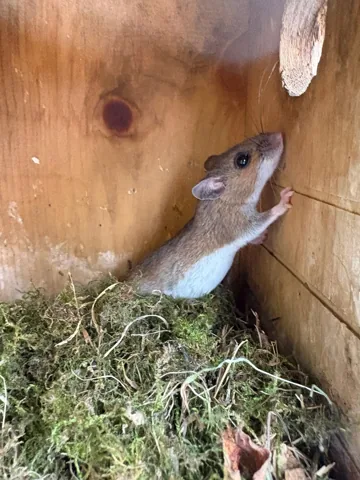 Deer Mouse
Peromyscus species (shown: P. maniculatus)
The deer mouse is a wild mouse with a white belly and a furred, two-toned tail that sometimes moves into cabins, sheds and homes. In the United States it spreads the most common hantavirus that causes hantavirus pulmonary syndrome (HPS), a severe and potentially deadly lung disease, so the droppings and nests it leaves need careful cleanup.
Side by side
Each line compares the house mouse (Mus musculus) with the deer mouse (Peromyscus maniculatus). The white-footed mouse (Peromyscus leucopus) looks and behaves much like the deer mouse; see the next section.[2][1][4]
- Size: an adult house mouse is about 5 to 7 inches long, including the 3- to 4-inch tail, according to UC IPM; ICWDM gives a body length of 3 to 4 inches and a tail of 2 to 4 inches. ICWDM says deer mice are about 3 to 4 inches long plus the tail, and the Missouri Department of Conservation gives a total length of 4 3/8 to 8 inches, usually 6 inches or less.[2][3][4][5]
- Weight: house mice typically weigh 0.4 to 0.9 ounces (ICWDM). Missouri gives deer mice a weight of 1/3 to 1 ounce.[3][5]
- Color: house mice are gray-brown with a gray or buff-colored belly. Deer mice are grayish to reddish brown on the back and sides, sharply marked off from white (sometimes grayish) underparts, with white legs and feet.[3][2][5][1]
- Tail: the house mouse tail is nearly hairless with obvious scale rings. The deer mouse tail is moderately to well furred and sharply bicolored, white on the bottom and dark on top.[3][2][5][1][4]
- Eyes and ears: house mice have small, black, somewhat protruding eyes and large, sparsely haired ears. Deer mice have large, protruding black eyes and large, scantily furred ears; ICWDM says Peromyscus mice have larger eyes and ears than house mice.[3][2][5][4]
- Odor: a musky odor is a sign of house mice, and UC IPM says it is commonly associated with them. ICWDM says white-footed and deer mice do not have the characteristic mousy odor of house mice.[3][2][4]
- Where they live: house mice often live near people, in and around homes, schools, food facilities and restaurants; in farm country they favor taller vegetation such as hedgerows. Deer mice live in forests, grasslands, scrublands and farmland, and aren't common in urban and residential areas unless large or numerous parks or fields are nearby.[2][1]
- Buildings they pick: deer mice often enter vacated homes, cabins and other structures, where they build nests and store food. House mice seldom venture more than 30 feet from their nest sites and food supply.[1][2]
- Food habits: house mice nibble, eating in about 200 small meals each night. Deer mice cache food and store some near their nests, especially in autumn when tree seeds and nuts are plentiful.[2][1]
- Season: Missouri says deer mice commonly enter buildings in the fall. UC IPM says deer mice nest in family groups through the winter and don't usually breed in winter, though in warm regions they may breed year-round. House mice with plentiful, stable food and shelter can reproduce year-round.[5][1][2]
- Breeding: a female house mouse may have 5 to 10 litters a year of about 5 or 6 pups each. Deer mouse litters are typically three to six young, and Missouri says the main mating periods are spring and fall.[2][1][5]
- Signs: nests, droppings and other signs left by deer mice are similar to those of house mice, so droppings alone won't tell you which mouse you have. House mouse droppings average 1/4 inch long.[1][4][3]
- Disease: CDC says the most common hantavirus that causes hantavirus pulmonary syndrome in the United States is spread by the deer mouse. CDC says lymphocytic choriomeningitis (LCM) is spread by the common house mouse.[6][9]
Where the white-footed mouse fits in
The deer mouse and the white-footed mouse are the two most common and widely distributed of the native Peromyscus mice in the United States, and ICWDM says all Peromyscus species are often called white-footed mice or deer mice. UC IPM's deer mouse guide even gives white-footed mouse as another name for the deer mouse.[4][1]
All Peromyscus mice have white feet, usually white undersides and brownish upper parts. ICWDM says white-footed mice are about 3.5 to 4 inches long, not counting the tail. The deer mouse and some other species have a sharp line between the brown back and white belly and a sharply bicolored tail; Missouri says the white-footed mouse is usually larger, with a slightly longer tail that lacks that sharp color contrast.[4][5]
Range and habitat differ. The deer mouse is found throughout most of North America; the white-footed mouse is found in the United States east of the Rocky Mountains except in parts of the Southeast. In Missouri, the deer mouse lives mostly in open fields, pastures and fencerows, while the white-footed mouse lives mostly in wooded areas.[4][5]
Even experts struggle. ICWDM says it is difficult even for an expert to tell all the Peromyscus species apart, and UC IPM says they are hard to tell from one another. ICWDM adds that all Peromyscus species cause similar problems and need similar solutions, so for a homeowner the key split is house mouse vs any white-bellied, bicolor-tailed Peromyscus mouse.[4][1]
Why the difference matters
Hantavirus: CDC says people get hantavirus mainly from contact with rodent urine, droppings and saliva. When fresh urine, droppings or nesting materials of an infected rodent are stirred up, the virus can get into the air and be breathed in. A bite or scratch can also spread it, but that is rare.[6][7]
LCM: CDC says people can get LCM when they are exposed to fresh urine, droppings, saliva or nesting materials from infected rodents, and that the virus is spread by the common house mouse.[9]
So clean up carefully after any mouse. CDC's cleanup advice applies whenever mice or rats are in or around your home, not just when you are sure they are deer mice. The full steps are on our hantavirus safety guide.[7][8]
Control choices differ a little too. UC IPM says to avoid glue boards for deer mice, because trapped mice urinate and defecate as they struggle. For house mice, which stay close to their nests, UC IPM says to space traps no more than about 10 feet apart where they are active.[1][2]
How to confirm which mouse you have
Droppings and nests look alike, so you need to see the mouse itself, alive in a photo or dead in a trap.[1][4]
- Photo tips: get a side view that shows the tail and the line between back and belly. A white belly and feet with a tail that is dark above and white below points to a deer mouse or white-footed mouse; an all gray-brown mouse with a scaly, nearly bare tail points to a house mouse.[1][4][3]
- Trapped mouse: don't pick it up bare-handed. CDC says to wear rubber or plastic gloves, spray the dead rodent and nest with disinfectant, let it soak 5 minutes or as the label says, and submerge a trap holding a rodent in disinfectant for 5 minutes. Then you can turn it over to check the belly and tail.[8]
- Smell: a musky odor points to house mice; ICWDM says deer and white-footed mice lack that mousy odor.[3][4]
- Food stores: stashes of seeds, acorns or nuts near a nest fit deer mice, which cache food especially in autumn.[1]
- Tracking patch: ICWDM suggests a patch of flour rolled smooth and left overnight in a pathway to show whether rodents are active. It confirms activity, not which mouse.[3]
What to do for each
Air out before you clean: CDC says to open all doors and windows for 30 minutes before cleaning and leave the area during that time.[8]
Never sweep or vacuum droppings: CDC says this can put tiny droplets carrying viruses into the air. Spray urine and droppings with a disinfectant or a fresh bleach solution of 1 part bleach to 9 parts water until very wet, let it soak 5 minutes or as the label directs, and wipe up with paper towels.[8]
Seal entry points: UC IPM says mice can get in through openings as small as 1/4 inch, and exclusion is the most successful and permanent form of house mouse control. Seal cracks with wire screen or coarse steel wool.[2]
House mice: trapping works well as a first step in homes and garages; set snap traps along walls, behind objects and where droppings are found. See our guide to getting rid of mice in the house.[2]
Deer mice: use snap traps rather than glue boards, and follow the cleanup steps for cabins, sheds and other closed-up buildings in our hantavirus safety guide before you sweep anything out.[1][8]
Common questions
- Do house mice carry hantavirus?
- CDC says the most common hantavirus that causes hantavirus pulmonary syndrome in the United States is spread by the deer mouse. House mice are linked to other diseases, such as LCM, so CDC's careful cleanup steps apply to any mouse.[6][9][7]
- What is the quickest way to tell a deer mouse from a house mouse?
- Look at the tail. A deer mouse's tail is furred and sharply two-toned, dark on top and white underneath. A house mouse's tail is one color and nearly hairless with scale rings.[1][4][3]
- Is a white-footed mouse the same as a deer mouse?
- They are separate species in the same genus, Peromyscus, but they look so similar that the names are often used for all Peromyscus mice. Missouri says the white-footed mouse is usually a little larger and its tail lacks the sharp two-tone contrast of the deer mouse's.[4][5]
- Why do I find deer mice in my cabin but house mice in my house?
- Deer mice live in forests, grasslands and farmland and often move into vacated homes, cabins and other structures, especially in fall. House mice live close to people year-round.[1][5][2]
- Can I tell them apart by droppings?
- No. ICWDM and UC IPM both say nests, droppings and other signs of deer mice are similar to those of house mice.[4][1]
Photo credits
- House Mouse: (c) Carrie Seltzer, some rights reserved (CC BY) — via iNaturalist, CC BY 4.0
- Deer Mouse: (c) Derek Duplessis, some rights reserved (CC BY) — via iNaturalist, CC BY 4.0
Sources
- UC Statewide IPM Program, “Pest Notes: Deer Mouse (Publication 74161).” ipm.ucanr.edu/PMG/PESTNOTES/pn74161.html (accessed 2026-11-14)
- UC Statewide IPM Program, “Pest Notes: House Mouse (Publication 7483).” ipm.ucanr.edu/PMG/PESTNOTES/pn7483.html (accessed 2026-11-14)
- Internet Center for Wildlife Damage Management, “House Mice.” icwdm.org/species/rodents/house-mice/ (accessed 2026-11-14)
- Internet Center for Wildlife Damage Management, “Deer and White-footed Mice.” icwdm.org/species/rodents/deer-and-white-footed-mice/ (accessed 2026-11-14)
- Missouri Department of Conservation, “Deer Mouse (field guide).” mdc.mo.gov/discover-nature/field-guide/deer-mouse (accessed 2026-11-14)
- Centers for Disease Control and Prevention, “About Hantavirus.” www.cdc.gov/hantavirus/about/index.html (accessed 2026-11-14)
- Centers for Disease Control and Prevention, “Hantavirus Prevention.” www.cdc.gov/hantavirus/prevention/index.html (accessed 2026-11-14)
- Centers for Disease Control and Prevention, “How to Clean Up After Rodents.” www.cdc.gov/healthy-pets/rodent-control/clean-up.html (accessed 2026-11-14)
- Centers for Disease Control and Prevention, “About Lymphocytic Choriomeningitis.” www.cdc.gov/lymphocytic-choriomeningitis/about/index.html (accessed 2026-11-14)