The short answer
- Look at the face. A shrew has a long, pointed snout that sticks out well past the mouth and tiny, beady eyes. A house mouse has a shorter muzzle, relatively large ears and small black eyes.[1][2][7]
- Look at the ears. A shrew's small ears are covered or nearly covered by its short, velvety fur, so it can look earless. A mouse's ears stand out.[2][1][7]
- Count the toes and check the teeth. Shrews have five toes on each foot; most mice have four toes on their front feet. Shrew teeth are sharp and pointed, often stained dark, while mice have chisel-like gnawing incisors.[2][4][1]
Animals on this page
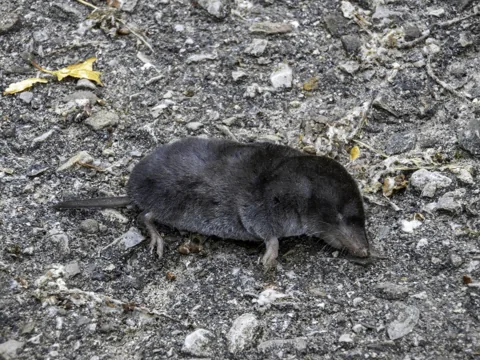 Shrews (northern short-tailed shrew)
Soricidae (e.g., Blarina brevicauda)
Shrews are small insect-eating mammals with long, pointed snouts and tiny eyes. They are mouselike but not mice, and the wildlife damage handbook notes that most species have no significant negative impact and aren't abundant enough to be pests. They eat large numbers of insects, including lawn and crop pests. This page uses the common northern short-tailed shrew as its main example.
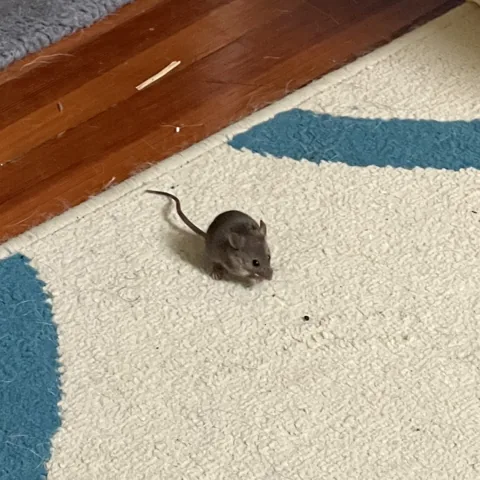 House Mouse
Mus musculus
The house mouse is a small, adaptable rodent that lives close to people in homes, schools and food businesses, eating and contaminating food, gnawing wiring and carrying disease.
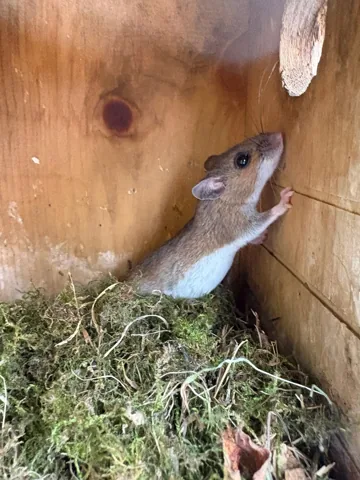 Deer Mouse
Peromyscus species (shown: P. maniculatus)
The deer mouse is a wild mouse with a white belly and a furred, two-toned tail that sometimes moves into cabins, sheds and homes. In the United States it spreads the most common hantavirus that causes hantavirus pulmonary syndrome (HPS), a severe and potentially deadly lung disease, so the droppings and nests it leaves need careful cleanup.
Side by side
What they are: house mice are rodents. Shrews belong to the family Soricidae in the order Eulipotyphla, with moles and hedgehogs; older references put them in Insectivora. MDC says shrews are more closely related to moles than to any other Missouri mammals.[7][1][3]
- Snout: shrews have an elongated head with a flexible, often movable snout that projects over and beyond the mouth. The Pennsylvania Game Commission says shrew noses are more pointed than those of mice.[1][2][3]
- Eyes: shrew eyes are tiny and probably give very limited vision; PGC calls them beadier than a mouse's. UC IPM describes house mice as having small black eyes, and its quick tell for shrews is a pointed snout and tiny eyes.[1][2][7]
- Ears: house mice have relatively large ears. Shrews have small external ears or none, and the ear openings are hidden in the fur; the Virginia Department of Wildlife Resources says the external ear of the northern short-tailed shrew is not apparent.[7][1][2][5]
- Teeth: mice have the chisel-like front teeth of rodents. Shrews have sharp, spiky teeth used for hunting, not gnawing plants, and the central incisors of both jaws are enlarged into grasping pincers. PGC adds that shrew teeth are often stained dark, which mouse incisors are not.[1][2]
- Feet: shrews have five clawed toes on each foot, with front and hind feet about the same size. Most mice have four toes on their front feet. WSU and PGC both use the toe count to separate shrews from mice.[2][4][1]
- Fur: shrew fur is short, dense, plush and one uniform color, and it lies flat whether you brush it forward or backward. House mice are usually light brownish to gray, with a tail that has almost no fur.[1][6][7]
- Size: an adult house mouse is about 5 to 7 inches long including a 3 to 4 inch tail, and weighs about 1/2 ounce. Missouri's shrews run from about 2 1/2 inches (least shrew) to 5 inches (short-tailed shrews) from nose to tail tip and from 1/16 ounce to 1 ounce. Penn State gives shrew body length as 3 to 4 inches and says one fits neatly into a tablespoon.[7][1][3]
- Tail: a house mouse's tail makes up much of its length. Shrew tails vary by species: in short-tailed shrews the tail is short and furred, always less than half the length of head and body, while masked (cinereus) and southeastern shrews have tails more than half the length of head and body. So tail length helps less here than it does with voles.[7][1][5]
- Food: house mice eat and contaminate stored food. Shrews eat mostly insects, including larvae and dormant pupae, plus earthworms, snails, slugs, spiders and centipedes; short-tailed shrews also take salamanders, small snakes, mice and other shrews, and eat some roots, nuts and fruit in winter.[7][1][4][5]
- Where they live: house mice live in close contact with people, in and around buildings. Shrews live on the ground amid leaf litter, under logs, stumps and rocks, and just under the surface, often using runways and tunnels built by moles and mice. Northern short-tailed shrews favor damp woods with thick leaf litter but also use fields of tall grass.[7][1][5][3]
- Activity: house mice are active mostly at night, though they are seen in daylight at times. Shrews must eat almost continuously, do not hibernate and are active year-round; Virginia says the northern short-tailed shrew is active day and night.[7][2][1][5]
- Odor: both can smell. UC IPM says a musky odor is commonly linked with mice, especially in large or long-term infestations, and PGC says shrews give off a musky odor that keeps many predators from eating them. Smell alone won't tell you which one you have.[7][2]
- Damage: house mouse gnawing can damage structures and property, and droppings, fresh gnaw marks and tracks show where they are active. Shrews don't gnaw on plant material, and the wildlife damage handbook says most shrew species have no significant negative impact and are not abundant enough to be pests.[7][1][6]
How to confirm which one you have
In a photo, zoom in on the head. A long, tapering snout well past the mouth, pinpoint eyes and no visible ears point to a shrew; a rounded muzzle, larger eyes and obvious ears point to a mouse.[1][2][7]
- If you have a dead animal, look at the front feet and the teeth. Five toes on the front feet and sharp, pointed, often dark-tipped teeth mean a shrew. Four front toes and a pair of chisel-shaped front teeth mean a mouse.[2][4][1]
- Brush the fur both ways. Shrew fur lies equally flat in any direction.[1]
- Check for food damage indoors. Gnawed packages, droppings and fresh gnaw marks along walls, behind objects and in dark corners are mouse signs. A shrew eats insects, not your pantry.[7][1]
- If the snout is pointed but the front feet are broad paddles with big claws, it is a mole, not a shrew. If the face is blunt with small ears and prominent orange gnawing teeth, it is a vole.[3][1]
- Telling one shrew species from another is hard. MDC says specialists use details of the skull and teeth, and PGC says it often takes an expert, so for a page like this the shrew-or-mouse question is the one that matters.[1][2]
Why the difference matters
A mouse in the house is a pest problem. House mice eat and contaminate food, can transmit disease and gnaw structures, and they can get in through openings as small as 1/4 inch.[7][9]
- A shrew in the yard is usually a help. Shrews eat insects such as caterpillars and centipedes plus snails and slugs, and in winter they hunt dormant grubs and pupae in leaf litter and soil. WSU calls them generally beneficial to gardens and says they should not be eliminated unless they become a nuisance.[4][1]
- Penn State and WSU say shrews don't create surface tunnels but often feed in the runways and tunnels of other small mammals; MDC adds that they also dig their own, mostly shallow tunnels. A shrew near lawn runways is not proof it made them.[3][4][1]
- Short-tailed shrews have venom in their saliva that immobilizes insect prey. That is one more reason to leave a shrew alone rather than pick it up.[1][5]
What to do for each
House mice: seal openings with wire screen or coarse steel wool, keep food and garbage in sealed containers, clear clutter and debris, and set traps along walls, behind objects, in dark corners and where droppings turn up. UC IPM says high-frequency electronic devices aren't effective.[7][9][8]
- Shrews outdoors: leave them be. They live in leaf litter and under logs and rocks, eat insects, snails and slugs, and most species are not abundant enough to be pests. Our shrew profile covers state rules on removing one that does become a nuisance.[4][1][6]
- A dead, uneaten small animal found outdoors may be a shrew: PGC says many predators kill shrews, perhaps mistaking them for mice, but often don't eat them because of their musky odor.[2]
- Our how to get rid of mice in the house guide covers sealing, trapping and bait stations step by step.[7]
Health notes
CDC says people get hantavirus from contact with rodents like rats and mice, especially their urine, droppings and saliva, and that the most common hantavirus causing illness in the US is spread by the deer mouse.[11]
- When cleaning up rodent droppings, CDC says to wear rubber or plastic gloves, not to sweep or vacuum them, and to disinfect with a household disinfectant or a fresh bleach solution (1 part bleach to 9 parts water).[10]
- Wild animals usually avoid people but may bite if threatened. MedlinePlus says to clean any animal bite with soap and water as soon as possible and get medical attention if needed.[12]
Common questions
- Is a shrew a type of mouse?
- No. Shrews are mouselike but are not rodents; they belong with the moles and hedgehogs in the order Eulipotyphla and lack a rodent's chisel-like gnawing teeth.[1][2]
- What is the fastest way to tell a shrew from a mouse?
- Look at the snout and ears. A shrew has a long, pointed snout, tiny eyes and ears hidden in its fur; a house mouse has relatively large ears and a shorter face.[2][1][7]
- Do shrews eat food in the house like mice?
- Shrews eat mainly insects and other small invertebrates and typically eat little plant material. House mice are the ones that eat and contaminate stored food.[1][7]
- Are shrews good to have in the garden?
- Usually. WSU Extension calls shrews generally beneficial in gardens because they eat insects, snails and slugs, and says they should not be eliminated unless they become a nuisance.[4][1]
- Are shrews venomous?
- Short-tailed shrews have venom in their saliva that they use to immobilize prey. PGC calls this a rare example of toxicity in mammals. Leave them alone and don't pick one up.[1][2][5]
- Why do I find dead shrews that nothing has eaten?
- PGC says many predators catch shrews, perhaps mistaking them for mice, but often don't eat them because of a repelling musky odor.[2]
Photo credits
- Shrews (northern short-tailed shrew): (c) Shaun Coleman, some rights reserved (CC BY) — via iNaturalist, CC BY 4.0
- House Mouse: (c) Carrie Seltzer, some rights reserved (CC BY) — via iNaturalist, CC BY 4.0
- Deer Mouse: (c) Derek Duplessis, some rights reserved (CC BY) — via iNaturalist, CC BY 4.0
Sources
- Missouri Department of Conservation, “Shrews (field guide).” mdc.mo.gov/discover-nature/field-guide/shrews (accessed 2026-11-14)
- Pennsylvania Game Commission, “Shrews and Moles.” www.pa.gov/agencies/pgc/wildlife/discover-pa-wildlife/shrews-and-moles (accessed 2026-11-14)
- Penn State Extension, “Identifying Moles, Voles, and Shrews.” extension.psu.edu/identifying-moles-voles-and-shrews (accessed 2026-11-14)
- Washington State University Extension, “Managing Small Fuzzy Vertebrate Pests.” wpcdn.web.wsu.edu/extension/uploads/sites/57/2021/08/Managing-Small-Fuzzy-Vertebrate-Pests.pdf (accessed 2026-11-14)
- Virginia Department of Wildlife Resources, “Northern short-tailed shrew.” dwr.virginia.gov/wildlife/information/nothern-short-tailed-shrew/ (accessed 2026-11-14)
- University of Nebraska-Lincoln / Internet Center for Wildlife Damage Management, “Shrews (Prevention and Control of Wildlife Damage, 1994).” digitalcommons.unl.edu/icwdmhandbook/55 (accessed 2026-11-14)
- University of California Statewide IPM Program, “Pest Notes: House Mouse.” ipm.ucanr.edu/PMG/PESTNOTES/pn7483.html (accessed 2026-11-14)
- Internet Center for Wildlife Damage Management, “House Mouse Damage Prevention and Control Methods.” icwdm.org/species/rodents/house-mice/house-mouse-damage-prevention-and-control-methods/ (accessed 2026-11-14)
- Centers for Disease Control and Prevention, “Seal Up to Prevent Rodent Infestations.” www.cdc.gov/healthy-pets/rodent-control/seal-up.html (accessed 2026-11-14)
- Centers for Disease Control and Prevention, “Clean Up After Rodents.” www.cdc.gov/healthy-pets/rodent-control/clean-up.html (accessed 2026-11-14)
- Centers for Disease Control and Prevention, “About Hantavirus.” www.cdc.gov/hantavirus/about/index.html (accessed 2026-11-14)
- MedlinePlus (National Library of Medicine), “Animal Bites.” medlineplus.gov/animalbites.html (accessed 2026-11-14)