On this page
How to identify it
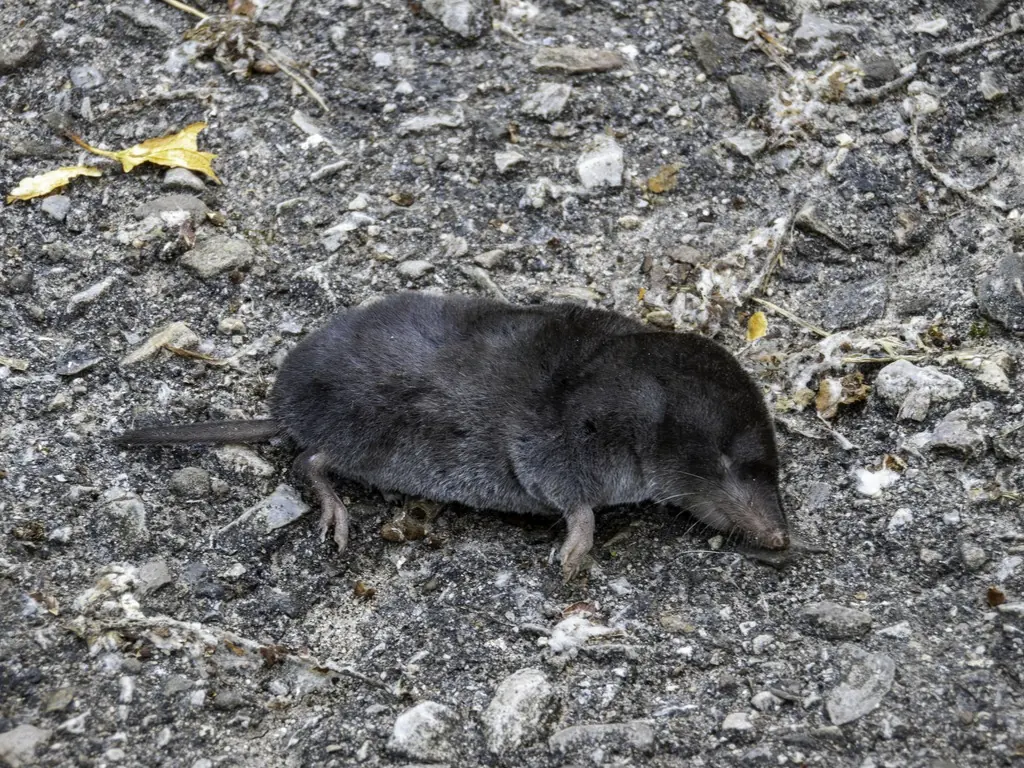
- Shrews have an elongated, pointed snout, often movable and projecting well past the mouth, dense fur of one uniform color, very small eyes and five clawed toes on each foot; external ears are small or absent.[1][4]
- Instead of a rodent's chisel-like gnawing teeth they have sharp, spiky teeth, and the front incisors of both jaws are enlarged into grasping pincers for holding struggling insects.[4]
- The velvety fur lies equally well brushed forward or backward.[4]
- Sizes run from about 2-1/2 or 3 inches long, tail included, for the least shrew to about 5 inches for short-tailed shrews. Virginia gives the northern short-tailed shrew an average total length of 115 mm (about 4-1/2 inches) and weight of 19.3 grams (about 2/3 ounce); Missouri gives up to 1 ounce.[4][2]
- The northern short-tailed shrew is grayish black, sometimes with a silvery or brownish cast, has no visible external ears, and its tail is always less than half the length of the head and body.[2][4]
Look-alikes
| Look-alike | How to tell them apart |
|---|---|
| House mouse | Mice are rodents with chisel-like front teeth for gnawing; shrews have sharp, spiky teeth, a long movable snout and much smaller eyes, and shrews are more closely related to moles than to mice.[4] |
| Moles | Moles have broad front feet with stout, outward-facing claws for digging; a shrew's front and hind feet are about the same size.[4][5] |
| Voles | Voles are rodents; ICWDM notes that shrews caught by accident in vole traps can be released alive.[7] |
Where it lives
Shrews are found throughout North America and vary widely in habitat. Missouri alone has six species; the northern short-tailed shrew favors damp woods and grassy fields with thick leaf litter and is usually the most abundant small mammal where it lives, Virginia says. GBIF's public U.S. records since 1990 for the shrew family (about 88,000) come from 48 states on the map, most from Alaska, Washington and New Hampshire.[1][4][2][13]
Biology and life cycle
Shrews burn energy fast and don't hibernate, so they eat all winter, digging out dormant insect larvae and pupae. Missouri says the masked (cinereus) shrew may eat three times its body weight in 24 hours, the least shrew 75 to 100 percent, and short-tailed shrews about half their weight.[4]
They eat mostly insects plus earthworms, slugs, snails, spiders, centipedes and other small animals; short-tailed shrews also take salamanders, small snakes, birds, mice and other shrews, and in winter some roots, nuts, fruits and fungi.[4][2]
The northern short-tailed shrew is active day and night all year, digs tunnels in soil or snow, sometimes nearly 2 feet deep, and also uses tunnels made by moles and mice.[2][4]
Short-tailed shrews have venom in their saliva that immobilizes prey. Missouri says it lets them store live insects as fresh food and that it slows the heart and breathing of larger victims; a purified venom protein made lab mice breathe irregularly, become paralyzed and convulse before dying, and a later genome study found the venom relatively simple, about seven proteins.[4][2][8][9]
Sources differ on breeding: Virginia gives a March-to-November season with 3 or 4 litters of 6 or 7 young, while Missouri says short-tailed shrews usually have only 1 to 3 litters a year. Gestation is about 22 days.[2][4]
Lifespans are short. Virginia gives 1 to 2 years; Missouri says most short-tailed shrews live a year to 18 months, surviving no more than one winter, though some may reach three years.[2][4]
Nests of dry leaves, grass and hair, 6 to 8 inches across, are built under logs, stumps, rocks or debris or in tunnel chambers.[2][4]
Damage and signs
- Shrews rarely cause damage; the wildlife damage handbook says most species aren't abundant enough to be considered pests. Missouri points out that beetle grubs and moth caterpillars, cutworms included, are routine food for them.[1][4]
- Short-tailed shrew populations can fluctuate sharply from year to year, Missouri notes.[4]
Health risk
The short-tailed shrews' saliva is venomous. Shrews also matter for tick-borne disease in the Northeast: one study found shrews fed 35% of blacklegged ticks and 55% of Lyme-infected ticks, more than white-footed mice; in southeastern New York, short-tailed shrews infected more than 17% of the ticks that fed on them with the babesiosis parasite; and a 2021 study points to shrews as a likely reservoir of deer tick virus (Powassan virus lineage 2).[2][4][8][10][11][12]
Control
Prevention
Outdoors, leave them be: shrews eat insects including lawn and crop pests, and Missouri notes pesticides can build up in them because they eat so much.[4]
Traps and physical control
Traps set for voles can catch shrews too; ICWDM says multiple-catch mouse traps catch several animals at once and non-target shrews can be released alive.[7]
When to call a professional
Know your state's rules before trapping. In New York, a landowner may take a shrew that is a nuisance or is damaging property without a permit, but it is illegal to move a live-trapped animal off the property where it was caught; for removal, New York directs people to a licensed nuisance wildlife control operator.[6]
Shrews are not rodents
Shrews belong with the moles, hedgehogs and solenodons in the order Eulipotyphla. The older order name Insectivora has been split up on DNA evidence, and some slightly older references still use Soricomorpha.[4][2]
Since they mainly eat insects and other small invertebrates, a shrew in the yard is usually helpful rather than a pest.[4][1]
Researchers are studying compounds from short-tailed shrew venom for possible use against conditions including high blood pressure, migraines and some cancers.[4]
Common questions
- Is a shrew a kind of mouse?
- No. Shrews are insect eaters with sharp, spiky teeth, pointed snouts, tiny eyes and five toes on each foot; mice are rodents with chisel-like gnawing teeth. Shrews are closer kin to moles.[4][1]
- Are shrews poisonous?
- Short-tailed shrews have venomous saliva that they use on prey; a purified venom protein from the northern short-tailed shrew was lethal to lab mice.[2][4][8]
- Can I trap a shrew and let it go somewhere else?
- Check state law first. New York, for example, lets landowners take a nuisance shrew without a permit but forbids releasing trapped animals anywhere other than the property where they were caught.[6]
Sources
- University of Nebraska-Lincoln Cooperative Extension, USDA-APHIS Animal Damage Control and Great Plains Agricultural Council, “Shrews, in Prevention and Control of Wildlife Damage (R. H. Schmidt, 1994).” digitalcommons.unl.edu/icwdmhandbook/55 (accessed 2026-11-11). Cited from the chapter abstract on the repository landing page only; the full-text PDF refused automated access (403) on 2026-11-11.
- Virginia Department of Wildlife Resources, “Northern short-tailed shrew (species profile, updated November 29, 2023).” dwr.virginia.gov/wildlife/information/nothern-short-tailed-shrew/ (accessed 2026-11-11)
- iNaturalist, “Blarina brevicauda taxon page (order and family).” www.inaturalist.org/taxa/63113 (accessed 2026-11-11)
- Missouri Department of Conservation, “Shrews (Sorex, Blarina and Cryptotis spp.).” mdc.mo.gov/discover-nature/field-guide/shrews (accessed 2026-11-11)
- Washington Department of Fish and Wildlife, “Living with wildlife: Moles.” wdfw.wa.gov/species-habitats/living/species-facts/moles (accessed 2026-11-11)
- New York State Department of Environmental Conservation, “Remove or 'Take' Nuisance Animals Legally.” dec.ny.gov/nature/animals-fish-plants/nuisance-wildlife-species/remove-take-legally (accessed 2026-11-11)
- Internet Center for Wildlife Damage Management, “Vole Damage Prevention and Control Methods.” icwdm.org/species/rodents/voles/vole-damage-prevention-and-control-methods/ (accessed 2026-11-11)
- Proceedings of the National Academy of Sciences, via PubMed, “Blarina toxin, a mammalian lethal venom from the short-tailed shrew Blarina brevicauda (Kita et al. 2004).” pubmed.ncbi.nlm.nih.gov/15136743/ (accessed 2026-11-11). Cited from the PubMed abstract.
- Genome Biology and Evolution, via PubMed, “A relatively simple venom in a diet generalist, the northern short-tailed shrew (Hanf and Chavez 2020).” pubmed.ncbi.nlm.nih.gov/32520994/ (accessed 2026-11-11). Cited from the PubMed abstract.
- Proceedings of the Royal Society B, via PubMed, “Conspicuous impacts of inconspicuous hosts on the Lyme disease epidemic (Brisson, Dykhuizen and Ostfeld 2008).” pubmed.ncbi.nlm.nih.gov/18029304/ (accessed 2026-11-11). Cited from the PubMed abstract.
- Emerging Infectious Diseases, via PubMed, “Reservoir competence of wildlife host species for Babesia microti (Hersh et al. 2012).” pubmed.ncbi.nlm.nih.gov/23171673/ (accessed 2026-11-11). Cited from the PubMed abstract.
- Communications Biology, via PubMed, “Incrimination of shrews as a reservoir for Powassan virus (Goethert et al. 2021).” pubmed.ncbi.nlm.nih.gov/34811484/ (accessed 2026-11-11). Cited from the PubMed abstract.
- Global Biodiversity Information Facility (GBIF), “Soricidae: occurrence records in the U.S., 1990-2026 (GBIF occurrence search).” api.gbif.org/v1/occurrence/search?taxonKey=5534&country=US&hasGeospatialIssue=false&occurrenceStatus=PRESENT&year=1990%2C2026&facet=stateProvince&facetLimit=400&limit=0 (accessed 2026-11-11). State counts are records reported (iNaturalist research-grade, museum specimens, surveys), not abundance.