On this page
How to identify it
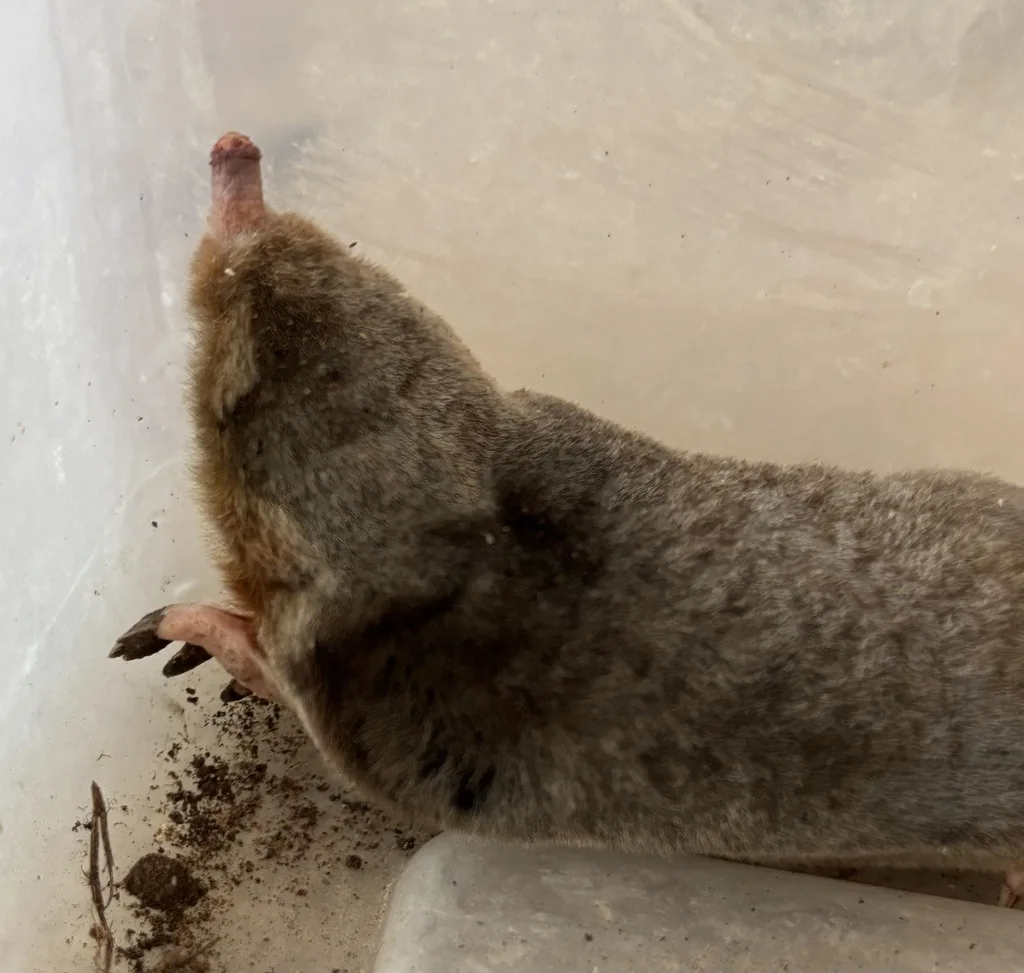
- A cylindrical body with a hairless, pointed snout, tiny eyes hidden in fur, and no external ears.[1][2]
- Large, spadelike front feet, broader than they are long in the eastern mole, with heavy claws for digging.[1][2]
- Short, dense, velvety fur and a short, nearly bare tail; male eastern moles are about 7 inches long.[1][2]
- Mounds are round and volcano-shaped, often in a line, and surface tunnels show as raised ridges that collapse when stepped on.[1][2][4]
Look-alikes
| Look-alike | How to tell them apart |
|---|---|
| Pocket gopher | Gopher mounds are crescent- or kidney-shaped with a plugged hole off to one side; gophers don't push up surface ridges, and unlike moles they feed on plant roots.[6][1][4] |
| Vole | Voles are plant-eating rodents that use open runways through grass; they often use mole tunnels and cause plant damage blamed on moles.[1][4] |
Where it lives
The eastern mole is the most common species, ranging across most of the eastern United States to Wyoming and Colorado; broad-footed, Townsend's and coast moles live west of the Rockies.[2][1]
Biology and life cycle
Moles have one litter a year, born mainly in early spring. ICWDM puts litters at 3 to 5 young, while UC IPM and Wildlife Illinois say three to four. Young mature in about 10 months; ICWDM says moles may live 3 to 5 years, and Wildlife Illinois says three to six.[3][1][11]
They are territorial and solitary, usually one per tunnel system except in the breeding season, and three to five per acre is considered an average to high density.[1][3]
Moles eat 70 to 100 percent of their body weight daily, mostly earthworms, grubs and other insects; plant material is eaten only incidentally.[3][1]
They are active year-round and most active after rain or watering, when soil is easy to dig; in dry spells they move to irrigated lawns.[1][3]
Damage and signs
- Tunneling dislodges plants and dries out their roots, and ridges and mounds disfigure turf and make mowing difficult.[1][4]
- Direct chewing damage to bulbs and roots is almost always caused by rodents such as voles or gophers, often using mole tunnels.[1][4]
- Structural damage is mostly limited to brick patios and pools, where digging can undermine them.[4]
Health risk
Moles are not among the animals CDC lists as most often found with rabies in the U.S., which are bats, skunks, raccoons and foxes. CDC advises washing any animal bite or scratch with soap and water and getting medical care quickly, and wearing gloves when handling sick or dead animals. Mole tunnels and mounds can also be a tripping hazard.[15][16][4]
Control
Keep them out
Protect small, valuable beds with hardware cloth or 1/4-inch wire mesh buried with a lip bent outward. Sources differ on depth: UC IPM says at least 2 feet and WSU 24 to 30 inches, while the Missouri, Illinois and North Carolina wildlife agencies say at least 12 inches. Raised beds can get a wire-mesh bottom.[1][7][10][11][12]
Traps and physical control
Trapping is the most dependable method, and the Missouri and Illinois wildlife agencies agree. Where legal, set scissor-jaw, harpoon or pincer-style mole traps in straight, active tunnels and follow the maker's instructions.[1][5][10][11]
Find active tunnels by tamping down short sections of ridge and watching which are raised again; set traps at least 18 inches from a mound.[1][5]
Pesticides
Grain baits rarely work because moles eat worms and insects. Worm-shaped bromethalin gel baits placed in tunnels show more promise and are still registered with EPA; use them only as the label directs. WSU recommends no chemical controls for moles, and Wildlife Illinois does not recommend toxicants.[1][5][13][7][11]
Castor oil repellents have shown minor effect on eastern moles, and treated moles may simply move to the neighbor's lawn. Others are less hopeful: Missouri knows of no effective repellent, Illinois has none registered, and WSU reports inconsistent results.[1][5][10][11][7]
When to call a professional
Aluminum phosphide burrow fumigant is a restricted-use pesticide for certified applicators and works poorly in porous, dry soil or shallow tunnels. Wildlife Illinois says fumigants are typically ineffective and does not recommend them.[5][1][11]
Methods that don't work
Vibrating, sonic, magnetic and pinwheel devices haven't been shown to drive moles away.[1][5]
Home remedies such as broken glass, gum, mothballs, bleach or used cat litter in tunnels are ineffective, and some are environmentally hazardous.[1][5]
Flooding tunnels wastes water, and the mole plant, Euphorbia lathyris, is not recommended because it is poisonous and weedy.[1][5]
Killing lawn grubs with insecticide doesn't reliably reduce moles, which also eat earthworms, and they may dig more while searching for food. Missouri adds that insecticides leave an unhealthy lawn ecosystem, while Wildlife Illinois says they may help in a lawn but are not a long-term fix.[5][1][10][11]
Legal status
Rules vary by state. Illinois does not protect moles, so they may be removed without a permit, and Missouri's Wildlife Code lets owners trap or shoot moles that cause damage. In California, moles are nongame mammals that owners may control by legal means.[11][10][1]
North Carolina requires a depredation permit to trap moles, though none is needed to use a registered pesticide. The star-nosed mole, a state Species of Special Concern, cannot be removed.[12]
Washington bans body-gripping traps, and the state Attorney General has said spring-loaded mole traps that grip or pierce the body fall under the ban. WSU says only cage traps or common rat and mouse traps may be used there, and the state can authorize only a few other trap types by special permit.[8][7][9]
Common questions
- Will killing grubs get rid of moles?
- Usually not. Moles also eat earthworms and other soil animals, and a lawn can be grub-free and still have moles.[5][1]
- Are moles rodents?
- No. Moles are insect-eating mammals related to shrews and bats, and they rarely eat plants.[1][2]
- Does one mound mean one mole?
- No. The number of mounds doesn't match the number of moles, and moles are territorial, so a yard often has only a few.[4][1]
- Do I need a permit to trap moles?
- It depends on the state. Illinois and Missouri allow it without a permit, North Carolina requires a depredation permit, and Washington bans the spring-loaded traps most people use.[11][10][12][8]
Sources
- University of California Statewide IPM Program, “Moles (Pest Notes, Home and Landscape).” ipm.ucanr.edu/home-and-landscape/moles/ (accessed 2026-11-13)
- Internet Center for Wildlife Damage Management, “Moles: Identification.” icwdm.org/species/other-mammals/moles/ (accessed 2026-11-13). Run by university wildlife damage specialists (maintained at the University of Wisconsin-Stevens Point); species modules are based on Prevention and Control of Wildlife Damage (University of Nebraska Cooperative Extension, 1994).
- Internet Center for Wildlife Damage Management, “Mole Biology.” icwdm.org/species/other-mammals/moles/mole-biology/ (accessed 2026-11-13). Run by university wildlife damage specialists (maintained at the University of Wisconsin-Stevens Point); species modules are based on Prevention and Control of Wildlife Damage (University of Nebraska Cooperative Extension, 1994).
- Internet Center for Wildlife Damage Management, “Mole Damage Identification.” icwdm.org/species/other-mammals/moles/mole-damage-identification/ (accessed 2026-11-13). Run by university wildlife damage specialists (maintained at the University of Wisconsin-Stevens Point); species modules are based on Prevention and Control of Wildlife Damage (University of Nebraska Cooperative Extension, 1994).
- Internet Center for Wildlife Damage Management, “Mole Damage Prevention and Control Methods.” icwdm.org/species/other-mammals/moles/mole-damage-prevention-and-control-methods/ (accessed 2026-11-13). Run by university wildlife damage specialists (maintained at the University of Wisconsin-Stevens Point); species modules are based on Prevention and Control of Wildlife Damage (University of Nebraska Cooperative Extension, 1994).
- University of California Statewide IPM Program, “Pocket Gophers (Pest Notes, Home and Landscape).” ipm.ucanr.edu/home-and-landscape/pocket-gophers/ (accessed 2026-11-13)
- Washington State University Extension, “Vertebrate: Moles (HortSense).” hortsense.cahnrs.wsu.edu/?p=5877 (accessed 2026-11-13)
- Washington State Office of the Attorney General, “Applicability of statutory prohibition against 'body-gripping traps' to certain mole traps (AGO 2002 No. 3).” atg.wa.gov/ago-opinions/applicability-statutory-prohibition-against-body-gripping-traps-certain-mole-traps (accessed 2026-11-13)
- Washington Department of Fish and Wildlife, “How to apply for a special permit to use body-gripping traps.” wdfw.wa.gov/node/21856 (accessed 2026-11-13)
- Missouri Department of Conservation, “Mole Control.” mdc.mo.gov/wildlife/nuisance-problem-species/mole-control (accessed 2026-11-13)
- Wildlife Illinois (Illinois Department of Natural Resources), “Eastern Mole.” wildlifeillinois.org/?p=441 (accessed 2026-11-13)
- North Carolina Wildlife Resources Commission, “Moles (Wildlife Control Agent guidance).” www.ncwildlife.gov/media/2285/download (accessed 2026-11-13)
- U.S. Environmental Protection Agency, “Pesticide Product and Label System search: TALPIRID.” ordspub.epa.gov/ords/pesticides/cswu/ProductSearch/partialprodsearch/v2/riname/TALPIRID (accessed 2026-11-13)
- Integrated Taxonomic Information System (ITIS), “Talpidae full hierarchy (ITIS TSN 179962).” www.itis.gov/ITISWebService/jsonservice/getFullHierarchyFromTSN?tsn=179962 (accessed 2026-11-13)
- Centers for Disease Control and Prevention, “About Rabies.” www.cdc.gov/rabies/about/index.html (accessed 2026-11-13)
- Centers for Disease Control and Prevention, “About Tularemia.” www.cdc.gov/tularemia/about/index.html (accessed 2026-11-13)
- Global Biodiversity Information Facility (GBIF), “Talpidae (GBIF Backbone Taxonomy).” api.gbif.org/v1/species/9469 (accessed 2026-11-13)