On this page
How to identify it
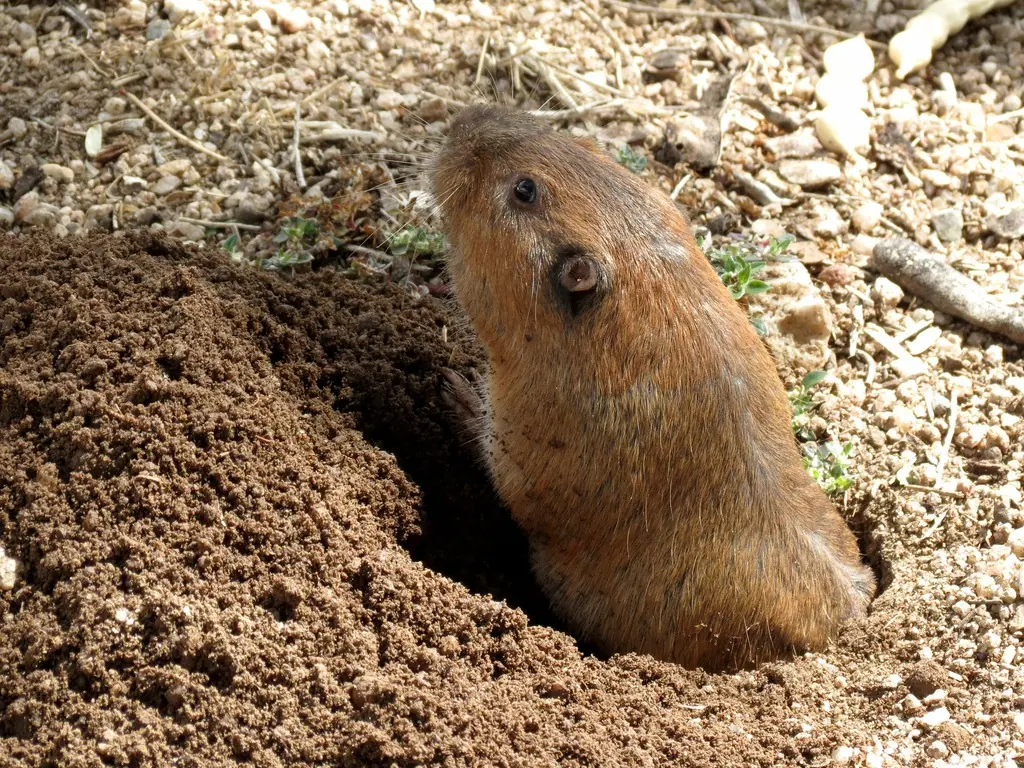
- A stout rodent with powerful front legs, large-clawed front paws, a short sparsely haired tail, and small eyes and ears. UC IPM gives a usual length of 6 to 10 inches including the tail; the Internet Center for Wildlife Damage Management (ICWDM) gives 5 to 14 inches across U.S. species.[1][2]
- Fur-lined pouches on the outside of each cheek, used to carry food and nesting material.[1][2]
- Fur color varies widely, from nearly black to pale brown or almost white, and tends to match the local soil.[2]
- Mounds of fresh soil are crescent- or horseshoe-shaped from above, with a plugged hole off to one side.[1][2]
Look-alikes
| Look-alike | How to tell them apart |
|---|---|
| Mole | Mole mounds are round and volcano-shaped with the plug in the middle, and moles push up raised feeding ridges just under the surface.[1][2] |
| Vole | Voles leave open burrow holes and surface runways and usually girdle trees above ground; gopher holes are plugged and gopher girdling is mostly below ground.[3][1] |
| Ground squirrel | Ground squirrel burrows are left open without a dirt mound.[1] |
Where it lives
Pocket gophers live only in the Western Hemisphere, where ICWDM counts 35 species in 5 genera; 14 species occur in the United States, with Thomomys gophers in the West and larger Geomys gophers on the central plains and in the Southeast.[2][4]
Biology and life cycle
Gophers live alone in burrow systems covering about 200 to 2,000 square feet, with feeding tunnels 6 to 12 inches deep and nest chambers as deep as 6 feet.[1]
They don't hibernate and can be active at any hour; one gopher can push up several mounds a day.[1]
Where soil is not irrigated, they usually raise one litter a year; in irrigated areas they can have up to three litters, typically averaging 5 to 6 young.[1]
They are strict plant eaters that feed mostly on roots met while digging, and sometimes on plants within a body length of an open hole.[1][4]
They do best in light, well-drained soils with plants that have fleshy roots, bulbs or tubers.[4]
Damage and signs
- Gophers eat roots and pull entire plants into their tunnels, damaging vegetables, ornamentals, vines, shrubs and trees.[1][5]
- They girdle trunks and large roots, mostly below ground, and under snow they can strip bark well up the trunk.[1][5]
- They gnaw flexible plastic water lines, drip irrigation and buried utility cables, and their tunnels can divert irrigation water and cause erosion.[1][5]
- Mounds in lawns interfere with mowing and spoil the look of turf.[1]
Health risk
Pocket gophers aren't considered a significant safety threat to people, but they bite hard when trapped; wear gloves, and keep toxic baits away from children and pets.[5][1]
Control
Prevention
After control, level old mounds and keep checking, since gophers move in from nearby fields and vacant lots.[1]
Keep them out
Line raised beds with hardware cloth or wire mesh, and plant shrubs and trees in wire baskets with room for roots to grow.[1][6]
Put 6 to 8 inches of coarse gravel, 1 inch or larger, around buried sprinkler lines and cables.[1][6]
Traps and physical control
Trapping is safe and effective: find the main tunnel with a probe near the plugged side of a fresh mound, then set traps in pairs facing each other. UC IPM names two-pronged pincer traps such as the Macabee, Cinch and Gophinator, and box traps such as the Victor Black Box.[1][6]
Stake traps so they can be retrieved, cover the opening where people or pets go, check often, and move traps if nothing is caught within 1 to 2 days.[1]
UC IPM says pressurized exhaust machines that inject carbon-monoxide-rich exhaust into the burrow were approved against burrowing rodents in California in 2012. Propane-oxygen explosive devices are only somewhat effective and too loud for residential areas.[1]
Pesticides
Toxic baits go only into the main underground tunnel, never on the surface; clean up spills and don't bait gardens with root vegetables. UC IPM names strychnine and zinc phosphide baits, which kill after a single feeding; ICWDM also lists the anticoagulants chlorophacinone and diphacinone as registered.[1][6]
When to call a professional
Aluminum phosphide fumigation requires a licensed applicator. In California it may only go into burrow systems more than 100 feet from any building where people or domestic animals are or may be, which in residential areas limits it to parks and athletic fields.[1]
Methods that don't work well
Smoke and gas cartridges usually fail because gophers quickly seal off their tunnels.[1]
No repellent has protected plants from gophers, and gopher purge, castor bean and garlic plants haven't been shown to repel them.[1][6]
Vibrating stakes, ultrasonic devices and pinwheels haven't worked in research, and gum or laxatives in burrows are also ineffective.[1][6]
Owls and other predators eat gophers but are too unreliable to protect a yard.[1]
Sources differ on fumigation. UC IPM says aluminum phosphide, applied by licensed pest control operators, is effective at controlling gophers; ICWDM says fumigants, including aluminum phosphide and gas cartridges, usually fail because gopher tunnels are too extensive for the gas to spread.[1][6]
ICWDM notes high concentrations of capsaicin have reduced gnawing on buried structures, but field effectiveness hasn't been shown and no products are registered for it.[6]
Legal status
Pocket gophers generally aren't protected by federal or state law.[2]
In California they are nongame mammals that can be controlled at any time by legal means, and no trapping license is needed.[1]
In California, anticoagulant gopher baits are no longer legal for residential use; take old products to a household hazardous waste facility.[1]
In Washington, the Mazama pocket gopher of Thurston, Pierce, Clark and Mason counties is state threatened, and its Thurston and Pierce county subspecies were listed as threatened under the U.S. Endangered Species Act in 2014; WDFW says lethal control is not allowed in those areas.[7]
Elsewhere in Washington, pocket gophers are unclassified: live traps need no permit, but WDFW requires a special trapping permit for all other traps.[7]
Colorado Parks and Wildlife lets landowners or their agents take pocket gophers without a permit, including with poisons and toxicants, on private property where they are causing damage.[8]
Common questions
- How do I tell a gopher mound from a mole mound?
- A gopher mound is fan- or crescent-shaped with the plugged hole to one side; a mole mound is round and volcano-shaped.[1][2]
- Do gopher traps need bait?
- No. UC Davis researchers found no benefit from bait behind traps, and human scent doesn't affect trapping success.[1]
- Do pocket gophers hibernate?
- No. They stay active all year, even when you see no fresh mounds.[1]
Sources
- University of California Statewide IPM Program, “Pocket Gophers (Pest Notes, Home and Landscape).” ipm.ucanr.edu/home-and-landscape/pocket-gophers/ (accessed 2026-11-12)
- Internet Center for Wildlife Damage Management, “Pocket Gophers: Identification.” icwdm.org/species/rodents/pocket-gophers/ (accessed 2026-11-12). Run by university wildlife damage specialists (maintained at the University of Wisconsin-Stevens Point); species modules are based on Prevention and Control of Wildlife Damage (University of Nebraska Cooperative Extension, 1994).
- University of California Statewide IPM Program, “Voles (Pest Notes, Home and Landscape).” ipm.ucanr.edu/home-and-landscape/voles/ (accessed 2026-11-12)
- Internet Center for Wildlife Damage Management, “Pocket Gopher Biology.” icwdm.org/species/rodents/pocket-gophers/pocket-gopher-biology/ (accessed 2026-11-12). Run by university wildlife damage specialists (maintained at the University of Wisconsin-Stevens Point); species modules are based on Prevention and Control of Wildlife Damage (University of Nebraska Cooperative Extension, 1994).
- Internet Center for Wildlife Damage Management, “Pocket Gopher Damage Identification.” icwdm.org/species/rodents/pocket-gophers/pocket-gopher-damage-identification/ (accessed 2026-11-12). Run by university wildlife damage specialists (maintained at the University of Wisconsin-Stevens Point); species modules are based on Prevention and Control of Wildlife Damage (University of Nebraska Cooperative Extension, 1994).
- Internet Center for Wildlife Damage Management, “Pocket Gopher Damage Prevention and Control Methods.” icwdm.org/species/rodents/pocket-gophers/pocket-gopher-damage-prevention-and-control-methods/ (accessed 2026-11-12). Run by university wildlife damage specialists (maintained at the University of Wisconsin-Stevens Point); species modules are based on Prevention and Control of Wildlife Damage (University of Nebraska Cooperative Extension, 1994).
- Washington Department of Fish & Wildlife, “Living with wildlife: Pocket gophers.” wdfw.wa.gov/species-habitats/living/species-facts/pocket-gophers (accessed 2026-11-12)
- Colorado Parks and Wildlife, “Common Human-Wildlife Conflict Species.” cpw.state.co.us/nuisance-wildlife (accessed 2026-11-12)
- iNaturalist, “Megascapheus bottae taxon page (order and family).” www.inaturalist.org/taxa/1624760 (accessed 2026-11-12)