On this page
How to identify it
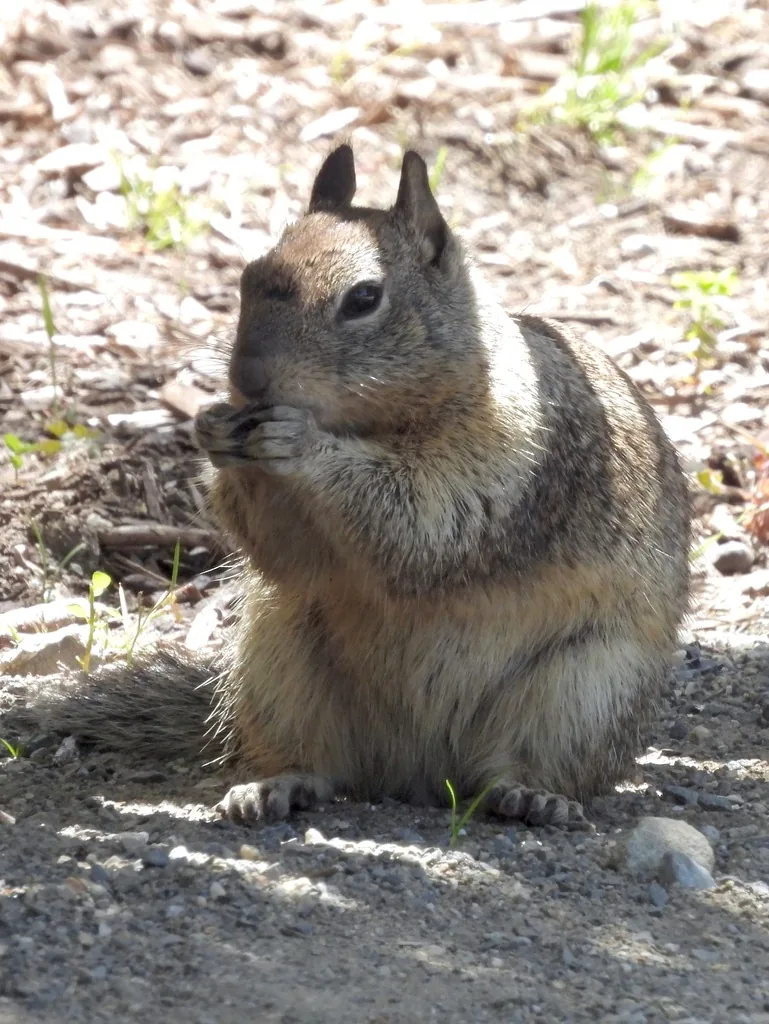
- Body and tail together measure 14 to 20 inches, and adults weigh about 21 to 30 ounces; males are a bit larger than females. Los Angeles County gives an overall length of 18 to 20 inches, with the body slightly longer than the tail.[1][3]
- Fur is mottled brown with white and gray flecks on the back, and lighter browns, grays and white underneath. A pair of dark triangular patches runs from the nape to just past the shoulders.[1][3]
- A white ring circles each eye, the ears stand up, and the tail is somewhat bushy but less full than a tree squirrel's. Los Angeles County notes a white fringe along the sides and tip of the tail, and internal cheek pouches for carrying food.[1][3]
- Burrow openings are about 4 inches across, and older entrances can be larger. Burrow systems usually have more than one entrance.[1][3]
Look-alikes
| Look-alike | How to tell them apart |
|---|---|
| Tree squirrels | A startled tree squirrel runs up a tree and almost never uses a burrow, while a frightened ground squirrel dives into its burrow.[1] |
| Pocket gophers | Pocket gophers push up crescent-shaped mounds and leave small, plugged feeder holes with no mound, unlike the open burrow entrances of ground squirrels.[2] |
| Voles | Meadow voles dig shallow burrows and leave well-worn trails on the surface between their burrow openings.[2] |
| Moles | Moles push up rounder, volcano-shaped mounds instead of crescent-shaped ones, and they eat worms, grubs and insects rather than plants.[2] |
Where it lives
The California ground squirrel lives throughout most of California and into northwestern Baja California, western Nevada, western Oregon and south central Washington.[1]
Biology and life cycle
They live in colonies of burrows, usually 5 to 30 feet long and within 2 to 3 feet of the surface, used for sleeping, raising young and storing food. Los Angeles County gives 2 to 4 feet or more below the surface, and UC says burrows occasionally reach 6 feet or more; colonies can hold several dozen animals.[1][3]
They are active by day, mostly from midmorning through late afternoon, and usually forage within about 75 yards of the burrow. Los Angeles County gives a home range under 150 yards across, but says squirrels have traveled up to 5 miles to start new colonies.[1][3]
Most hibernate in winter, and many adults go inactive for days or more during the hottest weather, plugging the burrow with soil near the nest. Los Angeles County calls the summer inactivity estivation.[1][3]
Females have one litter a year. UC IPM gives an average of 5 to 8 young; Los Angeles County gives seven to eight on average, ranging from 1 to 15. Young first leave the burrow at about 6 weeks old.[1][3]
They eat green grasses and leafy plants in spring, then switch to seeds, grains and nuts and start storing food as plants dry out. Los Angeles County adds that they also eat the eggs of ground-nesting birds.[1][3]
Damage and signs
- They feed on grains and on nut and fruit trees such as almond, apple, apricot, avocado, orange, peach and walnut.[1][3]
- In gardens they eat vegetable seedlings and can kill young trees, vines and shrubs by gnawing or girdling bark.[1][3]
- They gnaw plastic sprinkler heads, irrigation lines and boxes.[1][3]
- Burrows make mowing hard, create tripping hazards, dry out tree roots, and can undermine buildings badly enough to need repair. Los Angeles County adds roads, dams and slopes, where burrows contribute to erosion.[1][3]
Health risk
California ground squirrels carry fleas that can spread plague: a San Joaquin Valley study found three flea species on them, all potential plague vectors, and another study links two of those fleas and the squirrels to a major complex for amplifying the disease. CDC says sudden illness or death among wild rodents such as squirrels can signal plague activity. Don't handle dead squirrels; wear gloves if you must, and contact your local health department about disposal.[8][9][6][7]
Control
Prevention
Remove brush piles and debris; this takes away cover and makes squirrels and burrows easier to spot. CDC also advises removing brush, rock piles, junk and cluttered firewood to cut rodent habitat where plague occurs.[1][7]
Ground squirrels dislike dense vegetation, so letting grass grow taller can discourage them, though it may favor voles.[1]
Traps and physical control
Traps work when squirrel numbers are low to moderate; inspect them at least daily and keep children and pets away.[1]
Place box-type kill traps inside a covered box with a 3-inch entrance near active burrows to protect pets, children and other wildlife.[1]
Pesticides
Gas cartridges for burrow fumigation work best in spring when soil is moist; never fumigate in dry soil or during hibernation, and follow the label closely. Los Angeles County notes that gas cartridges can flare up, so don't use them under structures or where there is a fire hazard.[1][3]
Only fumigate active ground squirrel burrows, and skip any burrow that might hold kit foxes, burrowing owls or other nontarget animals. Los Angeles County gives burrowing owls as an example of animals that move into abandoned squirrel burrows.[1][3]
When to call a professional
Aluminum phosphide fumigant and zinc phosphide grain baits are restricted to licensed pest management professionals in California. Los Angeles County says the most effective fumigants are restricted-use pesticides for certified applicators and its poison grain baits are no longer sold to the public.[1][3]
Timing matters
Fumigating in spring is most effective because moist soil holds the gas in and squirrels die before they breed.[1][3]
Treated grain baits work better in summer and fall, when squirrels are eating mostly seeds.[1]
Filling burrows with soil doesn't stop reinvasion, since new squirrels quickly find and reopen old tunnels.[1]
What doesn't work
No frightening device or repellent has been shown to drive ground squirrels out of their burrows or away from an area.[1]
Burrow exploders aren't recommended for urban use and haven't proven effective.[1]
Hawks, coyotes and other predators eat ground squirrels but usually can't keep numbers low enough for a home gardener.[1]
Legal status
California regulations let rodents be taken at any time of year and in any number, except tree and flying squirrels and species listed as furbearers, threatened or endangered; UC IPM and Los Angeles County say owners or tenants may control ground squirrels that are damaging crops or property.[4][1][3]
UC IPM says live-captured ground squirrels must be released immediately on the property where they were caught or humanely euthanized, and Los Angeles County says trapped squirrels cannot be released elsewhere without written permission from the state wildlife department.[1][3]
The Mohave ground squirrel of the western Mojave Desert is listed as threatened under the California Endangered Species Act, and Los Angeles County says the San Joaquin antelope squirrel is too, so confirm the species before acting.[5][3]
Where sources disagree
Litter size: UC IPM gives an average of 5 to 8 young, while Los Angeles County gives seven to eight on average.[1][3]
Who lists the Mohave ground squirrel: UC IPM says the U.S. Fish and Wildlife Service lists it as threatened, while the California Department of Fish and Wildlife describes it as listed under the California Endangered Species Act.[1][5]
Common questions
- Is it a ground squirrel or a gopher in my yard?
- If you see the animal above ground and open 4-inch holes, it's likely a ground squirrel; gophers stay underground and plug their tunnels.[1][2][3]
- Can I use rat poison on ground squirrels?
- No. Products labeled for rats and mice should never be used on ground squirrels unless the label lists them as a target species; Los Angeles County adds that doing so violates federal and state law.[1][3]
- Why do ground squirrels keep coming back?
- Squirrels from nearby land move into empty burrows, so homes next to open land need ongoing monitoring and quick action when new burrows appear.[1][3]
Sources
- University of California Statewide IPM Program, “Pest Notes: Ground Squirrel, Publication 7438 (revised June 2025).” ipm.ucanr.edu/legacy_assets/PDF/PESTNOTES/pngroundsquirrel.pdf (accessed 2026-11-13)
- University of California Agriculture and Natural Resources, “Burrowing Rodents: Developing a Management Plan for Organic Agriculture in California (Publication 8688, April 2021).” ucanr.edu/sites/NapaCountyUCCE/files/397331.pdf (accessed 2026-11-11)
- Los Angeles County Agricultural Commissioner/Weights and Measures, “Ground Squirrels.” file.lacounty.gov/SDSInter/acwm/215269_g_squirrel_pdf.pdf (accessed 2026-11-11)
- California Department of Fish and Wildlife / California Fish and Game Commission, “2026-2027 Mammal Hunting and Trapping Regulations (incl. Cal. Code Regs. tit. 14, s. 472).” nrm.dfg.ca.gov/FileHandler.ashx?DocumentID=202568&inline (accessed 2026-11-13)
- California Department of Fish and Wildlife, “Mohave Ground Squirrel.” wildlife.ca.gov/Conservation/Mammals/Mohave-Ground-Squirrel (accessed 2026-11-11)
- Centers for Disease Control and Prevention, “About Plague.” www.cdc.gov/plague/about/index.html (accessed 2026-11-11)
- Centers for Disease Control and Prevention, “Preventing Plague.” www.cdc.gov/plague/prevention/index.html (accessed 2026-11-11)
- Journal of Vector Ecology, via PubMed, “Hubbart et al. (2011), Seasonal and among-site variation in the occurrence and abundance of fleas on California ground squirrels (Otospermophilus beecheyi).” pubmed.ncbi.nlm.nih.gov/21635649/ (accessed 2026-11-11)
- International Journal for Parasitology, via PubMed, “Smith et al. (2021), Host traits, identity, and ecological conditions predict consistent flea abundance and prevalence on free-living California ground squirrels.” pubmed.ncbi.nlm.nih.gov/33508332/ (accessed 2026-11-11)
- iNaturalist, “Otospermophilus beecheyi taxon page (order and family).” www.inaturalist.org/taxa/180007 (accessed 2026-11-11)