On this page
How to identify it
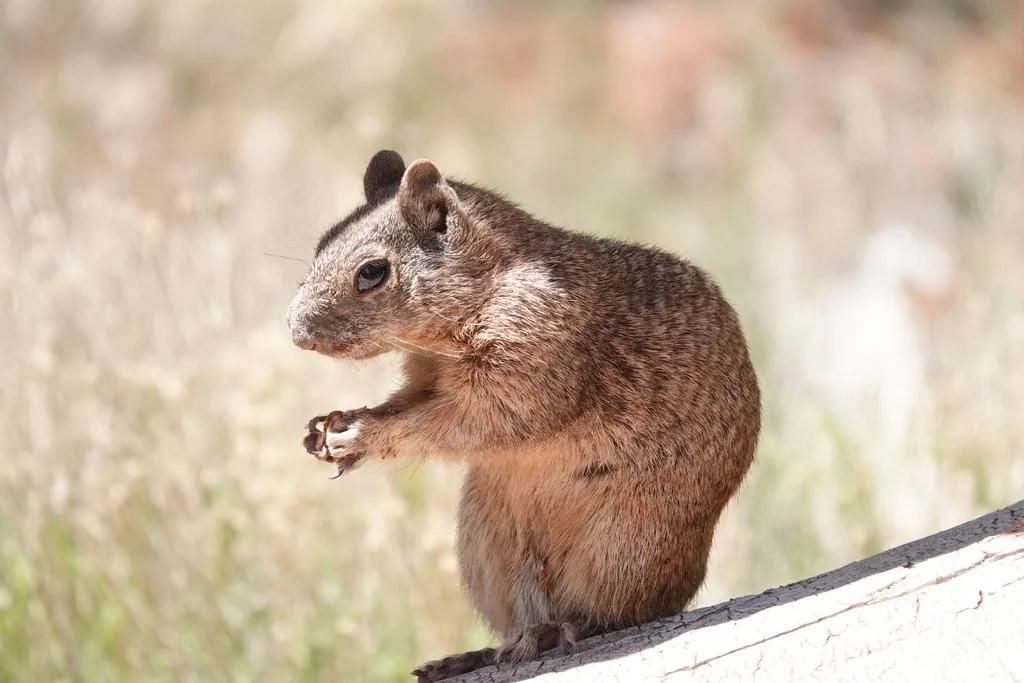
- It is big for a ground squirrel: the head and body are about 10.5 inches long, with a bushy tail about 8 inches long, and the fur is brownish gray mottled with white spots. The National Park Service gives a total length of 17 to 21 inches, with the tail almost half the length of the body, and notes patches of cinnamon brown.[1][2][4]
- Its ears stick up above the top of the head, and it lives in open burrows rather than the closed tunnel systems of gophers.[1][2]
- It climbs boulders, rocks and trees, uses big rocks as lookouts, and gives loud whistles or chirps that can be mistaken for bird calls.[4][2]
Look-alikes
| Look-alike | How to tell them apart |
|---|---|
| Prairie dogs | Prairie dogs are similar in size but have a much shorter tail, about 1.5 to 4 inches against the rock squirrel's 8 inches, and small ears that don't reach above the head.[1] |
| Tree squirrels (such as the Arizona gray squirrel) | Rock squirrels look similar but are larger and live in burrows rather than in trees.[5] |
Where it lives
Found from Mexico north to northern Utah and Colorado, across nearly all of Arizona and New Mexico except the highest elevations.[1][3]
Biology and life cycle
Mating runs from March to July, and after about a 30-day pregnancy a litter of 5 to 7 young is born. University of Arizona Extension says one litter is born a year and the pups stay in a grass nest in the burrow for about 6 to 7 weeks before coming above ground.[2]
They need little free water and use cheek pouches to carry and cache food. The National Park Service says rock squirrels have been seen surviving up to 100 days without water in the desert.[2][4]
They live in colonies, and burrow systems are reused year after year and extended each year, with several entrances. They live up to four or five years.[1][2]
They are active by day and hibernate in colder areas. In spring they eat green plants and flowers, then switch to seeds and fruit such as acorns, pine nuts, juniper berries, mesquite buds and cactus fruit, and occasionally insects.[2][1]
They often burrow under buildings, irrigation ditch banks and field edges, and usually don't form the large colonies other ground squirrels do.[2][3]
Damage and signs
- They dig up newly planted seeds and eat sprouting plants, flowers, vegetables, fruit and nuts, and their tunnels can divert irrigation water and undermine landscapes and structures.[1][2][3][5]
- Burrows can run under sidewalks, houses and outbuildings and weaken them, and open burrow entrances are hazards in parks, schools and horse areas.[2][5]
- Where people feed them, rock squirrels beg, get into packs and trash, and bite; at Grand Canyon, the National Park Service says they cause the most injuries to visitors.[6][4][2]
Health risk
Rock squirrels can host the fleas that spread plague. In Utah, researchers found flea species that bite rock squirrels also bite prairie dogs, mice, ground squirrels and other rodents, a mix thought to help plague persist; CDC lab infections showed rock squirrels vary widely in how they respond to the plague bacterium. CDC says sudden illness or death among wild rodents such as squirrels can signal plague activity: wear gloves if you handle a dead animal and contact your local health department about disposal. They can also bite when fed or handled.[10][9][7][8][4]
Control
Prevention
Frightening devices and repellents usually don't deter them, and once squirrels have been removed, destroy the burrow system to prevent new ones moving in.[2]
Never feed them. Feeding makes them bold and aggressive, and the National Park Service says human food has killed squirrels.[4][6][2]
Keep them out
New Mexico State says a 4-foot fence of small wire mesh topped with a smooth sheet-metal band 16 to 20 inches wide may keep them out of small garden areas, since they climb well; University of Arizona Extension finds fences generally ineffective against ground squirrels.[1][2]
Sanitation
Remove debris piles, stacked irrigation pipe, pallets and rock piles that give them places to burrow and hide. CDC gives the same advice for cutting rodent habitat where plague occurs.[2][1][8]
Traps and physical control
Live or lethal traps baited with nuts, orange slices or melon work best on small populations; check state and local laws before trapping. New Mexico State says to shade live traps and check them often, since squirrels can die of heat by late afternoon, and to open traps at dawn and close them at dusk to avoid catching skunks.[2][1]
Pesticides
Gas-cartridge fumigation works best in early spring before squirrels breed, while soil is moist; never fumigate burrows near homes, where fumes can seep inside. Zinc phosphide bait and aluminum phosphide are restricted-use pesticides for licensed applicators, and any bait must be labeled for rock squirrels.[1][2]
Live traps and release
University of Arizona Extension says squirrels released within half a mile often return to their burrow, and those that don't usually die from predators or starvation, so it favors humane euthanasia or lethal traps; New Mexico State likewise says release does not ensure survival.[2][1]
Where sources disagree
Fences: New Mexico State says a 4-foot small-mesh fence with a 16- to 20-inch sheet-metal band on top may keep rock squirrels out of small gardens, while University of Arizona Extension says fences are generally ineffective against ground squirrels.[1][2]
Common questions
- How can I tell a rock squirrel from other squirrels?
- Rock squirrels are large, gray-brown ground squirrels mottled with white, with a long bushy tail about 8 inches long and ears that reach above the head. They live in burrows among rocks rather than tree nests, and prairie dogs have much shorter tails.[1][2][5]
- Are rock squirrels dangerous?
- They can carry fleas that spread plague and they bite when fed or handled, so don't feed them, avoid handling them and use gloves with dead squirrels.[10][7][8][4]
- Should I relocate a rock squirrel I caught in a live trap?
- Extension services advise against it: released squirrels often return or die in unfamiliar areas. Check state and local laws before trapping.[2][1]
Sources
- New Mexico State University Cooperative Extension Service, “Controlling Rock Squirrel Damage in New Mexico (Circular 574).” pubs.nmsu.edu/_circulars/CR574/ (accessed 2026-11-11)
- University of Arizona Cooperative Extension, Yavapai County, “Rock Squirrels (Backyard Gardener, J. Schalau).” extension.arizona.edu/sites/extension.arizona.edu/files/attachment/RockSquirrels.pdf (accessed 2026-11-11)
- Utah State University Extension, “Rock Squirrels (fact sheet, July 2015).” digitalcommons.usu.edu/extension_curall/743 (accessed 2026-11-11)
- National Park Service, Zion National Park, “Rock Squirrel.” www.nps.gov/zion/learn/nature/rock-squirrel.htm (accessed 2026-11-11)
- National Park Service, Saguaro National Park, “Squirrels and Chipmunks of Saguaro National Park.” www.nps.gov/sagu/learn/nature/abert-squirrel.htm (accessed 2026-11-11)
- National Park Service, Grand Canyon National Park, “Wildlife Viewing and Safety Tips.” www.nps.gov/grca/learn/nature/wildlife_alert.htm (accessed 2026-11-11)
- Centers for Disease Control and Prevention, “About Plague.” www.cdc.gov/plague/about/index.html (accessed 2026-11-11)
- Centers for Disease Control and Prevention, “Preventing Plague.” www.cdc.gov/plague/prevention/index.html (accessed 2026-11-11)
- Journal of Wildlife Diseases, via PubMed, “Quan et al. (1985), Experimental plague in rock squirrels, Spermophilus variegatus.” pubmed.ncbi.nlm.nih.gov/4032620/ (accessed 2026-11-11)
- Vector-Borne and Zoonotic Diseases, via PubMed, “Eads, Biggins and Gage (2020), Ecology and management of plague in diverse communities of rodents and fleas.” pubmed.ncbi.nlm.nih.gov/33074791/ (accessed 2026-11-11)
- iNaturalist, “Otospermophilus variegatus taxon page (order and family).” www.inaturalist.org/taxa/180008 (accessed 2026-11-11)