On this page
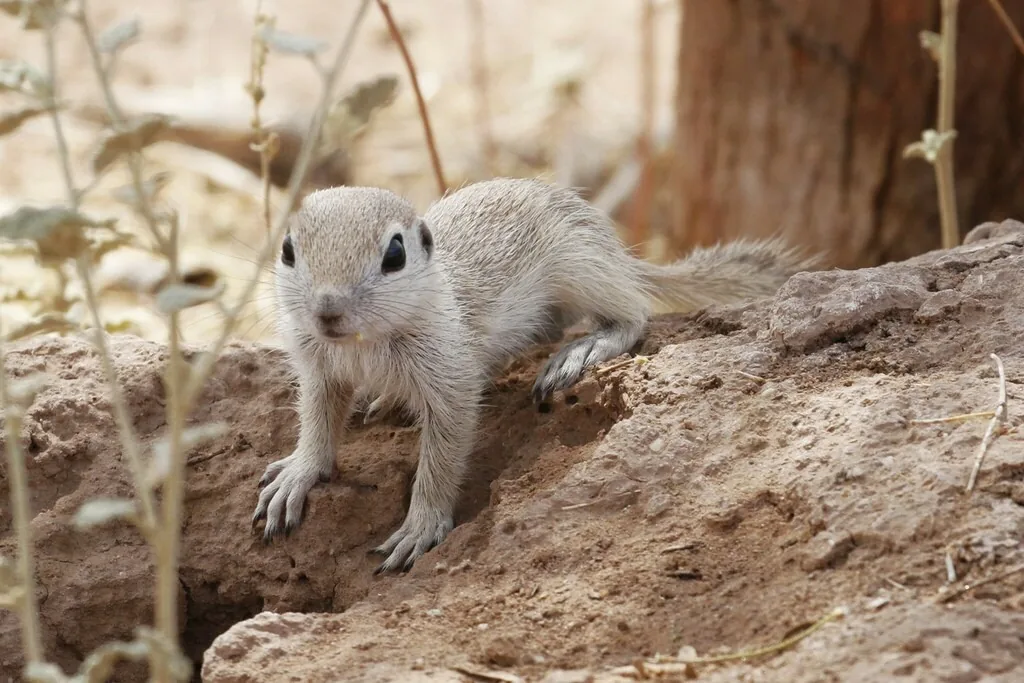
How to identify it
Look-alikes
| Look-alike | How to tell them apart |
|---|---|
| Antelope ground squirrels (such as Harris's antelope squirrel) | Harris's antelope squirrel shares its desert habitat and is set apart by a prominent stripe along its side; it stays active on even the hottest summer days.[2] |
Where it lives
Deserts of southeastern California, southern Nevada and western Arizona, and northeastern Baja California and Sonora in Mexico, in hot, dry, flat sandy areas with creosote scrub.[4][3]
Biology and life cycle
They are very social and live in colonies; young males leave the colony, while young females stay in the colony where they were born.[2]
They are most active in the morning and evening. The Nevada Department of Wildlife, quoted by the National Park Service, says they hibernate from late September or early October to early January, though in some areas they stay active all year.[3]
Lab studies found they save energy by letting body temperature drift with air temperature, from about 32 °C in cool air to about 40 °C in heat, without becoming inactive or losing sprint speed.[8][9]
Damage and signs
- In yards they dig burrow holes, for example around the base of trees, and keep gravel and plantings churned up; they get over walls by digging under or climbing anything not slick.[1]
- They can build large colonies: the National Park Service reports them abundant in the desert parts of Saguaro National Park and in large colonies at Casa Grande Ruins.[2][3]
Health risk
Like other wild rodents, they can host fleas. CDC says plague occurs naturally in parts of the western United States and cycles among wild rodents and their fleas, and that sudden illness or death among wild rodents such as squirrels could indicate plague activity; the Arizona Department of Health Services says fleas in northern Arizona routinely test positive, most often tied to prairie dogs and other small rodents. Avoid handling them, wear gloves with dead animals and contact your local health department with questions.[5][6][7]
Control
Keep them out
Protect favorite plants with small-mesh hardware cloth buried a few inches into the soil, and cover the barrier or line it with flashing or another slick material, since the squirrels also climb.[1]
Sanitation
Systematically remove the cover and habitat they use around the yard; CDC likewise advises clearing brush, rock piles, junk and cluttered firewood to cut rodent habitat.[1][6]
Traps and physical control
Trapping reduces numbers, but where they are common they can be contained rather than eliminated, so combine it with habitat removal and barriers.[1]
Common questions
- How do I get rid of ground squirrels in my desert yard?
- You can contain them but not eliminate them: combine habitat removal, trapping, and barriers of buried hardware cloth with a slick top edge.[1]
- Do round-tailed ground squirrels carry disease?
- Like other wild rodents they can carry fleas, and CDC says plague cycles among wild rodents and their fleas in parts of the western United States, so avoid handling them and use gloves with dead animals.[5][6][7]
Sources
- Arizona Daily Star (This Is Tucson), “You can contain ground squirrels (Garden Sage, P. L. Warren, Pima County Cooperative Extension).” thisistucson.com/you-can-contain-ground-squirrels/article_b4b8cd9a-9f9d-11e6-bf23-7f0767feb571.html (accessed 2026-11-11)
- National Park Service, Saguaro National Park, “Squirrels and Chipmunks of Saguaro National Park.” www.nps.gov/sagu/learn/nature/abert-squirrel.htm (accessed 2026-11-11)
- National Park Service, Casa Grande Ruins National Monument, “Common Mammals at Casa Grande Ruins (quoting the Nevada Department of Wildlife).” www.nps.gov/cagr/learn/nature/mammals.htm (accessed 2026-11-11)
- American Society of Mammalogists, Mammal Diversity Database, “Xerospermophilus tereticaudus, Round-tailed Ground Squirrel.” www.mammaldiversity.org/taxon/1001801 (accessed 2026-11-11)
- Centers for Disease Control and Prevention, “About Plague.” www.cdc.gov/plague/about/index.html (accessed 2026-11-11)
- Centers for Disease Control and Prevention, “Preventing Plague.” www.cdc.gov/plague/prevention/index.html (accessed 2026-11-11)
- Arizona Department of Health Services, “Protecting People and Pets against Plague in Arizona.” directorsblog.health.azdhs.gov/protecting-people-and-pets-against-plague-in-arizona/ (accessed 2026-11-11)
- Journal of Experimental Biology, via PubMed, “Wooden and Walsberg (2002), Effect of environmental temperature on body temperature and metabolic heat production in a heterothermic rodent, Spermophilus tereticaudus.” pubmed.ncbi.nlm.nih.gov/12089213/ (accessed 2026-11-11)
- Journal of Experimental Biology, via PubMed, “Wooden and Walsberg (2004), Body temperature and locomotor capacity in a heterothermic rodent.” pubmed.ncbi.nlm.nih.gov/14638831/ (accessed 2026-11-11)
- iNaturalist, “Xerospermophilus tereticaudus taxon page (order and family).” www.inaturalist.org/taxa/179993 (accessed 2026-11-11)