On this page
How to identify it
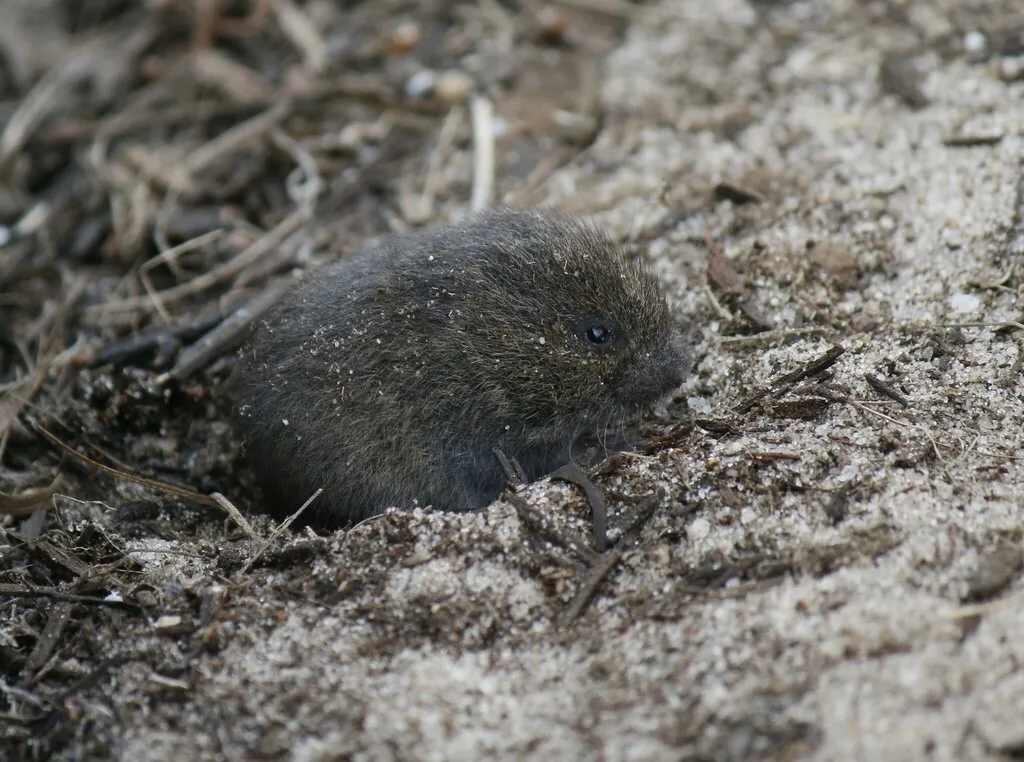
- A compact, heavy body with short legs, a short furred tail, small eyes and partly hidden ears.[1][3]
- Long, coarse fur that is usually blackish brown to grayish brown; fully grown voles measure about 5 to 8 inches including the tail.[1][3]
- Look for surface runways 1 to 2 inches wide connecting burrow openings about 1-1/2 to 2 inches across, usually hidden under grass or other cover.[1][2]
- Fresh grass clippings and greenish droppings about 3/16 inch long in the runways; the droppings turn brown or gray with age.[1]
Look-alikes
| Look-alike | How to tell them apart |
|---|---|
| House mouse | Voles are stockier, with a short tail and partly hidden ears, and they are poor climbers that usually stay outdoors rather than entering homes.[1] |
| Pocket gopher | Gophers leave closed dirt mounds and girdle trees mostly below ground; voles leave open burrow holes and runways and usually gnaw bark above ground.[1] |
| Mole | Moles are insect eaters with spadelike front feet that push up ridges and mounds; voles are plant-eating rodents that use surface runways.[4][1] |
Where it lives
Twenty-three vole species live in the United States, seven of them causing significant damage; the meadow vole is the most widely distributed, and the California vole is the most widespread in California.[3][1]
Biology and life cycle
Voles breed year-round, peaking in spring; females mature in 35 to 40 days, and litters usually hold 3 to 6 young.[1][5]
Most voles live less than a year, but populations often rise and crash in cycles every few years and have reached thousands per acre during outbreaks.[1][5]
They are active day and night all year and do not hibernate; under snow they tunnel through to the surface.[1][5]
They eat mostly grasses, other plants, bulbs and tubers, and gnaw bark and roots mainly in fall and winter.[1][5]
Damage and signs
- Voles feed on many garden crops, including lettuce, carrots, tomatoes, artichokes and sweet potatoes, and they damage turf and ground covers.[1][2]
- They gnaw bark of fruit and landscape trees near the soil line in irregular patches of marks about 1/8 inch wide; complete girdling can kill a tree.[1][2]
- Under snow, damage can extend a foot or more up the trunk and often goes unnoticed until spring.[1]
- Their chewing can puncture irrigation lines, and runways can divert irrigation water.[1][2]
- Voles only occasionally enter buildings, so they pose little threat to structures.[2]
Health risk
Voles rarely contact people, so they pose no major public health hazard. CDC lists voles among the animals plague can affect in the western U.S., spread mainly by flea bites or handling infected animals, and says tularemia can pass to people who handle infected rodents. Wear rubber gloves when handling them.[2][6][7][1]
Control
Prevention
Keep vole numbers from building by removing weeds, heavy mulch and dense ground cover, and mow lawns and grassy edges regularly.[1][8]
Keep vegetation away from young trees and vines: UC IPM suggests a vegetation-free circle 4 feet across, and Missouri says to clear mulch 3 feet or more from tree bases. Clean up spilled bird seed too.[1][9][8]
Keep them out
Wrap young trunks in hardware cloth cylinders of 1/4-inch mesh, buried about 6 inches and taller than expected snow.[8][1]
Protect a whole garden with 1/4-inch mesh fencing or flashing at least 12 inches high, with the bottom buried 6 to 10 inches.[1]
Traps and physical control
In small areas, set mouse snap traps at right angles across runways with the trigger in the runway, and cover them to protect birds.[1][8]
Pesticides
Zinc phosphide is the most common vole toxicant. UC IPM says it is the only one for residential settings in California and is restricted-use, limited to non-residential lawns, ornamentals, golf courses and parks; ICWDM says anticoagulant baits are also effective and registered in many states.[1][8][9]
Sources disagree on repellents. UC IPM calls capsaicin and castor oil repellents questionable, and Missouri says none are known to work; ICWDM names Miller's Hot Sauce Animal Repellent (capsaicin) and thiram bulb dips and reports that predator urine has reduced vole damage.[1][9][8]
What doesn't work on voles
Gas cartridges and other burrow fumigants fail because vole burrows are shallow and have many open holes.[1]
Ultrasonic and electromagnetic devices and flooding are ineffective, and no frightening device controls voles.[1][8]
Hawks, owls and other predators eat voles but rarely keep numbers below damaging levels around homes.[1][8]
Missouri's Department of Conservation says mothballs are not effective against voles.[9]
Legal status
Voles are nongame mammals that can generally be controlled when they cause damage; check with your state wildlife agency for local rules.[3][1]
The Wildlife Code of Missouri allows damage-causing voles to be trapped or shot (3 CSR 10-4.130).[9]
Colorado Parks and Wildlife lets landowners or their agents take voles without a permit on private property where they are causing damage.[10]
Common questions
- How do I know if I have voles or moles?
- Voles leave narrow surface runways through grass with open holes and clipped vegetation; moles push up soil ridges and volcano-shaped mounds.[1][4]
- Do voles come into the house?
- Rarely. They are poor climbers that live in grassy areas near buildings and only occasionally invade structures.[1][2]
- Why are there suddenly so many voles this year?
- Vole populations cycle and can surge to very high numbers in favorable years, so problems around homes usually come during outbreaks.[1][5]
Sources
- University of California Statewide IPM Program, “Voles (Pest Notes, Home and Landscape).” ipm.ucanr.edu/home-and-landscape/voles/ (accessed 2026-11-12)
- Internet Center for Wildlife Damage Management, “Vole Damage Identification.” icwdm.org/species/rodents/voles/vole-damage/ (accessed 2026-11-12). Run by university wildlife damage specialists (maintained at the University of Wisconsin-Stevens Point); species modules are based on Prevention and Control of Wildlife Damage (University of Nebraska Cooperative Extension, 1994).
- Internet Center for Wildlife Damage Management, “Voles: Identification.” icwdm.org/species/rodents/voles/ (accessed 2026-11-12). Run by university wildlife damage specialists (maintained at the University of Wisconsin-Stevens Point); species modules are based on Prevention and Control of Wildlife Damage (University of Nebraska Cooperative Extension, 1994).
- University of California Statewide IPM Program, “Moles (Pest Notes, Home and Landscape).” ipm.ucanr.edu/home-and-landscape/moles/ (accessed 2026-11-12)
- Internet Center for Wildlife Damage Management, “Vole Biology.” icwdm.org/species/rodents/voles/vole-biology/ (accessed 2026-11-12). Run by university wildlife damage specialists (maintained at the University of Wisconsin-Stevens Point); species modules are based on Prevention and Control of Wildlife Damage (University of Nebraska Cooperative Extension, 1994).
- Centers for Disease Control and Prevention, “How Plague Spreads (updated May 15, 2024).” www.cdc.gov/plague/causes/index.html (accessed 2026-11-12)
- Centers for Disease Control and Prevention, “How Tularemia Spreads.” www.cdc.gov/tularemia/causes/index.html (accessed 2026-11-12)
- Internet Center for Wildlife Damage Management, “Vole Damage Prevention and Control Methods.” icwdm.org/species/rodents/voles/vole-damage-prevention-and-control-methods/ (accessed 2026-11-12). Run by university wildlife damage specialists (maintained at the University of Wisconsin-Stevens Point); species modules are based on Prevention and Control of Wildlife Damage (University of Nebraska Cooperative Extension, 1994).
- Missouri Department of Conservation, “Vole Control.” mdc.mo.gov/wildlife/nuisance-problem-species/vole-control (accessed 2026-11-12)
- Colorado Parks and Wildlife, “Common Human-Wildlife Conflict Species.” cpw.state.co.us/nuisance-wildlife (accessed 2026-11-12)
- iNaturalist, “Microtus pennsylvanicus taxon page (order and family).” www.inaturalist.org/taxa/44311 (accessed 2026-11-12)