The short answer
- Face: a vole has a rounded, blunt snout, small black eyes and furred ears that barely stick out of its hair. A shrew has a long, pointed, flexible snout that reaches well past its mouth, and its very small eyes and ears are nearly hidden in the fur.[2][1][9]
- Teeth: voles have chisel-shaped front teeth for gnawing, which Penn State describes as prominent and orange. Shrews have sharp, spiky teeth for catching prey, often stained dark.[2][1][9][10]
- Size: shrews are the smaller animal. Penn State gives shrews 3 to 4 inches of body length and voles 4 to 6; Wildlife Illinois also says voles are larger than shrews.[1][2][4]
- Food and damage: voles eat grasses, bulbs, tubers, garden vegetables and tree bark and roots. Shrews eat mostly insects, worms, snails and other small animals and typically do not eat much plant material.[3][4][9][10]
Animals on this page
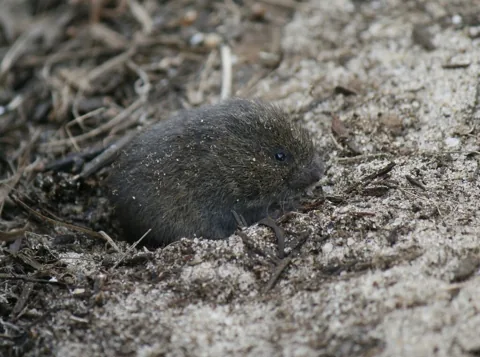 Voles (meadow mice)
Microtus species (shown: meadow vole, M. pennsylvanicus)
Voles, often called meadow mice, are small burrowing rodents that live in dense grass and ground cover. Their clearest sign is a maze of narrow surface runways, and they damage lawns, garden plants and the bark of young trees.
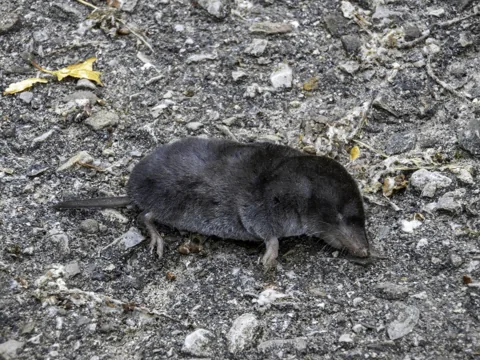 Shrews (northern short-tailed shrew)
Soricidae (e.g., Blarina brevicauda)
Shrews are small insect-eating mammals with long, pointed snouts and tiny eyes. They are mouselike but not mice, and the wildlife damage handbook notes that most species have no significant negative impact and aren't abundant enough to be pests. They eat large numbers of insects, including lawn and crop pests. This page uses the common northern short-tailed shrew as its main example.
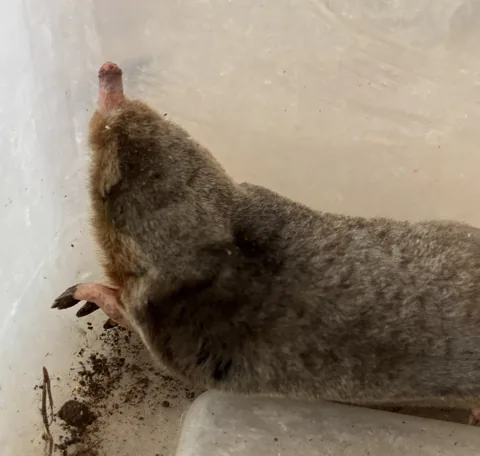 Moles
Talpidae (shown: eastern mole, Scalopus aquaticus; Scapanus species in the West)
Moles are small insect-eating mammals related to shrews, not rodents. They spend almost their whole lives underground hunting earthworms and insects, and their tunneling leaves raised ridges and mounds that disfigure lawns and gardens.
Side by side
A vole is a rodent, a close cousin of mice. A shrew is not a rodent at all: Penn State groups shrews with moles in the old order Insectivora, the insect eaters, and the Missouri Department of Conservation notes that grouping has since been split into newer orders.[1][2][9]
- Length, voles: mature voles are 5 to 7 inches long (Penn State), 5 to 8 inches including the tail (UC IPM) or about 4 1/4 to 7 inches, depending on species (Wildlife Illinois). Pine voles are 4 to 6 inches long in total.[2][3][4][7]
- Length, shrews: Missouri's shrews run from about 2 1/2 inches nose to tail tip (least shrew) to 5 inches (short-tailed shrew). The Pennsylvania Game Commission gives the short-tailed shrew as four to five inches long, and Penn State says a shrew fits neatly into a tablespoon.[9][10][1]
- Body: voles have a compact, heavy body, short legs and grizzled brown to reddish-brown fur. Short-tailed shrews have a cylindrical body, a distinct neck and short, slender legs with five clawed toes on each foot; they are generally gray, darker on the back.[3][4][9]
- Tail: a vole's tail is short, typically less than one-third the length of its body. The short-tailed and least shrews also have short tails, so the tail alone won't separate those two from a vole. Masked and southeastern shrews have longer tails, more than half the length of the head and body.[4][3][9][11]
- Snout and eyes: vole, rounded and blunt with small black eyes that are easy to see. Shrew, long and pointed with the nostrils at the tip, and eyes Missouri calls tiny and Virginia calls minute.[2][1][9][11]
- Ears: vole ears are small and furred and don't project much above the hair. On a shrew the external ear is not apparent; Missouri describes the least shrew's large ear openings as hidden in its velvety fur.[2][4][9][11]
- Teeth: vole, chisel-shaped gnawing incisors, orange on the front. Shrew, sharp and pointed teeth that are not well divided into incisors, canines and premolars; the front teeth work like pincers for holding struggling insects.[2][1][9][10]
- Diet: voles are mostly plant eaters, feeding on grasses, sedges, clover, seeds, bulbs, tubers and bark. Shrews eat insects, worms, snails, slugs, spiders and centipedes; the larger short-tailed shrews also take salamanders, small snakes, mice and other shrews.[3][4][2][9][10][11]
- Appetite: shrews are active year-round and must eat almost constantly. Missouri says short-tailed shrews can eat 50 percent of their weight each day and the least shrew 75 to 100 percent.[10][9]
- Venom: the short-tailed shrews have venom in their saliva that immobilizes prey. Voles have none.[9][11][13]
Runways, tunnels and holes
Voles make the signs. Meadow and prairie voles cut surface runways, small trails about 1 to 2 inches wide, through the grass, with several openings to burrows and nearby plants clipped close to the ground. Woodland voles run theirs just under the leaf litter, and pine voles do not use surface runways.[4][8]
Look in the runways for fresh grass clippings and greenish droppings about 3/16 inch long, which turn brown or gray with age. Missouri adds that, being vegetarians, voles leave bits of freshly cut plants in active runways.[3][6]
After snow melts in early spring, meadow vole runways can leave unsightly areas in lawns, golf courses and ground covers. Wildlife Illinois says the trails disappear quickly once grass starts growing and the lawn is not harmed.[2][4]
Shrews mostly borrow. Penn State says shrews hunt above ground and in tunnels made by moles or voles and do not create surface tunnels of their own. Missouri and Virginia describe some shrews building their own tunnel systems too, with short-tailed shrews digging nearly 2 feet down; Missouri says the surface tunnels may run just beneath sod or within leaf litter.[1][9][11]
So a runway system with clipped grass and gnawed plants points to voles even if you see a shrew in it. A shrew can be using the same runways, feeding on insects there.[1][9][8]
Plant damage: voles yes, shrews rarely
Voles girdle trees: they gnaw bark and roots, usually in fall or winter, and gnawing all the way around a trunk or root cuts off the tree's flow of nutrients and water. UC IPM lists almond, apple, avocado, cherry, citrus and olive among fruit trees they gnaw.[3][8][2]
Vole gnaw marks are about 1/8 inch wide and 3/8 inch long, set at various angles in irregular patches. Penn State and ICWDM caution that gnawing alone doesn't prove voles, because rabbits also gnaw bark; rabbit marks are larger and more uniform.[3][4][2][8]
In vegetable beds, UC IPM lists artichoke, beet, Brussels sprouts, cabbage, carrot, cauliflower, celery, lettuce, spinach, sweet potato, tomato and turnip among plants voles feed on. In late summer and fall they also store seeds, tubers, bulbs and rhizomes.[3][2]
Shrews typically do not eat much plant material. Missouri notes that short-tailed shrews eat more than the others, especially in winter, when they add roots, nuts, fruits, berries and fungi. The 1994 wildlife-damage handbook chapter on shrews says most species do not have significant negative impacts and are not abundant enough to be considered pests.[9][12]
How to confirm which one you have
If you have the animal in hand or in a photo, look at the face first: a long, pointed snout with eyes you can barely find is a shrew; a blunt, rounded face with visible black eyes is a vole. Then check the teeth: orange chisels mean a vole, small, sharp, pointed teeth that are often stained dark mean a shrew.[2][1][9][10]
Count toes if you can: shrews have five clawed toes on each foot.[9][10]
Check what's in your traps. Vole traps go in the runways, and shrews feed in vole and mole runways too, so look at the face before assuming every catch is a vole. A shrew in the trap doesn't explain gnawed bark or clipped grass.[4][5][1][9]
Read the damage. Girdled trunks, gnawed roots, eaten bulbs and grass clipped along 1- to 2-inch trails point to voles. No plant damage, and a small animal seen hunting in leaf litter, points to a shrew.[3][8][4][9]
What to do for each
Voles: keep grass mowed short to cut food and cover, keep mulch at least three inches back from tree trunks, and protect trunks or beds with hardware cloth of 1/4-inch or smaller mesh buried 6 to 8 inches into the soil.[4]
Trapping voles: mouse-size snap traps set at right angles to the runway, trigger end in the runway, work for small numbers. Cover each trap with a pot or board to keep pets and birds out; fall and late winter are the easiest times. Wildlife Illinois notes trapping over a large area is usually ineffective because voles breed so fast.[5][4][3][2]
Missouri law allows damage-causing voles to be trapped or shot; rules differ by state, so check with your state wildlife agency.[6][7]
Shrews: in a yard they are insect and slug eaters, and Missouri describes them taking crickets, grasshoppers and insect larvae and pupae. The wildlife-damage handbook says most species are not abundant enough to be considered pests. Our shrew profile covers state rules if one becomes a nuisance.[9][10][12]
Shrew bites and handling
Short-tailed shrews have venomous saliva, which the Pennsylvania Game Commission calls a rare example of toxicity in mammals. Missouri says the venom immobilizes insect prey, slows the heart and breathing and may break down muscle tissue of larger victims. A 2004 study isolated the toxin from the salivary glands of the northern short-tailed shrew and found it lethal to mice in the lab.[9][11][10][13]
Missouri also describes short-tailed shrews as exceedingly pugnacious and energetic.[9]
If any animal bites you, MedlinePlus advises washing the wound with soap and water as soon as possible and getting medical attention if necessary, since an infected bite can lead to serious medical problems.[14]
Common questions
- Is a shrew a rodent like a vole?
- No. Voles are rodents with chisel-like gnawing teeth. Shrews are insect eaters grouped with moles, with sharp, spiky teeth for hunting instead of gnawing plants.[2][9][1]
- Do shrews eat bulbs or girdle trees?
- Rarely, if at all. Shrews eat mostly insects and other small animals; short-tailed shrews add some roots, nuts and fruit in winter. Girdled trunks, gnaw marks about 1/8 inch wide and eaten bulbs are vole signs.[9][3][2]
- Are shrews venomous?
- The short-tailed shrews are. Their saliva carries a venom that paralyzes prey, and lab work found the purified toxin lethal to mice.[9][11][13]
- Why did I catch a shrew in my vole trap?
- Shrews hunt in the runways and tunnels of voles and moles, which is exactly where vole traps are set. Check the face: a long pointed snout means a shrew.[1][9][4]
Photo credits
- Voles (meadow mice): (c) David LaMagna, some rights reserved (CC BY) — via iNaturalist, CC BY 4.0
- Shrews (northern short-tailed shrew): (c) Shaun Coleman, some rights reserved (CC BY) — via iNaturalist, CC BY 4.0
- Moles: (c) Sam Kieschnick, some rights reserved (CC BY) — via iNaturalist, CC BY 4.0
Sources
- Penn State Extension, “Identifying Moles, Voles, and Shrews.” extension.psu.edu/identifying-moles-voles-and-shrews (accessed 2026-11-14)
- Penn State Extension, “Voles.” extension.psu.edu/voles (accessed 2026-11-14)
- University of California Statewide IPM Program, “Pest Notes: Voles (Meadow Mice).” ipm.ucanr.edu/home-and-landscape/voles/ (accessed 2026-11-14)
- Wildlife Illinois, University of Illinois Extension, “Voles.” wildlifeillinois.org/identify-wildlife/voles/ (accessed 2026-11-14)
- N.C. Cooperative Extension, Henderson County Center, “Trapping Voles in the Landscape.” henderson.ces.ncsu.edu/2024/03/trapping-voles-in-the-landscape/ (accessed 2026-11-14)
- Missouri Department of Conservation, “Vole Control.” mdc.mo.gov/wildlife/nuisance-problem-species/vole-control (accessed 2026-11-14)
- Internet Center for Wildlife Damage Management, “Voles: Identification.” icwdm.org/species/rodents/voles/ (accessed 2026-11-14)
- Internet Center for Wildlife Damage Management, “Vole Damage.” icwdm.org/species/rodents/voles/vole-damage/ (accessed 2026-11-14)
- Missouri Department of Conservation, “Shrews (field guide).” mdc.mo.gov/discover-nature/field-guide/shrews (accessed 2026-11-14)
- Pennsylvania Game Commission, “Shrews and Moles.” www.pa.gov/agencies/pgc/wildlife/discover-pa-wildlife/shrews-and-moles (accessed 2026-11-14)
- Virginia Department of Wildlife Resources, “Northern short-tailed shrew.” dwr.virginia.gov/wildlife/information/nothern-short-tailed-shrew/ (accessed 2026-11-14)
- University of Nebraska-Lincoln / Internet Center for Wildlife Damage Management, “Shrews (Prevention and Control of Wildlife Damage, 1994).” digitalcommons.unl.edu/icwdmhandbook/55 (accessed 2026-11-14)
- Proceedings of the National Academy of Sciences, “Blarina toxin, a mammalian lethal venom from the short-tailed shrew Blarina brevicauda: isolation and characterization (PNAS 2004).” pubmed.ncbi.nlm.nih.gov/15136743/ (accessed 2026-11-14)
- MedlinePlus (National Library of Medicine), “Animal Bites.” medlineplus.gov/animalbites.html (accessed 2026-11-14)