The short answer
- Raised ridges of soil across the lawn, with roughly circular mounds often lined up over a tunnel, are made by moles. Moles mostly eat grubs, beetles and worms and rarely eat plants.[1][2]
- Fan- or crescent-shaped mounds with a plugged hole off to one side are pocket gophers.[6][7]
- Paths 1 to 2 inches wide worn into the grass at the surface, with clipped grass and small droppings, are vole runways.[5][4]
- Small tunnels just under the turf in Southeast lawns, worst from late summer into fall, can be mole crickets.[8][9]
Profiles of lawn diggers
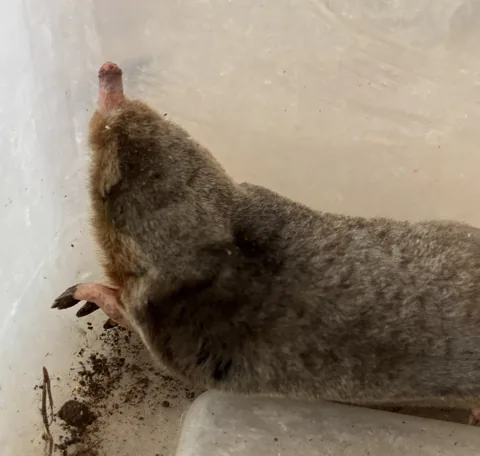 Moles
Talpidae (shown: eastern mole, Scalopus aquaticus; Scapanus species in the West)
Moles are small insect-eating mammals related to shrews, not rodents. They spend almost their whole lives underground hunting earthworms and insects, and their tunneling leaves raised ridges and mounds that disfigure lawns and gardens.
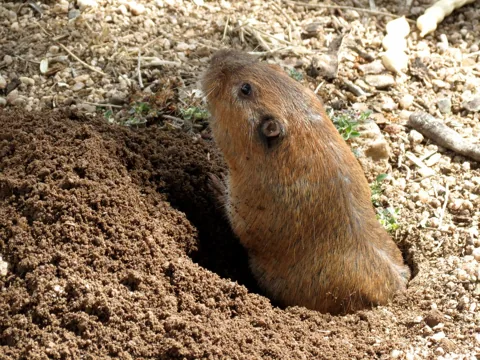 Pocket gophers
Thomomys and Geomys species (shown: Botta's pocket gopher, Thomomys bottae, listed by iNaturalist as Megascapheus bottae)
Pocket gophers are burrowing rodents named for the fur-lined cheek pouches they use to carry food. They rarely come above ground, but a single gopher can ruin a garden quickly by eating roots and pulling plants into its tunnels.
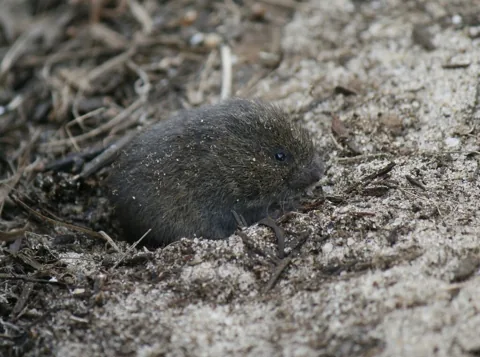 Voles (meadow mice)
Microtus species (shown: meadow vole, M. pennsylvanicus)
Voles, often called meadow mice, are small burrowing rodents that live in dense grass and ground cover. Their clearest sign is a maze of narrow surface runways, and they damage lawns, garden plants and the bark of young trees.
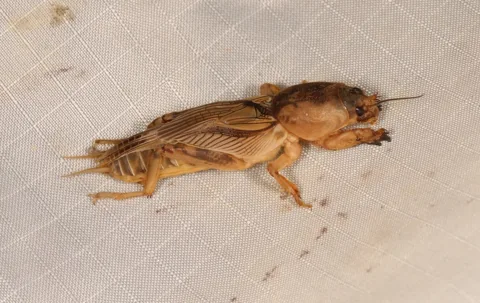 Mole Crickets
Neoscapteriscus species (tawny, southern and shortwinged mole crickets; N. vicinus shown)
Tawny and southern mole crickets are introduced species, thought to have arrived from South America in ships' ballast and first found in Southeastern port towns in the late 1800s and early 1900s. They are now serious turf pests in the sandy coastal Southeast: both tunnel just under the lawn, uprooting and drying out grass, and the tawny mole cricket also feeds on grass roots and shoots. UF/IFAS says three Neoscapteriscus species reached the Southeast around 1900, probably from Argentina and Uruguay.
Lawn clues and the likely culprit
- Ridges pushed up as an animal forces its way through the soil, plus mounds with circular edges made of small soil chunks, often in a line: moles. Some ridges are used only once.[1][2]
- Mounds of loose soil shaped like a fan or half circle, with the plugged burrow opening off to one side, and no open holes: pocket gophers. One gopher can throw up several mounds a day.[6][7]
- A maze of surface runways 1 to 2 inches wide hidden under the grass, linking open burrow holes about 1-1/2 to 2 inches across, with fresh grass clippings and greenish droppings about 3/16 inch long: voles. Where it snows, voles also tunnel through the snow.[4][5]
- Shallow tunnels just beneath the turf and small mounds, showing up in warm spells and doing the most damage from late August to October as the crickets mature: tawny or southern mole crickets, pests along the southeastern coast.[8][9]
- Mole mounds are round with the plug in the middle, gopher mounds are crescent-shaped with the plug to one side, and ground squirrel holes are left open with no mound.[6][1][7]
How to confirm
- Watch for new mounds and ridges. Fresh mounds mean a gopher is active, and fresh mounds or surface tunnels are the moment to start mole control.[6][1]
- Moles dig all year but show less surface activity during extreme cold, heat or drought, so quiet spells don't mean they've left.[1]
- For voles, pull back overhanging grass or ground cover to find the runways, and look for clippings and droppings in them.[4][5]
- For mole crickets, pour a soapy water drench over the tunneled area; Clemson says the crickets come to the surface quickly if they're there.[8]
What to do next
- Moles: trapping is the most dependable control. Use traps made for moles, since very few traps work for both moles and gophers.[1][3]
- Don't count on grub control to drive moles away. ICWDM says insecticides often don't reduce mole damage, and a lawn can be free of grubs and still have moles because they also eat worms and other soil animals.[3][2]
- Pocket gophers: UC IPM recommends traps placed in active burrows plus underground fencing, and warns that toxic baits can threaten wildlife, pets and children in a backyard.[6]
- Voles: protect young trees with hardware cloth or other trunk guards, keep grass mowed around beds, and fence gardens with mesh 1/4 inch or smaller that is buried 6 to 10 inches deep.[4]
- Mole crickets: Clemson lists mole cricket baits sold at garden centers and feed and seed stores, and a commercial product that uses a beneficial nematode.[8]
Common questions
- Will killing grubs get rid of moles?
- Usually not. Moles eat grubs but also earthworms, beetles and ants, and ICWDM notes a lawn can be free of grubs and still have moles.[3][2]
- Are moles eating my bulbs and plants?
- Rarely. Penn State says moles seldom eat plants; damage usually comes from roots disturbed by tunneling or from mice and voles using mole tunnels for cover.[2]
- How can I tell a mole mound from a gopher mound?
- Mole mounds are round with the plug near the center; gopher mounds are fan- or crescent-shaped with a plugged hole off to one side.[6][7][1]
Sources
- University of California Statewide IPM Program, “Pest Notes: Moles.” ipm.ucanr.edu/home-and-landscape/moles/ (accessed 2026-11-12)
- Penn State Extension, “Moles.” extension.psu.edu/moles (accessed 2026-11-12)
- Internet Center for Wildlife Damage Management, “Mole Damage Prevention and Control Methods.” icwdm.org/species/other-mammals/moles/mole-damage-prevention-and-control-methods/ (accessed 2026-11-12)
- University of California Statewide IPM Program, “Voles (Pest Notes, Home and Landscape).” ipm.ucanr.edu/home-and-landscape/voles/ (accessed 2026-11-12)
- Internet Center for Wildlife Damage Management, “Vole Damage Identification.” icwdm.org/species/rodents/voles/vole-damage/ (accessed 2026-11-12)
- University of California Statewide IPM Program, “Pest Notes: Pocket Gophers, UC ANR Publication 7433.” ipm.ucanr.edu/home-and-landscape/pocket-gophers/ (accessed 2026-11-12)
- Internet Center for Wildlife Damage Management, “Pocket Gophers: Identification.” icwdm.org/species/rodents/pocket-gophers/ (accessed 2026-11-12)
- Clemson Cooperative Extension Home & Garden Information Center, “Mole Cricket Management in Turfgrass (HGIC).” hgic.clemson.edu/factsheet/mole-cricket-management-in-turfgrass/ (accessed 2026-11-12)
- NC State Extension, “Mole Crickets in Turf (TurfFiles, 2017).” content.ces.ncsu.edu/mole-cricket-in-turf (accessed 2026-11-12)
Updated 2026-11-12. Built from sourced records. Spot an error? Tell us.