The short answer
- Measure the hole and look at the soil around it. Pencil-size holes with granular pellets are usually earthworms; ¼- to ½-inch holes in thin turf are usually ground-nesting bees; a ¾-inch hole with the dirt piled to one side in midsummer is a cicada killer; holes of 1 to 3 inches with no soil around them point to voles or chipmunks; a 10- to 12-inch hole with a big dirt pile is a groundhog.[1][23][24][25][30]
- The one to treat as dangerous is a hole with a steady stream of wasps going in and out. UC IPM says wasps flying from a hole in the ground indicate a probable nest, that ground-nesting yellowjackets defend their nests vigorously when disturbed, and not to disturb nests. Keep people, pets and the mower away until you know.[11]
- Shallow cone-shaped divots or rolled-up sod that appear overnight usually mean an animal was digging for grubs and worms: skunks dig 3- to 4-inch cone-shaped holes (ICWDM, Penn State), and raccoons roll up freshly laid sod (ICWDM, UC IPM).[18][17][20][19]
- Most small holes left by worms, solitary bees and cicadas need no treatment. N.C. State says damage from ground-nesting bees is usually minimal and control is rarely necessary, and Utah State calls earthworms natural aerators whose holes help water and nutrients move into the soil.[7][5]
Related pest profiles
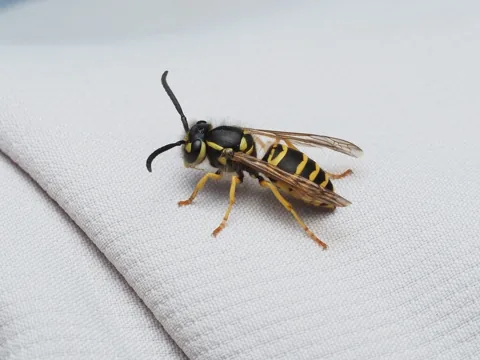 Eastern Yellowjacket
Vespula maculifrons
The eastern yellowjacket is a native, ground-nesting yellowjacket common across the eastern US in lawns, woodlands, pastures and parks; it defends its nest aggressively and can sting repeatedly.
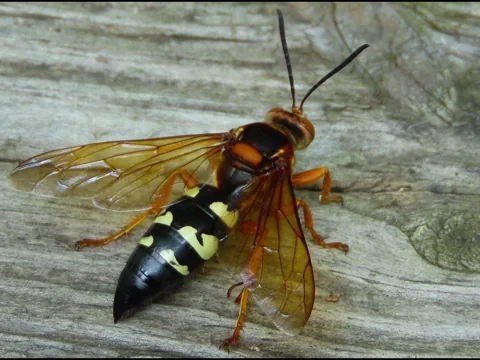 Eastern Cicada Killer
Sphecius speciosus
Cicada killers are very large solitary wasps seen mostly in July and August. Females dig burrows and stock them with annual cicadas. They look alarming, but the Missouri Department of Conservation calls them virtually harmless unless handled roughly, and Kentucky says they aren't a stinging hazard unless directly disturbed.
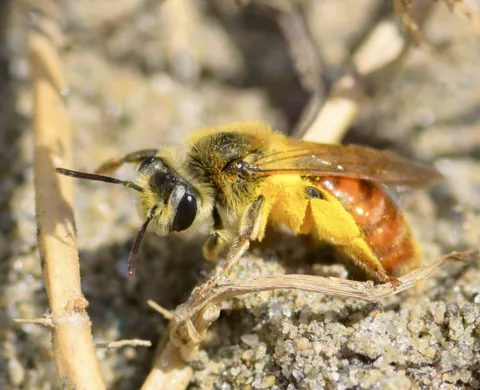 Mining Bees
Andrena species
Mining bees, genus Andrena, are solitary native bees that nest in the ground, often in dense spring aggregations in lawns and bare soil. They pollinate spring flowers and fruit crops, aren't aggressive, and Penn State says they aren't considered pests.
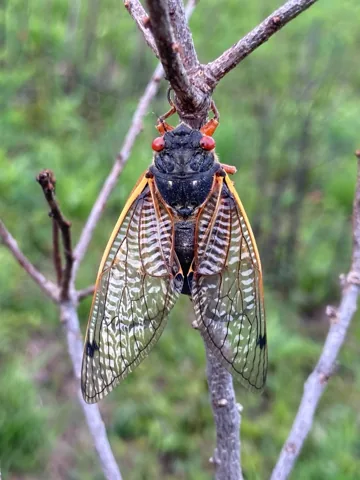 Periodical Cicadas
Magicicada species (e.g., M. septendecim)
Periodical cicadas spend 13 or 17 years underground feeding on root sap, then emerge together in huge numbers in late spring. They don't bite or sting; the real harm is egg-laying damage to small twigs, which matters most on young trees.
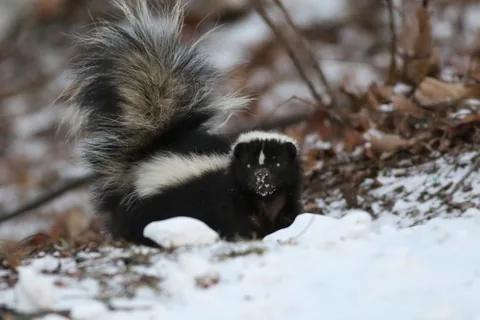 Striped skunk
Mephitis mephitis
The striped skunk is a cat-sized, black and white mammal that often lives under porches, decks and sheds. It digs lawns for grubs, sprays pets that corner it, and is one of the main wildlife carriers of rabies.
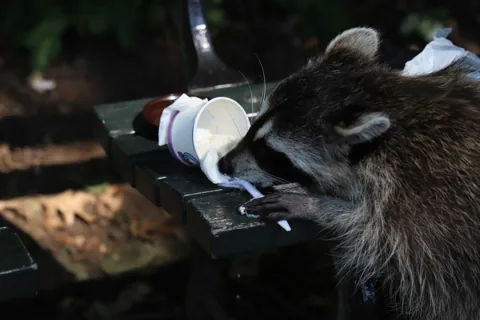 Raccoon
Procyon lotor
Raccoons are masked, ring-tailed mammals that adapt very well to towns and suburbs. They raid garbage and gardens, den in attics, chimneys and under decks, and can carry rabies and raccoon roundworm.
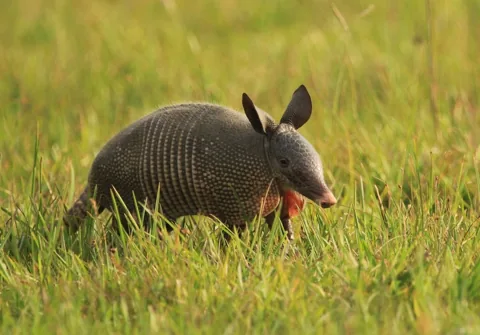 Nine-banded armadillo
Dasypus novemcinctus
The nine-banded armadillo is an armored, insect-eating mammal that has colonized much of the southern United States in the last 200 years. It roots through lawns, gardens and flower beds for insects and earthworms, and it digs burrows under foundations, slabs, driveways and pools.
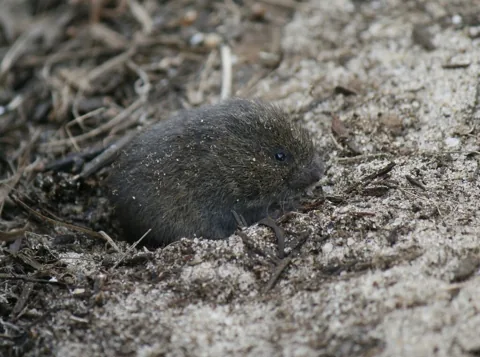 Voles (meadow mice)
Microtus species (shown: meadow vole, M. pennsylvanicus)
Voles, often called meadow mice, are small burrowing rodents that live in dense grass and ground cover. Their clearest sign is a maze of narrow surface runways, and they damage lawns, garden plants and the bark of young trees.
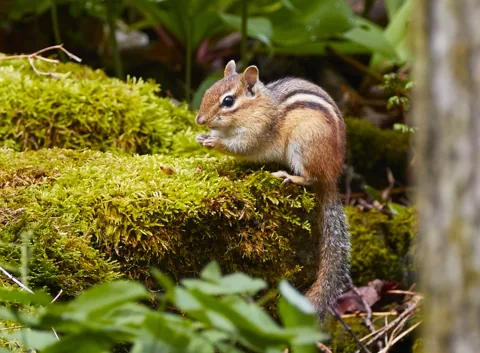 Eastern chipmunk
Tamias striatus
The eastern chipmunk is a small, striped ground squirrel that lives in woodland edges and around homes. Most problems are a nuisance, but many chipmunks burrowing near a house can undermine patios, stairs, retaining walls and foundations.
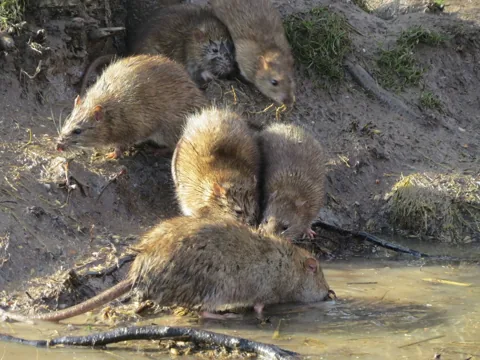 Norway Rat
Rattus norvegicus
The Norway rat, also called the brown or sewer rat, is a large, burrowing rat found throughout the contiguous United States wherever people live.
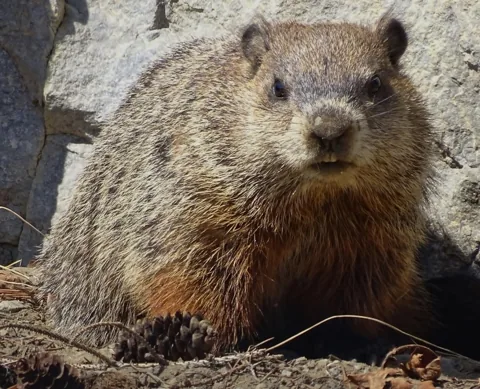 Groundhog (woodchuck)
Marmota monax
The groundhog, or woodchuck, is a burrowing member of the squirrel family found across eastern and central North America. It feeds on garden vegetables and clover by day and digs extensive burrows that can undermine foundations, sidewalks and pools.
Sort the holes by size and shape
Start with the smallest holes and work up. The sizes below come from the extension and agency sources cited; where two sources give different sizes, both are shown. Most culprits have their own profile or guide, linked further down.[1]
- Pencil-size hole with small piles of granular soil pellets: earthworms, especially the European night crawler. N.C. Cooperative Extension describes 1-inch high piles of castings around a pencil-sized hole, common in spring and fall when soils are moist. University of Kentucky says night crawlers pull leaves and twigs toward the hole, building a small tent-like pile, and the yard can take on a lumpy look.[1][4][5]
- Many ¼- to ½-inch holes close together, each with a small soil mound, in thin or bare turf in spring: ground-nesting (solitary) bees. N.C. Cooperative Extension says there can be 100 or more nesting in close quarters, Clemson says calls about bees digging holes in lawns come in early spring, and N.C. State says the soil mounds are sometimes mistaken for ant colonies.[1][8][7]
- Round holes about ½ inch across, often many under trees, in late spring: cicada nymph exit holes. Rutgers says the hole is about 1/2-inch in diameter and may be numerous under trees; some nymphs first build mud cones two or three inches high. N.C. Cooperative Extension describes nickel-size emergence holes from cicadas and June beetles, sometimes ringed with loose soil, in late spring and early summer. Penn State says periodical cicada nymphs build earthen turrets when the ground is too damp.[2][1][3]
- A ¾-inch hole with the dirt piled to one side, in dry bare or short-cut areas in summer, with very large wasps flying low: cicada killers. N.C. Cooperative Extension says the female digs a ¾-inch hole 18 to 24 inches deep, digging from late July to mid-August, with all the excavated dirt mounded to one side. Missouri Department of Conservation says the mound often has a shallow furrow leading to the entrance, as if someone dragged a thumb across the soil.[1][10][9]
- A hole with wasps flying straight in and out all day: a yellowjacket nest. UC IPM says yellowjackets nest in holes in the ground and that wasps flying from a hole in the ground indicate a probable nest. Penn State says the eastern yellowjacket is a ground-nesting species that is very common in woodlands, pastures, parks and lawns.[11][12]
- A mud tower 2 to 4 inches tall with an opening about 1 inch across, in wet or low ground: a crayfish chimney. N.C. Cooperative Extension says crayfish are typically the culprit when the site is wet or the water table is close to the surface. Clemson says the crayfish roll mud into small pellets and stack them, and that chimneys usually appear in spring. University of Arkansas Extension says they are most common in low-lying yards, near ditches or creeks, and in slow-draining clay.[1][14][15]
- Shallow cone- or funnel-shaped holes, or patches of upturned earth, that appear overnight: skunks (or raccoons) digging for grubs. ICWDM and Penn State give 3 to 4 inches across; UC IPM gives 3 to 5 inches. Penn State says dogs and squirrels also dig in yards but do not usually make circular holes.[18][17][16][1]
- Freshly laid sod rolled back in strips: raccoons. ICWDM says raccoons roll up freshly laid sod looking for earthworms and grubs and may return on successive nights. The sources disagree on holes: UC IPM says raccoons do not typically dig holes in lawns, while N.C. Cooperative Extension lists skunks and raccoons together for 3- to 4-inch funnel-shaped holes.[20][19][1]
- Cone-shaped holes 1 to 3 inches deep and 3 to 5 inches wide, where armadillos live: armadillo rooting. Clemson says armadillos make several cone-shaped holes when rooting and dig burrows 7 to 8 inches across. Missouri Department of Conservation says they find food with their nose and dig it out with sharp claws.[21][22]
- Holes about 1 to 2 inches across with no soil mound, linked by grassy runways: voles. N.C. Cooperative Extension gives 1 to 1½ inches; UC IPM gives 1-1/2 to 2 inches and says fresh green clippings and greenish droppings about 3/16 inch long in the runways are further evidence. Raised ridges or soil mounds point to moles or gophers instead (see our tunnels in the lawn guide).[1][23]
- A neat hole about 2 inches across with no soil around it, near a patio, steps, wall, woodpile or garage: a chipmunk. ICWDM says the entrance is usually about 2 inches across with no obvious mound because chipmunks carry soil away in their cheek pouches. University of Missouri gives 2- to 3-inch burrows cut neatly through the turf with no excavated soil at the entrance. N.C. Cooperative Extension says squirrels burying nuts leave similar holes, only about three inches deep.[24][25][1]
- Holes up to about 3 inches across under shrubs, woodpiles, sheds, trash or along a foundation: Norway rats. N.C. Cooperative Extension says rat tunnel entrances can be as large as 3 inches in diameter and are often hidden near shrubbery, wood piles and sheds. UC IPM says Norway rats build burrows along building foundations, beneath trash piles or in woodpiles, and lists burrows beneath garbage cans and compost piles as a sign of rats.[1][26]
- In California and the West, holes about 4 inches across in open ground, often several together: ground squirrels. UC IPM says California ground squirrel burrows are about 4 inches in diameter and live in colonial burrow systems.[29]
- A big hole 10 to 12 inches across with a large mound of fresh dirt: a groundhog (woodchuck). Penn State and N.C. Cooperative Extension both give 10 to 12 inches for the main entrance. Connecticut DEEP says burrows have at least 2 entrances, and N.C. Cooperative Extension says the secondary holes have no mounded soil around them.[30][1][31]
Is one hole a sign of more?
Often yes, but that is not always a problem. Ground-nesting bees nest in groups (N.C. Cooperative Extension says 100 or more can nest close together), and cicada exit holes can be numerous under trees (Rutgers). Clemson says these bees are not considered a significant medical threat to most people.[1][2][8]
A groundhog hole usually has company. Connecticut DEEP says most burrows are 25 to 30 feet long with at least 2 entrances, and the less visible ones are escape holes. ICWDM says woodchuck burrows undermine foundations of buildings, pools and sidewalks, and Penn State says burrowing can weaken building foundations.[31][32][30]
Overnight digging is a clue to what is under the turf. N.C. Cooperative Extension says skunks and raccoons dig at night looking for grubs and other insects, and that controlling grubs can reduce the food that draws them. Our brown patches in the lawn and grub guides show how to check for grubs.[1]
Safety first
Yellowjacket holes: stay back. UC IPM says ground- and cavity-nesting yellowjackets tend to defend their nests vigorously when disturbed, and defensive behavior increases as the season goes on and colonies get larger. UC IPM's advice is simple: don't disturb nests.[11]
If someone is stung: CDC/NIOSH says to wash the site with soap and water and remove the stinger by wiping gauze or scraping a fingernail over the area. People who are allergic to venom may have anaphylaxis, a severe and potentially life-threatening reaction that needs emergency care, and NIOSH says people with a history of severe reactions should carry an EpiPen. MedlinePlus says to call 911 for a severe reaction.[33][34]
Pets: Merck Veterinary Manual says yellowjackets and wasps, unlike honey bees, can sting multiple times, and that multiple stings can cause severe local and whole-body reactions in animals.[35]
Big wasps at small mounds are usually low risk. Missouri Department of Conservation says male cicada killers cannot sting at all, and the University of Kentucky says cicada killers are not considered stinging hazards unless directly disturbed. Clemson says ground-nesting bees are not aggressive and tend not to sting unless provoked or handled roughly.[10][9][8]
Mowers and ankles: Clemson says hitting crayfish chimneys can dull mower blades and send chunks of mud flying, and Penn State says groundhog mounds and burrow holes are a hazard to equipment, horses and riders.[14][30]
How to confirm what made the hole
Watch at the right time of day. N.C. Cooperative Extension says skunk and raccoon digging happens at night, groundhogs are active during the day, and cicada killers are active and very noticeable for a few weeks during the day. Watch a suspected yellowjacket hole from a distance in daylight; the University of Kentucky says to pinpoint the nest opening during the day.[1][13]
Plug test for burrows: ICWDM suggests plugging holes with paper to find which ones are active before sealing them for good; a plug that gets pushed out or chewed through marks a hole in use. Never plug a hole with wasps going in and out.[27][11]
Track test at a den opening: for a suspected skunk den, Penn State says to sprinkle a thin layer of flour on the ground in front of the opening and check it after dark for tracks.[17]
Look for runways and droppings: UC IPM says vole runways are hidden under grass and ground cover; pull it back to find fresh clippings and droppings. Earthworm holes have castings (granular soil pellets) around them, which N.C. Cooperative Extension says are most common in spring and fall when soils are moist.[23][1]
Check the soil and season: crayfish chimneys show up in saturated ground, often in spring (Clemson, University of Arkansas), and cicada killers pick dry, sandy, loose soil (University of Kentucky).[14][15][9]
What to do next for each culprit
Match the fix to the digger. N.C. Cooperative Extension says knowing what is causing the problem makes the solution more likely to work, and that for wildlife the first step is to reduce the food, water and shelter available.[1]
- Earthworms: usually leave them. Utah State says irrigating less often and more deeply keeps earthworms deeper in the soil so they leave fewer castings on the surface. NDSU suggests running a power rake over the lawn in two directions to break up castings once the grass has greened.[5][6]
- Ground-nesting bees and cicada killers: N.C. Cooperative Extension says they do not like wet sites and that watering encourages them to nest elsewhere. University of Kentucky says wood or stone mulch, shade or more irrigation in the area can make cicada killers move. See our ground bees guide and cicada killers vs yellowjackets.[1][9]
- Yellowjackets: see our wasp nest removal guide. University of Kentucky says yellowjacket treatment should be done at night when most of the wasps are in the nest and less active, and that if elimination is necessary it is often best to call a professional pest control firm.[13]
- Skunks, raccoons and armadillos: reduce the food. N.C. Cooperative Extension says to reduce the food, water and shelter available, which may include controlling grubs. See our guides to skunks, raccoons in the yard, armadillos and grubs in the lawn.[1]
- Crayfish: Clemson and University of Arkansas Extension both say no pesticides are approved for crayfish in lawns and that home remedies can contaminate water. Improve drainage, and knock down chimneys before mowing (Clemson). University of Arkansas says the chimneys crumble as the soil dries out.[14][15]
- Voles, chipmunks, rats and groundhogs: follow the matching guide below. For rats around a building, ICWDM says to seal holes and openings larger than ½ inch across with materials that resist gnawing.[27]
When to call a pro
A yellowjacket nest in a lawn, play area or path, or anyone in the household with a sting allergy: University of Kentucky says it is often best to call a professional pest control firm when a nest has to go, and NIOSH notes the risk of anaphylaxis for people allergic to venom.[13][33]
A groundhog burrow near a foundation, patio or pool: Connecticut DEEP says people needing help can hire a licensed Nuisance Wildlife Control Operator to remove problem animals and do exclusion work. Burrow fumigants with aluminum phosphide are Restricted Use Pesticides that only a certified applicator may apply (Penn State).[31][30]
Rats burrowing along a building, or a hole you still cannot identify: see our rat guide and find-a-pro page. ICWDM says rats seldom travel more than 400 feet from their burrows, so burrows by the house mean rats are working the building.[28]
Common questions
- What makes small round holes in my lawn overnight?
- Shallow cone-shaped holes 3 to 4 inches across that appear overnight are usually skunks digging for grubs (ICWDM, Penn State). Small pencil-size holes with soil pellets are earthworms (N.C. Cooperative Extension).[18][17][1]
- Are holes with no dirt around them from voles or chipmunks?
- Both leave holes with no soil mound. Vole holes are about 1 to 2 inches and connect to grassy runways (UC IPM, N.C. Cooperative Extension); chipmunk holes are about 2 to 3 inches, often near patios, walls or woodpiles (ICWDM, University of Missouri).[23][1][24][25]
- Should I fill in the holes?
- Not a yellowjacket hole: UC IPM says not to disturb nests. For rodent burrows, loosely plug them with paper first to see which are still active (ICWDM).[11][27]
- What are the mud towers in my wet yard?
- Crayfish chimneys. Clemson says no chemicals are labeled to control crawfish; improve drainage and knock the chimneys down before mowing.[14][1]
Photo credits
- Eastern Yellowjacket: Brighton Lee, public domain (CC0), via iNaturalist
- Eastern Cicada Killer: (c) Steve Kerr, some rights reserved (CC BY) — via iNaturalist, CC BY 4.0
- Mining Bees: (c) Bernie Paquette, some rights reserved (CC BY) — via iNaturalist, CC BY 4.0
- Periodical Cicadas: (c) Jake McCumber, some rights reserved (CC BY) — via iNaturalist, CC BY 4.0
- Striped skunk: (c) Richard Poort, some rights reserved (CC BY) — via iNaturalist, CC BY 4.0
- Raccoon: (c) Steven Bodzin, some rights reserved (CC BY) — via iNaturalist, CC BY 4.0
- Nine-banded armadillo: (c) Leo Lagos, some rights reserved (CC BY) — via iNaturalist, CC BY 4.0
- Voles (meadow mice): (c) David LaMagna, some rights reserved (CC BY) — via iNaturalist, CC BY 4.0
- Eastern chipmunk: David Bird, public domain (CC0), via iNaturalist
- Norway Rat: petehawkins, public domain (CC0), via iNaturalist
- Groundhog (woodchuck): (c) cornwallcen, some rights reserved (CC BY) — via iNaturalist, CC BY 4.0
Sources
- N.C. Cooperative Extension, Caldwell County Center, “What's Making This Hole in My Yard? (Seth Nagy).” caldwell.ces.ncsu.edu/2018/04/whats-making-this-hole-in-my-yard/ (accessed 2026-11-14)
- Rutgers New Jersey Agricultural Experiment Station, “Periodical Cicada (FS220).” njaes.rutgers.edu/fs220 (accessed 2026-11-14)
- Penn State Extension, “Periodical Cicada.” extension.psu.edu/periodical-cicada (accessed 2026-11-14)
- University of Kentucky Entomology, “ENTFACT-402: Earthworms: Benefits and Potential Issues.” entomology.mgcafe.uky.edu/ef402 (accessed 2026-11-14)
- Utah State University Extension, “Over Hill, Over Dale: Earthworms in the Lawn.” extension.usu.edu/yardandgarden/research/over-hill-over-dale-earthworms-in-the-lawn (accessed 2026-11-14)
- North Dakota State University Extension, “Night Crawlers Can Cause Lawn Problems.” www.ag.ndsu.edu/news/newsreleases/2011/april-25-2011/night-crawlers-can-cause-lawn-problems (accessed 2026-11-14)
- NC State Extension, “Ground-Nesting Bees in Turf (TurfFiles).” www.turffiles.ncsu.edu/insects/bees-in-turf/ (accessed 2026-11-14)
- Clemson Cooperative Extension Home & Garden Information Center, “Spring Has Sprung and So Have The (Ground-Nesting) Bees.” hgic.clemson.edu/spring-has-sprung-and-so-have-the-ground-nesting-bees/ (accessed 2026-11-14)
- University of Kentucky Entomology, “ENTFACT-004: Cicada Killer Wasps.” entomology.mgcafe.uky.edu/ef004 (accessed 2026-11-14)
- Missouri Department of Conservation, “Eastern Cicada Killer.” mdc.mo.gov/discover-nature/field-guide/eastern-cicada-killer (accessed 2026-11-14)
- University of California Statewide IPM Program, “Pest Notes: Yellowjackets and Other Social Wasps.” ipm.ucanr.edu/home-and-landscape/yellowjackets-and-other-social-wasps/ (accessed 2026-11-14)
- Penn State Extension, “Eastern Yellowjacket.” extension.psu.edu/eastern-yellowjacket (accessed 2026-11-14)
- University of Kentucky Entomology, “ENTFACT-620: Wasp and Hornet Control.” entomology.mgcafe.uky.edu/ef620 (accessed 2026-11-14)
- Clemson Cooperative Extension Home & Garden Information Center, “Crawfish Chimneys (Lance Beecher).” hgic.clemson.edu/factsheet/crawfish-chimneys/ (accessed 2026-11-14)
- University of Arkansas Cooperative Extension Service, “Crayfish Chimneys in Your Yard (Sherri Sanders).” uaex.uada.edu/counties/white/news/horticulture/Crayfish-Chimneys-in-your-yard.aspx (accessed 2026-11-14)
- University of California Statewide IPM Program, “Pest Notes: Skunks.” ipm.ucanr.edu/home-and-landscape/skunks/ (accessed 2026-11-14)
- Penn State Extension, “Skunks.” extension.psu.edu/skunks (accessed 2026-11-14)
- Internet Center for Wildlife Damage Management, “Skunk Damage Identification.” icwdm.org/species/carnivores/skunks/skunk-damage-identification/ (accessed 2026-11-14)
- University of California Statewide IPM Program, “Pest Notes: Raccoons.” ipm.ucanr.edu/home-and-landscape/raccoons/ (accessed 2026-11-14)
- Internet Center for Wildlife Damage Management, “Raccoon Damage Identification.” icwdm.org/species/other-mammals/raccoons/raccoon-damage-identification/ (accessed 2026-11-14)
- Clemson Cooperative Extension Home & Garden Information Center, “Armadillos.” hgic.clemson.edu/factsheet/armadillos/ (accessed 2026-11-14)
- Missouri Department of Conservation, “Nine-banded Armadillo.” mdc.mo.gov/discover-nature/field-guide/nine-banded-armadillo (accessed 2026-11-14)
- University of California Statewide IPM Program, “Pest Notes: Voles (Meadow Mice).” ipm.ucanr.edu/home-and-landscape/voles/ (accessed 2026-11-14)
- Internet Center for Wildlife Damage Management, “Chipmunk Biology.” icwdm.org/species/rodents/chipmunks/chipmunk-biology/ (accessed 2026-11-14)
- University of Missouri Extension, “Controlling Chipmunk Damage (G9527).” extension.missouri.edu/media/wysiwyg/Extensiondata/Pub/pdf/agguides/wildlife/g09527.pdf (accessed 2026-11-14)
- University of California Statewide IPM Program, “Pest Notes: Rats.” ipm.ucanr.edu/home-and-landscape/rats/ (accessed 2026-11-14)
- Internet Center for Wildlife Damage Management, “Norway Rats.” icwdm.org/species/rodents/norway-rats/ (accessed 2026-11-14)
- Internet Center for Wildlife Damage Management, “Norway Rat Biology.” icwdm.org/species/rodents/norway-rats/norway-rat-biology/ (accessed 2026-11-14)
- University of California Statewide IPM Program, “Pest Notes: Ground Squirrel (Publication 7438).” ipm.ucanr.edu/legacy_assets/PDF/PESTNOTES/pngroundsquirrel.pdf (accessed 2026-11-14)
- Penn State Extension, “Woodchucks (wildlife damage control fact sheet).” extension.psu.edu/woodchucks (accessed 2026-11-14)
- Connecticut Department of Energy and Environmental Protection, “Woodchuck (fact sheet, rev. 6/22).” portal.ct.gov/deep/wildlife/fact-sheets/woodchuck (accessed 2026-11-14)
- Internet Center for Wildlife Damage Management, “Woodchuck Damage Identification.” icwdm.org/species/rodents/woodchucks/woodchuck-damage-identification/ (accessed 2026-11-14)
- CDC National Institute for Occupational Safety and Health, “Insects and Scorpions at Work.” www.cdc.gov/niosh/outdoor-workers/about/insects-and-scorpions.html (accessed 2026-11-14)
- MedlinePlus, U.S. National Library of Medicine, “Insect bites and stings (Medical Encyclopedia).” medlineplus.gov/ency/article/000033.htm (accessed 2026-11-14)
- Merck Veterinary Manual, “Wasp, Bee, and Ant Stings to Animals.” www.merckvetmanual.com/toxicology/venomous-arthropods/hymenoptera (accessed 2026-11-14)