On this page
How to identify it
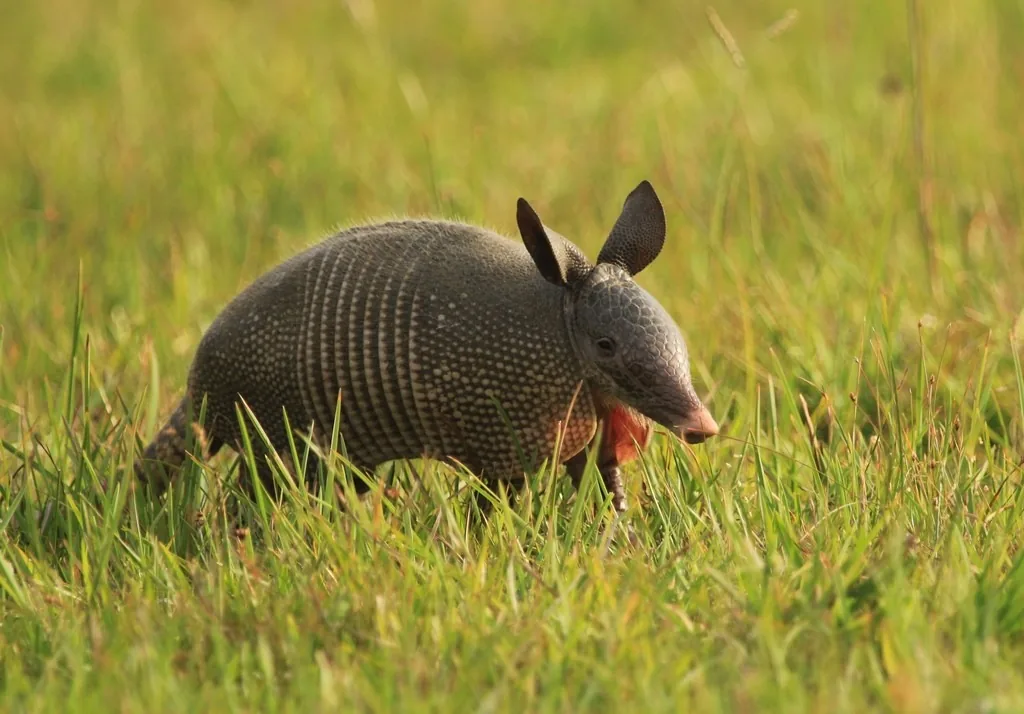
- A shell of bony, horn-covered armor over the head, body and tail, with nine movable bands around the middle between the shoulder and hip shields. Hair grows only between the plates and on the soft underside, and the color is mottled dark brown to yellowish white.[4][3]
- About opossum size, with a small head, a long, narrow pig-like snout and a long tapering tail ringed with armor. ICWDM gives 8 to 17 pounds; Missouri gives a usual weight of 11 3/4 to 14 pounds and a total length of 23 to 31 inches.[4][3]
- It has peg-like cheek teeth and no front or canine teeth, and it cannot curl into a ball. UF/IFAS counts 28 to 32 peg-like teeth in simple rows well back in the mouth, says only the ears and belly lack bony armor, and notes that males and females are about the same size and look alike.[4][3][5]
- Feeding leaves holes about 1 to 3 inches deep and 3 to 5 inches wide; burrow openings are about 7 to 8 inches across.[2][6]
- Tracks usually show the forward three toes with sharp claw marks. Missouri notes the front foot has 4 toes and the hind foot 5, but the outer toes often don't print, and the dragging shell can blur the tracks.[4][3]
Look-alikes
| Look-alike | How to tell them apart |
|---|---|
| Raccoon digging | Armadillo damage to turf can be extensive and hard to tell apart from raccoon digging; numerous shallow holes 3 to 5 inches wide and nearby burrows point to armadillos.[2][6] |
| White grubs (what armadillos hunt) | Insects, especially larvae, make up more than 90 percent of the diet, and ICWDM notes that controlling soil insects may reduce armadillo damage to grass.[6][7] |
Where it lives
ICWDM describes a range from Texas and southeast New Mexico through Oklahoma, southeast Kansas, southwest Missouri, Arkansas and southwest Mississippi to central Alabama, Georgia and Florida, extending north in recent times; Missouri reports them as far north as the Iowa line, and a 2024 study says the range continues to expand north and east. Cold limits the northern edge because armadillos don't hibernate and can't dig for food through snow and ice. GBIF's public records since 1990 (about 25,000, most filed under Dasypus mexicanus, a name some checklists now use for these armadillos) come from 15 states on the map, most from Texas, Florida and Georgia. In Florida, UF/IFAS says, armadillos spread from Texas into the Panhandle during the past century, while several introductions on the Atlantic coast from 1920 to about 1970 started a peninsular population; the two later merged, and armadillos now live in uplands throughout the state except the Keys and parts of the Everglades and Big Cypress swamp.[4][3][8][9][10][5]
Biology and life cycle
Females have one litter a year, and it is always identical quadruplets of the same sex. ICWDM gives birth in March or April after 150 days of gestation; Missouri explains that breeding is in summer, followed by a delay of 2 to 3 months before the embryo implants and splits into four, and about 4 months of development. UF/IFAS adds that newborns look like small adults, but their armor stays soft and leathery for some time and hardens with age.[6][3][5]
Young are weaned at 3 to 4 months. Missouri says they mature at 12 to 15 months; ICWDM gives 6 to 12 months for males and 12 to 24 months for females.[6][3]
Burrows are up to 15 feet long, under rocks, brush piles, stumps or terraces near dense cover, and an armadillo often has several in one area. Other animals use them as dens too. UF/IFAS says burrows are about 7 to 8 inches across, often under concrete patios, and that an armadillo with several burrows uses only one to raise its young.[6][3][5]
ICWDM says they are active from twilight through early morning in summer and forage during the warmest part of the day in winter. A winter camera study in Arkansas found more than 95 percent of activity at night at six sites but 30 to 60 percent by day at three quiet sites far from town.[6][11]
More than 90 percent of the diet is insects and their larvae, plus earthworms, spiders, scorpions and other invertebrates, some fruit, and occasionally small reptiles, frogs and bird eggs. Food is found by smell; sight and hearing are poor. UF/IFAS adds snails and says they eat large numbers of armyworms, cockroaches, ants, wasps, flies, beetles and grasshoppers, have been known to dig up entire yellow jacket nests, and occasionally eat berries and mushrooms; damage to ground-nesting birds' nests is rarely reported.[6][3][5]
When frightened they often jump straight up, which is one reason so many are hit by cars. In a 15-year Florida study, life expectancy was estimated at 3 years. UF/IFAS says armadillos are among the most common highway victims in Florida, and many are killed by dogs and coyotes.[3][1][5]
UF/IFAS says armadillos live in dense, shady cover such as brush, woodland or pine forest and prefer sandy or loam soils that are easy to dig. They usually rest in a burrow by day and become active in the late evening, at night or in early morning.[5]
Despite their awkward look they are agile runners and good swimmers, and UF/IFAS says they can even walk underwater across small streams.[5]
Damage and signs
- Numerous shallow feeding holes in lawns, flower beds and gardens, with flowers and other ornamental plants uprooted. UF/IFAS adds golf courses and says the holes are typically 1 to 3 inches deep and 3 to 5 inches wide.[2][3][5]
- Burrows under foundations, concrete slabs, driveways, pools and other structures. UF/IFAS says burrows under driveways and patios can cause structural damage, and burrows in pastures can be a hazard to livestock.[2][5]
- They occasionally eat poultry eggs.[2]
Health risk
Some wild armadillos in the southern United States carry the bacteria that cause leprosy (Hansen's disease), and the same strain has been found in armadillos and in many U.S. patients, so leprosy may spread from them to people. CDC says the risk is very low, most people who touch armadillos are unlikely to get it, and leprosy is curable. Studies disagree on how far the infection reaches: older surveys found it mainly in Texas and Louisiana, a 2015 study found infected armadillos at all 8 southeastern sites it sampled, and a 2024 study found no evidence of infection in 61 Tennessee armadillos. Avoid handling armadillos with bare hands and avoid contact with their blood and fluids, and cook armadillo meat thoroughly if you eat it.[12][13][14][8][15][2][3]
Control
Prevention
Clear brush and other dense ground cover near the house to discourage armadillos from setting up burrows.[7][6]
Cut back on watering and fertilizing the lawn. UF/IFAS says a moist, lush landscape is perfect for the earthworms and insect larvae armadillos dig for, and that watering nearby areas can sometimes draw armadillos away from a site.[5]
Keep them out
Protect valuable beds with a fence at least 3 feet high, buried 12 to 18 inches deep (deeper in sandy soil) and slanted outward at about 40 degrees to prevent climbing. House poultry so armadillos can't reach the eggs.[7]
Laying chicken wire along a patio, driveway or house foundation discourages armadillos from burrowing there, UF/IFAS says.[5]
Traps and physical control
Use sturdy, professionally made single- or two-door cage traps set along paths to burrows and along fences, with 6-foot board 'wings' to funnel the animal in. UF/IFAS says raccoon-sized cage traps placed near burrow entrances or along fences work best with the board wings added, that the benefit of bait is questionable (it suggests live earthworms or mealworms in soil in hanging nylon-stocking bags, or overripe fruit), and that armadillos enter more readily when leaf litter or soil covers the wire floor.[7][5]
Shooting, foothold traps, body-gripping traps and cable restraints are regulated differently by state; check state and local laws before using them.[7]
UF/IFAS describes catching armadillos as they leave a burrow by firmly pushing a 6-inch PVC pipe into the entrance of an active burrow, staking a nylon fishing throw-net over the entrance, or burying a bucket larger than 5 gallons in front of it under newspaper or plastic sheeting and a light layer of soil. Because armadillos are nocturnal, set these late in the afternoon and check them several hours after dark.[5]
Pesticides
Soil insecticides that reduce grubs may cut turf digging, but follow labels carefully to limit harm to other animals.[7]
What doesn't work
No repellents or toxicants are registered for armadillos, and no frightening devices are known to work. UF/IFAS adds that poison baits are ineffective.[7][5]
Legal status and relocation
Armadillos are unprotected in most states, but check state rules before trapping or shooting one.[4][7]
Relocation usually isn't practical and translocation is not recommended; ICWDM says that if it is legal in your state and necessary, take the animal at least 24 miles away to suitable habitat. Check state rules for disposing of carcasses. UF/IFAS also advises against relocating problem armadillos, because it only moves the problem elsewhere, can help spread disease and upsets the natural balance where the animal is released.[16][5]
Where the sources disagree
Birth timing: ICWDM gives birth in March or April after 150 days of gestation, while UF/IFAS says armadillos breed in late July and, after a delayed 5-month gestation, the young are born in February or March.[6][5]
Fence height: ICWDM calls for a fence at least 3 feet high, while UF/IFAS gives about 24 inches above ground with the bottom buried 18 inches; both slant it outward at about 40 degrees.[7][5]
Northern edge: UF/IFAS says armadillos occasionally turn up in Missouri and South Carolina, while the Missouri Department of Conservation reports them as far north as the Iowa line and a 2024 study says the range is still expanding north and east.[5][3][8]
Common questions
- What is digging small holes in my lawn at night?
- In the South, armadillos are a prime suspect: they leave many holes 1 to 3 inches deep while rooting for insects and earthworms, mostly from twilight through early morning in summer.[2][6]
- Can I get leprosy from an armadillo?
- It is possible but unlikely. CDC says some southern armadillos carry the bacteria and may spread it, the risk is very low, and leprosy is curable.[12]
- Will a repellent keep armadillos away?
- No repellent is registered for armadillos. Fencing, trapping and clearing the brush they burrow under are the practical options.[7]
- Are armadillos good for anything?
- UF/IFAS calls them beneficial to some degree because they eat adult insects and larvae, including armyworms, cockroaches, ants and grasshoppers, but the same feeding digs up lawns, flower beds and gardens.[5]
- Can I catch an armadillo at its burrow?
- UF/IFAS describes pushing a 6-inch PVC pipe into an active burrow entrance, staking a fishing throw-net over it, or burying a large bucket in front of it, set late in the afternoon and checked several hours after dark. Check your state's rules before trapping.[5][7]
Sources
- PLoS One, via PubMed, “Population dynamics and range expansion in nine-banded armadillos (Loughry et al. 2013).” pubmed.ncbi.nlm.nih.gov/23844183/ (accessed 2026-11-11). Cited from the PubMed abstract.
- Internet Center for Wildlife Damage Management, “Armadillo Damage Identification.” icwdm.org/species/other-mammals/armadillos/armadillo-damage-identification/ (accessed 2026-11-11). Run by university wildlife damage specialists (maintained at the University of Wisconsin-Stevens Point); species modules are based on Prevention and Control of Wildlife Damage (University of Nebraska Cooperative Extension, 1994).
- Missouri Department of Conservation, “Nine-Banded Armadillo (field guide).” mdc.mo.gov/discover-nature/field-guide/nine-banded-armadillo (accessed 2026-11-11)
- Internet Center for Wildlife Damage Management, “Armadillos: Identification.” icwdm.org/species/other-mammals/armadillos/ (accessed 2026-11-11). Run by university wildlife damage specialists (maintained at the University of Wisconsin-Stevens Point); species modules are based on Prevention and Control of Wildlife Damage (University of Nebraska Cooperative Extension, 1994).
- University of Florida IFAS Extension (EDIS), “The Nine-Banded Armadillo (Dasypus novemcinctus), WEC 76/UW082 (J. M. Schaefer and M. E. Hostetler).” ask.ifas.ufl.edu/publication/UW082 (accessed 2026-11-14)
- Internet Center for Wildlife Damage Management, “Armadillo Biology.” icwdm.org/species/other-mammals/armadillos/armadillo-biology/ (accessed 2026-11-11). Run by university wildlife damage specialists (maintained at the University of Wisconsin-Stevens Point); species modules are based on Prevention and Control of Wildlife Damage (University of Nebraska Cooperative Extension, 1994).
- Internet Center for Wildlife Damage Management, “Armadillo Damage Prevention and Control Methods.” icwdm.org/species/other-mammals/armadillos/armadillo-damage-prevention-and-control-methods/ (accessed 2026-11-11). Run by university wildlife damage specialists (maintained at the University of Wisconsin-Stevens Point); species modules are based on Prevention and Control of Wildlife Damage (University of Nebraska Cooperative Extension, 1994).
- J Wildl Dis, via PubMed, “Seroprevalence of leprosy in nine-banded armadillos from Tennessee, USA, 2021-22 (Turner et al. 2024).” pubmed.ncbi.nlm.nih.gov/38757151/ (accessed 2026-11-11). Cited from the PubMed abstract.
- Global Biodiversity Information Facility (GBIF), “Dasypus novemcinctus and records filed as Dasypus mexicanus: occurrence records in the U.S., 1990-2026 (GBIF occurrence searches).” api.gbif.org/v1/occurrence/search?taxonKey=2440779&country=US&hasGeospatialIssue=false&occurrenceStatus=PRESENT&year=1990%2C2026&facet=stateProvince&facetLimit=400&limit=0 (accessed 2026-11-11). Second query: https://api.gbif.org/v1/occurrence/search?verbatimScientificName=Dasypus+mexicanus&country=US&hasGeospatialIssue=false&occurrenceStatus=PRESENT&year=1990%2C2026&facet=stateProvince&facetLimit=400&limit=0 . State counts are records reported, not abundance.
- Global Biodiversity Information Facility (GBIF), “Species search: Dasypus mexicanus (accepted in some checklists, a synonym of D. novemcinctus in others).” api.gbif.org/v1/species/search?q=Dasypus%20mexicanus&rank=SPECIES&limit=5 (accessed 2026-11-11)
- Ecol Evol, via PubMed, “Nine-banded armadillo activity patterns are influenced by human activity (DeGregorio et al. 2021).” pubmed.ncbi.nlm.nih.gov/34824796/ (accessed 2026-11-11). Cited from the PubMed abstract.
- Centers for Disease Control and Prevention, “About Leprosy (Hansen's Disease) (last reviewed December 5, 2025).” www.cdc.gov/leprosy/about/index.html (accessed 2026-11-11)
- N Engl J Med, via PubMed, “Probable zoonotic leprosy in the southern United States (Truman et al. 2011).” pubmed.ncbi.nlm.nih.gov/21524213/ (accessed 2026-11-11). Cited from the PubMed abstract.
- Emerg Infect Dis, via PubMed, “Zoonotic leprosy in the southeastern United States (Sharma et al. 2015).” pubmed.ncbi.nlm.nih.gov/26583204/ (accessed 2026-11-11). Cited from the PubMed abstract.
- Lepr Rev, via PubMed, “Leprosy in wild armadillos (Truman 2005).” pubmed.ncbi.nlm.nih.gov/16248207/ (accessed 2026-11-11). Cited from the PubMed abstract.
- Internet Center for Wildlife Damage Management, “Armadillo Handling.” icwdm.org/species/other-mammals/armadillos/armadillo-handling/ (accessed 2026-11-11). Run by university wildlife damage specialists (maintained at the University of Wisconsin-Stevens Point); species modules are based on Prevention and Control of Wildlife Damage (University of Nebraska Cooperative Extension, 1994).
- Global Biodiversity Information Facility (GBIF), “Species record: Dasypus novemcinctus Linnaeus, 1758 (accepted; order Cingulata, family Dasypodidae).” api.gbif.org/v1/species/2440779 (accessed 2026-11-11)
- iNaturalist, “Dasypus novemcinctus taxon page (order and family).” www.inaturalist.org/taxa/47075 (accessed 2026-11-11)