On this page
How to identify it
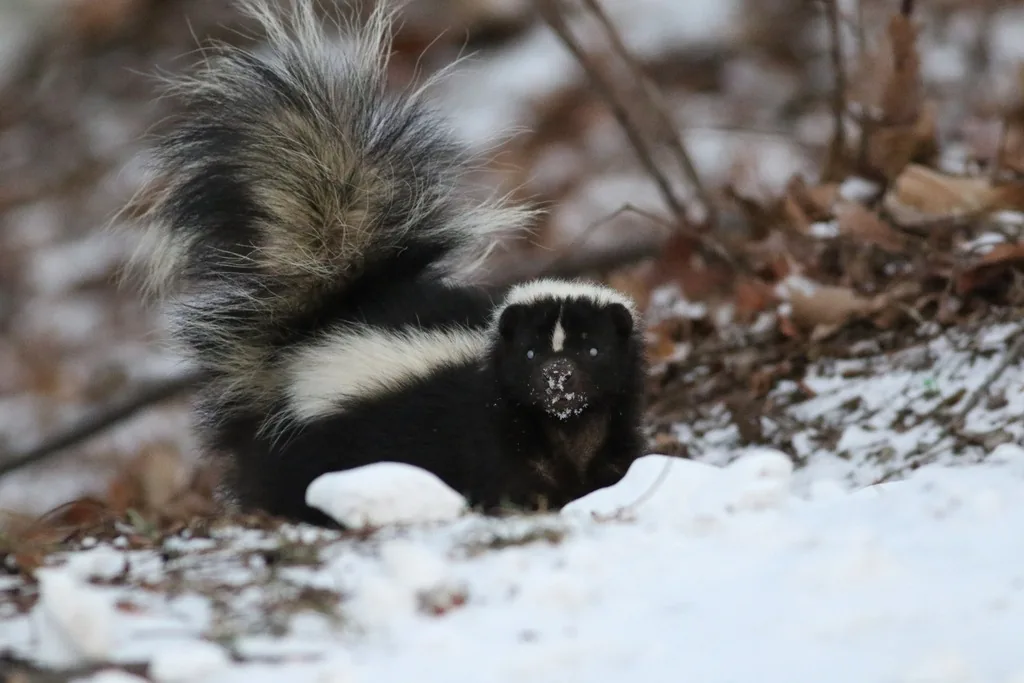
- Mostly black fur with white on the head and neck that usually splits into two white stripes down the back, though coat patterns vary.[1][3]
- About the size of a house cat, with a triangular head, short legs and long claws for digging. Sizes vary by source: up to 29 inches and around 8 pounds (ICWDM), 20 to 30 inches and 2 1/2 to 11 1/2 pounds (Missouri), or 22 to 32 inches including the tail (WDFW).[1][3][4][5]
- Tracks show five toes with claw marks, and the hind prints are about 2-1/2 inches long.[3]
- Droppings look like a cat's and are often full of insect parts. ICWDM gives 1/4 to 1/2 inch thick and 1 to 2 inches long; WDFW gives 1/2 inch thick and 2 to 4 inches long, usually with blunt ends.[3][5]
- Before spraying, a skunk usually stamps its front feet, hisses and arches its tail over its back.[1][2]
Look-alikes
| Look-alike | How to tell them apart |
|---|---|
| Raccoon | Skunks dig small cone-shaped holes in lawns, while raccoons tend to roll back sod; corn with knocked-down stalks points to raccoons rather than skunks.[6][2] |
| Opossum | Opossums can also give off a skunklike odor, so a smell alone does not prove a skunk is present.[3] |
| Spotted skunk | Spotted skunks are much smaller than striped skunks and have white spots and short broken stripes; they are fully protected in some states. California has both native species.[1][3][7][4] |
Where it lives
Striped skunks are common throughout the United States and Canada and are the most abundant of the four North American skunk species.[3]
Biology and life cycle
Skunks are mostly active at dawn, dusk and night, though striped skunks may move about in daytime near people.[1][8]
Breeding starts in late January (ICWDM) or February (UC IPM, WDFW and Missouri) and runs into March. Single litters of usually 4 to 6 kits are born mainly in May or early June, after roughly 7 to 10 weeks.[8][1][5][4]
They eat insects and grubs, mice, eggs, fruit, berries, pet food and garbage, and eat more insects in spring and summer.[1][8]
Skunks den in old burrows and under decks, porches and buildings; they do not truly hibernate but may stay in dens for weeks in the coldest weather.[1][8]
They see poorly but smell and hear well, and they can spray accurately 6 to 10 feet.[1]
Skunks are short-lived: UC IPM gives an average of about 2 to 3.5 years, and WDFW says striped skunks live 3 to 4 years in the wild.[1][5]
Damage and signs
- Skunk odor can soak into cloth furniture, clothing and carpets, and can reach items several floors away from where it started.[2]
- They dig 3- to 4-inch cone-shaped holes or patches of upturned soil in lawns and gardens while hunting grubs, and may roll back sod.[2][1]
- Skunks den under porches, decks, sheds and houses, and spray dogs that bark at or rush them.[1]
- They sometimes eat poultry eggs, opening them at one end, and occasionally kill fowl.[2]
Health risk
CDC lists skunks among the animals most often found with rabies in the U.S. Rabies spreads mainly through bites and scratches. Wash any bite or scratch right away with soap and water, get medical care urgently, and keep pets' rabies vaccinations current.[9]
Control
Prevention
Remove fallen fruit and spilled birdseed, keep tight lids on garbage cans, keep food scraps out of compost, bring pet food in by nightfall, and never feed skunks.[1][10]
Remove boards, rocks and debris from the ground, stack firewood tightly, and control mice and rats that skunks feed on.[1][10]
Keep them out
Close openings under porches, decks, sheds and houses with 1/4-inch hardware cloth, burying the bottom edge at least 6 inches to stop digging.[1][10]
Before sealing a den, spread a thin layer of flour at the entrance; fresh tracks after dark mean the skunk has left and the opening can be closed.[1]
A one-way door over the entrance lets skunks out but not back in, but it will not work while kits are too young to walk.[1][10]
Cover window wells and secure pits deeper than 3 inches so young skunks cannot become trapped in them.[10]
Traps and physical control
Where trapping is legal, enclosed plastic box traps or cage traps covered with a blanket reduce the chance of being sprayed.[1][10]
When to call a professional
If you have no skunk trapping experience, hire a professional wildlife control operator; some health departments also provide trappers.[1]
Removing skunk odor
UC IPM describes a home remedy of hydrogen peroxide, baking soda and liquid soap, which some people find works.[1]
Mix it fresh and use it right away, because it cannot be bottled or stored; dilute leftovers with water and pour them down the drain.[1]
UC IPM says the mixture can be used on pets, people, clothing and furniture if kept out of the eyes, and treated pets should be rinsed well.[1]
For a sprayed dog or cat, call your veterinarian for current washing advice, and avoid handling the pet with bare hands until it is washed.[1][2]
Sources differ on neutroleum-alpha. UC IPM calls it one of the most useful odor neutralizers for furniture and buildings but says not to use it on pets or people; WDFW says commercial preparations containing it, sold at some pet stores, may help on people and pets.[1][5]
WDFW warns never to use bleach or ammonia on pets, at any dilution.[5]
Rabies warning signs
Treat with great caution any skunk that seems tame or listless, wanders oddly in daylight, or approaches without fear.[1][2]
Report skunks behaving abnormally to local animal control rather than handling them.[2][9]
Keep dogs and cats vaccinated against rabies where skunks live.[9][1]
What doesn't work on skunks
There are no registered toxicants for skunks, and using rodent poison baits on them is illegal pesticide misuse.[1]
No frightening devices are effective, and commercial repellents do little.[10][1]
Ammonia and other strong-smelling repellents should not go under occupied buildings, because fumes can be drawn indoors.[1]
Legal status
Striped skunks are not protected in most states, but spotted skunks are fully protected in some; check with state wildlife officials before removing any skunk.[3]
Moving skunks is restricted in some states; California requires written permission, and rabies is one of the main reasons requests are denied.[1]
California classifies skunks as nongame mammals, and the owner or tenant may remove ones that are injuring or threatening property at any time in any legal manner.[1]
In Missouri, striped skunks may be trapped and hunted during designated seasons under the Wildlife Code of Missouri.[4]
Washington says it is illegal to keep skunks as pets.[5]
Common questions
- My dog was sprayed by a skunk. What should I do?
- Keep the dog outside, avoid touching it with bare hands, and call your veterinarian for washing advice and about rabies concerns.[2][1]
- What are the small cone-shaped holes in my lawn?
- They are often from skunks digging for grubs; the holes are about 3 to 4 inches across, and digging usually stops within about 3 weeks.[2][1]
- Will a skunk spray me if I walk by?
- Usually not. Skunks spray when startled or cornered and usually give a warning first, so back away slowly and quietly.[1][2]
Sources
- University of California Statewide IPM Program, “Skunks (Pest Notes, Home and Landscape).” ipm.ucanr.edu/home-and-landscape/skunks/ (accessed 2026-11-12)
- Internet Center for Wildlife Damage Management, “Skunk Damage Identification.” icwdm.org/species/carnivores/skunks/skunk-damage-identification/ (accessed 2026-11-12). Run by university wildlife damage specialists (maintained at the University of Wisconsin-Stevens Point); species modules are based on Prevention and Control of Wildlife Damage (University of Nebraska Cooperative Extension, 1994).
- Internet Center for Wildlife Damage Management, “Skunks: Identification.” icwdm.org/species/carnivores/skunks/ (accessed 2026-11-12). Run by university wildlife damage specialists (maintained at the University of Wisconsin-Stevens Point); species modules are based on Prevention and Control of Wildlife Damage (University of Nebraska Cooperative Extension, 1994).
- Missouri Department of Conservation, “Striped Skunk (Field Guide).” mdc.mo.gov/discover-nature/field-guide/striped-skunk (accessed 2026-11-12)
- Washington Department of Fish & Wildlife, “Living with wildlife: Skunks.” wdfw.wa.gov/species-habitats/living/species-facts/skunks (accessed 2026-11-12)
- University of California Statewide IPM Program, “Raccoons (Pest Notes, Home and Landscape).” ipm.ucanr.edu/home-and-landscape/raccoons/ (accessed 2026-11-12)
- California Department of Fish and Wildlife, “Human-Wildlife Conflicts: Skunks and Opossums.” wildlife.ca.gov/HWC/Skunks-Opossums (accessed 2026-11-12)
- Internet Center for Wildlife Damage Management, “Skunk Biology.” icwdm.org/species/carnivores/skunks/skunk-biology/ (accessed 2026-11-12). Run by university wildlife damage specialists (maintained at the University of Wisconsin-Stevens Point); species modules are based on Prevention and Control of Wildlife Damage (University of Nebraska Cooperative Extension, 1994).
- U.S. Centers for Disease Control and Prevention, “About Rabies.” www.cdc.gov/rabies/about/index.html (accessed 2026-11-12)
- Internet Center for Wildlife Damage Management, “Skunk Damage Prevention and Control Methods.” icwdm.org/species/carnivores/skunks/skunk-damage-prevention-and-control-methods/ (accessed 2026-11-12). Run by university wildlife damage specialists (maintained at the University of Wisconsin-Stevens Point); species modules are based on Prevention and Control of Wildlife Damage (University of Nebraska Cooperative Extension, 1994).
- iNaturalist, “Mephitis mephitis taxon page (order and family).” www.inaturalist.org/taxa/41880 (accessed 2026-11-12)