On this page
How to identify it
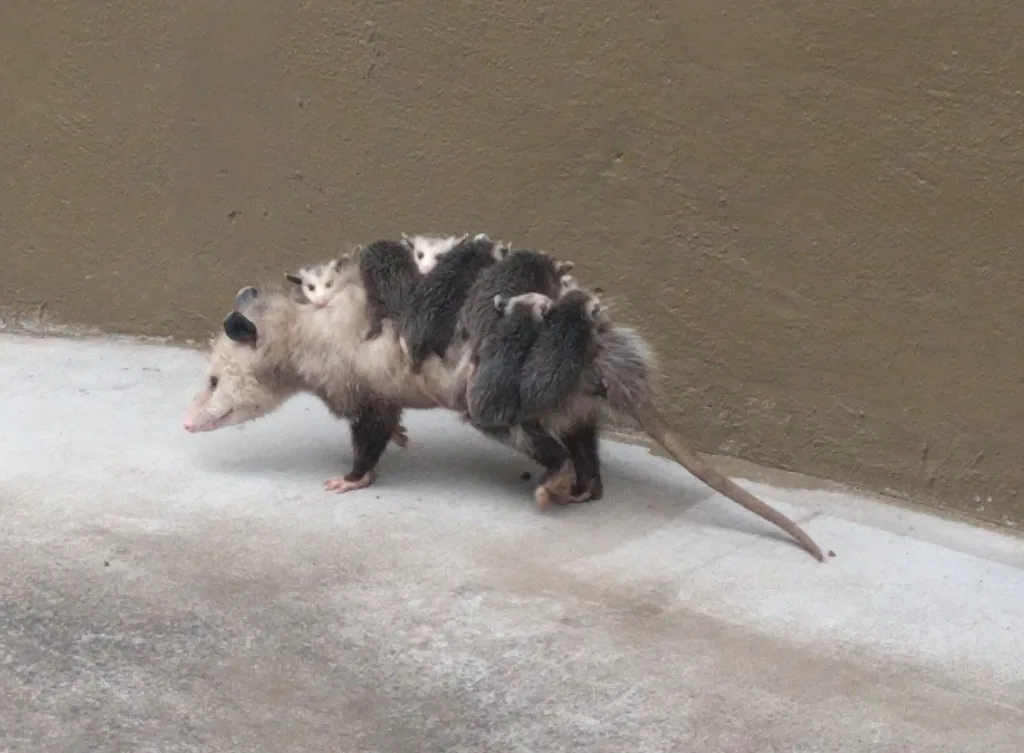
- About the size of a house cat, with coarse grayish fur, a long pointed face and rounded, hairless ears.[1][2]
- A long, hairless, grasping tail that makes up a little less than half the animal's total length.[1][2]
- Usually 2 to 3 feet long including the tail. UC IPM says most weigh 4 to 7 pounds, with large males reaching about 15 pounds; ICWDM gives up to 14 pounds, averaging 4 to 12, with males generally larger.[1][2]
- Tracks look like small hands with widely spread fingers, and the hind foot has a thumblike, clawless toe.[1][2]
- When threatened it may hiss, growl, bare its teeth, or go limp and play dead; its mouth holds 50 teeth, more than any other North American mammal.[1][3][2]
Look-alikes
| Look-alike | How to tell them apart |
|---|---|
| Raccoon | A clear hind-foot track tells them apart; opossums usually use existing openings, while raccoons tear new ones into buildings.[4][2] |
| Striped skunk | Opossum signs are often confused with skunk signs, and opossums can give off a mild skunklike odor, so check tracks before deciding.[4][2][3] |
Where it lives
Opossums live in the eastern, central and West Coast states but are absent from the Rockies and most Plains states; they were introduced to California in 1910.[2][1]
Biology and life cycle
Opossums are mostly active at night, though they may forage by day in cold weather; they do not hibernate.[1][3]
They eat almost anything, including fruit, nuts, insects, snails, mice, rats, eggs, carrion, garbage and pet food.[1][3]
Young are born just 13 days after mating, crawl into the mother's pouch and stay attached there for about 8 weeks by UC IPM's account, 7 to 8 weeks by ICWDM's.[1][3]
Litters average about 7 young, and females usually raise 2 litters a year; older young ride on the mother's back.[1][3]
Opossums do not dig their own burrows; they use old burrows, tree cavities and brush piles, or spaces under steps, decks and houses.[3][1]
Most young die in their first year, and few opossums live beyond 3 years in the wild.[1][3]
Damage and signs
- They feed on berries, grapes, tree fruit, nuts and garden produce, and get into compost, garbage cans and bird feeders.[1][4]
- Opossums eat pet food left outside and may even come indoors through pet doors in search of food.[1]
- They den under houses and mobile homes and often get indoors through gaps around pipes and drains under sinks.[4][1]
- They leave droppings on garden paths and patios and can seriously injure dogs and cats in fights.[1]
- Opossums prey on chickens, ducks and pigeons and eat eggs of wild quail and turkeys.[4]
- Opossums are definitive hosts of the organism that causes equine protozoal myeloencephalitis (EPM), which kills horses; an opossum denning or feeding in a stable may contaminate horse feed and water with its feces.[4]
Health risk
CDC says fleas that spread flea-borne typhus become infected by biting infected rats, cats or opossums, lists contact with opossums as a risk factor, and advises keeping opossums away from homes. A 2023 study found pathogenic Leptospira, the cause of leptospirosis, in urban wildlife including Virginia opossums in southern California; CDC notes leptospirosis spreads through the urine of infected animals.[5][6][7]
Control
Prevention
Pick up fallen fruit, bring pet food in by nightfall, keep tight lids on garbage cans, and keep food scraps in compost bins with locking lids.[1][8]
Cut back overgrown shrubs, trim trees at least 5 feet from the roof, stack firewood tightly, and store lumber about 18 inches off the ground.[1]
Keep them out
Close openings under decks, porches, sheds and houses, burying the bottom edge so opossums cannot dig under. UC IPM recommends 1/4-inch hardware cloth; ICWDM suggests 1- by 1/2-inch galvanized hardware cloth.[1][8]
Before sealing an opening, use a flour tracking patch to confirm the opossum has left; a mother carries her young with her when she goes.[1]
A one-way door over the main opening lets an opossum leave a structure but not get back in.[8]
Keep opossums out of gardens with a 4-foot poultry-wire fence whose top 12 to 18 inches bends outward unsupported, or add an electric wire near the top, about 3 inches out from the mesh.[1][8][9]
Traps and physical control
Where trapping is legal, opossums are easy to catch in a cage trap at least 10 by 12 by 32 inches set along their travel routes.[1][8]
Missouri's conservation department suggests baiting cage traps with cheese, slightly spoiled meat, fish or fruit; in Missouri, body-gripping traps may not be used in dry-land sets except 6 feet or more above ground, such as in an attic.[9]
When to call a professional
Because moving opossums is illegal without a permit in some states, such as California, many homeowners hire a wildlife control operator instead.[1]
When an opossum plays dead
An opossum that will not move, plays dead or bares its teeth may simply be frightened rather than sick.[4][3]
Move people and pets away and give it time to leave; if it has not left within 24 hours, assume it is sick or injured and have it removed.[4]
What doesn't work on opossums
No repellents or toxicants are registered for opossums, and rodent poison baits must never be used on them.[8][1]
Mothballs, naphthalene and ammonia are not legal or recommended as opossum repellents (UC IPM). Missouri's conservation department adds that mothballs are not effective and that naphthalene is toxic and its vapor harmful.[1][9]
Motion-activated sprinklers and other frightening devices rarely work for more than a few days.[1][8]
Legal status
Laws covering opossums vary by state, and many states have hunting or trapping seasons; contact state wildlife authorities before removing one.[2]
In California opossums are nongame mammals, and relocating them requires written permission from the state wildlife department.[1]
In Missouri, opossums are furbearers and game mammals taken in season, and opossums causing damage may be shot or trapped without a permit.[9]
Virginia's opossum trapping season runs November 15 to February 28, and opossums may be trapped on private land statewide in any season with the landowner's permission.[10]
Texas classifies the opossum as a fur-bearing animal with no closed season or bag limit; no license is needed to take a nuisance furbearer causing damage, but it may not be kept or sold.[11]
Wisconsin lists opossums as unprotected; they may be trapped year-round with a trapping license, and landowners or occupants need no license to trap them when they cause damage.[12]
Common questions
- Do opossums carry rabies?
- Rabies is a disease of mammals, spread mainly through bites and scratches, but CDC says it is most often found in bats, skunks, raccoons and foxes.[13]
- There's an opossum lying still in my yard. Is it dead?
- It may be playing dead from fright. Keep people and pets away for up to 24 hours, and if it has not moved on, assume it is sick or injured.[4][1]
- Are opossums a danger to my pets?
- Fights between pets and opossums are fairly common and pets are often hurt, especially pets left outdoors at night; bringing pet food in by nightfall reduces these run-ins.[1]
Sources
- University of California Statewide IPM Program, “Opossum (Pest Notes, Home and Landscape, UC ANR Publication 74123).” ipm.ucanr.edu/home-and-landscape/opossum/ (accessed 2026-11-12)
- Internet Center for Wildlife Damage Management, “Opossums: Identification.” icwdm.org/species/other-mammals/opossums/ (accessed 2026-11-12). Run by university wildlife damage specialists (maintained at the University of Wisconsin-Stevens Point); species modules are based on Prevention and Control of Wildlife Damage (University of Nebraska Cooperative Extension, 1994).
- Internet Center for Wildlife Damage Management, “Opossum Biology.” icwdm.org/species/other-mammals/opossums/opossum-biology/ (accessed 2026-11-12). Run by university wildlife damage specialists (maintained at the University of Wisconsin-Stevens Point); species modules are based on Prevention and Control of Wildlife Damage (University of Nebraska Cooperative Extension, 1994).
- Internet Center for Wildlife Damage Management, “Opossum Damage Identification.” icwdm.org/species/other-mammals/opossums/opossum-damage-identification/ (accessed 2026-11-12). Run by university wildlife damage specialists (maintained at the University of Wisconsin-Stevens Point); species modules are based on Prevention and Control of Wildlife Damage (University of Nebraska Cooperative Extension, 1994).
- Centers for Disease Control and Prevention, “About Flea-borne Typhus.” www.cdc.gov/typhus/about/murine.html (accessed 2026-11-12)
- Sci Rep 2023;13:14368, via PubMed, “Pathogenic Leptospira are widespread in the urban wildlife of southern California (2023).” pubmed.ncbi.nlm.nih.gov/37658075/ (accessed 2026-11-12)
- Centers for Disease Control and Prevention, “About Leptospirosis.” www.cdc.gov/leptospirosis/about/index.html (accessed 2026-11-12)
- Internet Center for Wildlife Damage Management, “Opossum Damage Prevention and Control Methods.” icwdm.org/species/other-mammals/opossums/opossum-damage-prevention-and-control-methods/ (accessed 2026-11-12). Run by university wildlife damage specialists (maintained at the University of Wisconsin-Stevens Point); species modules are based on Prevention and Control of Wildlife Damage (University of Nebraska Cooperative Extension, 1994).
- Missouri Department of Conservation, “Opossum Control.” mdc.mo.gov/wildlife/nuisance-problem-species/opossum-control (accessed 2026-11-12)
- Virginia Department of Wildlife Resources, “Furbearer Trapping Regulations and Seasons.” dwr.virginia.gov/hunting/regulations/furbearertrapping (accessed 2026-11-12)
- Texas Parks and Wildlife Department, “Overview: Fur-bearing Animal Regulations.” tpwd.texas.gov/regulations/outdoor-annual/hunting/fur-bearing-animal-regulations/general-regulations (accessed 2026-11-12)
- Wisconsin Department of Natural Resources, “Protected Wild Animals (General Trapping Regulations).” dnr.wisconsin.gov/node/119641 (accessed 2026-11-12)
- Centers for Disease Control and Prevention, “About Rabies.” www.cdc.gov/rabies/about/index.html (accessed 2026-11-12)
- iNaturalist, “Didelphis virginiana taxon page (order and family).” www.inaturalist.org/taxa/42652 (accessed 2026-11-12)