On this page
How to identify it
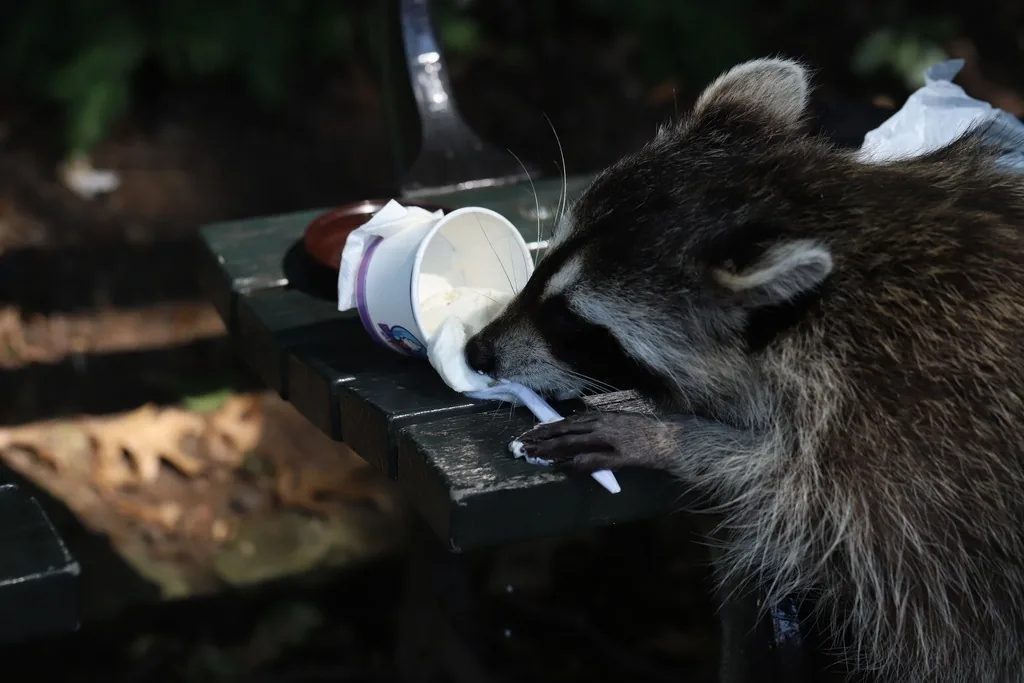
- A black mask across the eyes and a heavily furred tail with alternating light and dark rings.[1][3]
- A stocky body about 2 to 3 feet long with grizzled gray and black fur above. Weights differ by source: UC IPM gives 7 to 30 pounds, ICWDM 10 to 30, and Missouri Conservation 6 to 25 pounds with a total length of 21½ to 38 inches.[1][3][4]
- Tracks show five long toes, and the front prints look like small hands; climbing often leaves dirty smudges on downspouts and siding.[3][2]
- Latrines, where raccoons return to leave droppings, are usually in spots open to the sky such as roofs, sandboxes and fallen trees.[3]
Look-alikes
| Look-alike | How to tell them apart |
|---|---|
| Opossum | Opossums have a long, pointed face and a long hairless tail, and their hind tracks show a thumblike toe; raccoons have a masked face and a ringed, furred tail.[5][1][3] |
| Striped skunk | Skunks dig small cone-shaped holes in lawns while hunting grubs; raccoons more often roll back strips of sod instead of digging holes.[1] |
Where it lives
Raccoons live throughout the United States except at higher mountain elevations and parts of the arid Southwest, and they are most common in the wooded East.[3]
Biology and life cycle
Raccoons are active mainly at night, so they can live around a home for some time before anyone notices them.[1][6]
They eat almost anything, including fruit, nuts, corn, insects, crayfish, frogs, eggs, garbage, compost and pet food left outside.[1][6]
Mating peaks in February or March, and one litter is born after about 63 days, mostly in April or May; Missouri Conservation notes some litters come as late as August. ICWDM puts the average litter at 3 to 5 young, while UC IPM says 3 to 6, averaging about 4.[6][1][4]
Young stay with the mother through their first year, often sharing her den in winter.[6][1]
Raccoons do not truly hibernate, but they hole up in dens during severe winter weather, sometimes for weeks in the North.[6][1]
Populations skew young: ICWDM says half to three-quarters of a fall population is usually under a year old. A raccoon can live up to 12 years in the wild, but that is extremely rare.[6]
Missouri Conservation gives a home range of 1 to 10 square miles depending on habitat; ICWDM puts adult males at 3 to 20 square miles and females at 1 to 6.[4][6]
Damage and signs
- Females looking for a nest site may rip off shingles, fascia boards or roof vents to reach an attic, and they need only a 4-inch gap to get in.[1][2]
- Inside an attic they tear up insulation and duct wrap, and a latrine area can stain the ceiling below with urine and leave a strong odor.[1]
- Uncapped chimneys and spaces under porches, decks and crawl spaces are common den sites.[1][2]
- In gardens, sweet corn is a favorite: stalks are pulled down and many ears are partly eaten with the husks pulled back, usually just before harvest.[1][2]
- Raccoons roll up newly laid sod to hunt worms and grubs, especially in mid to late summer, and they may also take koi from ponds and kill poultry.[1][2][7]
- How much harm they do varies. Missouri Conservation says raccoons only rarely cause extensive damage to corn, gardens or chickens, but California Fish and Wildlife warns that raccoons with easy access to food can become food-conditioned and lose their fear of people.[4][8]
Health risk
Raccoons are among the animals most often found with rabies in the U.S., and they carry raccoon roundworm. CDC says human roundworm infections are rare but can be severe, most happen in children who put dirt or animal waste in their mouths, and symptoms usually start 1 to 4 weeks after exposure. Anyone who may have swallowed raccoon feces should get medical care right away.[9][10][8]
Control
Prevention
Use metal or sturdy garbage cans with tight lids secured by a bungee cord or wire, and keep cans in a rack or tied to a post so they cannot be tipped.[1][7]
Bring pet food in before dark, pick up fallen fruit and nuts, keep meat and other food scraps out of compost, and never feed raccoons.[1][7]
Cut back branches that hang over the roof, leaving a gap of at least 5 feet if possible, and remove woodpiles and dense brush where raccoons can den.[1]
Keep them out
Fasten a heavy chimney cap tightly to the chimney, but first make sure no raccoons, including young, are inside.[1][7]
Screen openings under porches, decks and sheds with galvanized hardware mesh, burying the bottom edge at least 6 inches deep and bending it outward 12 inches.[1]
Protect sweet corn and melons with a low two-wire electric fence, with wires about 6 and 12 inches above the ground, turned on from dusk to dawn.[1][7]
Traps and physical control
In small gardens, wrapping ripening corn ears in glass-filament tape, looped closed so raccoons can't open it, sharply cuts damage, though it takes more work than fencing.[7]
Where trapping is legal, use a sturdy cage trap at least 10 by 12 by 32 inches, anchor it, and set it at night to avoid catching pets.[1][7]
When to call a professional
Homeowners without trapping experience should hire a wildlife control operator, who can tell whether a trapped female is nursing young that would otherwise be left behind.[1]
Cleaning up raccoon latrines
Raccoon roundworm eggs take 2 to 4 weeks in the environment to become infectious, so avoid disturbing raccoon droppings.[10][2]
CDC advises carefully removing raccoon feces and contaminated material and burning it, burying it or sending it to a landfill.[10]
Decks, patios and similar surfaces can be treated with boiling water or a propane flame gun, and everyone should wash their hands after outdoor work or play.[10]
Raccoons keep returning to the same latrine spots, which California Fish and Wildlife says raises the chance that people and pets are exposed to roundworm.[8]
What doesn't work on raccoons
Lights, radios, scarecrows and motion-activated sprinklers or noisemakers work for only a few days before raccoons learn to ignore them.[1][7]
Sources disagree on repellents. UC IPM says no commercial repellent has worked on raccoons and home remedies such as mothballs and blood meal have failed; ICWDM lists Ro-Pel, a contact and taste repellent brushed onto surfaces to stop chewing animals, including raccoons, but not for use on edible plants or fruiting crops.[1][7]
No toxicants are registered for raccoon control.[7]
Legal status
Raccoons are protected furbearers in most states, though most have provisions for landowners dealing with damage; check with your state wildlife agency before using lethal control.[3][7]
California classifies raccoons as furbearers. Raccoons causing damage may be taken at any time by legal means, but moving one elsewhere requires written permission from California Fish and Wildlife.[1]
Released raccoons may return or become someone else's problem, and moving animals helps spread disease to pets, wildlife and people.[1]
Missouri manages raccoons as a furbearer with set hunting and trapping seasons, and the Wildlife Code of Missouri lets landowners control raccoons that have become a nuisance.[4]
In Minnesota a landowner, manager or occupant can take a raccoon that is damaging property without a license, but must notify a conservation officer within 24 hours; releasing a captured animal elsewhere needs permission from whoever controls the release site.[11]
Common questions
- I hear chirring and scratching in my chimney in spring. Is it raccoons?
- Likely. Raccoons often raise young on the smoke shelf, and the mother usually moves them out at weaning; cap the chimney right after they leave.[7]
- Can I trap a raccoon and release it somewhere else?
- Often not legally. Many states regulate it, California requires a permit, and moved raccoons can return or spread disease, so check with your state wildlife agency first.[1][3]
- Are raccoon droppings dangerous?
- They can be. Droppings may hold raccoon roundworm eggs that seriously harm people who swallow them, especially young children, so clean latrines carefully and wash your hands.[10][2]
Sources
- University of California Statewide IPM Program, “Raccoons (Pest Notes, Home and Landscape).” ipm.ucanr.edu/home-and-landscape/raccoons/ (accessed 2026-11-12)
- Internet Center for Wildlife Damage Management, “Raccoon Damage Identification.” icwdm.org/species/carnivores/raccoons/raccoon-damage-identification/ (accessed 2026-11-12). Run by university wildlife damage specialists (maintained at the University of Wisconsin-Stevens Point); species modules are based on Prevention and Control of Wildlife Damage (University of Nebraska Cooperative Extension, 1994).
- Internet Center for Wildlife Damage Management, “Raccoons: Identification.” icwdm.org/species/carnivores/raccoons/ (accessed 2026-11-12). Run by university wildlife damage specialists (maintained at the University of Wisconsin-Stevens Point); species modules are based on Prevention and Control of Wildlife Damage (University of Nebraska Cooperative Extension, 1994).
- Missouri Department of Conservation, “Raccoon (Field Guide).” mdc.mo.gov/discover-nature/field-guide/raccoon (accessed 2026-11-12)
- Internet Center for Wildlife Damage Management, “Opossums: Identification.” icwdm.org/species/other-mammals/opossums/ (accessed 2026-11-12). Run by university wildlife damage specialists (maintained at the University of Wisconsin-Stevens Point); species modules are based on Prevention and Control of Wildlife Damage (University of Nebraska Cooperative Extension, 1994).
- Internet Center for Wildlife Damage Management, “Raccoon Biology.” icwdm.org/species/carnivores/raccoons/raccoon-biology/ (accessed 2026-11-12). Run by university wildlife damage specialists (maintained at the University of Wisconsin-Stevens Point); species modules are based on Prevention and Control of Wildlife Damage (University of Nebraska Cooperative Extension, 1994).
- Internet Center for Wildlife Damage Management, “Raccoon Damage Prevention and Control Methods.” icwdm.org/species/carnivores/raccoons/raccoon-damage-prevention-and-control-methods/ (accessed 2026-11-12). Run by university wildlife damage specialists (maintained at the University of Wisconsin-Stevens Point); species modules are based on Prevention and Control of Wildlife Damage (University of Nebraska Cooperative Extension, 1994).
- California Department of Fish and Wildlife, “Human-Wildlife Conflicts: Raccoons.” wildlife.ca.gov/HWC/Raccoons (accessed 2026-11-12)
- U.S. Centers for Disease Control and Prevention, “About Rabies.” www.cdc.gov/rabies/about/index.html (accessed 2026-11-12)
- U.S. Centers for Disease Control and Prevention, “About Raccoon Roundworm.” www.cdc.gov/baylisascaris/about/index.html (accessed 2026-11-12)
- Minnesota Department of Natural Resources, “Wildlife Control: Taking a nuisance animal.” www.dnr.state.mn.us/livingwith_wildlife/taking.html (accessed 2026-11-12)
- iNaturalist, “Procyon lotor taxon page (order and family).” www.inaturalist.org/taxa/41663 (accessed 2026-11-12)