On this page
How to identify it
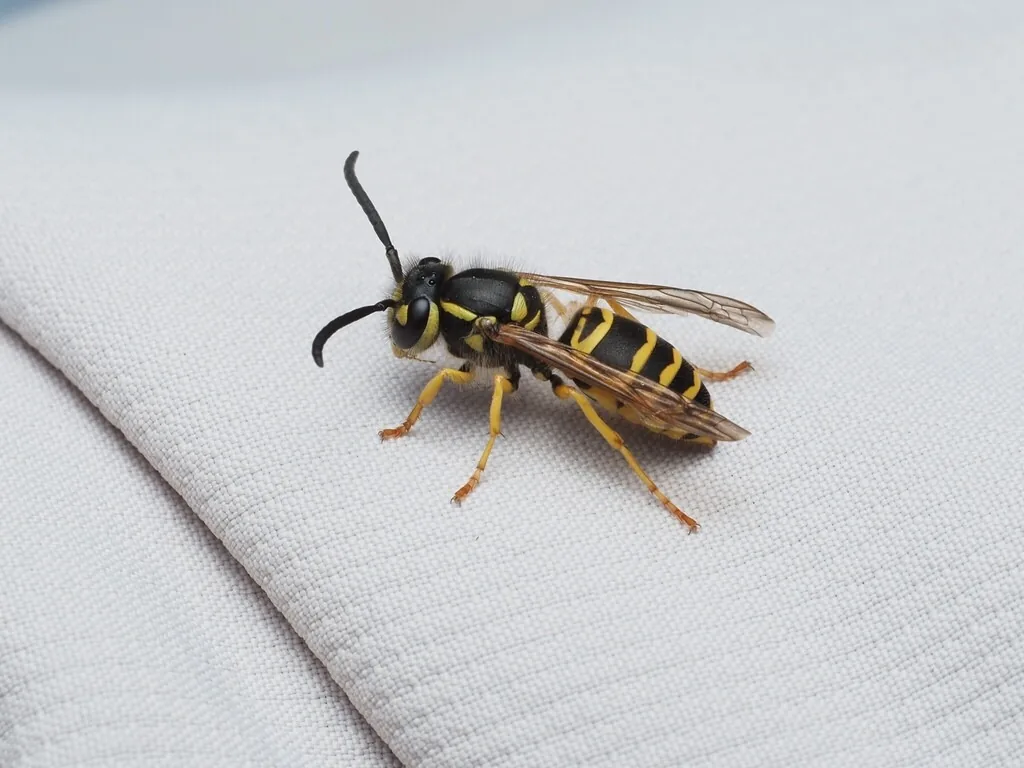
- Workers are about 1/2 inch long and queens up to 18 mm, black with yellow markings.[1][5]
- The first abdominal segment has a wide, anchor-shaped black mark on top.[1][5]
- MDC adds that the anchor has a flat top, and the black bands on the remaining segments are flat on top and wavy or zigzagged on the lower edge, with no free black dots.[5]
- A continuous yellow band on the cheek runs beside the eye but doesn't fully circle it.[1]
Look-alikes
| Look-alike | How to tell them apart |
|---|---|
| German yellowjacket | German yellowjackets have a small black mark on the first segment, spade-shaped in Penn State's description and diamond-shaped in MDC's, plus separate black dots down the sides of the abdomen.[2][5] |
| Southern yellowjacket | Its workers are yellow and black, but its queens are much larger, about 3/4 inch, and burnt orange.[3][5] |
| Ground-nesting solitary wasps | Cicada killers, great golden digger wasps and sand wasps also dig burrows, but each female works alone, without the busy, crowded entrance of a yellowjacket nest.[5] |
Where it lives
It's found through most of the eastern US, from North Dakota to Texas and east to the Atlantic coast.[1]
Biology and life cycle
In Pennsylvania, overwintered queens start nests in May or early June in forest floors, rock walls, creek banks, lawns and occasionally buildings.[1]
Typical of yellowjackets, CAES says, the queen builds 30 to 55 cells, lays an egg in each, and raises the first brood herself; about 30 days later the first 5 to 7 workers take over foraging and nest building.[6]
The first workers appear in June, after which the queen stays inside; males and new queens are produced in August and September.[1]
Mated queens overwinter under bark, in logs and leaf litter, and other protected spots.[1]
It is the primary host of the southern yellowjacket, whose queens often take over its young nests in spring.[8][3]
MDC calls it the most widespread and common of Missouri's yellowjackets. In a Wisconsin vineyard trapping study in 2015 and 2017, it was the most abundant wasp caught both years.[5][9]
Damage and signs
Health risk
For someone allergic to the venom, a sting can set off anaphylaxis quickly. NIOSH says people with a history of severe reactions should carry an epinephrine auto-injector, and MedlinePlus says anyone who had a severe, bodywide reaction should be referred to an allergist for skin testing and therapy.[11][10]
Control
Prevention
Nests away from doors, mowed lawns and public areas can be left alone; the wasps are beneficial predators of earwigs and caterpillars.[1][5]
Late in the season, MDC says, waiting for the first hard freeze may be best, and skunks sometimes dig nests up at night.[5]
Traps and physical control
Never plug the opening of a nest in a wall; the wasps may chew through the interior wall into the house.[1][7]
Pesticides
Ground nests can be killed at night by dusting insecticide directly down the opening while wearing protective clothing; scout the nest by day first.[1]
Penn State warns against standing back and dusting only the outside of the entrance, which angers the colony and raises the sting risk for days; dust liberally straight down the hole, then wash your clothes and shower.[1]
When to call a professional
Nests in walls or attics, and any nests near the homes of people with sting allergies, should be treated by a professional.[1]
Common questions
- How can I tell an eastern yellowjacket from other yellowjackets?
- Look for a wide, anchor-shaped black mark on the first abdominal segment and a yellow cheek band that doesn't fully circle the eye.[1][5]
- Should I plug a yellowjacket hole in my wall?
- No. Plugging it can make the wasps chew through the interior wall into your home.[1][7]
- Will yellowjackets use the same hole next year?
- Not the same colony. The workers and old queen die in fall, only new queens survive the winter, and MDC says old nests are usually not used again; CAES says nests are occupied for only one season.[5][6]
Sources
- Penn State Extension, “Eastern Yellowjacket.” extension.psu.edu/eastern-yellowjacket (accessed 2026-11-11)
- Penn State Extension, “German Yellowjackets.” extension.psu.edu/german-yellowjackets (accessed 2026-11-11)
- Mississippi State University Extension Service, “Southern Yellowjackets (Bug's Eye View, Vol. 2, No. 32).” extension.msstate.edu/taxonomy/term/4171/2016/southern-yellowjackets-vol-2-no-32 (accessed 2026-11-11)
- iNaturalist, “Vespula maculifrons taxon page (order and family).” www.inaturalist.org/taxa/119994 (accessed 2026-11-11)
- Missouri Department of Conservation, “Yellowjackets (Vespula Wasps), Field Guide.” mdc.mo.gov/discover-nature/field-guide/yellowjackets-vespula-wasps (accessed 2026-11-11)
- The Connecticut Agricultural Experiment Station, “Yellowjackets (Family Vespidae), fact sheet by Gale E. Ridge.” portal.ct.gov/-/media/caes/documents/publications/fact_sheets/entomology/yellowjackets_vespidae.pdf (accessed 2026-11-11)
- University of Kentucky Entomology, “ENTFACT-620: Controlling Wasps, Hornets, and Yellowjackets.” entomology.mgcafe.uky.edu/ef620 (accessed 2026-11-11)
- BMC Evolutionary Biology, via PubMed, “Hoffman EA, Kovacs JL, Goodisman MA (2008), Genetic structure and breeding system in a social wasp and its social parasite, BMC Evolutionary Biology 8:239.” pubmed.ncbi.nlm.nih.gov/18715511/ (accessed 2026-11-11). Cited from the PubMed abstract.
- Insects, via PubMed, “Guedot C et al. (2018), Species Composition, Abundance and Seasonal Phenology of Social Wasps in Wisconsin Vineyards, Insects 9(2):57.” pubmed.ncbi.nlm.nih.gov/29857557/ (accessed 2026-11-11). Cited from the PubMed abstract.
- Centers for Disease Control and Prevention, NIOSH, “Insects and Scorpions at Work.” www.cdc.gov/niosh/outdoor-workers/about/insects-and-scorpions.html (accessed 2026-11-11)
- MedlinePlus, U.S. National Library of Medicine, “Insect bites and stings (Medical Encyclopedia 000033).” medlineplus.gov/ency/article/000033.htm (accessed 2026-11-11)