On this page
How to identify it
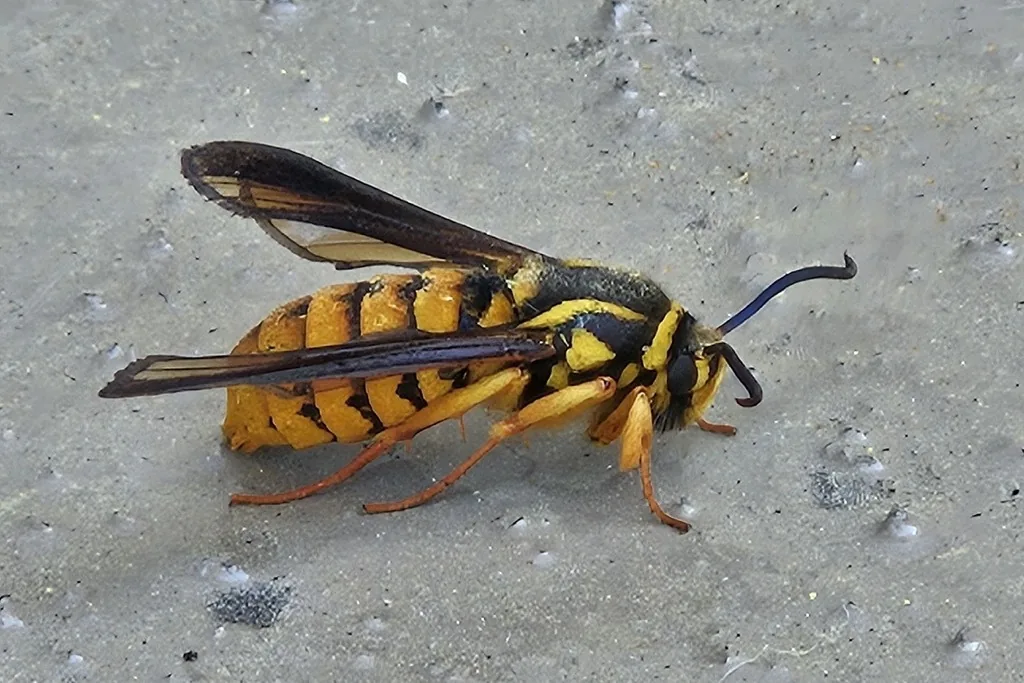
- Adult males are over an inch long and bear a remarkably close resemblance to a yellowjacket wasp; the prominent yellow markings and striking yellow abdomen set this species apart from the other clearwings caught in traps and make identification easy.[3]
- The adult is yellowish orange and black, closely resembling a yellowjacket or, in some forms, a paper wasp; wingspan is 30 to 40 mm in females and 27 to 36 mm in males. The forewings are clear except for brownish black scales near the leading edge, the hindwings are clear, and NC State notes that yellowjackets don't have the moth's fringed wings.[2][1]
- Paranthrene species are color-polymorphic, and some color forms were once described as separate species; a 2024 multi-gene study found P. simulans polyphyletic.[4]
- Larvae have a black head and purplish brown body and are 22 to 30 mm long when mature; entrance holes are 9.5 to 16 mm across, usually within the lowest 0.3 to 0.6 m of the trunk, between the root flanges.[2]
Look-alikes
| Look-alike | How to tell them apart |
|---|---|
| Ash/lilac borer | Also caught in the same May traps, but the least distinctive clearwing, with mostly opaque brown forewings and none of the oak clearwing's striking yellow abdomen.[3] |
| Yellowjackets | The mimicry is close enough that Rutgers compares trapped males directly to a yellowjacket; clearwing moths mimic wasps to avoid predators, and their wings are at least partly transparent with dark markings along and between the veins.[3] |
| Paranthrene palmii (another oak clearwing) | Another oak-boring clearwing, which the 1972 Forest Service manual records from the New York area to Florida and along the Gulf Coast to at least Mississippi, where it prefers red oaks, especially Nuttall and cherrybark oaks. Eggs go in bark crevices at the base of trees, preferably over 12 inches d.b.h., and larvae cut galleries up to 9 mm wide and 4 inches long that slope upward for the first inch or two and then run straight up; the life cycle in Mississippi takes 2 years.[5] |
Where it lives
Eastern Canada and throughout the eastern United States, west to Texas in the South and Minnesota in the North, on red and white oaks and American chestnut; Nuttall, Shumard, cherrybark and black oaks are favored in the South, and northern red, pin and black oaks in the North. The Forest Service's older Eastern Forest Insects (1972) gave a narrower range, Nova Scotia to Maryland, Illinois and the Lake States, and recorded it from black, red and pin oaks.[2][1][5]
Biology and life cycle
Adults emerge from April to June in the South and in June and July farther north; in New Jersey, Rutgers catches males in pheromone traps during May, among the earliest clearwings of spring.[2][1][3]
Moths mate on the day they emerge and live about 6 days. Females lay up to 459 eggs over 5 days in bark crevices, mostly around the base of the tree, and the eggs hatch in 15 to 18 days.[2]
Young larvae chew chambers in the inner bark, then tunnel into the wood; finished galleries are 9 to 10 cm long. The life cycle takes 2 years, and before pupating the larva caps its exit hole with a thin, parchment-like membrane. The 1972 manual says there are generally one to four larvae per tree, boring into the trunk wood 1 to 2 feet above the ground and then tunneling 2 to 3 inches upward in the center of the trunk.[2][1][5]
Fun fact: because the life cycle takes two years, the Forest Service reports heavier moth flights in odd-numbered years and lighter ones in even-numbered years.[2]
Damage and signs
- Signs are frass in bark crevices or hanging from entrance holes, wet spots at new attack sites, bark swelling and empty pupal cases sticking out of the trunk.[1][6][2]
- How serious it is depends on where the tree grows: Rutgers does not consider it a major landscape pest, and the Forest Service says forest losses are usually minimal because galleries are confined to the stump, but the Forest Service and NC State add that tunneling lets decay into the butt log, culls nursery stock, and in yards and street trees a single larva can open a tree to decay and heavy infestations can kill small trees.[3][2][1]
- The 1972 manual reports it, or a closely related species, infesting both natural oak growth and 2- to 5-inch nursery stock on Long Island.[5]
Health risk
NC State says the moths only look like yellowjackets and cannot hurt people; the caterpillars feed inside oak bark and wood, and no cited source describes any risk to people or pets.[1][2]
Control
Prevention
Step 1, know what you have: Rutgers notes the yellow-abdomened males turn up early in pheromone traps set for other clearwings, so a trap catch alone is not a reason to treat. Keeping trees healthy is the first defense against clearwing borers.[3][7]
Traps and physical control
Step 2, on a few yard trees, push a stiff wire into active galleries to kill the larvae and pupae. Woodpeckers are important natural enemies, especially in winter.[2]
Step 3, time any spray with a pheromone trap: hang it in early spring, check weekly, and spray 10 to 14 days after the first males are caught, when the eggs begin to hatch. NC State suggests early May in North Carolina.[7][1][3]
Pesticides
Step 4, protect valuable trees with a bark spray: the Forest Service says a long-residual insecticide applied to the base of valuable trees during the egg-laying period prevents larval entry. Kentucky says properly timed bark sprays of contact insecticides such as pyrethroids or chlorantraniliprole intercept newly hatched larvae, and that systemic injections or soil treatments generally have not given reliable control. NC State suggests a pyrethroid such as permethrin in early May and warns to keep pyrethroids away from pools, ponds and streams because they are very toxic to fish. Larvae already inside the wood are out of reach.[2][7][1]
Where the sources disagree
What it mimics: the Forest Service says the moth closely resembles queen yellowjackets; NC State says some moths resemble the paper wasp Polistes exclamans and others common yellowjackets.[2][1]
Flight season: the Forest Service gives April to June in the South and June and July in the North; NC State says moths emerge from April to June but also from April through July of the second year, and Rutgers catches males in New Jersey traps in May.[2][1][3]
Spray timing: NC State suggests early May in North Carolina, Kentucky says 10 to 14 days after the first males are caught in pheromone traps, and the Forest Service says during the egg-laying period.[1][7][2]
How serious: Rutgers does not consider it a major landscape pest, while NC State says tunneling promotes decay in the lower butt and causes losses in nursery production, and the Forest Service says heavy infestations can kill small trees.[3][1][2]
Gallery length: the Forest Service's 1972 Eastern Forest Insects says galleries reach up to 2 inches long, while its later leaflet gives finished galleries of 9 to 10 cm.[5][2]
Range: the 1972 manual gives Nova Scotia to Maryland, Illinois and the Lake States, while the later Forest Service leaflet and NC State give eastern Canada and the eastern United States, west to Texas in the South and Minnesota in the North.[5][2][1]
Common questions
- Is that yellowjacket on my oak actually a moth?
- Possibly. Male red oak clearwings are over an inch long and look remarkably like yellowjacket wasps, but they are day-flying moths, wasp mimics with partly transparent wings marked along the veins.[3]
- Does the oak clearwing kill trees?
- Rarely in forests, but it can: in yards and street trees one larva can let decay into the trunk, and heavy infestations can kill small trees. Rutgers does not rate it a major landscape pest. The 1972 Forest Service manual says there are generally only one to four larvae per tree.[2][3][5]
- Why does it turn up in my clearwing traps?
- Clearwing species share similar pheromones, so lures sold for other borers also attract the oak clearwing, which is one of the earliest species to fly in spring.[3]
- When should I spray my oak?
- Only valuable, attacked trees need it. Spray the trunk and main limbs 10 to 14 days after pheromone traps catch the first males, around early May in North Carolina.[7][1]
Sources
- NC State Extension, “Red Oak Clearwing Borer.” content.ces.ncsu.edu/red-oak-clearwing-borer (accessed 2026-11-13)
- USDA Forest Service, “Guide to Insect Borers in North American Broadleaf Trees and Shrubs (Agriculture Handbook AH-706): Paranthrene simulans.” research.fs.usda.gov/download/treesearch/22150.pdf (accessed 2026-11-13)
- Rutgers Cooperative Extension Plant & Pest Advisory (Rutgers New Jersey Agricultural Experiment Station), “Identifying Clearwing Moth Borers in Pheromone Traps (S. K. Rettke), Plant & Pest Advisory.” plant-pest-advisory.rutgers.edu/identifying-clearwing-moth-borers-in-pheromone-traps/ (accessed 2026-11-13)
- PLoS One (via NCBI PubMed), “Aposematic color polymorphism is a poor indicator of species boundaries in North American Paranthrene (Lepidoptera: Sesiidae) as evidenced by a multi-gene phylogeny (W. H. Smith III, W. H. Taft and A. I. Cognato, 2024) (abstract).” pubmed.ncbi.nlm.nih.gov/39602370/ (accessed 2026-11-13)
- USDA Forest Service, “Eastern Forest Insects, Miscellaneous Publication 1175 (W. L. Baker, February 1972; scanned copy).” archive.org/details/easternforestins1175bake (accessed 2026-11-14). Scanned copy of the USDA Forest Service publication on the Internet Archive; text read from the archive.org full-text (djvu.txt) file.
- NC State Extension, “Common Insect Pests of Oak in North Carolina.” content.ces.ncsu.edu/common-insect-pests-of-oak-in-north-carolina (accessed 2026-11-13)
- University of Kentucky Entomology, “Insect Borers of Trees and Shrubs (ENT-43).” entomology.mgcafe.uky.edu/ent43 (accessed 2026-11-13)
- Global Biodiversity Information Facility (GBIF), “Paranthrene simulans (Grote, 1881) (GBIF Backbone Taxonomy).” api.gbif.org/v1/species/1939833 (accessed 2026-11-13)