On this page
How to identify it
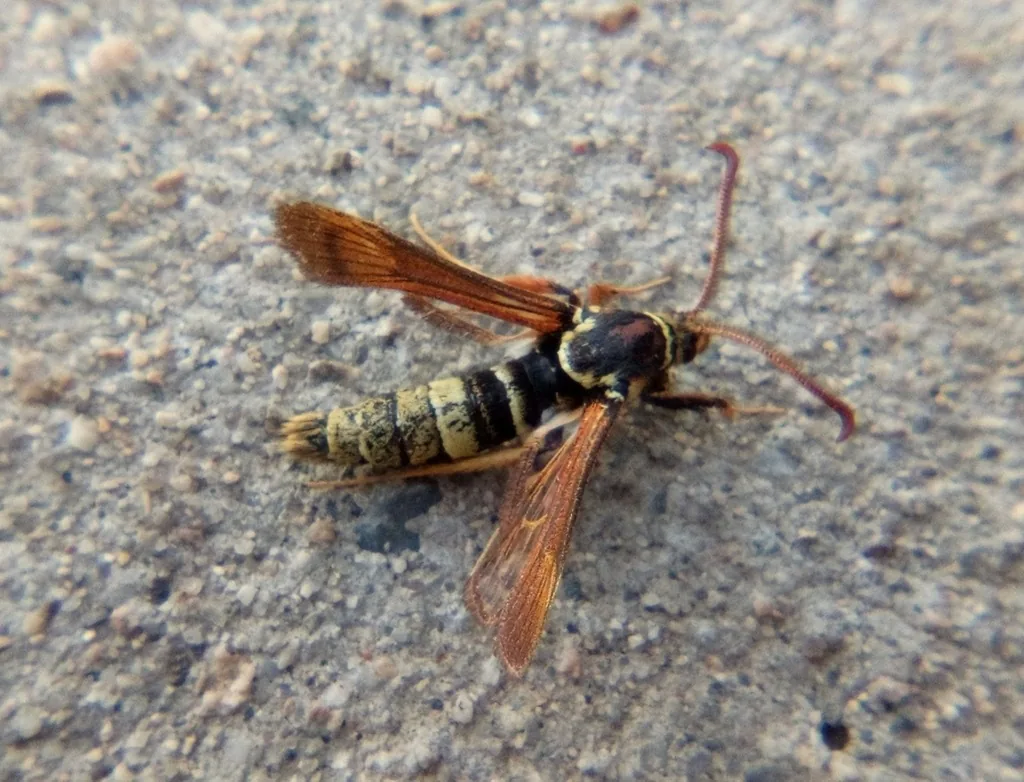
- Adults have orange to brownish forewings, clear hind wings, a black thorax with a yellow border and a yellow abdomen with three black bands. The desert form is pale yellow all over.[1]
- The moth resembles a yellowjacket but has a thick waist and feathery antennae.[1]
- Larvae are pale with dark heads and two hornlike spines on the back, and clearwing larvae reach 1 to 1 1/2 inches when grown. Empty brownish pupal cases, about 3/4 inch long, often stick out of the bark after the moths emerge.[1]
Look-alikes
| Look-alike | How to tell them apart |
|---|---|
| Yellowjackets | Yellowjackets have a narrow waist and threadlike antennae; the moth has a thick waist and feathery antennae.[1] |
| Sycamore borer | A related clearwing found mainly in sycamore.[1] |
| American hornet moth | It closely resembles the western poplar clearwing and attacks many of the same trees, but it is mostly blackish blue with some brown, orange or yellow.[1] |
Where it lives
UC IPM says it lives in warm, low-elevation areas of the West and is a pest in Southern California and the Central Valley. WSU Extension places it throughout the states west of the Rocky Mountains and in British Columbia, as far east as western Colorado.[1][2]
Biology and life cycle
Males emerge before females and fly mostly around dusk. The sources give different flight seasons (see Where the sources disagree).[1][2]
Females lay eggs in bark cracks, crevices and wounds, and the larvae bore into the bark, cambium or heartwood. The sources describe the eggs differently (see Where the sources disagree).[1][2]
Older larvae spend the winter inside trunks and stems. How long a generation takes differs by source (see Where the sources disagree).[1][2]
A 2024 DNA study found that moths called P. robiniae belong to more than one species. Two new look-alike species were split off, and color forms mostly don't line up with species boundaries.[4]
Damage and signs
- Poplar varieties vary widely in susceptibility, and willows tolerate infestation without apparent serious harm.[1]
- Larval tunnels weaken stems and trunks, so trees break in wind and are sometimes girdled. WSU Extension cites a Pacific Northwest survey in which 44% of trees were infested and 35,731 new cuttings had to be replanted.[2]
Health risk
UC IPM and WSU Extension discuss it only as a tree pest; no cited source describes any risk to people or pets.[1][2]
Control
Prevention
Check bark weekly for fresh pupal cases and use pheromone traps to time any action.[1]
Water trees well, since drought stress invites borers, though poplar, willow and birch can be attacked even with good irrigation. Avoid pruning while the moths are flying, usually late winter through late summer, because wounds attract them.[1]
Biological control
Commercial insect-killing nematodes injected into tunnels work against its larvae, and Apanteles wasps parasitize it.[1]
Mating disruption, which fills the air with the female sex pheromone, now protects commercial poplar plantings in the Pacific Northwest. UC IPM says it probably doesn't suit one or a few scattered landscape trees.[2][1]
Pesticides
Bark sprays get mixed reviews (see Where the sources disagree). UC IPM says only broad-spectrum, residual insecticides sprayed thoroughly onto the bark about 10 to 14 days after the first moth catch can prevent attacks, that their use generally requires a licensed applicator, and that sprays don't reach larvae already under the bark. For Pacific Northwest poplar plantings, WSU researchers recommend mating disruption instead.[1][2][3]
More from the research literature
A 2006 Journal of Economic Entomology report describes the native moth, normally scarce in Pacific Northwest streamside habitats, exploding in commercial hybrid poplar plantings: male trap catches rose 190-fold from 2001 to 2002, larvae girdled saplings and bored into limbs and trunks, and repeated insecticide applications failed to reduce the moths.[3]
WSU Extension notes that four major reviews of poplar pests hadn't listed this moth as a pest before those outbreaks.[2]
The researchers recommended dropping contact insecticides, using mating disruption, and later replanting with a less susceptible poplar clone.[3]
Where the sources disagree
Flight season: UC IPM says adults are active mainly from May through July, and in Southern California have also been found in November and February through May; WSU Extension says adults emerge from April through July.[1][2]
Eggs: UC IPM describes clearwing eggs in general as reddish to pale pink, hatching in about one to four weeks; WSU Extension describes this species' eggs as brown, hatching in about 14 days depending on temperature.[1][2]
Generation length: UC IPM says this species takes one to two years to complete a generation; WSU Extension says third- to fifth-stage larvae overwinter, but pupae found in first-year whips suggest a small proportion of each year's population completes development within one season.[1][2]
Sprays: UC IPM says residual bark sprays can protect high-value trees; WSU Extension says repeated applications recommended for California in 1994 did not work in Oregon and Washington, and the 2006 study recommends a halt to contact insecticides aimed at adult moths in favor of mating disruption.[1][2][3]
Common questions
- Is that a wasp or a moth on my poplar?
- A thick waist and feathery antennae mean it's a clearwing moth, not a yellowjacket.[1]
- Are willows hurt by western poplar clearwing?
- UC IPM says willows tolerate infestation, apparently without serious harm.[1]
- Can I spray to kill the larvae inside the trunk?
- Not effectively. UC IPM says sprays don't reach larvae under the bark and systemic insecticides haven't been found to control them; injecting insect-killing nematodes into the tunnels works better.[1]
Sources
- University of California Statewide IPM Program, “Clearwing Moths (Pest Notes).” ipm.ucanr.edu/home-and-landscape/clearwing-moths/ (accessed 2026-11-13)
- Washington State University Extension, “Western Poplar Clearwing Moth, Insect Pest Management in Hybrid Poplars Series (FS266E, Kittelson & Brown).” wpcdn.web.wsu.edu/wp-ecommerce/uploads/sites/2/product-4349-sku-FS266E.pdf (accessed 2026-11-13)
- Peer-reviewed literature (PubMed), “An endemic population of western poplar clearwing moths (Lepidoptera: Sesiidae) invades a monoculture of hybrid poplar (Brown JJ et al., Journal of economic entomology, 2006).” pubmed.ncbi.nlm.nih.gov/16813311/ (accessed 2026-11-13)
- PLoS One 2024;19:e0312508, via PubMed, “Aposematic color polymorphism is a poor indicator of species boundaries in North American Paranthrene (Smith, Taft & Cognato, 2024).” pubmed.ncbi.nlm.nih.gov/39602370/ (accessed 2026-11-13)
- Global Biodiversity Information Facility (GBIF), “Paranthrene robiniae (Edwards, 1880) (GBIF Backbone Taxonomy).” api.gbif.org/v1/species/9146244 (accessed 2026-11-13)