On this page
How to identify it
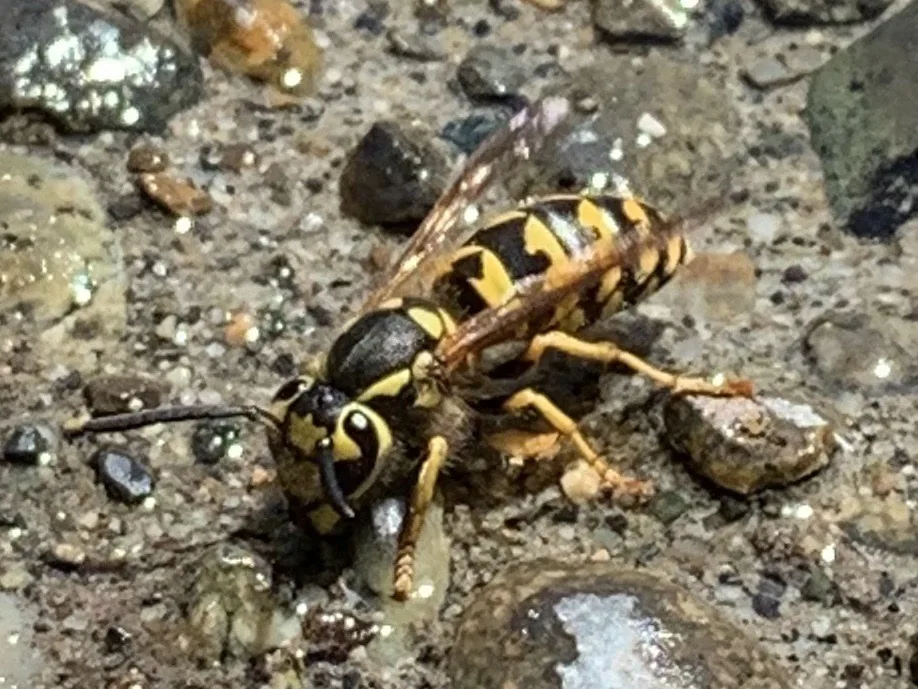
- Medium-sized wasps, black with jagged bands of bright yellow on the abdomen and a very short, narrow waist.[1]
- In flight they hold their legs close to the body, unlike paper wasps, which dangle their legs.[3]
- Nests are paper, built in rodent burrows, under rocks and landscape timbers, or in walls, attics and crawl spaces, enclosed in a paper envelope with a single entrance.[1][2]
Look-alikes
| Look-alike | How to tell them apart |
|---|---|
| European paper wasp | Larger and slimmer, with a thinner waist, orange-tipped antennae and dangling legs in flight; builds open, umbrella-shaped nests.[3] |
| Honey bee | Hairy and golden brown rather than shiny black and yellow; UK Entomology rates yellowjackets as more dangerous and unpredictable than honey bees.[2][4] |
| Bald-faced hornet | Black and white instead of black and yellow, larger, and builds football-shaped aerial nests.[2] |
| Eastern yellowjacket | The common ground-nesting yellowjacket of the eastern US has a wide, anchor-shaped black mark on the first abdominal segment.[5] |
| German yellowjacket | This invasive northern species has a small spade-shaped mark on the first segment, black spots down the sides, and often nests in walls.[6] |
| Southern yellowjacket | Its workers are yellow and black, but its queens are much larger, about 3/4 inch, and burnt orange.[7] |
Where it lives
Common across North America; the western yellowjacket is the species most often encountered in western states, and UC IPM notes the German yellowjacket is becoming more common in urban California, where it often nests in houses. Most nests are in the ground, often in old rodent burrows, but some species nest in wall and ceiling voids.[1][8][2][9]
Biology and life cycle
A queen that mated the previous fall starts each nest alone in spring; colonies reach 1,500 to 15,000 wasps depending on species.[1]
From spring to midsummer workers hunt insects for protein; by late summer colonies need sugar, so workers scavenge sweets, meat and garbage.[1][2]
Colonies usually die out in winter, though some in mild climates survive several years and grow very large.[1][2]
Yellowjackets have a smooth stinger, unlike the honey bee, which leaves its serrated stinger in the skin, so one wasp can sting more than once.[10]
Damage and signs
- Nests in walls can produce a wet spot that becomes a hole as the wasps enlarge their cavity.[1]
Health risk
Venom can cause an allergic reaction in some people. MedlinePlus lists swelling of the throat, lips, tongue and mouth, hives and trouble breathing as signs, says people with a sting allergy should always carry a prescribed epinephrine kit, and advises calling poison control or an emergency room if the person is allergic or was stung inside the mouth or throat. Many stings at once carry another risk: a 2025 review calls multiple wasp stings a significant threat because they can cause acute kidney injury, which it cites as an independent risk factor for death. CDC counted 1,109 U.S. deaths from hornet, wasp and bee stings from 2000 through 2017, an average of 62 a year.[9][11][12]
Control
Prevention
Keep food, drinks, pet food and garbage covered or indoors when wasps are around, and check open soda cans before drinking.[1][2]
If a yellowjacket lands on you, don't swat it or run; wait for it to leave or gently brush it away. UC IPM adds that defensive behavior builds as the season goes on and colonies grow while food gets scarce.[8]
Traps and physical control
Lure traps (heptyl butyrate) reduce western yellowjacket foragers but don't eliminate large populations; place them away from patios, between the area to protect and nesting areas. Water traps with protein bait work best for queens in late winter and early spring.[1]
Pesticides
Folk remedies like gasoline or flooding nests seldom work and can lead to many stings.[2]
When to call a professional
If a nest must be removed, the safest course is professional help; wasps attack when they sense spray on their nest, and stings are likely even at night.[1][2]
Don't seal the entrance of a nest behind siding; trapped wasps may chew inward and come out indoors.[2]
In California, UC IPM suggests asking your mosquito and vector control district whether it treats nests, or finding a licensed pest control operator.[8]
Common questions
- Why are yellowjackets so aggressive in late summer?
- Colonies are at their largest and food is scarce, so workers scavenge sweets and meat at picnics and defend nests more vigorously.[1][2]
- Can a yellowjacket sting more than once?
- Yes. A 2024 review of sting allergy notes that the yellow jacket's stinger is smooth and it can sting multiple times.[10]
Sources
- University of California Statewide IPM Program, “Pest Notes: Yellowjackets and Other Social Wasps, Publication 7450 (March 2012).” ipm.ucanr.edu/legacy_assets/PDF/PESTNOTES/pnyellowjackets.pdf (accessed 2026-11-13)
- University of Kentucky Entomology, “ENTFACT-620: Controlling Wasps, Hornets, and Yellowjackets.” entomology.mgcafe.uky.edu/ef620 (accessed 2026-11-13)
- Penn State Extension, “European Paper Wasp.” extension.psu.edu/european-paper-wasp (accessed 2026-11-13)
- University of Kentucky Entomology, “ENTFACT-606: Controlling Nuisance Honey Bees.” entomology.mgcafe.uky.edu/ef606 (accessed 2026-11-13)
- Penn State Extension, “Eastern Yellowjacket.” extension.psu.edu/eastern-yellowjacket (accessed 2026-11-13)
- Penn State Extension, “German Yellowjackets.” extension.psu.edu/german-yellowjackets (accessed 2026-11-13)
- Mississippi State University Extension Service, “Southern Yellowjackets (Bug's Eye View, Vol. 2, No. 32).” extension.msstate.edu/taxonomy/term/4171/2016/southern-yellowjackets-vol-2-no-32 (accessed 2026-11-13)
- University of California Statewide IPM Program, “Yellowjackets and Other Social Wasps.” ipm.ucanr.edu/home-and-landscape/yellowjackets-and-other-social-wasps/ (accessed 2026-11-13)
- NIH National Library of Medicine, MedlinePlus, “Bee, wasp, hornet, or yellow jacket sting (Medical Encyclopedia).” medlineplus.gov/ency/article/002847.htm (accessed 2026-11-13)
- Ital J Pediatr 2024;50:262, via PubMed Central, “Hymenoptera venom allergy in children (2024).” pmc.ncbi.nlm.nih.gov/articles/PMC11662473/ (accessed 2026-11-13). PMID 39707411
- BMC Nephrol 2025;26:471, via PubMed Central, “From sting to STING: role of inflammation in wasp sting induced AKI - a narrative review (2025).” pmc.ncbi.nlm.nih.gov/articles/PMC12362855/ (accessed 2026-11-13). PMID 40830760
- Centers for Disease Control and Prevention, MMWR, “QuickStats: Number of Deaths from Hornet, Wasp, and Bee Stings, Among Males and Females, United States, 2000-2017.” www.cdc.gov/mmwr/volumes/68/wr/mm6829a5.htm (accessed 2026-11-13)
- Global Biodiversity Information Facility (GBIF), “Vespula pensylvanica (de Saussure, 1857) (GBIF Backbone Taxonomy).” api.gbif.org/v1/species/1311698 (accessed 2026-11-13)
- iNaturalist, “Vespula pensylvanica taxon page (order and family).” www.inaturalist.org/taxa/61355 (accessed 2026-10-06)