On this page
How to identify it
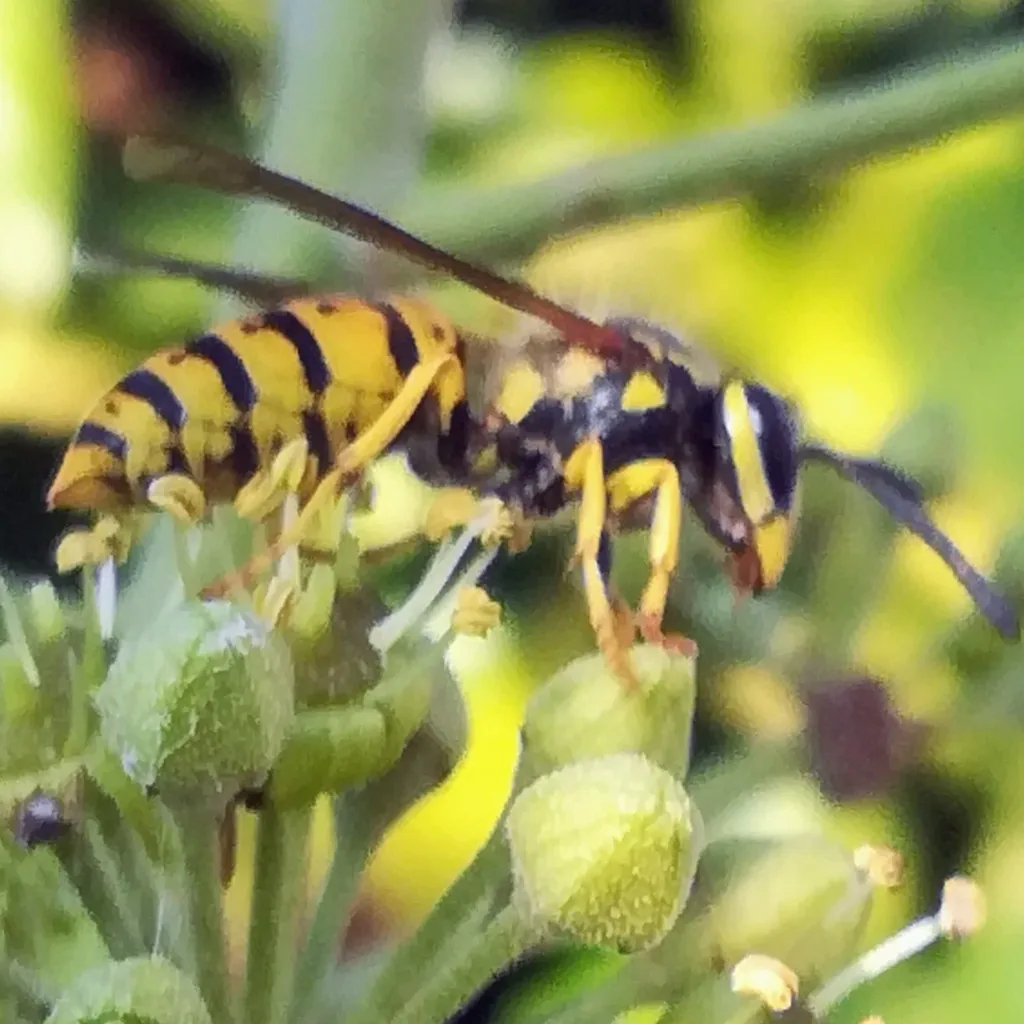
- Workers are about 1/2 inch long and queens about 3/4 inch, black and yellow.[1]
- The abdomen usually has a small spade-shaped black mark on the first segment and black spots down both sides from the second to fifth segments.[1]
- Sources describe that first-segment mark a little differently. Penn State's text calls it spade-shaped (its photo caption says anchor), while the Missouri Department of Conservation (MDC) calls it diamond-shaped and notes a separate black dot, not joined to a band, on each side of the later segments.[1][4]
- Nests are horizontal combs inside a gray to brown paper envelope, usually in attics, wall voids and other open spaces, sometimes underground.[1][4]
- Unlike the native eastern yellowjacket, MDC says, the German yellowjacket usually nests in the spaces between walls of buildings, and those nests can get quite large.[4]
- In California, UC IPM reports it becoming more common in many urban areas, where it frequently nests in houses.[6]
Look-alikes
| Look-alike | How to tell them apart |
|---|---|
| Eastern yellowjacket | Eastern yellowjackets have a wide, anchor-shaped black mark on the first segment and usually nest in the ground.[2][4] |
| European paper wasp | Also black and yellow, but with orange-tipped antennae, a thinner waist, legs that dangle in flight, and an open, umbrella-shaped nest with no paper envelope.[8] |
Where it lives
First detected in New York in 1891 and common across the Northeast by the 1970s, it now spans the northern US and southern Canada; south of Washington, D.C., it's limited to higher Appalachian elevations.[1]
Biology and life cycle
An overwintered queen starts each nest alone in spring; by fall, nests usually hold 1,000 to 3,000 workers.[1]
For yellowjackets in general the figures vary: the Connecticut Agricultural Experiment Station (CAES) says colonies peak at 1,000 to 4,000 individuals depending on species, MDC says a nest can hold 5,000 workers by September, and UC IPM gives 1,500 to 15,000.[5][4][6]
New queens and males leave to mate in fall, the males die, and new queens hibernate in dry, protected places while the old nest dies off.[1]
Nests in warm spots, including heated buildings, occasionally survive winter and keep growing, though large perennial nests are uncommon in North America.[1]
Where winters are warm, the picture changes. Penn State says a surviving nest can end up with hundreds of queens, and a modeling study of this species notes that in areas with warmer winters and longer summers, queens and workers can live through the winter and build large nests the next season.[1][9]
Its range in the East has limits: Penn State says that south of Washington, D.C., it is restricted to higher elevations of the Appalachians and generally absent from the Southeast, and CAES lists it across most of the US except the southernmost states.[1][5]
Damage and signs
- They prey on insects and scavenge carcasses, trash, fallen fruit and sugary drinks, so they often clash with people at trash cans and picnics.[1][4]
- In western New York they make up over 90 percent of yellowjackets caught in urban and suburban areas.[1]
- Penn State adds that the same study found it made up nearly 70 percent of yellowjackets caught in rural areas.[1]
- German yellowjackets sometimes attack honey bees, but Penn State says they usually go after single bees rather than the hive, and the colony usually repels them.[1]
- Foraging yellowjackets crawl into soda cans and can sting the lips or the inside of the mouth or throat, a risk MDC says is highest in late summer and fall.[6][4]
Health risk
A sting usually means pain at the site and can be treated at home, but a person who is allergic to the venom can go into anaphylaxis, a severe, potentially life-threatening reaction that needs emergency care right away.[11][10]
Control
Prevention
The simplest control is to wait for the first hard frost or two, which kills these annual nests.[1][4]
If you treat a nest yourself, Penn State says to wear long sleeves and pants with the cuffs taped or tucked into long socks, plus gloves.[1]
Keep them out
To keep overwintering queens out, seal cracks in siding and around windows and pipes that lead into wall voids.[1]
Traps and physical control
Never cover or close the outside entrance of a nest in a wall void; trapped wasps may chew into living spaces.[1][7]
Find the nest by day and treat it at night. CAES says to mark the spot so you can find it in the dark and never treat during the day, because yellowjackets see poorly at night and are less active in the cool.[5][7]
For traps, UC IPM notes that the common heptyl butyrate lure attracts mainly the western yellowjacket; adding meat such as chicken is believed to improve catches of German yellowjackets, and the meat should be replaced often because they don't come to rotting meat.[6]
Pesticides
Insecticidal dust at the entrance works best for hidden nests; for exposed nests, aerosol wasp sprays must soak through the paper envelope.[1]
When to call a professional
Penn State's advice: if you are allergic or otherwise unable to treat the nest yourself, contact a professional pest control company. CAES suggests a professional for hard-to-reach nests, especially in buildings.[1][5]
Common questions
- Why are yellowjackets coming out of my wall?
- German yellowjackets often nest in wall voids; don't block the entrance, or they may chew into the house.[1][7]
- Will a yellowjacket nest die on its own?
- Yes. German yellowjacket nests are annual, and the first hard frost or two kills them.[1][4]
- Why are yellowjackets flying around inside my house?
- In fall, CAES says, workers indoors can mean a nest in a nearby wall cavity, drawn in by the warmer air. In winter and spring they are usually overwintering queens; Penn State says to catch and kill them and then seal cracks in siding and around windows and pipes.[5][1]
- What should I do after a yellowjacket sting?
- Wash the area with soap and water and put ice wrapped in a cloth on it, 10 minutes on and 10 off. Call 911 for trouble breathing, swelling of the face or mouth, or throat tightness or trouble swallowing.[11][10]
Sources
- Penn State Extension, “German Yellowjackets.” extension.psu.edu/german-yellowjackets (accessed 2026-11-11)
- Penn State Extension, “Eastern Yellowjacket.” extension.psu.edu/eastern-yellowjacket (accessed 2026-11-11)
- iNaturalist, “Vespula germanica taxon page (order and family).” www.inaturalist.org/taxa/126155 (accessed 2026-11-11)
- Missouri Department of Conservation, “Yellowjackets (Vespula Wasps), Field Guide.” mdc.mo.gov/discover-nature/field-guide/yellowjackets-vespula-wasps (accessed 2026-11-11)
- The Connecticut Agricultural Experiment Station, “Yellowjackets (Family Vespidae), fact sheet by Gale E. Ridge.” portal.ct.gov/-/media/caes/documents/publications/fact_sheets/entomology/yellowjackets_vespidae.pdf (accessed 2026-11-11)
- University of California Statewide IPM Program, “Pest Notes: Yellowjackets and Other Social Wasps, Publication 7450 (March 2012).” ipm.ucanr.edu/legacy_assets/PDF/PESTNOTES/pnyellowjackets.pdf (accessed 2026-11-11)
- University of Kentucky Entomology, “ENTFACT-620: Controlling Wasps, Hornets, and Yellowjackets.” entomology.mgcafe.uky.edu/ef620 (accessed 2026-11-11)
- Penn State Extension, “European Paper Wasp.” extension.psu.edu/european-paper-wasp (accessed 2026-11-11)
- PLoS One, via PubMed, “Including irrigation in niche modelling of the invasive wasp Vespula germanica, PLoS One 12(7):e0181397 (2017).” pubmed.ncbi.nlm.nih.gov/28715452/ (accessed 2026-11-11). Cited from the PubMed abstract.
- Centers for Disease Control and Prevention, NIOSH, “Insects and Scorpions at Work.” www.cdc.gov/niosh/outdoor-workers/about/insects-and-scorpions.html (accessed 2026-11-11)
- MedlinePlus, U.S. National Library of Medicine, “Insect bites and stings (Medical Encyclopedia 000033).” medlineplus.gov/ency/article/000033.htm (accessed 2026-11-11)