On this page
How to identify it
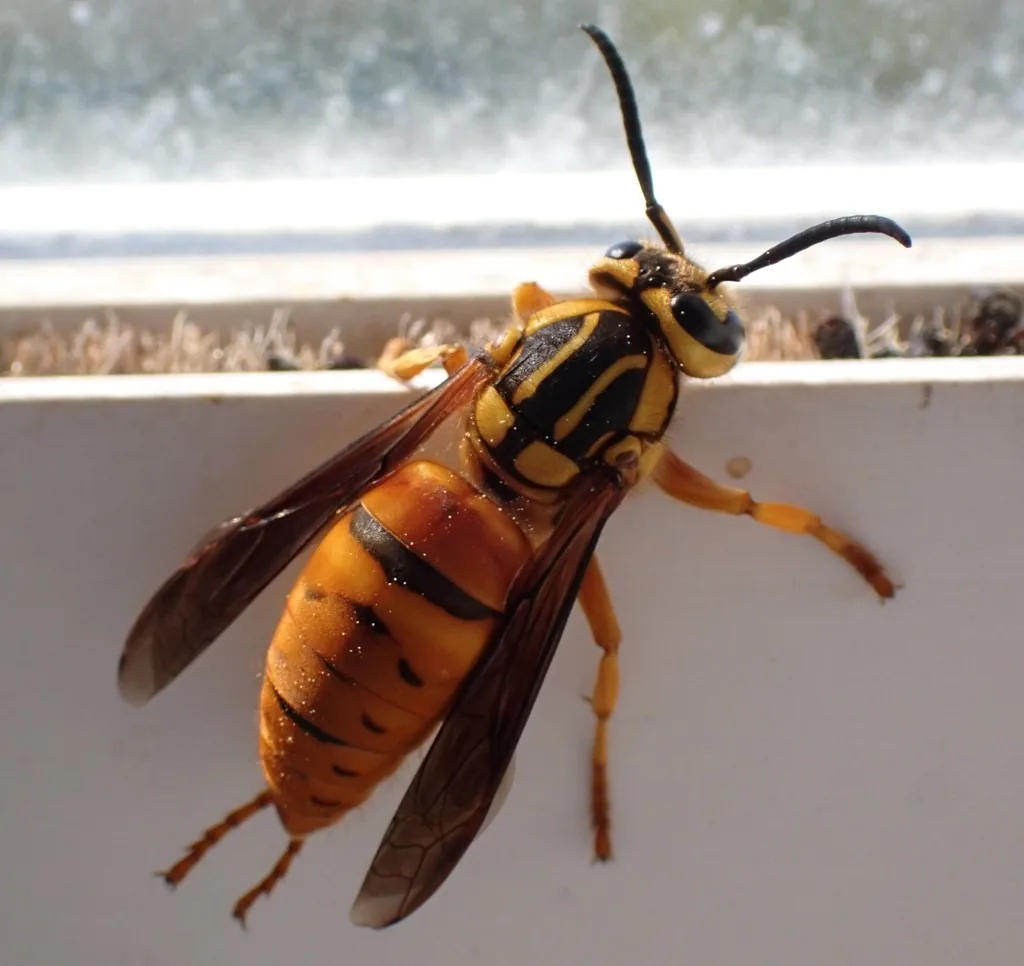
- Workers are small, about 3/8 inch long, and yellow and black.[4]
- Queens are much larger, about 3/4 inch, and burnt orange; males are colored like workers and intermediate in size.[4]
- MDC says it can be told from other yellowjackets by lengthwise black and yellow stripes on the shoulder-like plate just behind the head.[2]
- Large orange wasps in a dug-up nest are usually new southern yellowjacket queens.[4]
- UF/IFAS says Florida's yellowjackets can be told apart by body color and pattern without a hand lens. Males have seven abdominal segments, while queens and workers have six.[3]
Look-alikes
| Look-alike | How to tell them apart |
|---|---|
| Eastern yellowjacket | Eastern yellowjacket queens are yellow and black like their workers and smaller than southern yellowjacket queens.[4] |
| German yellowjacket | Usually nests between the walls of buildings rather than underground, and workers carry a diamond-shaped black mark on the first abdominal segment with separate black dots down the sides.[2] |
| Baldfaced hornet | Mostly black with a white face and larger than a yellowjacket; UF/IFAS notes it is actually a yellowjacket that builds aerial paper nests often a foot or more across, not a ground nest.[3] |
Where it lives
It is found throughout the eastern part of the United States and south as far as Honduras in Central America, according to a 2008 study of its populations. The Missouri Department of Conservation lists it among Missouri's yellowjackets. The University of Florida's Featured Creatures profile gives its range as the eastern United States and parts of Mexico and Central America, and says it is one of only two of the 18 North American (Nearctic) Vespula species known from Florida; the other is the eastern yellowjacket.[1][2][3]
Biology and life cycle
A single mated queen that overwintered under bark or a similar shelter starts each nest, which can grow to over a thousand wasps by fall.[4]
A high percentage of queens begin their nests in spring by taking over an eastern yellowjacket queen's nest.[4][2]
MDC explains how the takeover works. Southern yellowjacket queens become active later in spring than eastern yellowjackets, whose new colonies are just getting started. The southern queen kills the eastern queen, adopts her workers and starts producing her own, and in time the colony is all her offspring.[2]
Geneticists describe it as a facultative social parasite whose primary host is the eastern yellowjacket. Their study found its queens mate with several males, as is typical of Vespula wasps, and that host and parasite populations appear similar in size.[1]
In fall each nest produces males and new queens, and a large nest may hold dozens of each. Most nests die out with freezing weather, but in southern Mississippi a small percentage survive the winter and become large perennial nests.[4]
A genetic study of perennial nests from the southeastern US found they were produced by multiple reproductive females, unlike the single queen of a typical one-season colony, and nestmates were less closely related.[5]
UF/IFAS describes the yearly cycle: a single queen that mated the previous fall and spent the winter as an adult, usually under the bark of a log, founds the colony in spring. Once her first workers emerge they take over every job except egg laying, and she never leaves the nest again.[3]
Workers feed the larvae chewed-up insects, other arthropods and fresh carrion, and caterpillars appear to be a favorite food. In autumn the colony builds larger cells for new queens, which mate and look for winter shelter; in a typical colony the old queen dies and the rest of the colony dies with winter.[3]
Southern yellowjackets build both ground and aerial nests. One ground nest described in UF's profile was 20 cm (7 7/8 in) wide and 20 cm deep, and sat 22.5 cm (8 7/8 in) below the soil surface.[3]
Damage and signs
- Nests are usually underground but sometimes above ground, between hay bales or in insulation in wall or ceiling voids.[4][2]
- MDC adds that it commonly nests in disturbed habitats, and that it only rarely builds in aboveground cavities.[2]
- Florida records collected by UF include aerial nests built in palm material and in a rolled rug in a garage. The biggest, about 2.5 m (8.2 ft) tall, was built around the end of a tree stump, held 74 layers of comb and may have been two or three colonies that merged.[3]
- UF/IFAS points out that yellowjackets also destroy many insects that attack cultivated and ornamental plants; the trouble comes from nests near homes and from wasps drawn to sweet food and drink.[3]
Health risk
Most yellowjacket stings cause local pain that can be handled at home. Call 911 if someone who was stung has trouble breathing, wheezing, swelling anywhere on the face or in the mouth, or a tight throat.[6]
Control
Prevention
When a nest is found late in the season, avoiding the area and waiting for freezing weather may be the best approach.[4][7]
Treat at night, when the wasps are less active, wearing a beekeeper's veil and protective clothing.[4][7]
Before mowing, walk the lawn and watch for a hole with wasps flying in and out of it; MDC says many people find yellowjacket nests by running over them.[2]
Sanitation
Soft drinks, ripe fruit and watermelon attract yellowjackets, so keep them covered outdoors, pick fruit as it ripens and throw out rotten fruit. In yards, parks and schoolyards, UF/IFAS advises trash can lids that wasps can't get past.[3]
Traps and physical control
Don't shine a flashlight straight into the entrance, UK warns, since startled wasps fly toward the light. Spot the hole by day, then light it indirectly from the side, ideally with the light set on the ground.[7]
UF/IFAS says any do-it-yourself attempt should be made at night, when the nest is least active, but warns that any disturbance still brings instant activity; work cautiously but quickly in protective clothing. An injured yellowjacket often releases an alarm pheromone that sets off a defensive response from the rest of the colony.[3]
Pesticides
When a nest must go, aerosol wasp and hornet spray injected into the entrance hole is usually quick and effective.[4]
For nests deep in old rodent burrows, UK finds insecticide dusts puffed into the opening more effective than aerosols, because the dust travels farther and gets carried through the colony.[7]
When to call a professional
UK says it is usually prudent to call a professional when reaching a nest takes a ladder or is otherwise difficult.[7]
For nests that are large or hard to reach, for example inside the walls of a house, UF/IFAS says the safest course is to hire a pest control operator.[3][7]
Where the sources disagree
Winter survival: UF/IFAS describes the colony dying with winter's arrival; Mississippi State says that in southern Mississippi a small percentage of nests survive the winter and become large perennial nests.[3][4]
Common questions
- What are the big orange wasps in a yellowjacket nest?
- Likely new southern yellowjacket queens, which are about 3/4 inch long and burnt orange.[4]
- Do southern yellowjacket nests die in winter?
- Most do with freezing weather, but in southern Mississippi a small percentage survive and become large perennial nests.[4][5]
- Can a southern yellowjacket take over another nest?
- Yes. A high percentage of southern yellowjacket queens start out by killing an eastern yellowjacket queen in spring and taking over her nest and workers.[4][2]
- Do southern yellowjackets ever nest above ground?
- Usually not. MDC says it only rarely builds in aboveground cavities, but UF/IFAS cites Florida aerial nests in palm material, in a rolled rug in a garage and one about 8.2 ft tall around a tree stump.[2][3]
Sources
- BMC Evolutionary Biology, via PubMed, “Hoffman EA, Kovacs JL, Goodisman MA (2008), Genetic structure and breeding system in a social wasp and its social parasite, BMC Evolutionary Biology 8:239.” pubmed.ncbi.nlm.nih.gov/18715511/ (accessed 2026-11-14). Range line cited from the PMC full text (PMC2533669); other lines from the PubMed abstract.
- Missouri Department of Conservation, “Yellowjackets (Vespula Wasps), Field Guide.” mdc.mo.gov/discover-nature/field-guide/yellowjackets-vespula-wasps (accessed 2026-11-14)
- University of Florida/IFAS Extension (Featured Creatures), “Yellowjackets and Hornets, Vespula and Dolichovespula spp., EENY-081/IN238 (E. E. Grissell and T. R. Fasulo).” ask.ifas.ufl.edu/publication/IN238 (accessed 2026-11-14)
- Mississippi State University Extension Service, “Southern Yellowjackets (Bug's Eye View, Vol. 2, No. 32).” extension.msstate.edu/taxonomy/term/4171/2016/southern-yellowjackets-vol-2-no-32 (accessed 2026-11-14)
- Ecology and Evolution, via PubMed, “Dyson CJ et al. (2022), Social structure of perennial Vespula squamosa wasp colonies, Ecology and Evolution 12(2):e8569.” pubmed.ncbi.nlm.nih.gov/35169451/ (accessed 2026-11-14). Cited from the PubMed abstract.
- MedlinePlus, U.S. National Library of Medicine, “Insect bites and stings (Medical Encyclopedia 000033).” medlineplus.gov/ency/article/000033.htm (accessed 2026-11-14)
- University of Kentucky Entomology, “ENTFACT-620: Controlling Wasps, Hornets, and Yellowjackets.” entomology.mgcafe.uky.edu/ef620 (accessed 2026-11-14)
- iNaturalist, “Vespula squamosa taxon page (order and family).” www.inaturalist.org/taxa/233560 (accessed 2026-11-14)