On this page
How to identify it
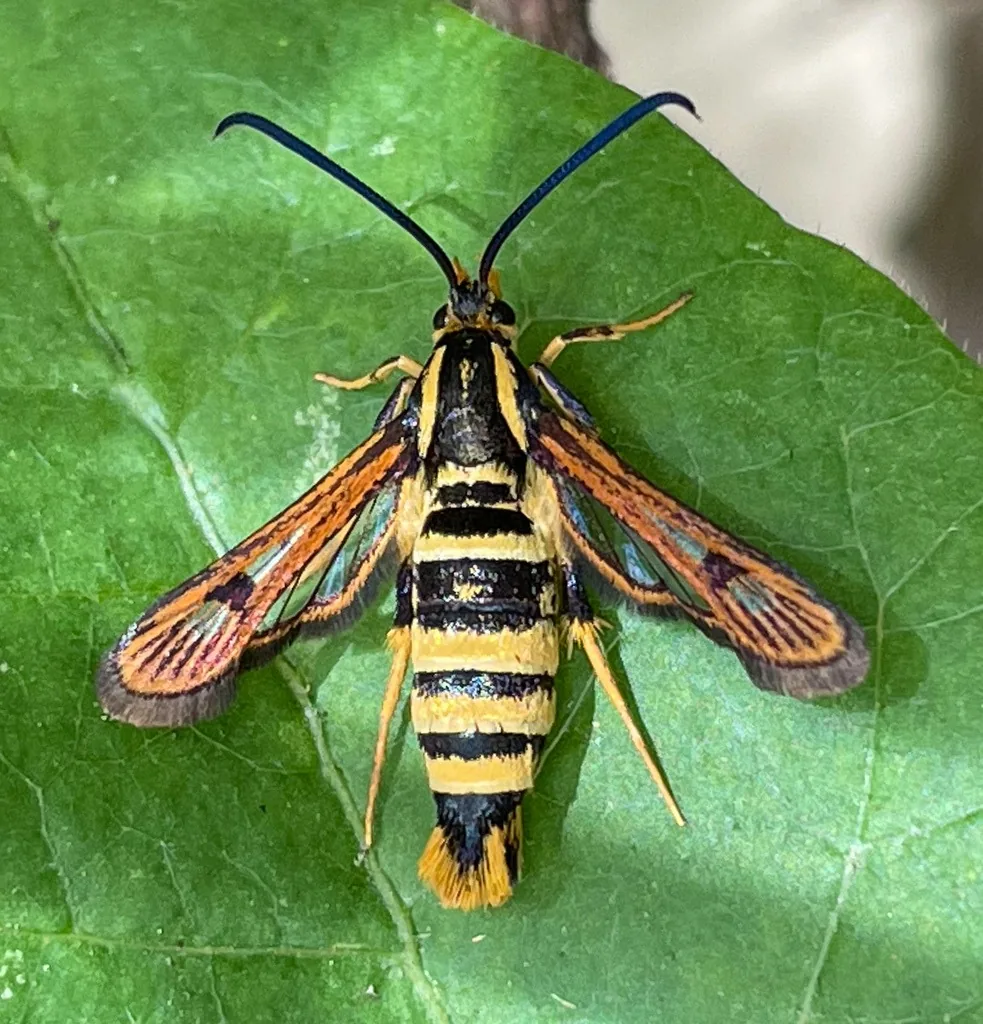
- Males are mostly yellow with a brownish-black head and black bands on the body; the legs are yellow except for black along the edges nearest the body, and the mostly clear wings have orange to yellow margins.[1]
- Clearwing larvae push sawdust-like frass from tunnels, and empty brownish pupal cases may stick out of the bark.[1]
- UC IPM says clearwing larvae in general are 1 to 1 1/2 inches long when mature, with a dark brown head and a whitish to pink body.[1]
Look-alikes
| Look-alike | How to tell them apart |
|---|---|
| Western poplar clearwing | Another clearwing that attacks poplar, birch and willow rather than sycamore.[1] |
| Carpenterworm | Its pupal cases closely resemble those of clearwing moths.[1] |
Where it lives
It occurs in the southwestern United States and also infests oak and ceanothus.[1]
Biology and life cycle
Clearwing adults live about a week. Females lay tiny reddish to pale pink eggs in bark cracks, crevices and wounds; the eggs hatch in one to four weeks and the larvae bore into the bark, cambium or heartwood.[1]
Sycamore borer adults are active mainly from May through July.[1]
In a University of California field test, sycamore borer larvae fed in dry galleries in the bark, unlike a related clearwing in alder that fed in moist galleries in the heartwood.[2]
Damage and signs
- Larvae bore under the bark, but UC IPM says sycamores tolerate extensive boring by this insect and the feeding apparently causes no serious harm.[1]
Health risk
It feeds on trees, and no cited source describes any risk to people or pets.[1][2]
Control
Prevention
Generally no control is recommended for sycamore borer.[1]
Biological control
Sources differ on nematodes. UC IPM says the commercial nematodes Steinernema carpocapsae and S. feltiae are effective against sycamore borer and other clearwing larvae. In a 1986 field test on sycamores, fall trunk sprays of S. feltiae or S. bibionis gave no significant control and a spring spray of S. feltiae killed 61 percent of larvae; the researchers called this borer hard to control with nematodes.[1][2]
UC IPM says parasitic wasps and predators kill clearwing larvae, though their importance hasn't been documented, and advises not spraying trees that tolerate borers, such as sycamores, so natural enemies aren't disrupted.[1]
More from the research literature
A University of California field test on the Riverside campus found sycamores heavily infested with sycamore borer, averaging about 52 galleries per tree. The larvae feed in dry galleries in the bark whose openings averaged about 0.05 inch across in October and 0.17 inch in April, and trunk sprays of insect-parasitic nematodes in the fall gave no significant control; a spring spray of Steinernema feltiae killed 61 percent of the larvae and S. bibionis 12.5 percent. The researchers concluded that this borer is hard to control with nematodes and that spring timing matters.[2]
Common questions
Sources
- University of California Statewide IPM Program, “Clearwing Moths (Pest Notes).” ipm.ucanr.edu/home-and-landscape/clearwing-moths/ (accessed 2026-11-13)
- Peer-reviewed literature (Journal of Arboriculture, International Society of Arboriculture), “Field Application of Entomogenous Nematodes for Biological Control of Clear-Wing Moth Borers in Alder and Sycamore Trees (H. K. Kaya and L. R. Brown, Journal of Arboriculture 12(6), 1986).” auf.isa-arbor.com/content/isa/12/6/150.full.pdf (accessed 2026-11-13)
- Global Biodiversity Information Facility (GBIF), “Synanthedon resplendens (Edwards, 1881) (GBIF Backbone Taxonomy).” api.gbif.org/v1/species/1940601 (accessed 2026-11-13)