On this page
How to identify it
- Early signs are dark sap spots on the trunk, then frass and sawdust pushed out of gallery openings.[1]
- Mature larvae are 2 to 3 inches long, greenish white or pinkish with a dark brown head. Unlike beetle borers, they have fleshy prolegs with hooks.[1][2][3]
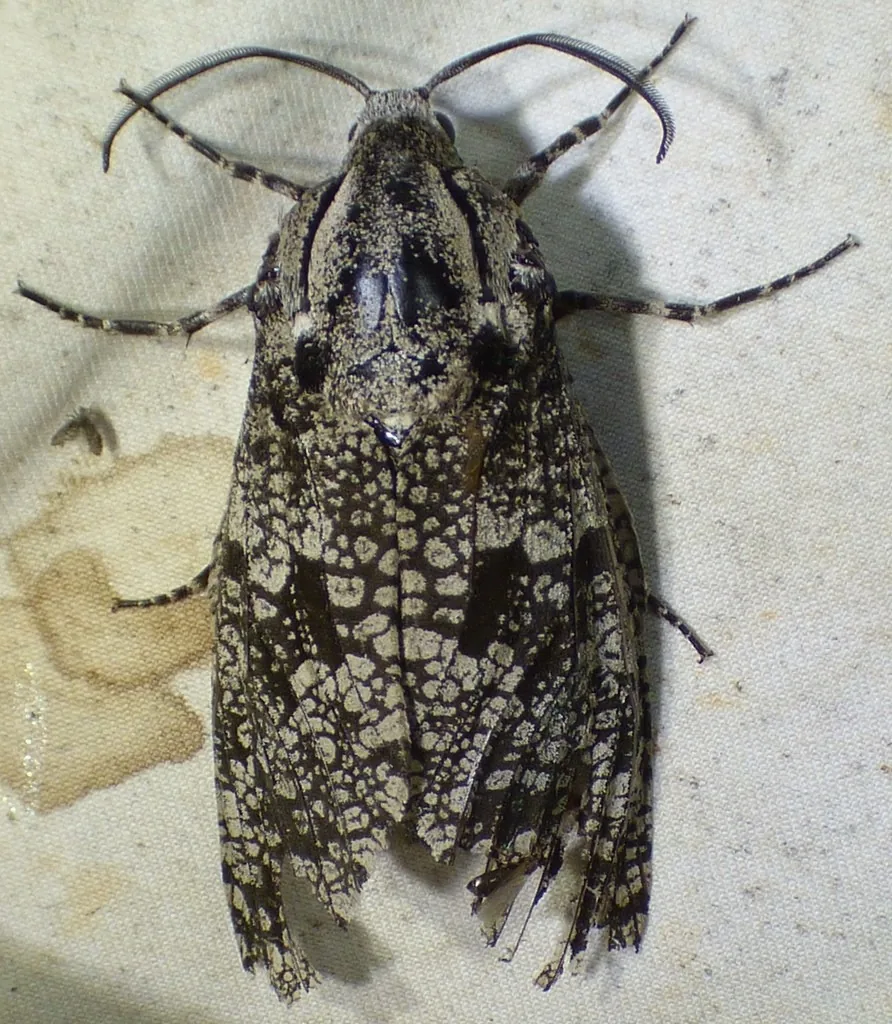
- Adults are robust moths with mottled black-and-gray forewings; females have about a 3-inch wingspan and pale hind wings, and the smaller males have orange hind wings.[1][2]
- In older infestations, empty pupal cases stick about two-thirds out of the bark; USU says they mean the tree has been infested for at least three years.[1][2]
Look-alikes
| Look-alike | How to tell them apart |
|---|---|
| Clearwing borers | Clearwing pupal cases are about 3/4 inch; carpenterworm cases are usually over 1-1/2 inches.[4] |
Where it lives
USU says it's found throughout the United States and southern Canada. Hosts include apricot, ash, birch, cottonwood, elm, black locust, maple, oak, pear, poplar and willow; UC IPM says trees near streams and rivers are more likely to be infested, and USU says cottonwood and willow are the main hosts in Utah.[2][1][3]
Biology and life cycle
Females lay eggs in bark cracks, near wounds or near existing galleries. They're poor fliers, so they often lay on the tree they emerged from, and infested trees tend to be reinfested.[1][2][3]
Larvae bore into sapwood and later heartwood; galleries reach about 1/2 inch wide and 6 to 10 inches long. Larvae keep the entrance open to push out frass and sawdust.[1][2]
Development takes 2 to 4 years in California and about 3 years in Utah, but 1 to 2 years in Mississippi; USU says adults emerge from late May to mid-July and live about a week.[1][2][3]
Damage and signs
Health risk
The caterpillars live inside trees. UC IPM, USU and Mississippi State describe tree damage only and don't mention any risk to people or pets; the hazard UC IPM describes is falling limbs.[1][2][3]
Control
Prevention
Keep trees vigorous with proper watering and care, and avoid bark injuries that invite borers.[1][2]
Traps and physical control
Probe light infestations with a long wire to kill larvae, then mark galleries and check weekly for fresh frass.[1][2]
Biological control
Beneficial nematodes injected into the galleries can kill larvae: UC IPM calls a single treatment with Steinernema feltiae or S. carpocapsae very successful, while USU says S. carpocapsae injections are somewhat effective.[1][2]
When to call a professional
Have an arborist inspect heavily infested trees; badly tunneled limbs may need removal, and USU says heavily infested or weak trees are probably best removed.[1][2]
Where the sources disagree
Eggs: UC IPM says females lay 3 to 6 eggs in a sticky mass; USU says 200 or more, singly or in masses.[1][2]
Life cycle: 2 to 4 years in California (UC IPM), 3 years in Utah and 4 at higher elevations (USU), and 1 to 2 years in the South (Mississippi State).[1][2][3]
Preventive sprays: USU says insecticides on the trunk and larger limbs while adults are active can kill newly hatched larvae, and UC IPM says homeowner carbaryl or permethrin bark sprays may give some control of adults. Mississippi State says preventive treatment isn't really practical for home landscapes except for high-value trees, since carpenterworms don't usually kill trees.[2][1][3]
Common questions
- What is the sawdust and sap coming from my ash tree?
- Probably carpenterworm galleries: they start as dark sap spots, then push out frass and sawdust.[1][2]
- Do sprays kill carpenterworms?
- Not once larvae are inside the wood. UC IPM says that apart from nematodes, insecticides don't reach larvae under bark and sprays must target adults, and control is hard.[1][2]
Sources
- University of California Statewide IPM Program, “Pest Notes: Carpenterworm (Publication 74105).” ipm.ucanr.edu/PMG/PESTNOTES/pn74105.html (accessed 2026-11-13)
- Utah State University Extension, “Carpenterworm (Prionoxystus robiniae) (Karren and Roe; revised July 2019 by R. Davis).” extension.usu.edu/planthealth/research/carpenterworms (accessed 2026-11-13)
- Mississippi State University Extension Service, “Carpenterworm, Bug's Eye View vol. 3 no. 30 (B. Layton, 2017).” extension.msstate.edu/newsletters/bugs-eye-view/2017/carpenterworm-vol-3-no-30 (accessed 2026-11-13)
- University of California Statewide IPM Program, “Pest Notes: Clearwing Moths (Publication 7477).” ipm.ucanr.edu/PMG/PESTNOTES/pn7477.html (accessed 2026-11-13)
- Global Biodiversity Information Facility (GBIF), “Prionoxystus robiniae Peck, 1818 (GBIF Backbone Taxonomy).” api.gbif.org/v1/species/1731812 (accessed 2026-11-13)
- iNaturalist, “Prionoxystus robiniae taxon page (order and family).” www.inaturalist.org/taxa/126293 (accessed 2026-10-06)